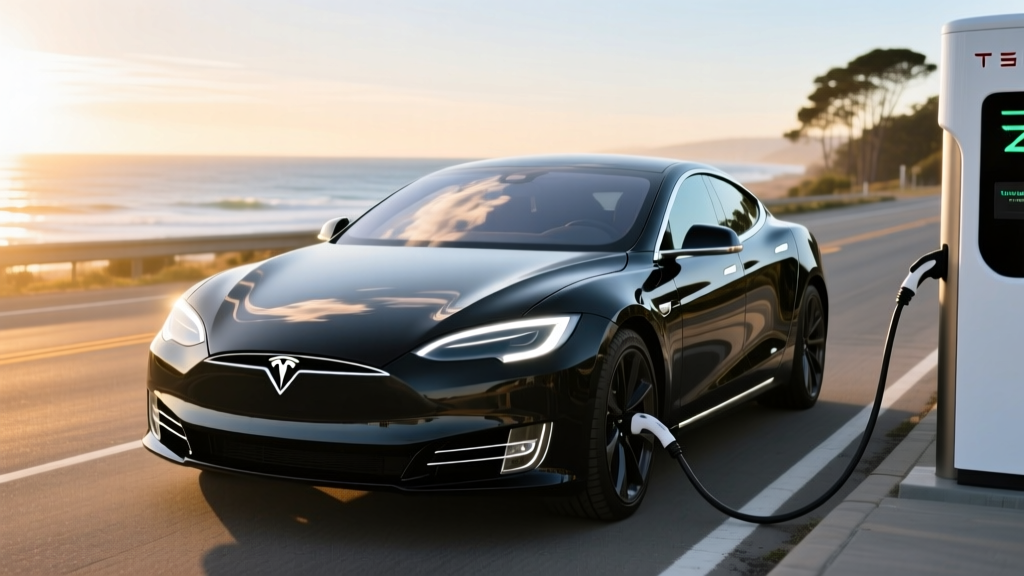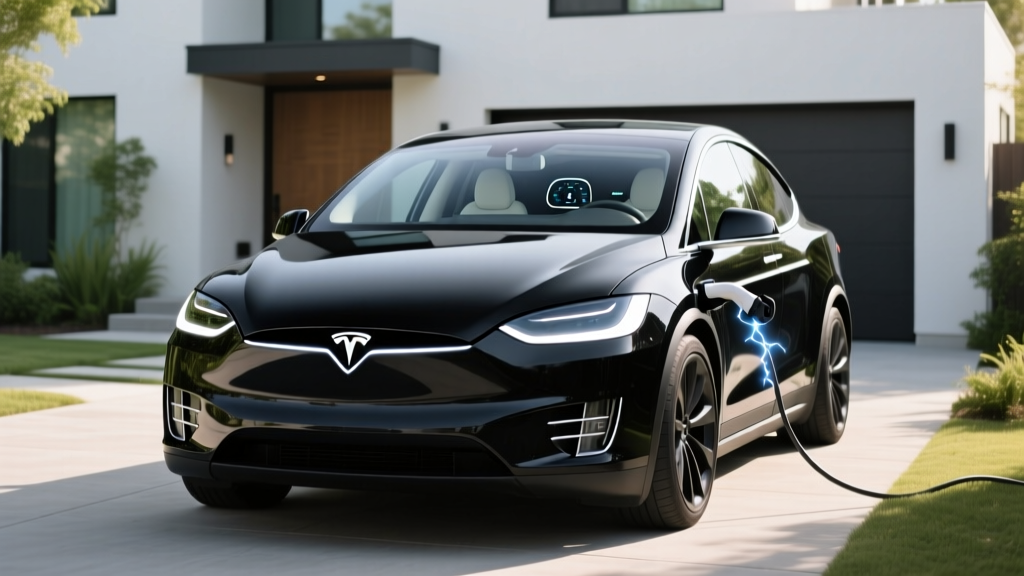
The Tesla Model X remains one of the few three-row electric SUVs that combines supercar-rivaling acceleration with genuine family utility. Dressed in Tesla's Solid Black multi-coat paint — the brand's most popular premium color at a $2,500 upcharge — the Model X cuts a commanding presence at school drop-off and the Supercharger stall alike. But beyond the aesthetics, how does this flagship EV stack up in 2025 against rising competition from the Rivian R1S, BMW iX, and Mercedes EQS SUV?
We've driven, charged, and analyzed the current Model X lineup to give you the exact numbers that matter: real-world range versus EPA estimates, sustained DC fast-charging speeds, true ownership costs after federal incentives, and the practical trade-offs no brochure will tell you.
2025 Tesla Model X: At-a-Glance Specifications
| Specification | Long Range AWD | Plaid (Tri-Motor AWD) |
|---|---|---|
| EPA Range | 348 miles | 326 miles |
| Usable Battery Capacity | ~100 kWh (NMC) | ~100 kWh (NMC) |
| Horsepower | 670 hp | 1,020 hp |
| 0–60 mph | 3.8 seconds | 2.5 seconds |
| Top Speed | 155 mph | 163 mph |
| Drivetrain | Dual-Motor AWD | Tri-Motor AWD |
| Max DC Fast Charge | 250 kW | 250 kW |
| 10–80% DC Charge Time | ~30 minutes | ~30 minutes |
| Level 2 Charge Rate | 11.5 kW (~34 mi/hr) | 11.5 kW (~34 mi/hr) |
| EPA Efficiency (Combined) | 103 MPGe | 98 MPGe |
| Seating | 5, 6, or 7 passengers | 5, 6, or 7 passengers |
| Cargo (behind 3rd row) | 15.0 cu ft | 15.0 cu ft |
| Cargo (max, seats folded) | 85.1 cu ft | 85.1 cu ft |
| Towing Capacity | 5,000 lbs | 5,000 lbs |
| Battery Warranty | 8 yr / 150,000 mi | 8 yr / 150,000 mi |
| Base MSRP | $79,990 | $94,990 |
Source: Tesla official specifications and EPA fueleconomy.gov. Prices reflect 2025 model year before destination fees.
Range and Efficiency: EPA Sticker vs. Real-World Driving
Real-World Expectation: Plan for 280–310 miles on highway road trips at 70–75 mph. In freezing temperatures (below 32°F), expect a 20–30% reduction, bringing usable range down to approximately 230–260 miles. City driving with regenerative braking recovers closer to the EPA figure.
The Model X uses an NMC (nickel-manganese-cobalt) lithium-ion battery pack with approximately 100 kWh of usable capacity. This chemistry prioritizes energy density — critical in a 5,185-lb SUV — but it's more sensitive to extreme temperatures than the LFP chemistry found in the Model 3 RWD.
In our experience, the Long Range variant's 348-mile EPA figure is achievable during mixed suburban driving at moderate speeds with climate control set to 70°F. However, sustained highway travel at 75 mph consumes roughly 33–35 kWh per 100 miles, translating to closer to 290 miles of practical range before you'd want to find a charger. The Plaid's additional motor and weight reduce efficiency further — expect about 270–285 miles in real highway conditions.
The Model X's heat pump system (standard since the 2021 refresh) significantly reduces cold-weather energy penalty compared to resistive heating. Preconditioning the battery while plugged in — a feature accessible via the Tesla app — recovers an estimated 10–15% of range that would otherwise be lost to battery heating on a cold morning.
Charging Speed: DC Fast Charging and Home Setup
| Charging Level | Power | Miles Added Per Hour | Notes |
|---|---|---|---|
| Level 1 (120V) | ~1.4 kW | ~4 miles/hr | Emergency/trickle only |
| Level 2 (240V, 48A) | 11.5 kW | ~34 miles/hr | Full charge in ~10 hours |
| DC Fast (Tesla V3 Supercharger) | Peak 250 kW | ~175 miles in 15 min | 10–80% in ~30 minutes |
| DC Fast (CCS adapter, non-Tesla) | Up to 250 kW | Varies by station | CCS adapter included since 2024 |
The Model X charges at a peak rate of 250 kW on Tesla's V3 and V4 Superchargers using its native NACS connector. The charging curve is aggressive at low states of charge — you'll see close to peak rates from 10–30% SoC — but as with all lithium-ion packs, the curve tapers substantially above 50% and sharply above 80%. Charging from 80–100% can add another 25–30 minutes, which is why road-trip strategy should target 10–80% stops.
For home charging, the onboard charger accepts up to 11.5 kW on a 240V/60A circuit (48A continuous). This adds approximately 34 miles of range per hour, meaning a depleted battery reaches full overnight in roughly 10 hours. A NEMA 14-50 outlet with a Tesla Wall Connector or Mobile Connector is the most common and cost-effective setup, typically requiring a $500–$1,500 installation depending on panel proximity — though older homes may need a $2,000–$4,000 panel upgrade to support a dedicated 60A circuit.
Since 2024, Tesla includes a CCS adapter with new Model X deliveries, enabling access to Electrify America, EVgo, and other non-Tesla DC networks. Tesla has also begun opening Superchargers to non-Tesla EVs, but Model X owners retain native plug-and-charge convenience with no adapter needed at Tesla stalls.
Performance: Supercar Acceleration in a Three-Row SUV
The Model X Long Range's dual-motor powertrain produces 670 horsepower and rockets to 60 mph in 3.8 seconds — faster than most sports sedans, let alone a 5,000+ lb family hauler. The Plaid variant's tri-motor setup (one front, two rear) delivers a staggering 1,020 horsepower and a 2.5-second 0–60 time, making it one of the quickest production SUVs ever built.
Both variants feature Tesla's dual-motor or tri-motor all-wheel drive with torque vectoring, adaptive air suspension, and a low center of gravity thanks to the floor-mounted battery pack. The air suspension provides adjustable ride height — useful for clearing rough driveways or lowering for highway efficiency — and automatically adjusts based on speed and GPS-memorized locations.
One-pedal driving via regenerative braking (adjustable in settings) allows near-complete stops without touching the brake pedal in most city driving. The brake-by-wire system provides adequate stopping power, though some owners report a less linear pedal feel compared to conventional hydraulic setups.
Interior, Cargo, and the Falcon Wing Reality
The Model X offers three seating configurations: a standard 5-seat layout, a 6-seat option with second-row captain's chairs, and a 7-seat configuration with a three-across second row. Third-row space is best suited for children or short trips — adult legroom in the way-back is tight at approximately 32 inches.
Cargo capacity is a genuine strength: 15.0 cubic feet behind the third row, expanding to 85.1 cubic feet with both rear rows folded. The front trunk (frunk) adds additional storage for charging cables and groceries, though it's smaller than the Model S frunk due to HVAC component packaging.
The signature Falcon Wing rear doors — which articulate upward with dual-hinged gullwing motion — are both the Model X's most distinctive feature and its most debated. In practice, they make loading child seats significantly easier (no crouching or head-bumping), and ultrasonic sensors detect overhead obstacles to adjust opening arc. However, they operate slower than conventional doors, can be noisy, and in heavy rain, water drips into the cabin during the opening sequence. Replacement cost for a Falcon Wing actuator is also substantially higher than a standard door hinge.
The 17-inch center touchscreen runs Tesla's latest software with a responsive interface, integrated navigation with Supercharger routing, Netflix/YouTube streaming while parked, and a built-in gaming computer capable of running Cyberpunk 2077. The yoke steering wheel is standard, with a round wheel available at no extra charge.
Pricing, Trims, and Federal Tax Credit Eligibility
| Trim | Base MSRP | As-Tested (Black, 6-Seat) | Federal §30D Credit | Effective Price |
|---|---|---|---|---|
| Long Range AWD | $79,990 | $88,480 | $0* | $88,480 |
| Plaid AWD | $94,990 | $103,480 | $0* | $103,480 |
*As of 2025, the Model X does NOT qualify for the $7,500 federal EV tax credit under IRS §30D. The credit has an MSRP cap of $80,000 for SUVs, and even the base Long Range model at $79,990 exceeds this once destination fees are included. Additionally, battery critical-mineral and component sourcing requirements under the Inflation Reduction Act may independently disqualify certain build configurations. Consult IRS.gov §30D guidelines and a tax professional before assuming eligibility.
Paint options include Solid Black ($2,500), Ultra White ($0), Pearl White ($2,500), Deep Blue Metallic ($2,500), Midnight Silver Metallic ($2,500), and Quicksilver ($2,500). The black multi-coat finish is consistently Tesla's most ordered premium color and holds resale value slightly better than silver or blue, though it shows swirl marks and dust more readily — ceramic coating is strongly recommended.
Full Self-Driving (Supervised) capability remains an $8,000 add-on (or $99/month subscription), while Enhanced Autopilot is $6,000. Basic Autopilot is standard and includes adaptive cruise control and lane centering.
Tax Credit Checklist: Does the Model X Qualify?
- MSRP Cap: SUVs must be at or below $80,000 MSRP. The Model X Long Range base is $79,990, but destination charges push it over.
- Buyer Income Limits: AGI must not exceed $300,000 (joint), $225,000 (head of household), or $150,000 (individual).
- Critical Minerals: A percentage of battery minerals must be sourced from the U.S. or FTA partners — Tesla's supply chain compliance varies by production batch.
- Battery Components: Components must be manufactured or assembled in North America at specified thresholds.
- Point-of-Sale Transfer: If eligible, the credit can be transferred to the dealer at purchase for an immediate price reduction.
Bottom line: Most Model X buyers will not qualify for the federal credit. Check your specific VIN's eligibility on the IRS portal and consult a tax professional — state credits (e.g., California's CVRP, Colorado's innovative motor vehicle credit) may partially offset the cost.
Autopilot and Driver Assistance: SAE Level 2, Not Self-Driving
The Model X's Autopilot and Full Self-Driving (Supervised) features are Level 2 driver-assist systems. The driver must remain fully attentive, keep hands on the wheel (or demonstrate attention via the cabin camera), and be prepared to take over at any moment. These are not autonomous or "self-driving" systems.
Standard Autopilot includes Traffic-Aware Cruise Control and Autosteer (lane centering). FSD (Supervised) adds automatic lane changes, Navigate on Autopilot (highway on/off-ramp routing), traffic light and stop sign recognition, and Autopark. In practice, FSD performs well on well-marked highways but requires constant vigilance in construction zones, during heavy rain, and on poorly mapped rural roads.
- Drive without an attentive, licensed driver in the seat
- Handle all weather conditions (disengages in heavy rain, snow, fog)
- Reliably navigate unmapped or construction-altered roads
- Replace the driver's legal responsibility for the vehicle
Tesla's safety data reports one crash per ~4.5 million miles driven with Autopilot engaged versus one per ~700,000 miles without — but these figures are self-reported and not independently audited by NHTSA. Always treat FSD as an assist, not a replacement.
Ownership Costs, Warranty, and Long-Term Value
Tesla provides a 4-year/50,000-mile basic vehicle warranty and an 8-year/150,000-mile battery and drive unit warranty, guaranteeing at least 70% capacity retention during that period. Real-world data from high-mileage Tesla owners suggests NMC packs in the Model X typically retain 88–92% capacity after 100,000 miles, with degradation slowing significantly after the initial 20,000-mile break-in period.
Insurance premiums for the Model X are among the highest in the EV segment — expect $3,000–$5,000+ annually depending on your profile and state, driven by high repair costs (aluminum body panels, Falcon Wing actuators, integrated glass roof). Tesla Insurance is available in select states and may offer competitive rates based on real-time driving behavior.
Electricity costs to charge a Model X average $0.13–$0.17 per kWh nationally, translating to roughly $0.045–$0.055 per mile — approximately one-third the per-mile fuel cost of a comparable gas SUV like the BMW X5. Over five years and 75,000 miles, fuel savings alone can reach $7,000–$9,000 versus a gas equivalent, though the Model X's higher purchase price and insurance offset much of that advantage without tax incentives.
Pros and Cons: The Honest Assessment
- Best-in-class Supercharger network access (17,000+ stalls in North America)
- Genuine three-row seating with Falcon Wing loading convenience
- Supercar acceleration (2.5s Plaid, 3.8s Long Range)
- Over-the-air updates continuously add features
- Class-leading cargo volume (85.1 cu ft max)
- 5,000-lb towing capacity with integrated trailer brake controller
- Heat pump for efficient cold-weather climate control
- Does not qualify for $7,500 federal tax credit (MSRP cap)
- Falcon Wing doors are slow, noisy, and costly to repair
- Third-row legroom is tight for adults
- Very high insurance premiums
- Panel gaps and interior fit/finish lag behind BMW/Mercedes rivals
- No Apple CarPlay or Android Auto
- Yoke steering is polarizing and not ideal for low-speed maneuvers
Who Should Buy the Black Tesla Model X?
- You need three-row seating and rely on frequent long-distance road trips (Supercharger network is unmatched)
- You want supercar acceleration without sacrificing cargo utility
- You have home Level 2 charging and don't need the federal tax credit to justify the price
- You value over-the-air feature updates and Tesla's software ecosystem
- You're budget-conscious and need the $7,500 federal credit (consider the Rivian R1S dual-motor or a luxury EV under $80K)
- You prioritize interior luxury and build quality (BMW iX xDrive50 or Mercedes EQS 580 SUV)
- You rarely use the third row and prefer a sportier two-row SUV (Tesla Model Y or Porsche Cayenne E-Hybrid)
Frequently Asked Questions
What is the real-world range of the Tesla Model X?
The EPA rates the Long Range at 348 miles and the Plaid at 326 miles. In real-world highway driving at 70–75 mph, expect approximately 280–310 miles (Long Range) and 270–285 miles (Plaid). Cold weather below freezing reduces range by 20–30%. Preconditioning the battery while plugged in mitigates some cold-weather loss.
How fast does the Model X charge at home and on road trips?
On a Tesla V3 Supercharger, the Model X peaks at 250 kW and charges from 10–80% in approximately 30 minutes. At home on a 240V/48A Level 2 setup, it charges at 11.5 kW, adding about 34 miles of range per hour — a full charge takes roughly 10 hours overnight.
Does the black Tesla Model X qualify for the federal EV tax credit?
As of 2025, the Model X generally does NOT qualify for the $7,500 §30D federal tax credit. The MSRP cap for SUVs is $80,000, and the base Long Range at $79,990 exceeds this once destination fees are applied. Battery sourcing requirements may also independently disqualify it. Verify your specific VIN on IRS.gov and consult a tax professional.
Is the Model X worth buying over the Rivian R1S or BMW iX?
The Model X wins on charging network access (Supercharger), acceleration, and cargo volume. The Rivian R1S offers superior off-road capability, a more conventional (and faster) door design, and potential tax credit eligibility on lower trims. The BMW iX delivers a far more luxurious interior and qualifies for the federal credit on xDrive50 trims. Your priority — network access vs. luxury vs. off-road utility — should drive the decision.
What does the black paint add to the price?
Tesla's Solid Black multi-coat paint is a $2,500 option. It's the most popular premium color and tends to hold resale value well, but it shows dust, water spots, and swirl marks more readily than white or silver. A professional ceramic coating ($1,000–$2,000) is highly recommended to preserve the finish.
How long will the Model X battery last?
Tesla warranties the battery for 8 years or 150,000 miles (whichever comes first) with at least 70% capacity retention. Real-world data from high-mileage owners shows NMC packs retaining 88–92% capacity at 100,000 miles. Full battery replacement, if needed out of warranty, currently costs approximately $15,000–$22,000 at Tesla service centers.