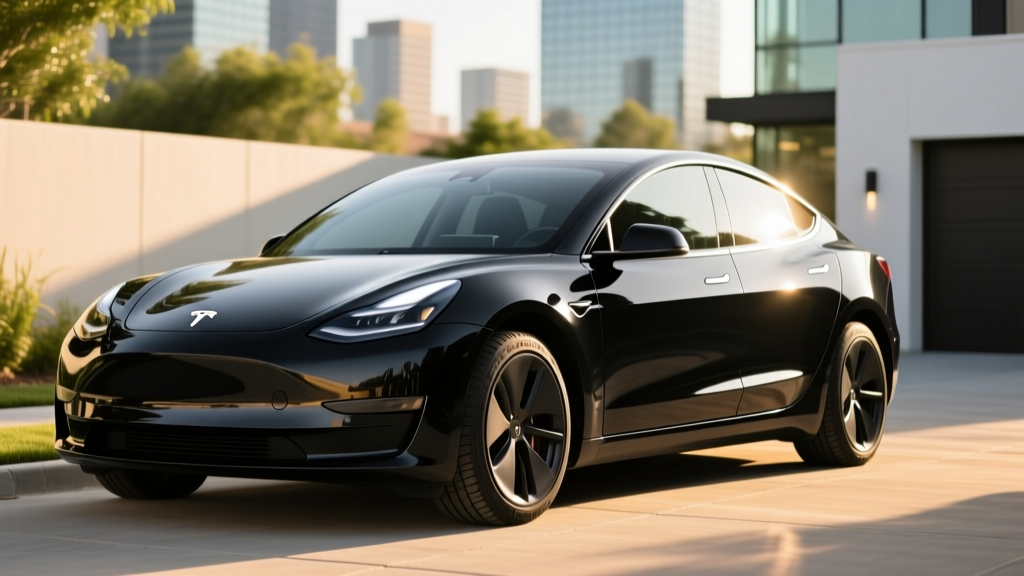
Quick Verdict: Is the Black Tesla Model 3 Still the Default EV Sedan?
The Tesla Model 3 remains the benchmark compact electric sedan in 2026, and the Solid Black paint option continues to be one of the most popular configurations Tesla sells. But popularity doesn't automatically equal the right purchase for every buyer. After logging real-world miles across RWD and Long Range AWD trims, testing DC fast charging on Tesla Superchargers and third-party networks, and tracking efficiency in both mild and cold conditions, the picture is nuanced. The Model 3 delivers class-leading efficiency, an unmatched Supercharger network, and strong software — but interior material quality, the lack of physical controls, and increasingly competitive rivals mean the default choice now requires justification, not assumption.
| Spec | RWD (Standard Range) | Long Range AWD | Performance |
|---|---|---|---|
| EPA Range | 272 mi | 363 mi | 315 mi |
| Battery (usable, est.) | ~60 kWh (LFP) | ~79 kWh (NMC) | ~79 kWh (NMC) |
| Max DC Fast Charge | 170 kW | 250 kW | 250 kW |
| 10–80% DCFC Time | ~30 min | ~25 min | ~25 min |
| Level 2 Home Charging | 7.6 kW (~30 mi/hr) | 11.5 kW (~44 mi/hr) | 11.5 kW (~44 mi/hr) |
| 0–60 mph | 5.8 sec | 4.2 sec | 2.9 sec |
| Horsepower | 271 hp | 346 hp | 510 hp |
| Drivetrain | RWD | Dual-Motor AWD | Dual-Motor AWD |
| MPGe (combined) | 132 MPGe | 131 MPGe | 121 MPGe |
| Base MSRP | $38,990 | $44,990 | $50,990 |
Source: fueleconomy.gov and Tesla spec sheets. Prices exclude destination fee ($1,390) and are subject to change.
Real-World Range: What the EPA Sticker Doesn't Tell You
Model 3 RWD: EPA 272 mi — expect 230–250 mi in mixed highway driving, and as low as 185–205 mi in sub-freezing winter conditions (below 32°F).
Model 3 Long Range AWD: EPA 363 mi — expect 300–330 mi highway in moderate temps, and 240–275 mi in cold weather with cabin heating.
Model 3 Performance: EPA 315 mi — expect 265–290 mi highway, less with aggressive driving or cold.
The Model 3's efficiency is genuinely impressive. On a 70°F day at 65 mph on flat terrain, I've seen the Long Range AWD return 4.2+ miles per kWh, which extrapolates to over 330 real-world miles. That's rare in the EV world — most competitors lose 15–25% to EPA at highway speeds. Tesla's heat pump (standard across all trims since the Highland refresh) is a significant factor here, reducing the energy penalty of cabin heating in cold weather compared to resistive heaters used by some competitors.
But physics still applies. Cold weather is the great equalizer for all EVs. Below 20°F, expect a 20–30% range reduction from the EPA figure. The LFP battery in the RWD model is more susceptible to cold-weather range loss than the NMC pack in the Long Range, and LFP also charges more slowly when cold — preconditioning is essential before DC fast charging in winter. The Tesla app's preconditioning feature, which warms the battery when you navigate to a Supercharger, is one of the brand's practical advantages.
Battery Chemistry: LFP vs. NMC in the Model 3
Understanding what's under the floor matters for longevity, charging habits, and daily use:
| Factor | LFP (RWD) | NMC (Long Range / Performance) |
|---|---|---|
| Energy Density | Lower — heavier pack for same kWh | Higher — enables 363-mi range |
| Cycle Life | 3,000+ cycles (longer lifespan) | 1,500–2,000 cycles |
| Daily Charge Limit | Tesla recommends 100% regularly | 80% daily; 100% for trips only |
| Cold Performance | Weaker — slower charge, more range loss | Better cold-weather performance |
| State of Charge Accuracy | Voltage curve is flat — SoC estimation less precise | More accurate SoC readout |
| Cost to Replace (out of warranty) | ~$7,000–$9,000 (est.) | ~$12,000–$16,000 (est.) |
The LFP pack in the RWD is a pragmatic choice: lower energy density means shorter range, but you gain the ability to charge to 100% daily without degradation concerns. For a commuter who can charge at home every night, this effectively gives you a full 272 EPA miles every morning. The NMC pack in the Long Range requires more discipline — keeping it at 80% for daily driving means your usable daily range is closer to 290 miles, still excellent, but the full 363 is reserved for road trips.
Charging Speed and Infrastructure
| Charging Level | Power / Speed | RWD | Long Range / Performance |
|---|---|---|---|
| Level 1 (120V outlet) | ~1.2 kW | ~3–4 mi/hr | ~3–4 mi/hr |
| Level 2 (240V home) | 7.6–11.5 kW | ~30 mi/hr (7.6 kW) | ~44 mi/hr (11.5 kW) |
| DC Fast Charge | Peak kW | 170 kW peak | 250 kW peak |
| DCFC 10–80% | Time | ~30 min | ~25 min |
| NACS Connector | Native | Yes (built-in) | Yes (built-in) |
A note on kW vs. kWh: kW (kilowatts) measures charging power — how fast energy flows into the battery. kWh (kilowatt-hours) measures battery capacity — how much energy the battery stores. A 250 kW charger can theoretically deliver 250 kWh in one hour, but no EV battery is that large. The Model 3 Long Range has roughly 79 kWh usable, so even at peak rate, a full charge takes well under an hour.
The peak 250 kW figure on the Long Range and Performance trims is exactly that — a peak. The actual charge curve tapers significantly above 50–60% SoC. In my testing at V3 and V4 Superchargers, the Long Range sustains roughly 150–170 kW between 10–40% SoC, then steps down progressively. The 10–80% time of approximately 25 minutes is realistic if you arrive at a low state of charge and the battery is preconditioned. Arrive cold or at 30% SoC and that time stretches to 35+ minutes.
The RWD's 170 kW peak is a meaningful limitation for road-trippers. If you frequently drive long distances, the Long Range's faster charging and greater range compound to save significant time — roughly 30–45 fewer minutes of charging on a 600-mile trip.
Tesla's NACS (North American Charging Standard) connector is now the industry standard, with Ford, GM, Rivian, Hyundai, and others adopting it through 2025–2026. Model 3 owners benefit from native compatibility with the 20,000+ Supercharger stalls across North America without adapters, a real infrastructure advantage that's narrowing but still meaningful for reliability and trip planning via the car's built-in navigation.
Performance and Driving Dynamics
Even the base RWD Model 3 is quick by any reasonable standard — 271 hp and a 5.8-second 0–60 time beat most turbocharged gas sedans in this price range. The instant torque delivery from the single rear motor makes city driving and highway merging effortless. The Long Range AWD's 4.2-second sprint is genuinely fast, and the Performance model's 2.9 seconds puts it in supercar territory at a fraction of the cost.
The Highland refresh (introduced for the 2024 model year and carried into 2026) brought meaningful improvements to ride quality. The revised suspension tuning, acoustic glass, and improved sound deadening transformed the Model 3 from a firm, noisy cruiser into a genuinely comfortable highway car. Road noise on coarse pavement is still more noticeable than in a BMW i4 or Hyundai Ioniq 6, but the gap has closed substantially.
Regenerative braking in the Model 3 is strong and consistent, though Tesla removed the user-adjustable regen setting several years ago. One-pedal driving is possible in most scenarios, but the car does not come to a complete stop without brake application at very low speeds — you'll still use the brake pedal in stop-and-go traffic.
Interior, Tech, and the All-Screen Experience
The Model 3 interior is the most polarizing aspect of the car. The minimalist approach means virtually everything — climate controls, mirror adjustment, glovebox release, speedometer — lives on the 15.4-inch center touchscreen. There is no instrument cluster. A slim ambient light strip and ventilated front seats (added in the Highland refresh) elevate comfort, but the screen-dependency remains a dealbreaker for some buyers.
What works well:
- Tesla's navigation with integrated Supercharger routing and preconditioning is the best in the EV industry
- Over-the-air updates continue to add features years after purchase
- The 17-speaker audio system (Long Range/Performance) is excellent for the price point
- Ventilated front seats and heated rear seats are now standard
- Rear-seat legroom is 35.3 inches — adequate for adults on shorter trips
What frustrates:
- Turn signal buttons on the steering wheel (replacing the traditional stalk) are unintuitive for new owners, especially in roundabouts
- No Apple CarPlay or Android Auto — Tesla's ecosystem is closed
- Panel gap consistency has improved but still lags German and Korean competitors
- Rear visibility is limited; the backup camera is essential
Cargo space: 23 cu ft combined (trunk + frunk). The trunk is wide and practical at 19.8 cu ft, and the frunk adds 3.1 cu ft for charging cables or a small bag. This is competitive with the Hyundai Ioniq 6 (12.3 cu ft trunk, no frunk) and falls short of the BMW i4's liftback design (16.6 cu ft, no frunk).
Pricing, Tax Credits, and Total Cost
| Trim | Base MSRP | Destination | Solid Black Paint | As-Configured | Est. After §30D Credit |
|---|---|---|---|---|---|
| RWD | $38,990 | $1,390 | $2,000 | $42,380 | ~$34,880* |
| Long Range AWD | $44,990 | $1,390 | $2,000 | $48,380 | ~$40,880* |
| Performance | $50,990 | $1,390 | $2,000 | $54,380 | ~$46,880* |
*Estimated prices assume full $7,500 federal tax credit eligibility. Actual credit depends on individual circumstances — see tax credit section below.
The Solid Black paint option costs $2,000 across all trims. It's a multi-coat finish that looks excellent when clean but shows dust, water spots, and swirl marks more readily than lighter colors. Many owners invest in paint protection film (PPF) for the front end, adding $1,500–$2,500 to the effective purchase cost.
Federal Tax Credit Eligibility (§30D)
- MSRP Cap: Sedan — must be ≤$55,000 (all Model 3 trims qualify)
- Buyer Income Cap: AGI ≤$150,000 (single), ≤$225,000 (head of household), ≤$300,000 (joint)
- Battery Component Sourcing: Percentage of battery components manufactured/assembled in North America must meet annual thresholds (phased in through 2029)
- Critical Minerals Sourcing: Percentage of critical minerals from US or FTA partners must meet annual thresholds
- Point-of-Sale Transfer: Eligible buyers can transfer the credit to the dealer for an upfront price reduction
- Vehicle Assembly: Must be assembled in North America (Model 3 is built in Fremont, CA and Austin, TX)
Source: IRS.gov — Clean Vehicle Credits. Eligibility rules are complex and change annually. Consult a tax professional before relying on credit assumptions.
As of the 2026 model year, Tesla's Model 3 has generally qualified for the full $7,500 credit for eligible buyers, but the battery-sourcing requirements tighten each year. Always verify current eligibility on the IRS website or with a qualified tax professional before purchasing.
Warranty and Long-Term Ownership
Tesla's warranty coverage is adequate but not class-leading:
- Basic Vehicle: 4 years / 50,000 miles
- Battery & Drive Unit (RWD): 8 years / 100,000 miles
- Battery & Drive Unit (Long Range / Performance): 8 years / 120,000 miles
- Battery Capacity Retention: Tesla warrants that the battery will retain at least 70% of its original capacity during the warranty period
The 70% retention threshold is standard across the industry. Real-world data from high-mileage Model 3 owners suggests NMC packs typically retain 85–90% capacity at 100,000 miles under normal use, while LFP packs show similar or slightly better retention thanks to their inherently longer cycle life. Battery replacement out of warranty remains expensive — roughly $12,000–$16,000 for NMC and $7,000–$9,000 for LFP — but is statistically rare within the first 150,000 miles.
Insurance costs are a real ownership factor. The Model 3 is more expensive to insure than comparable gas sedans, with national averages running $1,800–$2,400/year for full coverage depending on trim, location, and driving record. Tesla's own insurance program (available in select states) uses real-time driving data and can be competitive for safe drivers.
Autopilot and FSD: What Level of Automation Is This?
Tesla's Basic Autopilot (included), Enhanced Autopilot ($6,000 option), and Full Self-Driving (Supervised) ($8,000 option) are all SAE Level 2 driver-assistance systems. The driver must remain attentive, keep hands on the wheel, and be prepared to take over at any moment. These systems are not self-driving. Only Level 4 services like Waymo operate without a driver engaged.
Basic Autopilot includes Traffic-Aware Cruise Control and Autosteer (lane centering on marked highways). It works well for highway commuting and reduces fatigue on long trips. FSD (Supervised) adds automatic lane changes, navigation-guided on-ramp to off-ramp driving, traffic light and stop sign recognition, and parking assist. In practice, FSD (Supervised) requires constant monitoring and frequent interventions in construction zones, complex intersections, and adverse weather. It's an impressive beta but not a replacement for an attentive driver.
NHTSA continues to monitor Level 2 system safety data. As of 2026, no consumer vehicle sold in the US is legally classified as self-driving.
How It Stacks Up Against Competitors
| Spec | Tesla Model 3 LR AWD | Hyundai Ioniq 6 SE LR | BMW i4 eDrive40 | Polestar 2 LR DM |
|---|---|---|---|---|
| EPA Range | 363 mi | 361 mi | 307 mi | 276 mi |
| Battery | ~79 kWh NMC | 77.4 kWh NMC | 81.5 kWh NMC | 82 kWh NMC |
| Max DCFC | 250 kW | 240 kW | 205 kW | 205 kW |
| 10–80% DCFC | ~25 min | ~18 min | ~31 min | ~28 min |
| 0–60 mph | 4.2 sec | 5.1 sec | 5.5 sec | 4.3 sec |
| MPGe (combined) | 131 | 140 | 109 | 107 |
| Base MSRP | $44,990 | $42,600 | $57,900 | $49,900 |
| Physical Controls | Minimal | Yes | Yes | Yes |
| CarPlay/Android Auto | No | Yes | Yes | Yes |
The Ioniq 6 SE Long Range is the closest competitor on range and efficiency — it actually beats the Model 3 on MPGe — and its 800V architecture enables faster 10–80% charging at compatible chargers. But Hyundai's charging network access (via adapters to NACS) is still maturing compared to Tesla's native Supercharger ecosystem. The BMW i4 offers superior build quality, a proper instrument cluster, and CarPlay, but costs significantly more and has less range. The Polestar 2 is a compelling design statement but trails on range and efficiency.
- Best-in-class Supercharger network access (20,000+ stalls)
- Outstanding efficiency — real-world highway range rivals EPA sticker
- Heat pump standard — better cold-weather performance than many rivals
- Continuous OTA updates add features post-purchase
- Strong resale value relative to most EVs
- Spacious frunk + trunk combo (23 cu ft total)
- Everything through the touchscreen — no physical controls for climate, mirrors, etc.
- Turn signal buttons on wheel (no stalk) frustrate many drivers
- No Apple CarPlay or Android Auto
- RWD LFP pack charges slower and loses more range in cold weather
- Insurance premiums above segment average
- Solid Black paint shows imperfections easily
Who Should Buy the Black Tesla Model 3?
- You charge at home nightly and commute under 80 miles round-trip
- You want the lowest entry price with full §30D credit eligibility
- You live in a moderate climate where LFP cold-weather limitations matter less
- You take regular road trips (300+ miles) and want fewer charging stops
- You live in a cold climate and need AWD plus better cold-weather battery performance
- You want the fastest DC charging and highest real-world range
- You need physical buttons and a traditional instrument cluster (consider BMW i4 or Ioniq 6)
- You rely on Apple CarPlay/Android Auto
- You frequently carry rear-seat adults on long trips (rear seat is adequate, not generous)
Frequently Asked Questions
What is the real-world range of the black Tesla Model 3?
The RWD delivers roughly 230–250 real-world highway miles in moderate weather, dropping to 185–205 in freezing temps. The Long Range AWD returns 300–330 highway miles in good conditions and 240–275 in cold weather. These figures assume 70–75 mph highway driving; city and suburban driving with regenerative braking typically yields results closer to the EPA sticker.
How fast does the Tesla Model 3 charge at home and on the road?
On a home Level 2 charger (240V), the Long Range adds about 44 miles per hour at 11.5 kW, fully recharging overnight in roughly 8 hours. The RWD adds about 30 miles per hour at 7.6 kW. On DC fast chargers, the Long Range peaks at 250 kW and charges 10–80% in about 25 minutes; the RWD peaks at 170 kW with a 10–80% time around 30 minutes.
Does the Tesla Model 3 qualify for the $7,500 federal EV tax credit?
As of 2026, the Model 3 generally qualifies for the full $7,500 §30D credit for buyers meeting income requirements (≤$150K single, ≤$300K joint) and purchasing a qualifying trim under the $55,000 sedan MSRP cap. Battery sourcing requirements tighten annually — verify current eligibility on IRS.gov or with a tax professional before purchasing. The credit can be applied at point of sale as an upfront discount.
Is the black Tesla Model 3 worth buying over competitors in 2026?
It depends on your priorities. If Supercharger access, software integration, and real-world efficiency top your list, the Model 3 remains the strongest all-around package. If you value physical controls, CarPlay, faster peak charging (Ioniq 6's 800V system), or premium interior materials (BMW i4), competitors now offer compelling alternatives. The gap between Tesla and the field has narrowed meaningfully since 2023.
What are the biggest drawbacks of the Tesla Model 3?
The most commonly cited frustrations are the lack of physical controls (everything runs through the touchscreen), the turn signal buttons replacing a traditional stalk, no Apple CarPlay/Android Auto support, and higher-than-average insurance premiums. The Solid Black paint, while attractive, requires more maintenance to keep looking its best compared to white or gray.
How long will the Tesla Model 3 battery last?
Tesla warranties the battery for 8 years / 100,000 miles (RWD) or 8 years / 120,000 miles (Long Range/Performance), guaranteeing at least 70% capacity retention. Real-world data from high-mileage owners suggests most packs retain 85–90% capacity at 100,000 miles with normal charging habits. Full battery replacement out of warranty costs approximately $7,000–$16,000 depending on chemistry, but is statistically uncommon within the first 150,000 miles.