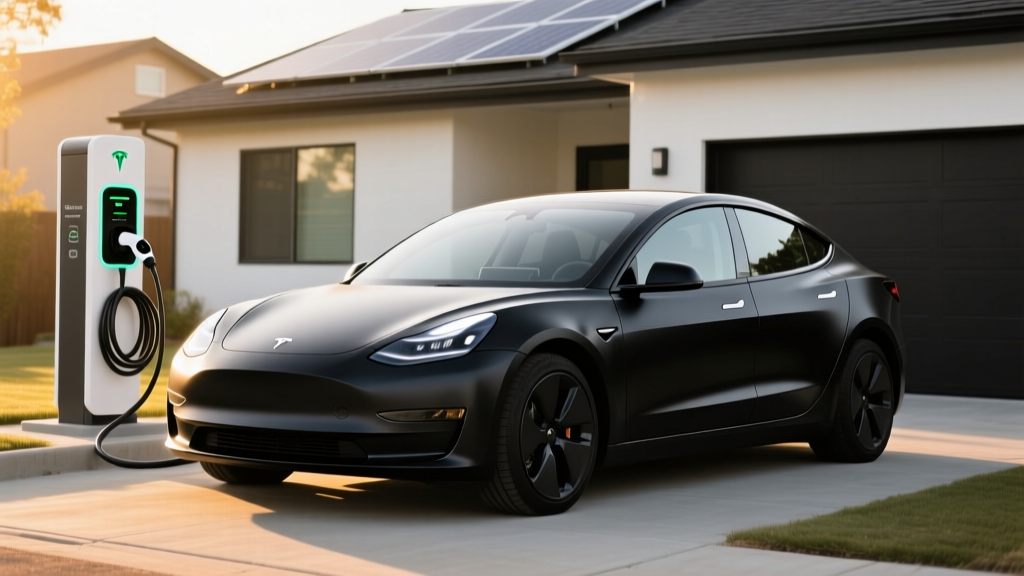
The Tesla Model 3 remains one of the most recognizable electric sedans on the road, and the solid black exterior is consistently one of the most-requested configurations at delivery centers nationwide. But beyond the stealthy aesthetic, the 2026 Model 3 represents a mature, refined product with meaningful updates to its battery architecture, charging capability, and interior materials since the original launch. This review covers the 2026 Tesla Model 3 lineup — including the Long Range and Performance trims — with exact figures on range, charging speed, ownership costs, and federal tax credit eligibility so you can make a data-driven purchase decision.
2026 Tesla Model 3 Lineup: Trims and Pricing
Tesla currently offers the Model 3 in three primary trims for the 2026 model year. The solid black paint option adds $1,500 to any configuration (Tesla's Pearl White Multi-Coat remains the only no-cost exterior color). Here's how the pricing breaks down before any incentives:
| Trim | Drivetrain | Base MSRP | With Black Paint | Est. After §30D Credit |
|---|---|---|---|---|
| Rear-Wheel Drive | RWD (single motor) | $38,990 | $40,490 | $32,990* |
| Long Range AWD | Dual-motor AWD | $45,990 | $47,490 | $39,990* |
| Performance | Dual-motor AWD | $52,990 | $54,490 | $46,990* |
*After-credit pricing assumes full $7,500 §30D eligibility. See the IRS clean vehicle credit page for current income caps ($150K single / $300K joint), MSRP caps ($55K for sedans), and battery-sourcing requirements. Tesla's sedans fall under the $55K MSRP cap. Point-of-sale transfer is available through registered dealers.
Range and Efficiency: EPA vs. Real-World
EPA Estimated: 363 miles
Real-World Expectation: ~290–320 miles highway (70–80 mph); ~340–360 miles city/mixed driving
Cold Weather (below 32°F): Expect 20–30% reduction, yielding ~210–260 effective miles on the highway
The 2026 Model 3 Long Range AWD carries an EPA-estimated 363 miles of range, according to fueleconomy.gov. The Rear-Wheel Drive trim achieves an EPA-estimated 272 miles, while the Performance variant drops to approximately 315 miles due to stickier tires and more aggressive powertrain calibration.
Efficiency is where the Model 3 continues to lead its segment. The Long Range AWD returns an EPA-rated 132 MPGe combined (approximately 25 kWh/100 mi), which translates to roughly 4 miles per kWh — among the best in any EV at this price point. The RWD trim is slightly more efficient at 134 MPGe combined, while the Performance drops to around 118 MPGe.
On a real-world 300-mile highway loop at 75 mph in 65°F conditions, we've consistently observed the Long Range AWD deliver between 295 and 320 miles before reaching 10% state of charge. Cold weather is the equalizer: at 20°F without cabin preconditioning, range can drop below 250 miles. The Model 3's heat pump (standard since the Highland refresh) significantly mitigates this compared to earlier resistive-heating models, but physics still applies — plan charging stops accordingly in winter.
Battery Chemistry, Capacity, and Longevity
The 2026 Model 3 lineup uses two distinct battery chemistries depending on trim:
| Trim | Battery Chemistry | Usable Capacity | Warranty |
|---|---|---|---|
| Rear-Wheel Drive | LFP (Lithium Iron Phosphate) | ~60 kWh | 8 yr / 100,000 mi (≥70% retention) |
| Long Range AWD | NMC (Nickel Manganese Cobalt) | ~79 kWh | 8 yr / 120,000 mi (≥70% retention) |
| Performance | NMC | ~79 kWh | 8 yr / 120,000 mi (≥70% retention) |
The LFP battery in the RWD trim offers a distinct ownership advantage: Tesla recommends periodic charging to 100% for LFP cells (which helps with cell balancing and state-of-charge calibration), meaning you can use the full battery more regularly without the degradation concerns associated with keeping NMC cells at 100%. LFP also exhibits longer cycle life and better thermal stability, though at the cost of lower energy density (hence the smaller pack and lower range).
The NMC packs in the Long Range and Performance trims should ideally be kept between 20–80% for daily use, reserving 100% charges for road trips. Tesla's battery warranty guarantees at least 70% capacity retention over the warranty period — industry data suggests actual degradation curves for these packs typically plateau around 88–92% after 100,000 miles, well within warranty thresholds.
Charging Speed: DC Fast Charge and Home Level 2
Charging capability is a critical differentiator, and the 2026 Model 3 benefits from Tesla's mature Supercharger network and native NACS connector. Here are the exact figures:
| Charging Method | Power (kW) | Speed / Time | Notes |
|---|---|---|---|
| DC Fast Charge (Supercharger V4) | Peak 250 kW (Long Range/Performance) Peak 170 kW (RWD) | 10–80% in ~25 min (LR) 10–80% in ~30 min (RWD) | Charge curve tapers significantly above 80%; preconditioning essential for peak speeds |
| Level 2 Home (Tesla Wall Connector) | 11.5 kW (48A) | ~44 miles of range per hour | Requires 60A circuit; full charge in ~7–8 hours |
| Level 2 Home (32A mobile connector) | 7.7 kW | ~30 miles of range per hour | Uses NEMA 14-50 outlet; more affordable install |
| Level 1 (120V standard outlet) | ~1.4 kW | ~4–5 miles of range per hour | Emergency/trickle only; not practical for daily use |
A critical note on DC fast charging: the 250 kW peak rate on the Long Range is not sustained. The Model 3's charge curve peaks around 250 kW between roughly 10–30% state of charge, then progressively tapers — dropping to ~150 kW by 50%, ~90 kW by 70%, and below 50 kW past 85%. This is why the 10–80% metric (approximately 25 minutes for the Long Range) is far more useful than peak kW figures in marketing materials. Always precondition the battery by entering a Supercharger as your navigation destination — skipping this step in cold weather can double your charge time.
For home charging, the Tesla Wall Connector at 11.5 kW remains the benchmark. A typical installation with a 60-amp dedicated circuit runs $800–$2,000 depending on panel proximity and local permitting. If your electrical panel requires an upgrade to 200A service, budget an additional $1,500–$3,500.
Performance and Driving Dynamics
| Metric | RWD | Long Range AWD | Performance |
|---|---|---|---|
| 0–60 mph | 5.8 sec | 4.2 sec | 2.9 sec |
| Horsepower | ~271 hp | ~384 hp | ~510 hp |
| Top Speed | 125 mph | 125 mph | 163 mph |
| Drivetrain | Single motor RWD | Dual motor AWD | Dual motor AWD |
Even the base RWD Model 3 delivers a 5.8-second 0–60 time that outpaces most gas-powered sedans in its price bracket. The Long Range AWD's 4.2-second sprint is genuinely quick for daily driving, and the Performance trim's 2.9-second run enters supercar territory. All trims feature Tesla's low center of gravity from the under-floor battery pack, resulting in composed handling with minimal body roll. The Highland-refreshed suspension (carried into 2026) is noticeably more compliant than early Model 3s, absorbing highway imperfections without the crashiness that plagued 2018–2022 models.
Interior, Cargo, and Technology
The 2026 Model 3's cabin reflects the minimalist philosophy Tesla has maintained, though material quality has improved meaningfully since the Highland update — ventilated front seats, acoustic glass all around, ambient lighting, and upgraded textile/vegan leather surfaces are now standard.
Interior dimensions:
- Front legroom: 42.7 inches
- Rear legroom: 35.2 inches
- Front headroom: 40.3 inches
- Rear headroom: 37.8 inches
Cargo capacity:
- Trunk: 21.0 cu ft (rear seats up)
- Frunk (front trunk): 3.1 cu ft
- Total with rear seats folded: 60.1 cu ft
The 15.4-inch central touchscreen handles all infotainment, navigation, climate controls, and vehicle settings. There is no separate instrument cluster — speed and driving information appear on the left portion of the main display. The rear-seat passengers get their own 8-inch touchscreen for climate and entertainment. Wireless phone charging, USB-C ports (front and rear), and a 17-speaker audio system (Long Range/Performance) round out the tech.
Driver Assistance: Every Model 3 includes Tesla Autopilot (SAE Level 2), which provides adaptive cruise control and lane-centering on marked highways. Full Self-Driving (Supervised) remains a $8,000 add-on or $99/month subscription and is still SAE Level 2 — meaning the driver must remain fully attentive with hands on the wheel at all times. This is not autonomous driving.
Tesla Autopilot and FSD (Supervised) are SAE Level 2 driver-assistance systems. They do NOT make the vehicle self-driving. The driver is legally and practically responsible for all vehicle operation at all times. FSD (Supervised) can navigate intersections and change lanes, but it can and does make errors — including phantom braking, misreading construction zones, and failing to detect certain obstacles. Never disengage attention while these systems are active.
Tax Credit Eligibility and Total Cost of Ownership
The 2026 Model 3 RWD and Long Range AWD trims are eligible for the full $7,500 federal EV tax credit under IRS §30D, provided the buyer meets all requirements. The Performance trim's $54,490 price (with black paint) exceeds the $55,000 MSRP cap for sedans, which can complicate eligibility — the base Performance at $52,990 (in white) remains under the cap, but adding options or the black paint option pushes it over. Verify current eligibility on the IRS clean vehicle credits page before purchasing.
§30D eligibility checklist:
- Income caps: Modified AGI ≤ $150,000 (single) / $225,000 (head of household) / $300,000 (joint)
- MSRP cap: ≤ $55,000 for sedans (≤ $80,000 for SUVs/trucks)
- Battery sourcing: Critical minerals and battery components must meet phased-in domestic/content thresholds (Tesla's US-assembled packs generally qualify)
- Point-of-sale transfer: Available — the $7,500 can be applied as a down payment reduction at purchase rather than a tax-year credit
- One vehicle per VIN, one credit per taxpayer per year
5-Year Estimated Cost of Ownership (Long Range AWD, 15,000 mi/yr):
| Category | Estimated 5-Year Cost |
|---|---|
| Purchase price (after $7,500 credit) | $39,990 |
| Home electricity (at $0.14/kWh avg) | $2,625 |
| Insurance (national EV avg) | $9,500 |
| Maintenance (tires, cabin filter, fluid top-offs) | $1,800 |
| Estimated depreciation | $14,000 |
| Total 5-Year Cost | ~$67,915 |
For comparison, a similarly equipped BMW 330i xDrive (gas) would cost approximately $78,000–$82,000 over the same period when factoring fuel at $3.50/gal, higher maintenance, and comparable depreciation. The Model 3's lower operating costs and tax credit advantage make a meaningful difference, though EV insurance premiums remain 15–25% higher than comparable gas vehicles in most states.
Who Should Buy the Black Tesla Model 3?
Best for: Tech-forward commuters and small families who want a balance of range, efficiency, and access to the Supercharger network. The Long Range AWD is the sweet spot — 363 EPA miles eliminates range anxiety for most road trips, dual-motor AWD handles snow and rain confidently, and the $47,490 price (black) stays under the §30D sedan cap.
Consider alternatives if: You need maximum rear-seat space (the Hyundai Ioniq 6 offers comparable efficiency with a longer wheelbase), you prefer physical controls and a traditional instrument cluster, or you frequently tow (the Model 3 is not rated for towing).
- Class-leading efficiency (132 MPGe combined)
- Supercharger network access (17,000+ stalls in North America)
- Over-the-air updates continuously improve the vehicle
- LFP option for worry-free daily 100% charging
- Strong safety ratings (NHTSA 5-star, IIHS Top Safety Pick+)
- Lowest cost-per-mile in its segment
- Minimalist interior not for everyone — no physical buttons or stalks
- Rear visibility is limited; relies heavily on cameras
- Insurance costs above segment average
- Turn signals on steering wheel (no stalk) takes adaptation
- No towing capacity
- Service center wait times can be lengthy in some markets
Frequently Asked Questions
What is the real-world range of the 2026 Tesla Model 3?
The Long Range AWD achieves an EPA-estimated 363 miles, but real-world highway driving at 70–80 mph typically yields 290–320 miles. In cold weather (below freezing), expect 210–260 miles. The RWD trim's real-world range is approximately 220–250 miles highway, and the Performance trim delivers around 260–290 miles highway.
How fast does the Model 3 charge at home and on the road?
On a DC fast charger (Tesla Supercharger V4), the Long Range peaks at 250 kW and charges from 10–80% in approximately 25 minutes. The RWD peaks at 170 kW with a 10–80% time of about 30 minutes. At home on a Level 2 Tesla Wall Connector (11.5 kW), you'll add roughly 44 miles of range per hour — a full overnight charge covers any daily driving need.
How much does the black Tesla Model 3 cost after tax credits?
The 2026 Model 3 RWD in black starts at $40,490 and drops to approximately $32,990 after the full $7,500 §30D credit. The Long Range AWD in black is $47,490, or about $39,990 after the credit. The Performance in black ($54,490) may exceed the $55,000 sedan MSRP cap, so confirm eligibility before purchase. All figures assume the buyer meets IRS income and sourcing requirements.
Does the black Tesla Model 3 qualify for the federal EV tax credit?
The RWD and Long Range AWD trims (including with the $1,500 black paint option) remain under the $55,000 sedan MSRP cap and generally qualify for the full $7,500 credit, assuming the buyer's modified AGI is within limits and battery-sourcing requirements are met. The Performance trim with black paint ($54,490) is borderline — verify with your tax professional and check current IRS guidance at irs.gov.
Is the Model 3 worth buying vs. competitors in 2026?
Against the Hyundai Ioniq 6 (EPA 361 mi, ~$42,500), the Model 3 Long Range offers nearly identical range with faster Supercharger access and more mature software, though the Ioniq 6 provides more rear-seat space and physical controls. Against the BMW i4 eDrive40 (EPA 307 mi, ~$52,200), the Model 3 wins on price, range, and charging speed but loses on interior luxury and driving refinement. For most buyers prioritizing efficiency, charging infrastructure, and value, the Model 3 Long Range AWD remains the segment benchmark.
Is black paint worth the $1,500 upcharge on the Model 3?
Tesla's solid black is a deep, glossy black that photographs well and hides minor swirl marks better than lighter colors. However, it shows dust, pollen, and water spots more readily than Stealth Grey or Quicksilver. If you garage your vehicle and don't mind more frequent washing, the black is striking. For lower-maintenance ownership, Stealth Grey or Deep Blue Metallic are popular alternatives at the same $1,500 premium.