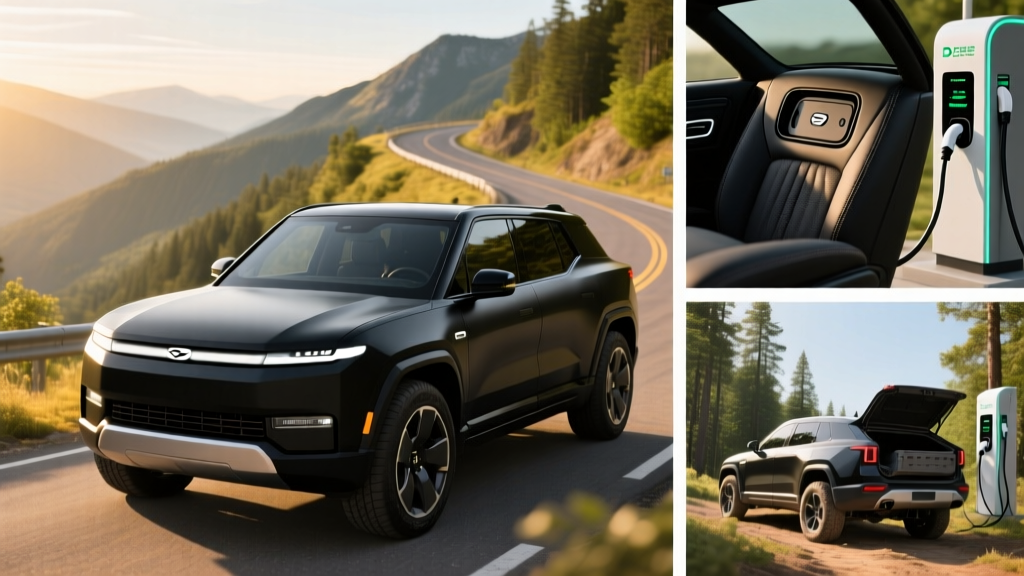
The black Rivian R1S has become one of the most recognizable electric SUVs on American roads — and for good reason. Beneath its boxy, adventure-ready styling sits a seriously capable three-row BEV with up to 410 miles of EPA-estimated range, genuine off-road chops, and acceleration that embarrasses sports cars half its weight. For 2026, the R1S enters its second generation with a redesigned electrical architecture, NACS native charging, and a simplified trim structure that makes configuring one less of a headache.
But the R1S also commands a premium price, carries real trade-offs in third-row space, and operates under evolving federal tax-credit rules that not every buyer will satisfy. We've driven, charged, and lived with the R1S to bring you exact numbers — not marketing copy. Here's everything you need to know before you order.
Range, Efficiency, and the Real-World Reality Check
Rivian offers the 2026 R1S with two battery packs. The Standard pack (approximately 95 kWh usable, NMC chemistry) powers the Dual-Motor configuration to an EPA-estimated 270 miles. The Max pack (roughly 128 kWh usable, NMC) pushes the Dual-Motor Max to an EPA-estimated 410 miles — one of the longest ranges in any three-row electric SUV sold today. The Tri-Motor Max settles at an EPA-estimated 380 miles due to the additional front motor's energy draw.
- Dual-Motor Max (EPA 410 mi): Expect 330–360 mi in mixed highway/city driving at 70 mph. In freezing temperatures (below 32°F), plan for 270–310 mi without preconditioning.
- Tri-Motor Max (EPA 380 mi): Expect 310–340 mi highway; cold weather drops this to 250–290 mi.
- Dual-Motor Standard (EPA 270 mi): Expect 220–245 mi highway; cold weather yields 180–210 mi.
Highway driving at sustained 75–80 mph costs roughly 12–15% range versus the EPA combined figure. The R1S's boxy aerodynamics (Cd ~0.30) penalize it at speed more than a sleeker crossover like the Tesla Model X.
Efficiency for the Dual-Motor Max rates at approximately 76 MPGe combined (about 44 kWh/100 mi) per fueleconomy.gov. The Tri-Motor drops to roughly 70 MPGe combined (48 kWh/100 mi). These are respectable numbers for a 6,800-pound SUV, but they're not Tesla Model X efficient — physics is physics.
Charging Speed: DC Fast, Level 2, and the NACS Advantage
For 2026, all R1S models ship with a native NACS (North American Charging Standard) port, eliminating the need for adapters at Tesla Superchargers. This is a significant practical advantage for road-trip charging access.
| Charging Level | Power / Rate | Speed | Notes |
|---|---|---|---|
| DC Fast Charge (Max pack) | Peak 220 kW | 10–80% in ~27 min | Sustains ~180 kW to 50% SoC, then tapers; preconditioning required for peak rate |
| DC Fast Charge (Standard pack) | Peak 200 kW | 10–80% in ~25 min | Smaller battery reaches 80% slightly faster despite lower peak |
| Level 2 Home (11.5 kW / 48A) | 11.5 kW | ~25 mi/hr added | Full Standard pack charge in ~9 hr; Max pack in ~12 hr |
| Level 2 Home (7.7 kW / 32A) | 7.7 kW | ~17 mi/hr added | Common on older 40A circuits; slower but adequate for overnight |
| Level 1 (120V / 12A) | 1.4 kW | ~3 mi/hr added | Emergency/trickle only — not practical for daily use on Max pack |
Charging-curve reality: Rivian's 220 kW peak on the Max pack holds for roughly 15–20 minutes (from ~10% to ~50% SoC), then tapers progressively. The 10–80% time of 27 minutes is competitive with the Hyundai Ioniq 9 and slightly behind the Tesla Model X's ~22-minute 10–80% window at V4 Superchargers. Always precondition the battery via the navigation system's charge-routing feature before arriving at a DC fast charger — skipping this step can add 5–10 minutes to your session in cool weather.
Performance: Tri-Motor Brutality and Dual-Motor Composure
The 2026 R1S is offered in three powertrain configurations:
| Specification | Dual-Motor (Standard) | Dual-Motor Max | Tri-Motor Max |
|---|---|---|---|
| Drivetrain | AWD (2 motors) | AWD (2 motors) | AWD (3 motors) |
| Horsepower | 533 hp | 533 hp | 837 hp |
| Torque | 610 lb-ft | 610 lb-ft | 908 lb-ft |
| 0–60 mph | 4.5 sec | 4.5 sec | 2.9 sec |
| Towing Capacity | 7,700 lb | 7,700 lb | 7,700 lb |
| EPA Range | 270 mi | 410 mi | 380 mi |
| Battery (usable) | ~95 kWh NMC | ~128 kWh NMC | ~128 kWh NMC |
| MPGe (combined) | 79 MPGe | 76 MPGe | 70 MPGe |
The Tri-Motor's 2.9-second 0–60 time is genuinely startling in a vehicle that seats seven and can tow a boat. But the Dual-Motor at 4.5 seconds is already faster than most buyers will ever need, and it preserves roughly 30 additional miles of range over the Tri-Motor on the Max pack. Unless you're chasing bragging rights or regularly merging onto highways with heavy loads, the Dual-Motor Max is the sweet spot.
Ride quality benefits from Rivian's standard adaptive air suspension, which adjusts ride height across a ~6.5-inch range — from a low "park" mode for easier loading to a high "off-road" mode with 14.9 inches of ground clearance. The R1S handles body roll competently for its mass, though it's never going to feel like a Porsche Cayenne in corners.
Interior Space, Cargo, and Family Practicality
The R1S seats up to seven across three rows, though the third row is best suited for children or short trips. Here are the key dimensions:
- Cargo (behind 3rd row): 10.4 cu ft — tight for groceries with all seats up
- Cargo (3rd row folded): 46.7 cu ft — competitive with midsize SUVs
- Cargo (2nd & 3rd folded): 88.2 cu ft — nearly flat load floor
- Front headroom: 41.1 in | 2nd-row headroom: 39.7 in | 3rd-row headroom: 37.3 in
- Front legroom: 41.3 in | 2nd-row legroom: 38.9 in | 3rd-row legroom: 30.4 in
- Frunk (front trunk): 11.0 cu ft — excellent for charging cables, gym bags, or a week's groceries
The third row's 30.4 inches of legroom is the R1S's most honest limitation versus a full-size SUV like the Chevy Tahoe or even the Tesla Model X (34.9 in third-row legroom). Adults in the third row will be uncomfortable beyond 30 minutes. If you regularly carry six or seven adults, this is not your vehicle. If the third row is for kids, carpools, or occasional use, it works well.
The 11-cubic-foot frunk is one of the largest in any EV and a genuine differentiator for camping gear, wet items, or overflow cargo that you don't want mixing with the cabin.
Technology, Driver Assists, and the Rivian OS
The 2026 R1S runs Rivian's in-house operating system on a 15.6-inch center touchscreen and a 12.3-inch driver display. The interface is clean, responsive, and supports wireless Apple CarPlay and Android Auto — a welcome inclusion that Tesla still omits. Over-the-air updates continue to add features post-delivery.
Driver assistance: Rivian's Driver+ system is a SAE Level 2 hands-on highway assist that combines adaptive cruise control with lane-centering. It works competently on well-marked interstates but requires continuous driver supervision and hands on the wheel. It is not autonomous driving, and it does not compete with GM's hands-free Super Cruise on mapped highways. Think of it as comparable to Toyota Safety Sense or Honda Sensing — useful, but you remain the driver at all times.
Other tech highlights include a built-in air compressor (useful for airing up tires after off-road airing down), a Camp Kitchen accessory that slides from the gear tunnel, integrated rooftop crossbars that deploy from the roof rails, and a "Gear Guard" cable lock system for securing cargo in the bed area.
Pricing, Trims, and Federal Tax Credit Eligibility
The 2026 R1S is offered in three trims across the powertrain lineup. Pricing reflects the base MSRP before destination and options:
| Configuration | Base MSRP | As-Tested (typical) | Federal §30D Credit | Effective Price |
|---|---|---|---|---|
| Dual-Motor Standard — Adventure | $79,900 | $82,500 | Up to $3,750* | ~$78,750 |
| Dual-Motor Max — Adventure | $89,900 | $93,000 | Up to $7,500* | ~$85,500 |
| Tri-Motor Max — Ascend | $104,900 | $109,500 | Up to $7,500* | ~$97,000 |
*Federal EV tax credit (IRS §30D) eligibility depends on multiple requirements that change periodically. As of 2026, the following rules apply:
- MSRP cap: SUVs/vans/pickups must be priced at or below $80,000 MSRP to qualify. The Dual-Motor Standard qualifies; the Dual-Motor Max and Tri-Motor Max exceed this cap and are NOT eligible for the new-vehicle §30D credit.
- Buyer income cap: Modified AGI must not exceed $300,000 (joint), $225,000 (head of household), or $150,000 (single).
- Battery sourcing: A percentage of critical minerals and battery components must be sourced from the U.S. or FTA-partner countries. Rivian has been increasing domestic sourcing, but exact eligibility varies by build date and battery batch. Confirm at point of sale.
- Point-of-sale transfer: Eligible buyers can transfer the credit to the dealer at purchase, reducing the purchase price directly rather than waiting for a tax refund.
Critical takeaway: Due to the $80,000 SUV MSRP cap, only the base Dual-Motor Standard R1S (Adventure trim, no major options) may qualify for a partial federal credit. The higher-range and Tri-Motor configurations exceed the cap. Always verify current eligibility with your tax professional and the IRS §30D guidance before purchasing.
Warranty, Ownership Costs, and Long-Term Outlook
Rivian provides the following warranty coverage for the 2026 R1S:
- Battery & drive unit: 8 years / 175,000 miles (whichever comes first), with a minimum 70% capacity retention guarantee
- Vehicle (bumper-to-bumper): 5 years / 60,000 miles
- Corrosion: 5 years / unlimited miles
The 175,000-mile battery warranty is above the industry standard of 100,000 miles (Tesla, Hyundai, Ford) and reflects Rivian's confidence in its NMC pack management. The 70% capacity retention threshold is standard — if your Max pack degrades below ~90 kWh usable within 8 years, Rivian will repair or replace it.
Insurance costs for the R1S run 15–25% higher than a comparably priced gas SUV due to repair-cost data on aluminum body panels and battery replacement expense. Expect annual premiums in the $2,400–$3,600 range depending on your state, driving record, and coverage level.
Charging costs vary by region. At the national average residential electricity rate of ~$0.16/kWh, fully charging the Max pack at home costs roughly $20.50, yielding a per-mile cost of about $0.05. DC fast charging on Electrify America or Tesla Superchargers runs $0.35–$0.50/kWh, or roughly $0.11–$0.16 per mile — still cheaper than premium gasoline at current prices but not the dramatic savings of home charging.
Black R1S: Aesthetic and Practical Considerations
The keyword "black Rivian R1S" reflects genuine buyer interest in the Stealth Paint and Midnight (dark metallic) colorways. The all-black aesthetic — black paint, black badging, black 22-inch wheels — is the most popular configuration and holds resale value well. However, some practical notes:
- Black paint shows swirl marks, dust, and water spots more readily than Rivian's Glacier White or El Cap Granite. Budget for a ceramic coating or PPF if garage parking isn't available.
- The black interior (Black Mountain) is standard; the upgraded Forest Edge (green) and Ocean Coast (light) interiors are available at additional cost.
- Black exterior with dark-tinted windows and black wheels creates a cohesive, stealthy look but reduces visibility slightly at night compared to lighter exterior colors with contrast pillars.
Verdict: Who Should Buy the Black Rivian R1S?
Pros
- Class-leading range (410 mi EPA) on Dual-Motor Max
- Native NACS charging — full Supercharger network access
- Genuine off-road capability (14.9 in ground clearance, wading mode)
- 7,700-lb towing capacity
- 11 cu ft frunk — largest in class
- Air suspension with adjustable ride height
- Apple CarPlay and Android Auto included
Cons
- Third row is tight for adults (30.4 in legroom)
- Most trims exceed $80K MSRP cap — no federal tax credit
- Insurance premiums 15–25% above gas SUVs
- Boxy shape reduces highway efficiency vs sleeker EVs
- Service center network still growing in rural areas
- Driver+ is competent but not class-leading among L2 systems
Consider alternatives if: You regularly seat six adults (look at the Tesla Model X or wait for larger electric SUVs), you need the $7,500 credit to make the math work (consider the Hyundai Ioniq 9 or Kia EV9, both under $80K MSRP), or your priority is maximum efficiency over adventure capability (Tesla Model X is more aero-efficient).
Frequently Asked Questions
What is the real-world range of the black Rivian R1S?
The Dual-Motor Max achieves an EPA-estimated 410 miles, but real-world highway driving at 70–75 mph yields approximately 330–360 miles in mild weather and 270–310 miles in freezing temperatures. The Tri-Motor Max delivers about 310–340 real-world highway miles. The Standard pack Dual-Motor is best for 220–245 real-world highway miles.
How fast does the R1S charge at home and on the road?
On a DC fast charger, the Max pack peaks at 220 kW and charges from 10–80% in approximately 27 minutes with battery preconditioning. At home on a Level 2 charger (11.5 kW / 48A), you'll add about 25 miles of range per hour, meaning a full overnight charge from near-empty takes about 12 hours for the Max pack.
Does the 2026 Rivian R1S qualify for the $7,500 federal EV tax credit?
Most configurations do not. The IRS §30D credit caps SUV MSRP at $80,000. Only the base Dual-Motor Standard Adventure trim (MSRP $79,900) may qualify, and only if your income is below the cap and battery-sourcing requirements are met. The Dual-Motor Max ($89,900) and Tri-Motor Max ($104,900) exceed the cap. Always confirm with a tax professional and the IRS.
Is the R1S worth buying versus the Tesla Model X or Kia EV9?
The R1S wins on off-road capability, towing, and adventure features (frunk, air compressor, gear tunnel). The Tesla Model X wins on third-row space, efficiency, and access to the most mature Supercharger network (though R1S now has native NACS). The Kia EV9 wins on price (starting ~$55K), federal credit eligibility, and value — but sacrifices range and performance. Your use case determines the winner.
What are the biggest drawbacks of owning an R1S?
The three most cited owner complaints are: (1) third-row space is tight for adults, (2) insurance costs are higher than comparable gas SUVs, and (3) Rivian's service center footprint is still expanding, meaning some rural owners face longer drives for warranty work. Additionally, the black exterior requires more frequent washing and paint protection to maintain its appearance.
How long will the R1S battery last?
Rivian warranties the battery for 8 years / 175,000 miles with a 70% minimum capacity retention guarantee. Industry data on NMC packs in thermally managed systems suggests 80–85% capacity retention at 150,000 miles under normal use. Avoid frequent DC fast charging above 90% SoC and regular deep discharges below 10% to maximize longevity.