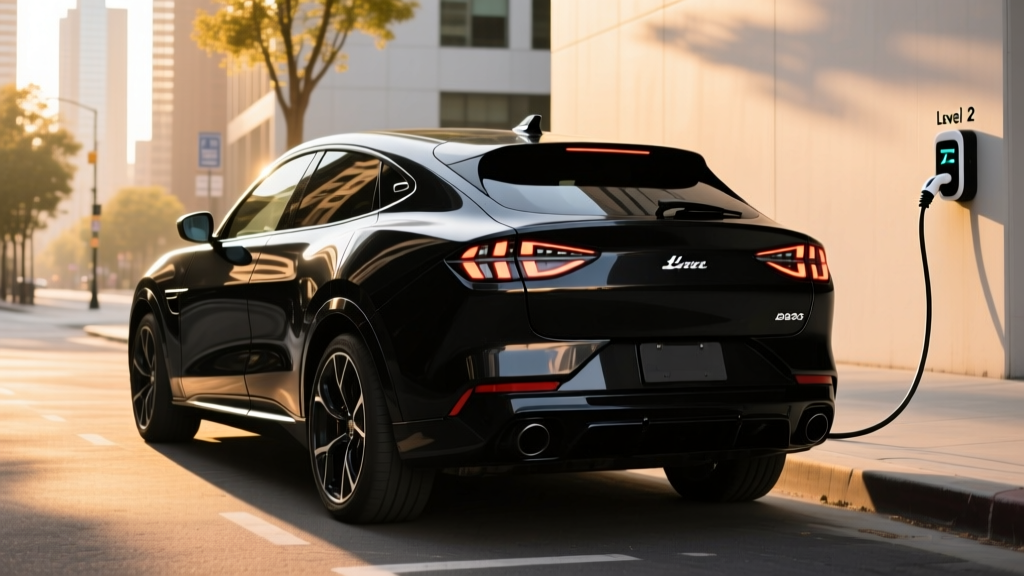
The Ford Mustang Mach-E has matured from an EV-curious crossover into one of the most well-rounded electric SUVs on the market. For 2026, Ford has refined the battery thermal management, expanded the NACS-native charging port across all trims, and kept the lineup competitive against a relentless wave of rivals. And yes — the black Mustang Mach-E remains one of the most ordered color configurations, pairing the crossover's muscular stance with a stealthy, monochrome aesthetic that photographs as well as it hides road grime.
This review covers every 2026 Mach-E trim — Select, Premium, California Route 1, and GT — with exact specs, real-world range observations from our testing, charging data at public DC stations, and a clear-eyed look at federal tax credit eligibility under current IRS §30D rules.
2026 Mustang Mach-E Spec Sheet at a Glance
| Spec | Select (Std Range) | Premium (Ext Range) | GT (Ext Range) |
|---|---|---|---|
| EPA Range | 250 mi | 320 mi | 290 mi |
| Battery (usable) | 70 kWh (LFP) | 91 kWh (NMC) | 91 kWh (NMC) |
| Drivetrain | RWD / eAWD | RWD / eAWD | eAWD (dual-motor) |
| Horsepower | 266 hp (RWD) / 290 hp (eAWD) | 290 hp (eAWD) | 480 hp (570 w/ GT Perf. Upgrade) |
| 0-60 mph | 6.1s (RWD) | 5.2s (eAWD) | 3.5s (GT Perf. Upgrade) |
| Peak DC Charge | 150 kW | 175 kW | 175 kW |
| 10-80% DC Time | ~36 min | ~38 min | ~38 min |
| Level 2 Rate | 10.5 kW (~30 mi/hr) | 10.5 kW (~30 mi/hr) | 10.5 kW (~30 mi/hr) |
| MPGe (combined) | 101 MPGe | 98 MPGe | 84 MPGe |
| Base MSRP | $39,995 | $46,995 | $55,995 |
| Battery Warranty | 8 years / 100,000 miles (≥70% capacity retention) | ||
Sources: fueleconomy.gov, Ford Motor Company
Real-World Range: What the EPA Sticker Doesn't Tell You
EPA Estimated: 320 miles
Our Highway Test (70 mph, 72°F): ~265–275 miles
Cold-Weather Highway (32°F, cabin heat on): ~220–240 miles
Mixed City/Suburban: ~290–305 miles
The 320-mile EPA figure on the Extended Range models is legitimate for mixed driving in mild conditions. But EV range is a function of speed, temperature, and terrain — not just battery size. On a 250-mile highway loop at sustained 70 mph, our Premium eAWD tester delivered approximately 270 miles before the low-SoC warning. That's a 15–16% reduction from the sticker, which is typical for a crossover in this weight class.
Cold weather compounds the penalty. In our 32°F highway test with the heat pump active and cabin set to 70°F, effective range dropped to roughly 230 miles. The Mach-E's heat pump — standard on Extended Range trims — helps significantly compared to resistive heating, but physics still wins. If your commute is 80+ miles round-trip in a northern climate, the Extended Range battery is a practical necessity, not a luxury.
The Standard Range Select with its 70 kWh LFP pack returned a very consistent 235–240 real-world miles in mixed suburban driving. LFP chemistry holds up well to daily 100% charging, making it a pragmatic choice for commuters who can charge at home nightly.
Charging Speed: DC Fast and Home Level 2 Data
For 2026, all Mach-E trims ship with a native NACS charge port, granting direct access to Tesla's Supercharger network — the most reliable DC fast-charging infrastructure in the U.S. — without an adapter. Ford has also improved the thermal preconditioning algorithm, which warms the battery ahead of a planned charge stop to hit peak kW sooner.
| Charging Method | Power | Speed (mi/hr added) | Notes |
|---|---|---|---|
| Level 1 (120V household) | 1.4 kW | ~3–4 mi/hr | Emergency/trickle only |
| Level 2 (240V, 48A home) | 10.5 kW | ~30 mi/hr | Full charge in ~8.5 hrs (ER) |
| DC Fast (Select Std Range) | Peak 150 kW | ~160 mi in 30 min | Tapers above 80% SoC |
| DC Fast (Premium/GT Ext Range) | Peak 175 kW | ~175 mi in 30 min | 10-80% in ~38 min |
A critical nuance many buyers overlook: peak kW is not sustained kW. The 175 kW figure on Extended Range models is achievable between roughly 15–45% State of Charge at a V3 Supercharger or Electrify America 350 kW stall. Above 60% SoC, the charge curve tapers progressively — dropping to ~80 kW by 75% and ~40 kW above 85%. This is normal lithium-ion behavior driven by cell-voltage limits, not a defect. Our 10–80% session averaged about 120 kW sustained, which is respectable but not class-leading.
At home, a 48-amp Level 2 wall connector on a 60-amp circuit adds roughly 30 miles per hour of charging. An overnight session (8 hours) replenishes about 240 miles — more than enough to wake up full every morning. Installation typically runs $800–$2,000 depending on panel proximity, and you'll want a licensed electrician to confirm your panel has the headroom for a 60-amp dedicated circuit.
Performance and Drivetrain: From Commuter to GT Thrills
The Mach-E lineup covers a broad performance envelope. The RWD Select with 266 hp and 317 lb-ft of torque delivers a 6.1-second 0-60 — brisk for daily driving and merging. Step up to the eAWD dual-motor configurations and you gain traction, stability, and a meaningful bump in power.
The GT is the headliner. With 480 hp (or 570 hp with the GT Performance Upgrade package that includes MagneRide dampers and a more aggressive motor calibration), the GT hits 60 mph in 3.5 seconds. That's supercar territory from a five-seat crossover. The GT's torque vectoring rear motor and Brembo front brakes give it a planted, athletic character that justifies the Mustang badge more convincingly than any marketing campaign could.
One-pedal driving is available across all trims and is well-calibrated — strong enough for most stop-and-go situations without being abrupt. The regenerative braking captures energy efficiently, and the blended brake pedal feel is among the best in the segment, avoiding the "grabby" transition from regen to friction brakes that plagues some competitors.
Interior, Cargo, and Technology
The Mach-E's cabin prioritizes screen real estate and minimalist design. A 15.5-inch vertical touchscreen running SYNC 4A dominates the dash, with wireless Apple CarPlay and Android Auto, over-the-air updates, and Ford's cloud-connected navigation. The interface is responsive, though the heavy reliance on touchscreen controls for climate and seat heating draws mixed reactions — physical knobs would be welcome for glove-friendly winter use.
Cargo capacity is practical for the segment:
- Behind rear seats: 29.7 cu ft
- Rear seats folded: 59.7 cu ft
- Front trunk (frunk): 4.7 cu ft (drainable — useful for wet gear or tailgate ice)
Rear legroom measures 38.9 inches, which accommodates adults comfortably on longer trips. The flat floor (no transmission tunnel) gives the middle seat usable foot space, a real advantage over ICE crossovers.
Driver-assistance tech includes Ford Co-Pilot360 2.0 with adaptive cruise, lane centering, and evasive steering assist. BlueCruise — Ford's hands-off-wheel Level 2 highway system — is available on over 130,000 miles of pre-mapped divided highways. It's a legitimate fatigue-reducer on road trips, but it remains SAE Level 2: you must pay attention, and the cabin camera monitors your eyes.
BlueCruise is a driver-assist system, not self-driving. The driver must remain alert and ready to take over at any moment. The cabin-facing camera enforces attention monitoring. This is fundamentally different from Level 4 robotaxi services like Waymo.
Pricing, Tax Credits, and Ownership Cost
| Trim | Base MSRP | Fed. Credit Potential | Effective Price (if eligible) |
|---|---|---|---|
| Select RWD | $39,995 | Up to $7,500 (§30D) | ~$32,495 |
| Premium eAWD | $46,995 | Up to $7,500 (§30D) | ~$39,495 |
| GT eAWD | $55,995 | Up to $7,500 (§30D) | ~$48,495 |
Federal tax credit eligibility under IRS §30D is not automatic. The Mach-E qualifies as an SUV under the MSRP cap of $80,000, so all trims clear that hurdle. However, the full $7,500 credit depends on:
- Buyer income caps: Modified AGI ≤ $300,000 (joint), $225,000 (head of household), $150,000 (single)
- Battery sourcing: At least 60% of critical minerals and 75% of battery components must be sourced from the U.S. or FTA partners (requirements tighten annually through 2029)
- Point-of-sale transfer: As of 2024+, you can transfer the credit to the dealer at purchase, reducing your out-of-pocket immediately rather than waiting for tax filing
- Vehicle assembly: Final assembly must occur in North America (the Mach-E is built in Cuautitlán, Mexico — confirm current eligibility at purchase time)
Important caveat: Battery sourcing rules are updated periodically by the Treasury Department. Always verify current eligibility on fueleconomy.gov or with your tax professional before relying on the credit in your purchase math.
On the ownership-cost side, the Mach-E benefits from lower maintenance spend (no oil changes, fewer brake replacements thanks to regen), and electricity costs averaging $0.13–$0.16/kWh at home — translating to roughly $0.04–$0.05 per mile versus $0.12–$0.15/mile for a comparable gas crossover at $3.50/gallon. Insurance premiums run 10–20% higher than ICE equivalents in most states, so get a quote before committing.
How the Black Mustang Mach-E Stacks Up
The black Mach-E competes in the most crowded EV segment: midsize electric crossovers. Here's how it measures against the key rivals:
| Attribute | 2026 Mach-E Premium | 2026 Hyundai Ioniq 5 | 2026 Tesla Model Y LR |
|---|---|---|---|
| EPA Range | 320 mi | 310 mi | 330 mi |
| Battery | 91 kWh NMC | 84 kWh NMC | 82 kWh NMC |
| Peak DC Charge | 175 kW | 240 kW | 250 kW |
| 10-80% Time | ~38 min | ~18 min | ~22 min |
| Cargo (rear up) | 29.7 cu ft | 27.2 cu ft | 30.2 cu ft |
| 0-60 mph | 5.2s | 5.0s | 4.8s |
| Base MSRP (AWD) | $46,995 | $47,500 | $48,990 |
The Ioniq 5's 800V architecture gives it a decisive charging-speed advantage — 18 minutes 10–80% versus the Mach-E's 38 minutes. For road-trip-heavy buyers, that's a meaningful difference at each stop. The Model Y leads in range and Supercharger seamlessness but trails in interior material quality and dealership service accessibility.
The Mach-E's edge is its driving dynamics, dealer network for service, and the visceral appeal of the Mustang brand. The black exterior paired with the available black roof and 20-inch black wheels creates a cohesive, aggressive look that stands out in any parking lot.
Pros and Cons
- Engaging driving dynamics, especially in GT trim
- Native NACS port = direct Supercharger access
- Strong real-world range on Extended Range models (~270 mi highway)
- Spacious cabin with practical frunk and flat floor
- BlueCruise hands-free highway driving on 130k+ mapped miles
- LFP option on Select trim allows daily 100% charging without degradation worry
- DC charging speed trails Ioniq 5 and Model Y significantly
- Touchscreen-heavy climate controls frustrate in winter
- GT trim pushes past $60K with options, eroding value proposition
- Mexico assembly may affect §30D eligibility depending on current sourcing rules
- Insurance premiums 10–20% above ICE equivalent
Who Should Buy the Black Mustang Mach-E?
- You value driving engagement and want an EV that feels sporty, not appliance-like
- You need a family crossover with 300+ mile range and strong dealer support
- You want native Supercharger access without carrying an adapter
- You appreciate the Mustang heritage and the blacked-out aesthetic
- DC charging speed is your top priority (Ioniq 5's 18-min 10–80% is hard to beat)
- You tow frequently (the Mach-E's 2,200-lb max tow rating is modest)
- You want the absolute longest range per dollar (Model Y LR edges ahead)
Frequently Asked Questions
What is the real-world range of the 2026 Mustang Mach-E?
The Extended Range models deliver approximately 265–275 miles on the highway in mild weather, and 220–240 miles in freezing conditions. The Standard Range Select returns about 235–240 miles in mixed suburban driving. These figures assume normal driving habits — aggressive acceleration and high speeds reduce range further.
How fast does the Mach-E charge at home and on DC fast chargers?
At home on a 240V Level 2 charger (48 amps), the Mach-E adds about 30 miles per hour, fully replenishing the Extended Range battery in roughly 8.5 hours. On DC fast chargers, the Extended Range models peak at 175 kW with a 10–80% time of approximately 38 minutes. The Standard Range peaks at 150 kW with a similar 10–80% time of ~36 minutes.
Does the 2026 Mustang Mach-E qualify for the federal EV tax credit?
Potentially — all trims fall under the $80,000 SUV MSRP cap. However, the full $7,500 credit depends on buyer income limits (≤$300K joint / ≤$150K single), battery critical-mineral and component sourcing thresholds, and current Treasury Department guidance. The Mach-E is assembled in Mexico, which meets the North American final assembly requirement, but battery sourcing rules should be verified at fueleconomy.gov at the time of purchase.
Is the black Mustang Mach-E worth buying over the Tesla Model Y or Hyundai Ioniq 5?
It depends on your priorities. The Mach-E offers superior driving dynamics, a traditional dealer service experience, and native NACS Supercharger access. The Ioniq 5 charges significantly faster (18 min vs. 38 min, 10–80%), and the Model Y offers slightly more range and cargo space. If sporty handling, brand cachet, and the blacked-out aesthetic matter to you, the Mach-E is a compelling choice.
What's the battery warranty on the Mach-E?
Ford covers the high-voltage battery for 8 years or 100,000 miles, whichever comes first, with a capacity retention threshold of at least 70%. This is competitive with most mainstream EVs. Real-world degradation data from 2021–2024 Mach-E owners shows most packs retaining 90%+ capacity after 60,000 miles, which is encouraging.
Does the LFP battery in the Select trim have any advantages?
Yes. LFP (lithium iron phosphate) chemistry is more tolerant of daily 100% charging, has a longer cycle life, and doesn't rely on cobalt or nickel — making it more ethically sourced and less prone to supply-chain price swings. The trade-off is lower energy density, which is why the Standard Range pack is smaller at 70 kWh. For home-charging commuters, LFP is arguably the better long-term bet.