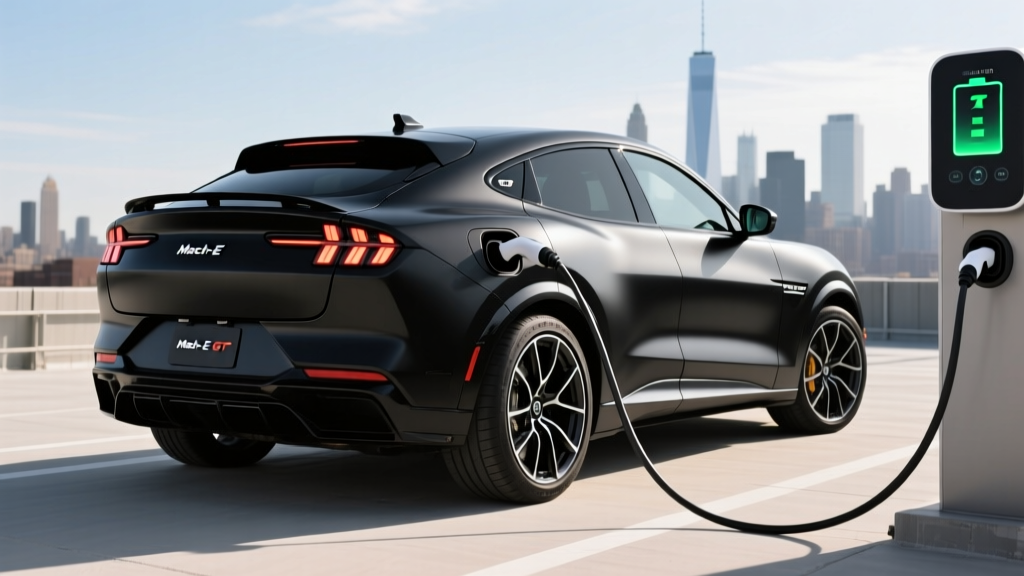
The Ford Mustang Mach-E GT has carved out a unique space in the electric performance-SUV segment since its debut, and the 2026 model year continues to refine the formula. If you've been searching for a black Mustang Mach-E GT — whether for its aggressive styling, dual-motor all-wheel-drive performance, or Ford's expanding Blue Oval charging ecosystem — this review covers every number that matters: real-world range, charging curves, tax-credit eligibility, and how it stacks up against the Tesla Model Y Performance and Hyundai Ioniq 5 N.
Quick Verdict: Who Should Buy the Mach-E GT?
The 2026 Mustang Mach-E GT is best suited for drivers who want a practical daily-driver with serious acceleration, decent DC fast-charging speeds, and a sportback crossover profile. It's a strong fit for suburban commuters with home Level 2 charging access, small families needing 50+ cubic feet of cargo space, and road-trippers willing to plan around the Electrify America and Tesla Supercharger (via adapter) networks. It is not the longest-range EV in its class — buyers prioritizing maximum range over performance should look at the Mach-E Premium RWD or the Tesla Model Y Long Range instead.
Range, Efficiency, and Real-World Expectations
The 2026 Mach-E GT pairs a dual-motor AWD drivetrain with Ford's extended-range battery pack. Here is what the EPA says versus what you should plan for in actual driving:
Real-world expectation: plan for 240–260 miles in mixed highway/city driving at moderate temperatures (65–80°F). Sustained highway speeds above 75 mph will push consumption closer to 220–230 miles of effective range. In cold weather (below 32°F), expect a 20–30% reduction, landing between 195–225 miles depending on cabin heating use and whether you precondition the battery. The Mach-E GT's performance-oriented tuning and heavier dual-motor setup consume more energy than the single-motor variants.
Efficiency comes in at 84 MPGe combined (city/highway), which translates to approximately 40 kWh per 100 miles. That's competitive with other performance EVs like the BMW iX M60 but trails efficiency-focused crossovers like the Hyundai Ioniq 5 (110+ MPGe). The GT's weight — approximately 4,900 lbs — and all-season performance tires contribute to the higher consumption.
| Spec | Value |
|---|---|
| EPA Range | 280 miles |
| Battery (usable) | 91 kWh, NMC chemistry |
| Drivetrain | Dual-motor AWD |
| Horsepower | 480 hp (536 hp w/ Performance Upgrade) |
| 0–60 mph | 3.5 sec (3.3 sec w/ Performance Upgrade) |
| Max DC Fast Charge | 150 kW peak |
| 10–80% DC Charge Time | ~36 minutes |
| Level 2 Home Charge Rate | 10.5 kW (~30 mi/hr) |
| MPGe (combined) | 84 MPGe |
| Cargo Volume (rear seats up/down) | 29.7 / 59.7 cu ft |
| Front Trunk (Frunk) | 4.7 cu ft |
| Base MSRP (GT) | $59,995 |
| Battery/Powertrain Warranty | 8 years / 100,000 miles |
Battery Chemistry and Long-Term Degradation
Ford equips the Mach-E GT's extended-range pack with NMC (nickel manganese cobalt) lithium-ion cells, supplied primarily by LG Energy Solution and SK On. NMC chemistry offers higher energy density than LFP (lithium iron phosphate), which is why it's used in the performance-oriented GT — you get 91 kWh of usable capacity in a package that fits the sportback's floor.
The trade-off: NMC cells are more sensitive to sustained high state-of-charge and extreme temperatures. Ford recommends daily charging to 80–90% for routine use and only charging to 100% before long trips. Ford's battery management system includes a buffer (roughly 5–7 kWh above and below the usable window) to protect against deep discharge and overcharge degradation.
Ford warrants the battery pack for 8 years or 100,000 miles, guaranteeing it will retain at least 70% of original capacity. Real-world data from 2021–2024 Mach-E owners shows degradation in the 3–6% range after 60,000 miles, which is in line with industry averages for liquid-cooled NMC packs. For comparison, LFP-equipped vehicles like the Tesla Model 3 RWD often show less than 2% degradation over similar mileage but sacrifice energy density and cold-weather performance.
Charging Speed: DC Fast, Level 2, and the NACS Transition
The 2026 Mach-E GT charges at a peak rate of 150 kW on DC fast chargers. That's adequate for road trips but noticeably slower than competitors like the Hyundai Ioniq 5 (peak 240 kW) and Tesla Model Y (peak 250 kW on V3 Superchargers). Here's the full charging picture:
| Charging Level | Power (kW) | Speed (miles added/hr) | Notes |
|---|---|---|---|
| Level 1 (120V household) | ~1.4 kW | ~3–4 mi/hr | Emergency/trickle only |
| Level 2 (240V home, 48A) | 10.5 kW | ~30 mi/hr | Full charge overnight (~9 hrs) |
| DC Fast (CCS/NACS adapter) | 150 kW peak | ~180 mi/hr at peak | 10–80% in ~36 min; tapers above 80% |
Charging curve reality check: The Mach-E GT hits its 150 kW peak only between roughly 15–35% state of charge. From 35–60%, it sustains around 110–120 kW, and from 60–80%, it drops to approximately 60–75 kW. This taper is why the 10–80% time is 36 minutes rather than the ~25 minutes you'd calculate from peak rate alone. Above 80%, charging slows dramatically — plan to unplug at 80% on road trips unless you absolutely need the last 20%.
For the 2025 model year, Ford began equipping new Mach-E vehicles with the NACS (North American Charging Standard) port natively, replacing the CCS1 connector. The 2026 model continues with NACS, granting access to Tesla's Supercharger network (17,000+ stalls in the US) without an adapter. If you're buying a used 2022–2024 Mach-E with CCS, Ford provides a complimentary CCS-to-NACS adapter for Supercharger access. According to Ford's EV charging page, the Blue Oval Charge Network aggregates over 84,000 charge points across multiple providers.
Performance: 480 Horsepower and a 3.5-Second 0–60
The Mach-E GT's dual permanent-magnet synchronous motors produce 480 horsepower and 600 lb-ft of torque in standard GT trim. Opt for the GT Performance Upgrade ($5,000) and output rises to 536 hp and 648 lb-ft, dropping the 0–60 mph time from 3.5 seconds to 3.3 seconds. Both figures place the GT firmly in sports-car territory — a Mustang Mach-E GT will outrun a base Porsche Cayenne to 60 mph.
Ford's MagneRide adaptive dampers (included on the GT) provide a surprisingly compliant ride in Comfort mode while firming up substantially in Unbridled Extend drive mode. The GT's 4,900-lb curb weight is noticeable in tight corners compared to a Porsche Taycan or Tesla Model 3 Performance, but the low center of gravity and torque-vectoring AWD keep it composed on highway sweepers.
One-pedal driving with strong regenerative braking is standard, and Ford's Brake by Wire system blends regen and friction braking seamlessly. Towing capacity is rated at 2,300 lbs with the factory tow package — enough for a small utility trailer or a pair of jet skis, but not a travel trailer.
Interior, Tech, and Driver-Assistance Systems
The Mach-E GT's cabin centers on a 15.5-inch vertical touchscreen running Ford's SYNC 4A infotainment system. Wireless Apple CarPlay and Android Auto are standard, along with a 10.2-inch digital instrument cluster. The GT adds a panoramic fixed-glass roof, ActiveX synthetic leather sport seats with heating and ventilation, and a 10-speaker B&O sound system.
Cargo space is generous for the sportback segment: 29.7 cubic feet behind the rear seats and 59.7 cubic feet with the 60/40 split rear seats folded. The 4.7-cubic-foot frunk is useful for charging cables or a small bag. Rear-seat legroom measures 38.9 inches — adequate for adults on longer trips, though the sloping roofline reduces headroom for passengers over 6 feet tall.
Ford's BlueCruise hands-free driving system operates on pre-mapped divided highways (over 130,000 miles of compatible roads as of 2026). It handles steering, acceleration, and braking, but the driver must remain attentive at all times. An interior camera monitors eye gaze and will issue escalating warnings — then bring the vehicle to a controlled stop — if the driver looks away for too long. BlueCruise does not navigate city streets, construction zones, or unmapped roads. It is not comparable to Waymo's Level 4 robotaxi service, which operates without any human driver in geofenced urban areas.
BlueCruise comes with a 90-day free trial on the 2026 Mach-E GT; after that, it costs approximately $75/month or $800/year for continued hands-free highway access. Standard Ford Co-Pilot360 2.0 features (adaptive cruise, lane centering, automatic emergency braking, blind-spot monitoring) are included at no extra cost.
Pricing, Tax Credits, and Total Cost
The 2026 Mustang Mach-E GT carries a base MSRP of $59,995, including destination. With the GT Performance Upgrade, premium paint colors (the black-on-black configuration typically adds no premium for standard Shadow Black, but Rapid Red or Star White tri-coat adds $400–$500), and the Ford Protect extended service plan, as-tested prices commonly land between $63,000 and $67,000.
- MSRP cap: SUVs/crossovers must be ≤ $80,000 MSRP. The Mach-E GT qualifies ($59,995 base).
- Buyer income cap: AGI ≤ $150,000 (single) or ≤ $300,000 (joint filers). Exceed these and the credit phases out.
- Battery sourcing: A percentage of critical minerals and battery components must be sourced from the US or FTA-partner countries. Ford has been progressively re-shoring supply chains, but the exact credit amount ($3,750 or $7,500) depends on the specific VIN's battery sourcing compliance. Check fueleconomy.gov for the latest per-model eligibility.
- Point-of-sale transfer: As of 2024, the credit can be transferred to the dealer at purchase, reducing the purchase price upfront rather than waiting for a tax refund.
- State/local incentives: Vary by jurisdiction — consult your state's energy office or a tax professional for specifics.
| Scenario | Price |
|---|---|
| Base MSRP (GT) | $59,995 |
| As-tested (GT Perf. Upgrade + options) | ~$65,495 |
| After $7,500 federal credit (if eligible) | ~$52,495 |
| After $3,750 partial credit | ~$56,245 |
| Estimated 5-yr fuel savings vs. gas SUV (15k mi/yr) | ~$4,500–$6,000 |
On the ownership-cost side, the Mach-E GT's insurance premiums tend to run 15–25% higher than a comparably priced gas crossover due to repair-cost data on EVs. Home charging at the national average of $0.16/kWh costs approximately $14.50 for a full 91 kWh charge, or about $0.05 per mile — roughly one-third the per-mile cost of a 22-MPG gas SUV at $3.50/gallon.
Pros and Cons
- 3.5-sec 0–60 with 480 hp; 3.3 sec with Performance Upgrade
- NACS port standard — native Tesla Supercharger access
- Spacious cargo area (59.7 cu ft) for a sportback
- BlueCruise hands-free highway driving on 130,000+ mapped miles
- Qualifies for up to $7,500 federal tax credit (MSRP and sourcing permitting)
- MagneRide adaptive suspension balances comfort and handling
- 150 kW peak DC charging is slower than Ioniq 5 (240 kW) and Model Y (250 kW)
- 280-mile EPA range trails Model Y Long Range (320+ mi)
- 20–30% range loss in sub-freezing temperatures
- BlueCruise requires paid subscription after 90-day trial
- Insurance premiums 15–25% above gas crossover averages
- Rear headroom tight for passengers over 6 ft due to roofline
How It Compares: Mach-E GT vs. Model Y Performance vs. Ioniq 5 N
| Spec | Ford Mach-E GT | Tesla Model Y Perf. | Hyundai Ioniq 5 N |
|---|---|---|---|
| EPA Range | 280 mi | 303 mi | 221 mi |
| Battery | 91 kWh NMC | ~78 kWh NMC | 84 kWh NMC |
| Horsepower | 480 hp (536 w/ upgrade) | ~510 hp | 641 hp (w/ N Grin Boost) |
| 0–60 mph | 3.5 sec | 3.5 sec | 3.4 sec |
| Peak DC Charge | 150 kW | 250 kW | 240 kW |
| 10–80% Time | ~36 min | ~25 min | ~18 min |
| Base MSRP | $59,995 | ~$54,990 | ~$67,500 |
| Federal Credit Eligible | Up to $7,500 | Up to $7,500 | Up to $7,500 |
| Cargo (behind rear seats) | 29.7 cu ft | 30.2 cu ft | 27.2 cu ft |
The Mach-E GT's primary advantage is its blend of American-brand familiarity, MagneRide ride quality, and NACS Supercharger access. The Model Y Performance charges faster and goes farther on a charge but offers a firmer ride and a more minimalist interior that polarizes buyers. The Ioniq 5 N is the track-focused wildcard — stunning charge speeds and 641 hp, but significantly less range and a higher starting price.
Frequently Asked Questions
What is the real-world range of the black Mustang Mach-E GT?
The EPA rates the 2026 Mach-E GT at 280 miles. In real-world mixed driving at moderate temperatures, expect 240–260 miles. Highway driving at 75+ mph drops this to roughly 220–230 miles, and winter conditions (below 32°F) can reduce range to 195–225 miles. Preconditioning the battery while plugged in helps mitigate cold-weather losses.
How fast does the Mach-E GT charge at home and on the road?
On a home Level 2 charger (240V, 48A), the Mach-E GT charges at 10.5 kW, adding approximately 30 miles of range per hour — a full charge takes about 9 hours. On DC fast chargers, it peaks at 150 kW, with a 10–80% charge in approximately 36 minutes. The 2026 model's native NACS port provides direct access to Tesla Superchargers.
Does the 2026 Mustang Mach-E GT qualify for the federal EV tax credit?
The Mach-E GT's $59,995 MSRP falls well under the $80,000 SUV cap. Buyer income must be ≤$150,000 (single) or ≤$300,000 (joint). The credit amount ($3,750 or $7,500) depends on battery-sourcing compliance for the specific VIN. The credit can be applied at the point of sale as a purchase-price reduction. Always verify current eligibility on fueleconomy.gov and consult a tax professional.
Is the Mach-E GT worth buying over the Tesla Model Y Performance?
Choose the Mach-E GT if you prioritize ride comfort (MagneRide), a more traditional crossover interior, and BlueCruise highway assist. Choose the Model Y Performance if maximum range (303 mi), faster DC charging (250 kW), and Tesla's Supercharger network reliability are your top priorities. Both qualify for the federal credit, but the Model Y starts roughly $5,000 lower.
What are the biggest drawbacks of the Mach-E GT?
The 150 kW peak DC charging speed is the Mach-E GT's most significant competitive weakness — it adds 10–15 minutes to road-trip charging stops compared to the Ioniq 5 or Model Y. Range (280 mi EPA) is adequate but not class-leading, and cold-weather range loss is more pronounced than in LFP-equipped vehicles. Insurance costs also run above average for the segment.
Is BlueCruise the same as Tesla's Full Self-Driving?
No. Both BlueCruise and FSD (Supervised) are SAE Level 2 driver-assistance systems that require continuous driver attention. BlueCruise operates hands-free only on pre-mapped divided highways (130,000+ miles), while FSD operates on more road types but requires hands-on-wheel monitoring in most jurisdictions. Neither is "self-driving" — only Level 4 robotaxi services like Waymo operate without a human driver.
Sources: fueleconomy.gov (EPA range and efficiency data), Ford.com Mach-E specifications, IRS.gov §30D clean vehicle credit rules.