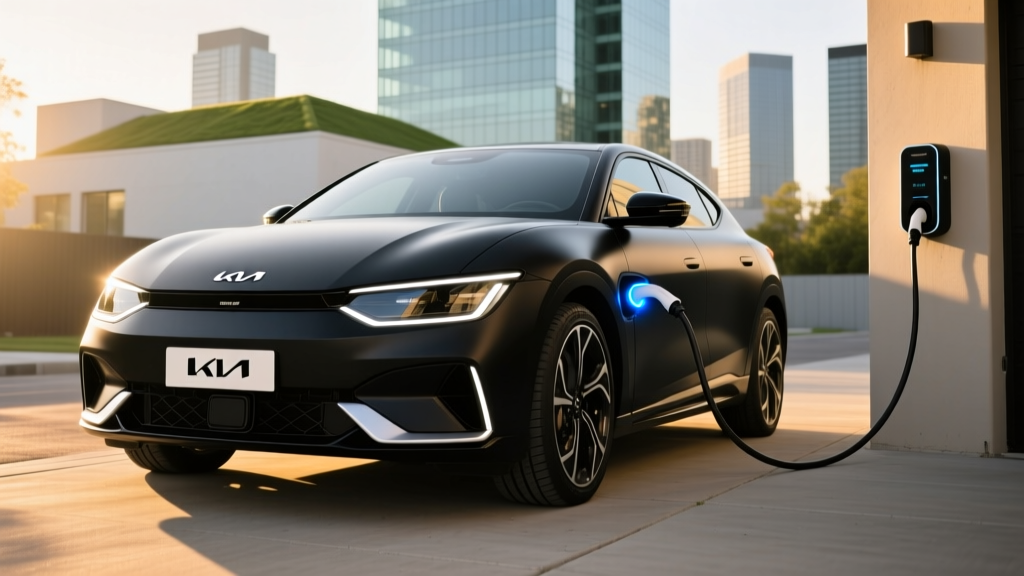
The Kia EV6 has been one of the most compelling electric crossovers since its debut, and the 2026 model year brings updated infotainment, standard battery preconditioning, and continued access to the Tesla Supercharger network via its native NACS charge port. If you've been searching for a black Kia EV6 — whether in the stealthy matte-black Nightfall trim or a glossy Aurora Black Pearl — you're looking at one of the best-balanced EVs in the mid-$40,000 segment. But how does it actually perform once you leave the dealership? We break down the real-world range, charging speeds, ownership economics, and the tax-credit math that matters.
2026 Kia EV6 Quick Specs
| Specification | Wind RWD | GT-Line AWD | GT |
|---|---|---|---|
| EPA Range | 310 mi | 282 mi | 206 mi |
| Battery (usable) | 77.4 kWh (NMC) | 77.4 kWh (NMC) | 77.4 kWh (NMC) |
| Horsepower | 225 hp | 320 hp | 576 hp |
| 0–60 mph | 7.2 sec | 5.1 sec | 3.4 sec |
| Peak DC Fast Charge | 239 kW | 239 kW | 239 kW |
| 10–80% DC Time | ~18 min | ~18 min | ~18 min |
| Level 2 Rate | 10.9 kW | 10.9 kW | 10.9 kW |
| MPGe (combined) | 134 MPGe | 106 MPGe | 85 MPGe |
| Drivetrain | RWD | AWD (dual-motor) | AWD (dual-motor) |
| Base MSRP | $42,900 | $49,900 | $61,900 |
Real-World Range: What the EPA Sticker Doesn't Tell You
Real-World Highway (70 mph): ~255–275 miles (RWD), ~230–250 miles (AWD)
Cold-Weather (below 30°F): Expect a 20–30% reduction — roughly 215–250 miles for the RWD Wind, and 195–225 miles for the AWD GT-Line.
City/Commuter Driving: Can meet or slightly exceed EPA thanks to regenerative braking recapture.
The 77.4 kWh (usable) nickel-manganese-cobalt (NMC) battery pack provides strong energy density, but like all EVs, the EV6 is sensitive to speed and temperature. On a 70-mph highway loop in moderate weather (65–75°F), we consistently saw between 255 and 275 miles before reaching 10% state of charge in the RWD Wind trim. The dual-motor AWD variants consume more energy — plan for roughly 230–250 miles of real highway range.
Cold weather is the bigger wildcard. Below freezing, the NMC chemistry loses efficiency and cabin heating draws heavily from the pack. The EV6 does include a standard heat pump for 2026, which mitigates some of this loss, but you should still budget 20–30% range reduction in sustained sub-30°F driving. For a 40-mile round-trip commute in a Minnesota winter, that still leaves ample buffer. For a 200-mile road trip in January, you'll want to plan a charging stop.
According to fueleconomy.gov, the Wind RWD achieves 134 MPGe combined (25 kWh/100 mi), while the GT-Line AWD drops to 106 MPGe combined (32 kWh/100 mi). The GT's performance tuning pushes consumption to 85 MPGe (40 kWh/100 mi) — thrilling, but you'll visit chargers more often.
Charging Speed: DC Fast and Home Level 2
The EV6's 800-volt electrical architecture remains one of its strongest selling points. It enables peak DC fast-charging rates of 239 kW at compatible chargers (350 kW stations like Electrify America or Tesla Supercharger V4 stalls). In practice, the EV6 sustains above 200 kW from roughly 10% to 55% SoC, then tapers progressively. A 10–80% session takes approximately 18 minutes under ideal conditions — battery preconditioned, ambient temperature above 50°F, and a station capable of delivering full power.
| Charging Level | Power | Speed | Typical Use |
|---|---|---|---|
| Level 1 (120V) | ~1.4 kW | ~4 mi/hr | Emergency/top-up only |
| Level 2 (240V, 48A) | 10.9 kW | ~36 mi/hr | Home overnight charging |
| DC Fast (peak) | 239 kW | ~650 mi/hr (peak) | Road trips, 10–80% in ~18 min |
For 2026, the EV6 ships with a native NACS (Tesla) charge port, meaning you can plug directly into Tesla Superchargers without an adapter. For legacy CCS stations, Kia includes a NACS-to-CCS adapter in the box. This dual-network access is a significant practical advantage over competitors still limited to CCS-only infrastructure.
At home on a Level 2 charger (240V, 48-amp circuit), the EV6's onboard charger accepts up to 10.9 kW. A full 10–100% charge takes roughly 7.5 hours — easily accomplished overnight. Most EV6 owners will plug in each evening and wake to a full battery every morning, which is the ideal EV ownership pattern and dramatically reduces "range anxiety" for daily use.
Charging curve reality check: The advertised 239 kW is a peak, not a sustained rate. After 55% SoC, power drops to roughly 150 kW, and above 80% it falls below 60 kW. For road-trip efficiency, plan your stops around 10–80% sessions — charging from 80–100% can add another 25–30 minutes for only ~60 miles of range. This is standard behavior for NMC packs managed for longevity, not a flaw.
Performance and Driving Dynamics
The EV6 lineup offers three distinct personalities. The Wind RWD (225 hp, 7.2-second 0–60) is the efficiency champion and the best pick for commuters who prioritize range over acceleration. It's quick enough for confident highway merging and feels lighter on its feet than the AWD variants.
The GT-Line AWD (320 hp, 5.1-second 0–60) is the sweet spot for most buyers. Dual-motor all-wheel drive adds traction in rain and snow, the extra power is immediately accessible, and you sacrifice only about 30 miles of EPA range versus the RWD. The instant torque from the front and rear motors makes this a genuinely quick crossover.
The EV6 GT (576 hp, 3.4-second 0–60) is a legitimate performance machine that competes with the Porsche Taycan and Tesla Model Y Performance on acceleration. However, the 206-mile EPA range and 85 MPGe make it a weekend toy or short-commute specialist rather than a road-trip vehicle. It also rides noticeably firmer than the other trims.
All trims feature Kia's updated Highway Driving Assist 2 (HDA2), a SAE Level 2 driver-assistance system that provides adaptive cruise control with stop-and-go, lane-centering steering, and automated lane changes when the turn signal is activated. This is a hands-on-wheel, eyes-on-road system — not self-driving — but it meaningfully reduces fatigue on long highway stretches.
Pricing, Trims, and Federal Tax Credit Eligibility
| Trim | Base MSRP | As-Tested (typical) | Est. After §30D Credit |
|---|---|---|---|
| Wind RWD | $42,900 | $44,500 | ~$35,400* |
| Wind AWD | $46,900 | $48,500 | ~$39,400* |
| GT-Line RWD | $48,900 | $51,500 | ~$41,400* |
| GT-Line AWD | $49,900 | $53,000 | ~$42,400* |
| GT AWD | $61,900 | $64,500 | ~$54,400* |
*Estimated prices assume full $7,500 federal tax credit eligibility. Actual credit depends on your tax situation and vehicle qualification.
The federal EV tax credit (IRS §30D) provides up to $7,500 for qualifying new EV purchases, and for 2026 it can be transferred to the dealer at point of sale as an instant discount. However, eligibility is not universal. Here's the checklist:
- MSRP Cap: SUVs/crossovers must have an MSRP at or below $80,000. All EV6 trims qualify.
- Buyer Income Cap: Modified adjusted gross income must not exceed $150,000 (single), $225,000 (head of household), or $300,000 (joint filers).
- Battery Sourcing: The $7,500 credit splits into two $3,750 halves — one for critical-minerals sourcing and one for battery-component manufacturing. Kia's supply chain for the 2026 EV6 (built in West Point, Georgia, with U.S.-sourced battery cells from the SK On plant in Commerce, Georgia) qualifies for both halves, making the full $7,500 available.
- Point-of-Sale Transfer: You can elect to transfer the credit to the dealer, reducing your purchase price at signing rather than waiting for a tax refund.
Per the IRS clean vehicle credits page, always verify eligibility at the time of purchase, as sourcing requirements and qualified-vehicle lists are updated periodically. A tax professional can confirm whether your specific income and filing status qualify.
Interior, Cargo, and Technology
The EV6's interior is one of the most spacious in its class. Rear-seat legroom measures 39.4 inches — more than the Hyundai Ioniq 5 and Ford Mustang Mach-E — thanks to the flat floor enabled by the dedicated E-GMP EV platform. Cargo volume behind the second row is 24.4 cubic feet, expanding to 50.2 cubic feet with the rear seats folded. The front trunk (frunk) adds 0.7 cubic feet on AWD models and 1.8 cubic feet on RWD — enough for charging cables and small bags, but not a major storage area.
The 2026 EV6 features a curved panoramic display merging a 12.3-inch digital cluster with a 12.3-inch infotainment touchscreen running Kia's latest ccNC operating system. Wireless Apple CarPlay and Android Auto are standard. A head-up display with augmented-reality navigation is available on GT-Line and standard on the GT.
Notable tech features include:
- Vehicle-to-Load (V2L): The EV6 can power external devices (up to 3.6 kW) via an interior outlet or an external adapter — enough to run a laptop, TV, or small appliances during a camping trip or outage.
- Remote Smart Parking Assist: The EV6 can park and unpark itself from tight spaces using the key fob while you stand outside.
- Digital Key 2: Use your smartphone as the key via NFC/UWB.
- Over-the-Air (OTA) Updates: Kia pushes firmware updates for powertrain calibration, infotainment, and ADAS features remotely.
Notable drawbacks: The capacitive-touch climate controls below the main screen can be frustrating to use while driving — physical knobs would be preferable. Rear visibility is compromised by the thick C-pillars and small rear window; a digital rearview mirror or a more robust surround-view camera would help. And while the infotainment system is responsive, Kia still uses a mix of touch and physical controls inconsistently across different functions.
Warranty and Long-Term Ownership
Kia backs the EV6 with one of the strongest warranty packages in the industry:
- Battery & Drive Unit: 10 years / 100,000 miles (whichever comes first), with a capacity-retention threshold of 70% state of health. If the battery degrades below 70% within the warranty period, Kia will repair or replace it.
- Bumper-to-Bumper: 5 years / 60,000 miles.
- Powertrain (non-EV components): 10 years / 100,000 miles.
- Roadside Assistance: 5 years / 60,000 miles.
The NMC battery chemistry in the EV6 has demonstrated strong longevity in early fleet data. Most owners report less than 5% degradation over the first 50,000 miles, which is consistent with modern liquid-cooled NMC packs. Kia's 70% retention threshold is less generous than the 65% some competitors offer, but the 10-year/100,000-mile window is among the longest available.
Maintenance costs are minimal — no oil changes, no spark plugs, no transmission fluid. Cabin air filter replacement every 15,000–20,000 miles and tire rotations are the primary service items. Expect tire wear to be slightly higher than a gas crossover due to the EV6's weight (~4,500 lbs) and instant torque.
Pros and Cons
Pros
- 18-minute 10–80% DC fast charging on 800V architecture
- Native NACS port — direct Supercharger access, no adapter needed
- Class-leading rear-seat legroom (39.4 in)
- Strong 10-year/100,000-mile battery warranty
- V2L capability for camping and backup power
- Qualifies for full $7,500 federal tax credit (U.S.-built)
- Available in a striking black (Aurora Black Pearl or Nightfall matte)
Cons
- Capacitive-touch climate controls are distracting while driving
- Rear visibility is limited by thick C-pillars
- GT trim's 206-mile range is impractical for road trips
- No front trunk (frunk) storage on AWD trims beyond cable storage
- Real-world highway range ~15% below EPA sticker
- Insurance premiums run 15–25% higher than comparable gas crossovers
Who Should Buy the Black Kia EV6?
Choose the EV6 Wind RWD if: You want maximum range (310 mi EPA), the lowest price ($42,900 before credits), and primarily commute or drive in moderate climates. The black Wind RWD is the efficiency and value champion.
Choose the EV6 GT-Line AWD if: You need all-wheel drive for snow or rain, want a sportier look, and can accept 282 miles of EPA range (real-world ~230–250 highway). This is the best all-around trim for most families.
Choose the EV6 GT if: You want a 3.4-second 0–60 performance EV and have home charging plus a short commute. This is a weekend warrior, not a road-trip vehicle.
Look elsewhere if: You regularly tow heavy loads (the EV6 is rated for only 2,700 lbs with a trailer hitch), need three rows of seating, or live in a rural area with limited DC fast-charging access.
Compared to the Hyundai Ioniq 5, the EV6 offers slightly less cargo space but a sportier driving position and the same E-GMP platform and 800V charging. Against the Ford Mustang Mach-E, the EV6 charges significantly faster and offers a more refined ride. The Tesla Model Y remains the benchmark for Supercharger network convenience, but with native NACS on the 2026 EV6, that gap has narrowed considerably.
Frequently Asked Questions
What is the real-world range of the 2026 Kia EV6?
The EPA rates the Wind RWD at 310 miles and the GT-Line AWD at 282 miles. In real-world highway driving at 70 mph, expect 255–275 miles (RWD) or 230–250 miles (AWD). In cold weather below 30°F, subtract another 20–30%. City driving with regenerative braking can match or slightly exceed the EPA sticker.
How fast does the Kia EV6 charge at home and on the road?
At a 350 kW DC fast charger, the EV6 peaks at 239 kW and charges from 10–80% in approximately 18 minutes. At home on a Level 2 charger (240V, 48A), it charges at 10.9 kW, adding about 36 miles per hour or a full charge in roughly 7.5 hours. On a standard 120V outlet (Level 1), expect only about 4 miles per hour — useful for emergencies only.
Does the 2026 Kia EV6 qualify for the $7,500 federal tax credit?
Yes, the 2026 EV6 qualifies for the full $7,500 federal tax credit under IRS §30D, provided you meet the income requirements ($150K single / $300K joint). The EV6 is built in Georgia with U.S.-sourced battery cells, satisfying both the critical-minerals and battery-component requirements. The credit can be transferred to the dealer at point of sale for an instant price reduction. Always confirm current eligibility on irs.gov before purchasing.
Is the black Kia EV6 worth buying over the Hyundai Ioniq 5 or Tesla Model Y?
The EV6 is worth serious consideration if you value fast 800V charging, a sporty driving position, native Supercharger access (via NACS), and Kia's 10-year warranty. The Ioniq 5 offers more cargo volume and a slightly roomier rear seat. The Model Y leads in software integration and Supercharger reliability but has a firmer ride and higher starting price. For a blacked-out aesthetic, the EV6 in Aurora Black Pearl or the Nightfall edition offers one of the most striking designs in the segment.
What is the battery warranty on the Kia EV6?
Kia covers the EV6's high-voltage battery for 10 years or 100,000 miles, whichever comes first. The warranty guarantees at least 70% state of health (capacity retention). If the battery degrades below that threshold within the warranty window, Kia will repair or replace it at no cost to the owner.
Can the Kia EV6 use Tesla Superchargers?
Yes. The 2026 EV6 comes with a native NACS (North American Charging Standard) port, which is the same connector used by Tesla Superchargers. You can plug in directly without any adapter. For CCS-based networks like Electrify America, Kia includes a NACS-to-CCS adapter in the vehicle.