Quick Verdict: Why the Black Ioniq 5 Earns Its Spot
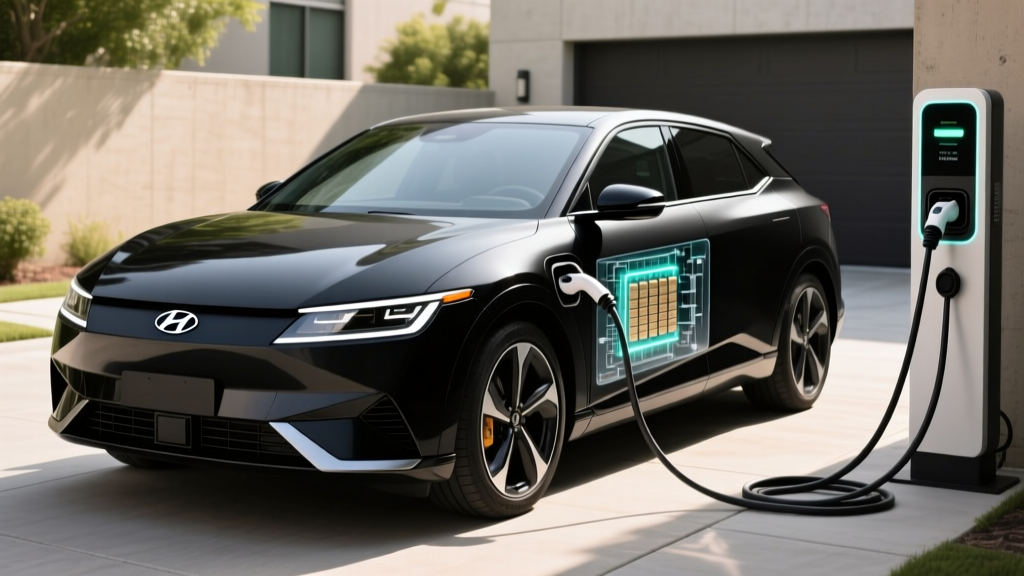
The Hyundai Ioniq 5 in Abyss Black (or Phantom Black, depending on trim) remains one of the most compelling electric crossovers on the market for 2026. It pairs an 800-volt architecture — rare at its price point — with a usable 84 kWh NMC battery, a now-standard NACS charge port, and a crossover footprint that threads the needle between daily commuting and family road trips. The black exterior, paired with Hyundai's pixel-LED lighting and parametric surfacing, gives it a stealth-modern look that photographs well and hides road grime better than the lighter palette options.
But aesthetics aside, the real question is whether the Ioniq 5's EPA range, charging speed, and ownership economics justify its MSRP in a segment now crowded with the Tesla Model Y, Ford Mustang Mach-E, and Kia EV6. This review breaks down the exact numbers.
Range and Efficiency: EPA vs. the Real World
Real-World Expectation: ~260–285 mi on mixed highway driving in moderate temps; ~215–240 mi in sustained sub-30°F winter conditions; expect 270–295 mi in city-dominant commuting with regen.
The rear-wheel-drive Ioniq 5 with the Long Range battery posts an EPA combined 318 miles — a figure that holds up reasonably well in suburban and city driving, where regenerative braking recaptures energy and speeds stay below 65 mph. On a 75-mph highway loop in 65°F weather, expect roughly 270–285 miles before the state-of-charge warning. In freezing temperatures with the cabin heater active, the heat pump (standard on most trims) mitigates some loss, but plan on 215–240 miles realistically.
Efficiency lands at approximately 114 MPGe combined (29 kWh/100 mi) for the RWD model per fueleconomy.gov. The AWD dual-motor variant drops to around 101 MPGe combined (33 kWh/100 mi), trading some range for the traction and 320-horsepower output.
Battery, Chemistry, and Long-Term Degradation
The 2026 Ioniq 5 uses an 84 kWh usable NMC (nickel-manganese-cobalt) lithium-ion battery pack. Hyundai has not adopted LFP chemistry for this model — the trade-off is that NMC delivers higher energy density (critical for fitting 318 miles of range into a midsize crossover footprint) at the cost of slightly faster calendar degradation compared to LFP packs found in base Tesla Model Y trims.
Hyundai's battery warranty covers 10 years or 100,000 miles (whichever comes first) against capacity loss below 70% of original — one of the strongest guarantees in the segment. Real-world data from 2022–2024 Ioniq 5 owners suggests roughly 5–8% degradation over the first 60,000 miles, with the curve flattening afterward. The 800V architecture's thermal management system helps keep cell temperatures in check during repeated DC fast charging, which matters for long-term state-of-health.
| Attribute | RWD (SE/SEL/Limited) | AWD (SEL/Limited) |
|---|---|---|
| EPA Range | 318 mi (SE/SEL); 303 mi (Limited) | 290 mi (Limited) |
| Battery (usable) | 84 kWh, NMC | 84 kWh, NMC |
| Horsepower | 225 hp | 320 hp |
| 0–60 mph | ~7.0 sec | ~4.5 sec |
| Drivetrain | Rear-wheel drive | Dual-motor AWD |
| Max DC Fast Charge | 238 kW (800V) | 238 kW (800V) |
| 10–80% DC Time | ~18 min (peak conditions) | ~18 min (peak conditions) |
| Level 2 Home Charge | 10.9 kW (~36 mi/hr) | 10.9 kW (~36 mi/hr) |
| MPGe (combined) | 114 MPGe (29 kWh/100mi) | 101 MPGe (33 kWh/100mi) |
| Charge Port | NACS (native) | NACS (native) |
| Towing Capacity | 1,650 lbs | 2,300 lbs |
Charging Speed: The 800V Advantage in Practice
The Ioniq 5's 800-volt electrical architecture is its most underappreciated asset. At a 350 kW DC fast charger (such as Electrify America or EVgo's latest stations), the Ioniq 5 peaks at approximately 238 kW and sustains above 180 kW through roughly 55% state-of-charge before tapering. The 10–80% charge takes about 18 minutes under ideal thermal conditions — meaning the battery is preconditioned, either via the car's route-planning system or by driving for 20+ minutes before plugging in.
At a more common 150 kW DC charger, expect 10–80% in roughly 25–28 minutes. The charge curve tapers noticeably above 80%, so unless you need the final 20% for a long leg, unplugging at 80% saves significant time.
| Charge Level | Power | Time (10–80%) | Miles Added per Hour |
|---|---|---|---|
| Level 1 (120V household) | ~1.4 kW | ~72 hours | ~5 mi/hr |
| Level 2 (240V home, 48A) | 10.9 kW | ~7.5 hours | ~36 mi/hr |
| DC Fast (150 kW station) | ~130 kW avg | ~25–28 min | ~520 mi/hr (peak) |
| DC Fast (350 kW station) | ~238 kW peak | ~18 min | ~900 mi/hr (peak) |
For 2026, the Ioniq 5 ships with a native NACS port, meaning direct access to Tesla's Supercharger network (now open to non-Tesla EVs via NACS) without an adapter. This dramatically expands reliable DC fast-charging options for road trips — a major practical advantage over CCS-only vehicles still relying on adapters.
Performance and Driving Dynamics
The RWD Ioniq 5 delivers 225 hp and a 0–60 mph time around 7.0 seconds — adequate for merging and passing, though not thrilling. The AWD dual-motor variant bumps output to 320 hp and 446 lb-ft of torque, dropping the 0–60 to roughly 4.5 seconds. Instant electric torque makes the AWD feel quicker than the number suggests in stoplight-to-stoplight driving.
Ride quality leans comfortable over sporty. The wheelbase stretches 118.1 inches (longer than the Tucson), yielding composed highway manners and a spacious cabin. Steering is light and accurate if not particularly communicative. The one-pedal driving mode (i-Pedal) is well-calibrated, allowing full stops without touching the friction brakes — a feature many EV commuters quickly come to rely on.
Interior, Cargo, and Technology
Inside, the black Ioniq 5's cabin uses a dual 12.3-inch display setup (cluster + infotainment) with Hyundai's latest ccNC software. Wireless Apple CarPlay and Android Auto are standard. The flat floor and sliding center console (on SEL and above) create an airy, lounge-like front row. Physical climate controls persist below the screen — a practical choice that avoids the touchscreen-only frustration plaguing some competitors.
Cargo volume: 27.2 cubic feet behind the rear seats, expanding to 59.3 cu ft with the 60/40 split folded. The front trunk (frunk) adds 0.85 cu ft on RWD models (2.0 cu ft on AWD) — enough for charging cables and a small bag, but not a standout.
Passenger space: 41.7 inches of front legroom and 39.4 inches of rear legroom — competitive with the Model Y and noticeably roomier than the Mach-E in the second row.
On the ADAS front, Hyundai's Highway Driving Assist 2 (HDA2) provides competent SAE Level 2 lane centering and adaptive cruise with stop-and-go. It requires hands-on-wheel supervision at all times and does not autonomously navigate intersections or city streets. The available Remote Smart Parking Assist lets you move the car in and out of tight spaces via the key fob — a useful party trick for narrow garages.
Pricing, Trims, and Federal Tax Credit Eligibility
The 2026 Hyundai Ioniq 5 starts at approximately $42,600 MSRP for the SE Standard Range and climbs to roughly $54,200 for a fully equipped AWD Limited. Abyss Black and Phantom Black are available across all trims at no additional charge (matte finishes, where offered, carry a premium).
| Trim | Drivetrain | Base MSRP | Est. After §30D Credit* |
|---|---|---|---|
| SE Standard Range | RWD | $42,600 | ~$35,100 |
| SE | RWD | $46,650 | ~$39,150 |
| SEL | RWD | $49,650 | ~$42,150 |
| Limited | RWD | $52,200 | ~$44,700 |
| Limited | AWD | $54,200 | ~$46,700 |
*Federal tax credit estimates assume full $7,500 eligibility under IRS §30D. Actual eligibility depends on buyer income caps ($150K single / $300K joint MAGI), vehicle MSRP caps ($80K for SUVs), battery critical-mineral and component sourcing requirements, and manufacturer compliance. The credit may be applied as a point-of-sale reduction at participating dealers. Always verify current-year rules at irs.gov and consult a tax professional.
As of 2026, Hyundai's Georgia-built Ioniq 5 has improved its battery-sourcing compliance compared to early post-IRA years, making more trims eligible for the full or partial credit — but specific eligibility can shift quarterly as supply chains adjust. Confirm with your dealer before signing.
Ownership Costs and Warranty
Hyundai backs the Ioniq 5 with a 5-year/60,000-mile new-vehicle warranty and a 10-year/100,000-mile battery and powertrain warranty — among the most generous in the EV segment and a key differentiator versus Tesla's 4-year/50,000-mile basic and 8-year/120,000-mile battery coverage.
Estimated annual charging costs for 15,000 miles of mixed driving run approximately $550–$750 at national average residential electricity rates (~$0.16/kWh), compared to roughly $1,800–$2,200 for a similarly sized gas crossover at $3.50/gallon. Over five years, the fuel savings alone can offset $5,000–$7,000 of the purchase premium, before factoring in reduced maintenance (no oil changes, fewer brake replacements thanks to regen).
Insurance premiums for the Ioniq 5 average 10–20% higher than a comparable gas Hyundai Tucson, reflecting higher repair costs and EV-specific parts pricing — a factor worth quoting before purchase.
Who the Black Ioniq 5 Suits Best
Choose the Ioniq 5 RWD if: You commute 30–60 miles daily, charge at home overnight, prioritize cabin comfort and tech over sporty driving, and want maximum range per dollar.
Choose the Ioniq 5 AWD if: You face snow or unpaved roads, frequently carry passengers and cargo, or want the 4.5-second 0–60 for highway merging confidence.
Look elsewhere if: You need 350+ miles of EPA range (consider the Ioniq 6 or Lucid Air), require 5,000+ lb towing (look at the F-150 Lightning or Rivian R1S), or want a third row (Kia EV9 or Tesla Model X).
Pros
- 800V architecture enables 18-min 10–80% DC charging at 350 kW stations
- Native NACS port for Tesla Supercharger access without adapter
- Spacious cabin with flat floor and generous rear legroom (39.4 in)
- 10-year/100,000-mile battery warranty
- Physical climate controls alongside touchscreen
- Competitive MSRP with strong §30D tax-credit eligibility potential
Cons
- Frunk is small (0.85–2.0 cu ft) compared to some competitors
- AWD range drops to 290 mi EPA — noticeable on road trips
- ADAS (HDA2) requires hands-on; no hands-free mode like BlueCruise
- Rear wiper omission on earlier builds (verify 2026 includes it)
- Insurance premiums run higher than gas equivalents
Frequently Asked Questions
What is the real-world range of the black Ioniq 5?
The RWD Ioniq 5 posts an EPA 318 miles, but expect 260–285 miles in real-world highway driving and 215–240 miles in freezing weather. City commuting with regenerative braking can push closer to or slightly above the EPA figure.
How fast does the Ioniq 5 charge at home and on the road?
At a 350 kW DC fast charger, the Ioniq 5 peaks at 238 kW and charges 10–80% in approximately 18 minutes. On a home Level 2 charger (10.9 kW / 48A), a full charge takes about 7.5 hours, adding roughly 36 miles of range per hour.
How much does the 2026 Ioniq 5 cost after tax credits?
The base SE Standard Range starts at $42,600 MSRP. With full $7,500 §30D federal tax-credit eligibility, the effective price drops to approximately $35,100. Eligibility depends on income caps, battery sourcing compliance, and MSRP thresholds — verify at irs.gov and with your dealer before purchasing.
Does the black Ioniq 5 qualify for the federal EV tax credit?
As of 2026, many Ioniq 5 trims assembled in Georgia qualify for partial or full §30D credits, but eligibility hinges on battery critical-mineral sourcing, buyer income limits ($150K single / $300K joint), and the $80K SUV MSRP cap. Rules can change quarterly; confirm current status on irs.gov.
Is the Ioniq 5 worth buying over the Tesla Model Y or Kia EV6?
The Ioniq 5 wins on 800V charging speed, cabin space, and warranty length. The Model Y offers a larger Supercharger footprint (though the gap is closing with NACS adoption), slightly more range, and over-the-air updates. The Kia EV6 shares the Ioniq 5's platform but has a sportier design and slightly less cargo room. Test-drive all three — the decision often comes down to ergonomics and software preference.
Is the Ioniq 5 self-driving?
No. Hyundai's Highway Driving Assist 2 is an SAE Level 2 driver-assistance system. It provides lane centering and adaptive cruise but requires the driver to remain engaged, hands on the wheel, and eyes on the road at all times.