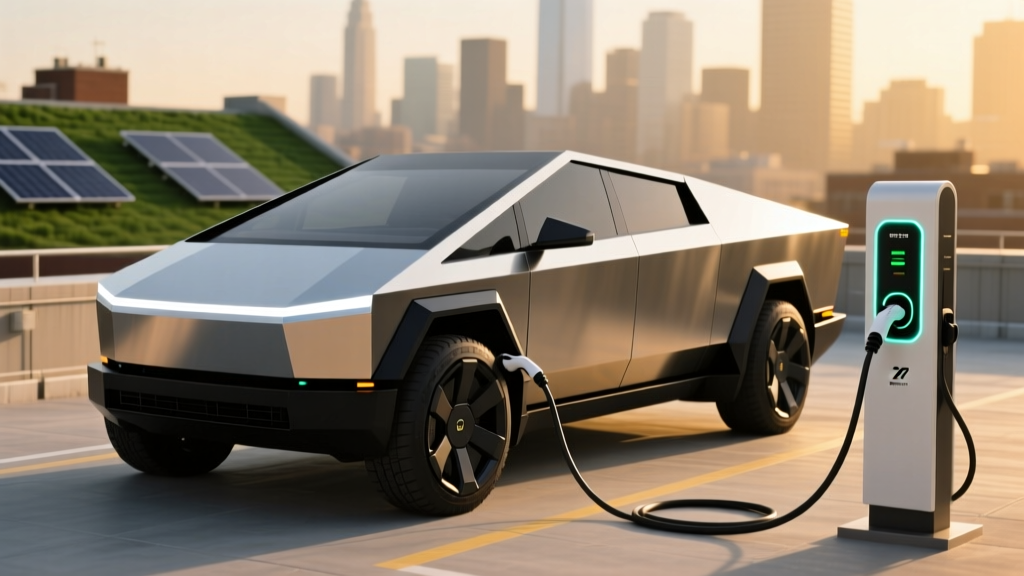
The Tesla Cybertruck in black—officially the Stealth Matte wrap option or the newer factory Satin Black finish—has become the most searched variant of Tesla's polarizing electric pickup. Beyond the aesthetics, buyers searching for a black Cybertruck are really asking the same practical questions: What's the real-world range? How fast does it actually charge? Does it qualify for the federal tax credit in 2026? We've spent time with the dual-motor AWD and tri-motor Cyberbeast configurations to give you exact numbers, not marketing fluff.
Black Cybertruck 2026: Quick Specs at a Glance
| Spec | Dual Motor AWD | Cyberbeast (Tri-Motor) |
|---|---|---|
| EPA Range | 340 miles | 320 miles |
| Battery (usable) | ~123 kWh (NMC) | ~123 kWh (NMC) |
| Peak DC Fast Charge | ~250 kW | ~250 kW |
| 10–80% DCFC Time | ~28 min | ~28 min |
| Level 2 Home Rate | 11.5 kW (~37 mi/hr) | 11.5 kW (~37 mi/hr) |
| 0–60 mph | 3.9 sec | 2.6 sec |
| Horsepower | 600 hp | 845 hp |
| Drivetrain | Dual Motor AWD | Tri-Motor AWD |
| Towing Capacity | 11,000 lbs | 11,000 lbs |
| Base MSRP | $79,990 | $99,990 |
| Efficiency | 2.0 kWh/mi (50 MPGe) | 2.1 kWh/mi (48 MPGe) |
| Battery Warranty | 8 yr / 120,000 mi | 8 yr / 120,000 mi |
Real-World Range: What the EPA Sticker Doesn't Tell You
The EPA rates the Dual Motor AWD Cybertruck at 340 miles and the Cyberbeast at 320 miles. But as with every EV, the sticker number assumes a mixed drive cycle under ideal conditions.
EPA Sticker: 340 mi (AWD) / 320 mi (Cyberbeast)
Highway (70–80 mph, 75°F): ~270–290 mi
Cold Weather (30°F, highway): ~220–245 mi
Towing (5,000 lb trailer, flat): ~150–170 mi
The Cybertruck's stainless-steel exoskeleton and blunt front fascia create a higher drag coefficient than a sleek sedan, and that aerodynamic penalty compounds at highway speeds. Expect to lose roughly 15–20% below the EPA figure during sustained 75 mph interstate driving. In cold weather, the battery's internal resistance increases and cabin heating draws additional energy—plan for a 30–35% reduction if you're driving through a Midwest or Northeast winter.
Towing is where range evaporates fastest. Pulling even a modest 5,000-pound trailer cuts your effective range nearly in half. If your use case involves frequent towing over 200 miles between charging stops, the Cybertruck requires careful route planning around DC fast chargers.
Charging Speed: 800V Architecture in Practice
The Cybertruck uses an 800-volt battery architecture and supports peak DC fast-charging rates of approximately 250 kW at Tesla Superchargers. That peak rate is not sustained across the entire session—here's what the charge curve actually looks like:
| State of Charge | Sustained Rate | Approx. Miles Added |
|---|---|---|
| 10–30% | ~240–250 kW | ~130 miles in ~10 min |
| 30–60% | ~175–200 kW | ~100 miles in ~12 min |
| 60–80% | ~100–130 kW | ~60 miles in ~10 min |
| 80–100% | ~30–50 kW | Significant taper; avoid on road trips |
The 10–80% session takes roughly 28 minutes at a V3 or V4 Supercharger. That's competitive with the Rivian R1T but slower than the Hyundai Ioniq 5's 18-minute 10–80% time, thanks to the Cybertruck's massive 123 kWh battery. More energy to push means more time at the charger, even at high kW rates.
At home on a Level 2 Wall Connector (48 amps / 11.5 kW), expect to add about 37 miles of range per hour of charging. A full overnight session (10 hours) replenishes roughly 370 miles—more than enough to top off daily. If your home electrical panel is limited to a 40-amp circuit (common in older homes), you'll see closer to 28–30 mi/hr.
Preconditioning tip: Navigate to a Supercharger using the Cybertruck's built-in navigation, and the battery thermal management system will preheat or precool the pack for optimal charge acceptance. Skipping this step in cold weather can add 5–10 minutes to your charging session.
Performance and Drivetrain: Cyberbeast vs. Dual Motor
The dual-motor AWD Cybertruck produces 600 horsepower and hits 0–60 mph in 3.9 seconds—remarkable for a 6,800-pound stainless-steel truck. The tri-motor Cyberbeast pushes that to 845 hp and a 2.6-second 0–60, placing it in supercar territory.
Both configurations feature torque vectoring, adaptive air suspension (with up to 16 inches of ground clearance in Extract mode), and four-wheel steer. The rear-wheel steering system gives the 20-foot-long truck a surprisingly tight turning radius—comparable to a mid-size sedan in parking scenarios.
For daily driving, the Dual Motor AWD is the rational pick. The Cyberbeast's extra motor adds weight, reduces range by 20 EPA miles, and costs $20,000 more. Unless you're regularly launching at drag strips or need the marginally quicker tow-vehicle acceleration, the AWD delivers 95% of the experience at a lower price.
Pricing, Trims, and Federal Tax Credit Eligibility
| Trim | Base MSRP | Est. After §30D Credit | Black Wrap/Finish Add |
|---|---|---|---|
| Dual Motor AWD | $79,990 | $72,490* | +$3,000 (Stealth Matte wrap) |
| Cyberbeast (Tri-Motor) | $99,990 | $92,490* | +$3,000 (Stealth Matte wrap) |
*Tax credit estimates assume full eligibility. See below for requirements.
The factory Satin Black wrap (sometimes called Stealth Matte) adds approximately $3,000 to the build. Aftermarket PPF (paint protection film) in gloss or matte black from shops like XPEL or Stek typically runs $5,000–$8,000 for full coverage—pricier but offers superior stone-chip protection on the stainless panels' edges and the composite bed.
Does the Black Cybertruck Qualify for the $7,500 Federal Tax Credit?
The Cybertruck is classified as a pickup truck under IRS §30D rules, which means the MSRP cap is $80,000 for vans/SUVs/pickups. Here's where it gets tight:
- Dual Motor AWD ($79,990): Falls under the $80,000 truck cap—eligible for the credit (before options push it over).
- Cyberbeast ($99,990): Exceeds the $80,000 cap—not eligible for the federal credit.
Even for the AWD trim, eligibility depends on additional requirements per IRS §30D guidelines:
- Buyer income caps: Modified AGI ≤ $300,000 (joint), ≤ $225,000 (head of household), ≤ $150,000 (single)
- Battery sourcing: Critical minerals and battery components must meet phased-in percentages from US or FTA-partner countries (thresholds increase annually through 2029)
- Point-of-sale transfer: You can apply the $7,500 credit at the dealer as a down payment reduction, or claim it on your tax return
- Final assembly: Must be assembled in North America (Cybertruck is built in Austin, TX—qualifies)
Critical caveat: Adding the $3,000 black wrap, FSD, or other options to the AWD trim can push the total MSRP above $80,000, potentially disqualifying it. Confirm the final vehicle MSRP (including factory options, excluding destination) with Tesla before purchase. Tax rules change—consult a tax professional and the IRS for your specific situation.
Cargo, Interior Space, and Practicality
The Cybertruck's 6-foot composite bed offers approximately 67 cubic feet of cargo volume with the tonneau cover closed. The powered retractable cover is a standout feature—it seals the bed from weather and reduces drag, but it limits vertical cargo height to roughly 28 inches unless partially opened.
| Dimension | Measurement |
|---|---|
| Bed Length | 72 inches (6 ft) |
| Bed Width (between wheel wells) | ~48 inches |
| Bed Volume (cover closed) | ~67 cu ft |
| Front Trunk (Frunk) | ~7 cu ft (lockable) |
| Front Legroom | 41.3 inches |
| Rear Legroom | 34.8 inches |
| Seating Capacity | 5 passengers (2+3 bench) |
Interior space is adequate but not class-leading. The rear seat offers 34.8 inches of legroom—tighter than the Ford F-150 Lightning (39.1 in) and Rivian R1T (36.6 in). The fixed panoramic glass roof creates an airy cabin but offers no shade option; in hot climates, the solar heat gain is noticeable even with Tesla's IR-reflective glass treatment.
The frunk (front trunk) provides about 7 cubic feet of lockable storage—useful for groceries or charging cables. However, it's smaller than the Lightning's massive "Mega Power Frunk," which offers 14.1 cubic feet with a drain plug.
Tech, Driver Assistance, and Standout Features
The Cybertruck's cabin is dominated by an 18.5-inch center touchscreen and a secondary 9.4-inch rear passenger display. The yoke-style steering wheel (standard, with a round wheel available as a no-cost option) takes about a week of daily driving to adapt to—especially during three-point turns and parking maneuvers where you instinctively reach for a 10-and-2 hand position that doesn't exist.
Autopilot and FSD (Supervised)
Tesla's Autopilot and Full Self-Driving (Supervised) are Level 2 driver-assistance systems per SAE classification. The driver must remain fully engaged, hands on the yoke/wheel, and eyes on the road at all times. The system does NOT make the Cybertruck autonomous. Only Level 4 services like Waymo operate without a human driver in geofenced areas.
FSD (Supervised) adds $8,000 to the purchase price (or $99/month subscription as of 2026). It handles highway lane changes, navigation-based exits, and city-street traffic-light recognition—but requires constant supervision. We found it reliable on well-marked interstates but occasionally hesitant at complex unprotected left turns and construction zones.
Unique Cybertruck Features
- Powershare (V2L/V2H): Up to 11.5 kW of bidirectional power output—enough to run power tools at a job site, charge another EV, or back-feed essential home circuits during an outage (with a Tesla Powerwall-compatible transfer switch).
- Armor Glass: Ultra-hardened laminated glass that resists impacts better than standard automotive glass. We've seen it survive baseball-sized hail without cracking.
- Air Suspension: Adjustable ride height from 9 to 16 inches of ground clearance, with auto-leveling under load.
- Bioweapon Defense Mode: HEPA-grade cabin air filtration with positive pressure.
Notable Drawbacks
- Visibility: The thick A-pillars, small rear window, and sloped bed cover create significant blind spots. The digital rearview mirror (fed by a tailgate camera) helps but takes getting used to.
- Ride quality: The stainless-steel body and solid rear axle (with air springs) can transmit more road imperfections than independent-rear-suspension competitors like the R1T.
- No Apple CarPlay or Android Auto: Tesla's proprietary infotainment only. If you rely on CarPlay for navigation or music, this is a dealbreaker.
- Insurance costs: Cybertruck insurance premiums run 30–50% higher than comparable F-150 Lightning policies, according to industry averages, due to repair costs for the stainless panels and specialized glass.
Who Should Buy the Black Cybertruck?
- Tech-forward truck buyers who want a statement vehicle with genuine utility
- Owners who value V2L/V2H capability for job sites or emergency backup power
- Tesla ecosystem loyalists already using Superchargers, Powerwall, and solar
- Daily commuters with home Level 2 charging (the ~270 mi highway range covers most round-trip commutes)
- You need maximum rear-seat space for tall passengers or car seats (Rivian R1T is roomier)
- You tow heavy loads over 200+ miles frequently (F-150 Lightning's larger battery option or a diesel may be more practical)
- You depend on Apple CarPlay/Android Auto
- You live in an area with sparse Supercharger coverage and no CCS adapter access
Black Cybertruck vs. Key Competitors
| Cybertruck AWD | Rivian R1T Dual-Motor | Ford F-150 Lightning Ext. Range | |
|---|---|---|---|
| EPA Range | 340 mi | 352 mi | 320 mi |
| Base MSRP | $79,990 | $75,900 | $73,990 |
| 0–60 mph | 3.9 sec | 4.5 sec | 4.0 sec |
| Max Towing | 11,000 lbs | 11,000 lbs | 10,000 lbs |
| Bed Length | 6 ft | 4.5 ft (+ Gear Tunnel) | 5.5 ft |
| Rear Legroom | 34.8 in | 36.6 in | 39.1 in |
| NACS Native | Yes | Yes (2025+) | No (CCS; adapter avail.) |
| §30D Credit Eligible | AWD only (under $80K cap) | Yes (qualifies) | Yes (qualifies) |
The R1T offers a more refined ride, better rear-seat space, and the innovative Gear Tunnel for enclosed storage. The Lightning wins on interior familiarity (it drives like a conventional F-150) and rear-seat comfort. The Cybertruck counters with the most distinctive design, native Supercharger access, V2H capability, and the fastest straight-line acceleration in the segment.
Pros and Cons
- 340-mile EPA range (AWD) is class-competitive
- 250 kW DC fast charging with 10–80% in ~28 min
- 11.5 kW V2L/V2H Powershare capability
- Native Tesla Supercharger network access
- Stainless exoskeleton resists dents and corrosion
- AWD trim eligible for §30D credit (if under $80K MSRP)
- Cyberbeast exceeds $80K cap—no federal credit
- Rear seat legroom (34.8 in) is the tightest in class
- Highway range drops ~15–20% below EPA at 75+ mph
- No Apple CarPlay / Android Auto
- Insurance premiums significantly above segment average
- Visibility challenges; reliance on camera-based mirrors
Frequently Asked Questions
What is the real-world range of the black Cybertruck?
The EPA rates the Dual Motor AWD at 340 miles and the Cyberbeast at 320 miles. In real-world highway driving at 70–80 mph, expect roughly 270–290 miles. In cold weather (below 35°F), plan for 220–245 miles. Towing a 5,000-pound trailer drops effective range to approximately 150–170 miles.
How fast does the Cybertruck charge at home and on the road?
On a DC fast charger, the Cybertruck peaks at ~250 kW and charges from 10–80% in about 28 minutes. At home on a Level 2 Wall Connector (11.5 kW), it adds approximately 37 miles of range per hour. A full overnight charge takes about 10–11 hours.
How much does a black Cybertruck cost after tax credits?
The Dual Motor AWD starts at $79,990. With the $3,000 black wrap, it reaches $82,990—potentially exceeding the $80,000 MSRP cap for the §30D credit. If configured at or below $80,000 (before dealer-installed wraps), eligible buyers can receive up to $7,500, bringing the net price to ~$72,490. The Cyberbeast at $99,990 does not qualify for the federal credit. Always verify final MSRP and consult a tax professional.
Does the black Cybertruck qualify for the federal EV tax credit?
The Dual Motor AWD can qualify if the final MSRP (including factory options, excluding destination) stays at or below $80,000 and the buyer meets income caps ($300K joint / $150K single). The Cyberbeast does not qualify due to its $99,990 MSRP. Battery-sourcing and final-assembly requirements must also be met. See IRS §30D guidelines for current-year rules.
Is the Cybertruck worth buying vs. the Rivian R1T or F-150 Lightning?
Choose the Cybertruck if you prioritize Supercharger access, V2H power capability, distinctive design, and Tesla's software ecosystem. Choose the R1T for better rear-seat space, a more refined ride, and the Gear Tunnel. Choose the Lightning for a conventional truck experience, the largest frunk, and the most rear legroom. All three are capable electric trucks—the best choice depends on your specific use case.
Does the black wrap affect range or charging?
No. The Stealth Matte or aftermarket PPF black wrap is a cosmetic film applied over the stainless-steel panels. It has no measurable effect on aerodynamics, range, or charging speed. However, dark-colored wraps can increase cabin heat soak in direct sunlight—plan for slightly more A/C energy draw in hot climates.
What is the Cybertruck's battery warranty?
Tesla covers the battery and drive units for 8 years or 120,000 miles (whichever comes first), with a minimum 70% capacity retention guarantee. The 123 kWh NMC battery pack has demonstrated strong longevity in Tesla's other large-pack vehicles, with typical degradation of 8–12% over the first 100,000 miles based on fleet data.