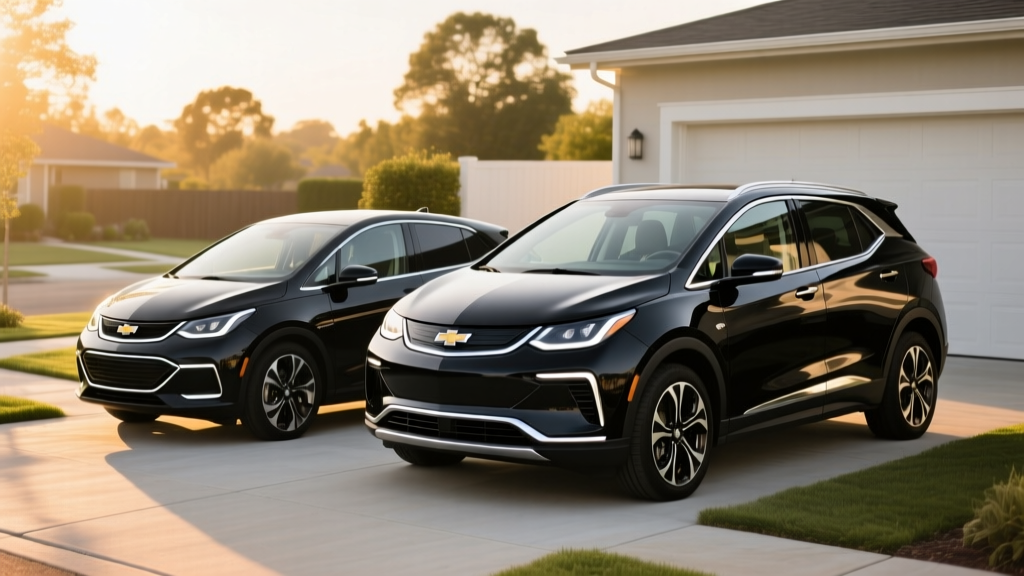
The Chevy Bolt has long been the budget-conscious buyer's gateway into electric vehicles, and the 2026 model year sharpens that value proposition further. Whether you're eyeing a Midnight Black Metallic Bolt EV hatchback or the slightly roomier Bolt EUV crossover, this is a platform that prioritizes everyday usability over headline-grabbing performance. After spending time with both body styles, we've compiled the exact numbers, real-world observations, and ownership math you need before signing a purchase agreement.
2026 Chevy Bolt EV and EUV: Quick Verdict
The 2026 Bolt EV delivers 259 miles of EPA-estimated range from a 65 kWh (usable) lithium iron phosphate (LFP) battery, while the longer-wheelbase Bolt EUV returns 247 miles. Both use a single front-mounted motor producing 200 horsepower and 266 lb-ft of torque. DC fast charging peaks at 115 kW — adequate but not class-leading. With a starting MSRP around $26,990 for the EV and $28,990 for the EUV, and potential eligibility for the full $7,500 federal tax credit under IRS §30D, the Bolt remains one of the cheapest new EVs you can buy in America.
For buyers searching for a black Chevy Bolt specifically, the Midnight Black Metallic and Black Granite Metallic paint options are available across all trims. The darker aesthetic pairs well with the available black roof delete on the EUV Premier, giving it a stealthy, monochromatic look that hides road grime better than lighter finishes.
Range, Battery, and Real-World Efficiency
| Specification | Bolt EV (Hatchback) | Bolt EUV (Crossover) |
|---|---|---|
| EPA Estimated Range | 259 miles | 247 miles |
| Battery Capacity (Usable) | 65 kWh | 65 kWh |
| Battery Chemistry | LFP (Lithium Iron Phosphate) | LFP (Lithium Iron Phosphate) |
| Combined MPGe | 120 MPGe | 115 MPGe |
| Energy Consumption | 28 kWh/100 mi | 29 kWh/100 mi |
| Drivetrain | FWD, Single Motor | FWD, Single Motor |
| Horsepower | 200 hp | 200 hp |
| Torque | 266 lb-ft | 266 lb-ft |
| 0–60 mph | 6.5 seconds | 6.8 seconds |
| Battery Warranty | 8 years / 100,000 miles | 8 years / 100,000 miles |
Real-World Range Expectations
EPA Sticker: 259 miles (EV) / 247 miles (EUV)
Highway (70–75 mph): Expect 215–235 miles. The Bolt's boxy shape and lack of a heat pump on base trims reduce highway efficiency noticeably.
City / Mixed Driving: 250–270 miles is achievable. Regenerative braking in stop-and-go traffic helps recoup energy, and the LFP pack handles frequent partial charges well.
Cold Weather (below 32°F): Plan for 185–210 miles. LFP batteries are more susceptible to cold-weather range loss than NMC chemistries — preconditioning while plugged in is essential to mitigate this.
Bottom Line: The 259-mile EPA figure is realistic for mild-weather city and suburban driving. Road trippers and cold-climate owners should budget 15–25% off the sticker.
The switch to LFP chemistry for the 2026 model year is a significant move. LFP batteries trade some energy density for longevity — they tolerate daily charging to 100% better than NMC packs, meaning Chevy recommends you can charge to full regularly without accelerating degradation. For commuters who plug in nightly, this is a genuine advantage. The trade-off is that LFP cells are heavier and less energy-dense, which partly explains why the Bolt's range didn't jump further despite the platform redesign.
According to fueleconomy.gov, the Bolt EV's combined 120 MPGe places it competitively against the Hyundai Kona Electric (129 MPGe) and well ahead of most electric crossovers in the $30,000–$40,000 bracket.
Charging Speed: DC Fast, Level 2, and Level 1
Charging speed remains the Bolt's most debated spec. The 2026 model retains a peak DC fast-charge rate of 115 kW via its CCS1 connector (with NACS adapter compatibility for Tesla Supercharger access). Here's what that translates to in practice:
| Charging Level | Power / Rate | Speed (Miles Added) | Notes |
|---|---|---|---|
| Level 1 (120V household) | ~1.4 kW | ~4 miles per hour | Emergency / overnight trickle only |
| Level 2 (240V home, 32A) | 7.7 kW | ~25 miles per hour | Full charge in ~8.5 hours |
| Level 2 (240V, 48A capable) | 11.5 kW (vehicle-limited) | ~37 miles per hour | 0–100% in ~6 hours |
| DC Fast Charge (CCS1) | 115 kW peak | 10–80% in ~30 minutes | Tapers significantly above 80%; adds ~150 mi in 30 min |
The 10–80% DC fast-charge time of approximately 30 minutes is functional for road trips but trails competitors like the Hyundai Ioniq 5 (18 minutes at 240 kW) or even the newer Chevrolet Equinox EV. The charge curve tapers hard above 80% — plan to unplug at 80% on road trips to avoid painfully slow top-offs.
For home charging, the onboard charger accepts up to 11.5 kW on Level 2, which means a 48-amp hardwired wall connector will fill the 65 kWh battery from empty in roughly 6 hours. Most owners installing a 32-amp circuit (the most common residential setup) will see a full overnight charge in about 8.5 hours — perfectly adequate for daily use. If you're installing a Level 2 home charger, budget $500–$1,500 for equipment and electrician labor, depending on whether your panel needs an upgrade.
Pricing, Trims, and Federal Tax Credit Eligibility
The 2026 Chevy Bolt EV and EUV are offered in two trims each: LT and Premier. Here's the current pricing breakdown:
| Model / Trim | Base MSRP | Est. Federal Credit | Effective Price |
|---|---|---|---|
| Bolt EV LT | $26,990 | Up to $7,500 | ~$19,490 |
| Bolt EV Premier | $30,990 | Up to $7,500 | ~$23,490 |
| Bolt EUV LT | $28,990 | Up to $7,500 | ~$21,490 |
| Bolt EUV Premier | $33,490 | Up to $7,500 | ~$25,990 |
Tax credit eligibility requires meeting several conditions under IRS §30D:
- Buyer income caps: Modified AGI must not exceed $150,000 (single), $225,000 (head of household), or $300,000 (married filing jointly).
- MSRP cap: The vehicle's MSRP must not exceed $55,000 for cars (hatchbacks) — all Bolt trims clear this easily.
- Battery sourcing: A percentage of critical minerals and battery components must be sourced from the U.S. or free-trade-agreement countries. GM has worked to qualify the Bolt's LFP supply chain, but verify current-year compliance on fueleconomy.gov before purchasing.
- Point-of-sale transfer: As of 2024, buyers can transfer the credit to the dealer at purchase, reducing the out-of-pocket price immediately rather than waiting for a tax refund.
Always confirm eligibility with your tax professional and check the latest IRS guidance at irs.gov, as battery-sourcing rules tighten annually and can affect whether a specific build qualifies for the full $7,500 or a partial $3,750.
Interior, Cargo Space, and Technology
The Bolt EV hatchback offers 16.3 cubic feet of cargo space behind the rear seats, expanding to 57.0 cu ft with the 60/40 split rear seats folded. The Bolt EUV provides 16.3 cu ft behind the second row and 54.5 cu ft total — slightly less overall due to the crossover's roofline taper, though rear legroom improves to 39.1 inches (vs. 36.0 inches in the EV).
Front legroom is a generous 42.1 inches in both models. For a subcompact EV, the cabin feels airy, especially in the EUV with its available panoramic sunroof. The black interior with ebony leatherette on Premier trims complements the black exterior paint options well, and the darker cabin hides wear better over high-mileage ownership.
Infotainment and tech highlights:
- 11.0-inch diagonal touchscreen with wireless Apple CarPlay and Android Auto
- 8.0-inch digital driver information cluster
- Available Super Cruise hands-free driving on compatible divided highways (EUV Premier option)
- Wireless phone charging pad (Premier standard)
- Wi-Fi hotspot capability via OnStar
Driver assistance (Chevy Safety Assist, standard on all trims):
- Automatic Emergency Braking with Front Pedestrian Braking
- Lane Keep Assist with Lane Departure Warning
- Following Distance Indicator
- IntelliBeam automatic high beams
- Adaptive Cruise Control (available on LT, standard on Premier)
Super Cruise: SAE Level 2 — Not Self-Driving
When equipped, Super Cruise allows hands-free driving on over 750,000 miles of compatible divided highways in the U.S. and Canada. However, this is an SAE Level 2 system: the driver must remain attentive, and the cabin camera monitors eye gaze. If you look away or become unresponsive, the system will escalate alerts and eventually bring the vehicle to a stop. This is not autonomous driving (Level 4) — you are still the driver.
Pros, Cons, and Who the Bolt Is For
Pros
- Lowest MSRP in the new EV market — under $27,000 before incentives
- LFP battery chemistry supports daily 100% charging with minimal degradation
- 259-mile EPA range is ample for most commutes and errands
- Strong 8-year/100,000-mile battery and powertrain warranty
- Spacious interior for a subcompact, especially rear-seat legroom in EUV
- Eligible for full $7,500 federal tax credit (verify sourcing compliance)
- Super Cruise availability on EUV Premier is rare at this price point
Cons
- DC fast charging peaks at only 115 kW — 30-minute 10–80% time trails rivals
- No heat pump on base LT trim reduces cold-weather efficiency
- LFP battery loses more range in freezing temperatures vs. NMC packs
- FWD-only — no AWD option for snow-belt buyers
- No frunk (front trunk) — all cargo is rear-hatch only
- Road-trip charging stops take longer than competitors at 350-kW stations
Who Should Buy the Black Chevy Bolt?
Choose the Bolt EV if: You're a commuter driving under 60 miles daily, you have access to Level 2 home charging, and you want the lowest-cost entry into a new EV with strong range. The black hatchback's understated look and low running costs make it an excellent urban and suburban daily driver.
Choose the Bolt EUV if: You need more rear-seat legroom for car seats or taller passengers, you want the available Super Cruise for highway commutes, and you don't mind sacrificing 12 miles of EPA range for the crossover form factor.
Look elsewhere if: You regularly road-trip more than 300 miles in a day (the 115 kW charge speed adds time), you need AWD for harsh winters, or you want the latest 800V charging architecture found in Hyundai/Kia/Genesis EVs.
How the Bolt Compares to Key Competitors
At this price point, the Bolt's closest rivals include the Hyundai Kona Electric (261 miles EPA, $32,975), the Nissan Leaf (up to 212 miles, from ~$28,140), and the Chevrolet Equinox EV (319 miles, from ~$33,600). The Bolt undercuts all three on price, though the Kona Electric charges faster (100 kW but with a smaller battery, achieving 10–80% in ~26 minutes) and the Equinox EV offers meaningfully more range and a more modern platform.
Against the used-EV market, a black Chevy Bolt from 2023–2025 can be found for $18,000–$23,000 and may qualify for the $4,000 used-EV credit (subject to income caps and dealer requirements). However, older Bolts used NMC batteries with different charging and care profiles, and the 2026 LFP pack represents a meaningful longevity upgrade.
Frequently Asked Questions
What is the real-world range of the 2026 black Chevy Bolt?
In mild weather with mixed city and suburban driving, expect 245–265 miles from the Bolt EV and 235–250 miles from the EUV. Highway driving at 75 mph drops this to roughly 215–235 miles, and freezing temperatures can reduce range to 185–210 miles. Preconditioning the battery while plugged in helps recover some cold-weather loss.
How fast does the Chevy Bolt charge at home and on DC fast chargers?
On a Level 2 home charger (240V, 48A), the Bolt charges at up to 11.5 kW, adding about 37 miles of range per hour and reaching a full charge in roughly 6 hours. On a DC fast charger, it peaks at 115 kW and charges from 10% to 80% in approximately 30 minutes. Charging slows substantially above 80% SoC — always plan to unplug at 80% during road trips.
How much does the 2026 Chevy Bolt cost after the federal tax credit?
The Bolt EV LT starts at $26,990 MSRP and could cost as little as $19,490 after the full $7,500 federal tax credit, assuming you meet all IRS §30D requirements (income caps, battery sourcing, MSRP cap). The EUV LT starts at $28,990, or approximately $21,490 after the credit. Confirm eligibility with your tax professional before relying on the credit.
Does the black Chevy Bolt qualify for the federal EV tax credit?
The Bolt EV and EUV are designed to qualify for up to $7,500 under IRS §30D, but eligibility depends on your income (under $150K single / $300K joint), the vehicle's battery sourcing compliance for the current year, and the MSRP cap (all Bolt trims clear the $55,000 car cap). Check fueleconomy.gov for the latest qualifying list and consult a tax professional.
Is the Chevy Bolt worth buying versus the Hyundai Kona Electric or Equinox EV?
If budget is the primary driver, the Bolt wins decisively — it's $5,000–$7,000 cheaper than the Kona Electric and Equinox EV before incentives, and the 259-mile range covers most daily needs. If you prioritize faster DC charging or longer road-trip range, the Equinox EV (319 miles, faster charging) or Kona Electric are worth the premium. For pure value-per-mile of range, the Bolt is hard to beat.
Does the Bolt's LFP battery need special care?
LFP batteries actually benefit from being charged to 100% periodically — Chevy recommends regular full charges to help the battery management system calibrate cell balancing. Unlike NMC packs, you don't need to baby an LFP battery by capping charges at 80%. The main care tip is to precondition in cold weather and avoid leaving the car at very low SoC (below 10%) for extended periods.