Quick Verdict: The Black Cadillac Lyriq in 2026
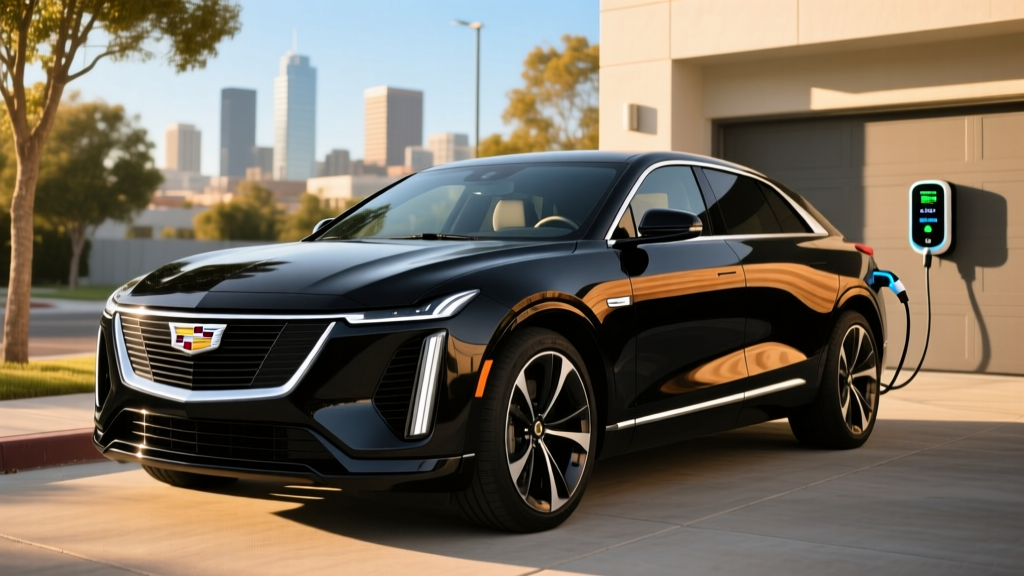
The 2026 Cadillac Lyriq remains General Motors' flagship luxury electric crossover, and in black — specifically the Celestial Black Metallic or Black Raven tricoat finishes — it projects the quiet authority that luxury EV buyers crave. Underneath the monochromatic elegance sits GM's Ultium platform with a 102 kWh usable battery, up to 314 miles of EPA-estimated range, and a premium cabin that rivals the BMW iX and Genesis Electrified GV70 on fit and finish. For 2026, the Lyriq carries over largely unchanged from the refreshed 2025 model year, retaining the 33-inch LED advanced display, available Super Cruise hands-free driving, and the 190 kW peak DC fast-charge capability that defines its road-trip manners.
This review covers every number that matters: real-world range expectations, charging-curve behavior, trim pricing, federal tax credit eligibility under current IRS §30D rules, and where the Lyriq wins or loses against its closest competitors.
Range, Efficiency, and the Real-World Reality
- EPA Estimated: 314 miles (RWD Luxury/ Sport) | 307 miles (AWD Sport)
- Real-World Highway (70-75 mph, moderate temps): ~255–275 miles
- Real-World Cold Weather (below 32°F, mixed driving): ~210–240 miles
- City / Commuter Driving: ~290–310 miles (regen-heavy routes approach EPA sticker)
The Lyriq's 102 kWh usable Ultium battery pack uses NMC (nickel manganese cobalt) chemistry, which prioritizes energy density over the extreme cycle life of LFP cells found in some competitors. That translates to strong range in a physically large vehicle, but it also means you should expect typical lithium-ion degradation behavior — roughly 8–12% capacity loss over 8 years based on GM's own warranty threshold and industry-wide NMC aging data.
Efficiency lands at 89 MPGe combined for the RWD model, or roughly 38 kWh per 100 miles according to fueleconomy.gov. That's competitive with the BMW iX xDrive50 but trails the more aerodynamic Tesla Model X. On the highway at sustained 75 mph speeds, expect efficiency to drop to approximately 42–45 kWh/100mi, which is where the real-world range gap opens up.
Charging Speed: DC Fast, Level 2, and the Curve
| Charging Level | Power / Rate | Speed (Miles Added) | Notes |
|---|---|---|---|
| Level 1 (120V household) | 1.4 kW | ~4 miles per hour | Emergency/trickle only — ~75+ hours for full charge |
| Level 2 (240V home, 48A) | 11.5 kW (onboard charger max) | ~34 miles per hour | Full charge in ~9.5 hours; ideal overnight setup |
| DC Fast Charge (peak) | 190 kW | ~190 miles in 30 min (10-80%) | Peak rate only sustained to ~40% SoC; tapers significantly above 80% |
| DC Fast Charge (10-80%) | ~130 kW avg | 10–80% in ~33 minutes | Real-world average accounting for charge-curve taper |
The Lyriq's 190 kW peak DC fast-charge rate is respectable but no longer class-leading. The Hyundai Ioniq 5 peaks at 240 kW, and the Porsche Macan Electric hits 270 kW on 800V architecture. Where the Lyriq holds its ground is in the 10–80% window: GM's thermal management system keeps the battery in its optimal temperature range, so the charge curve is relatively flat through 55–60% State of Charge before tapering begins. Expect roughly 33 minutes from 10–80% at a functioning 200+ kW Electrify America or EVgo station.
Above 80%, the charge rate drops sharply to protect the NMC cells — typical for this chemistry. Plan your road trips to charge from 10–80% and skip the last 20% unless you're at your final destination. The Lyriq comes with a CCS1 connector in North America; GM has announced NACS (Tesla-style) adapter support, and 2026 models can access the Tesla Supercharger network using the provided adapter.
For home charging, the Lyriq's 11.5 kW onboard charger is a strong point. With a properly installed 48-amp Level 2 wall connector on a 60-amp dedicated circuit, you'll add roughly 34 miles of range per hour — enough to fully replenish overnight. Installation costs typically range from $800–$2,200 depending on panel capacity and run length; if your home has a 200-amp panel with available headroom, expect the lower end of that range.
Performance and Drivetrain
| Specification | RWD Luxury / Sport | AWD Sport |
|---|---|---|
| Horsepower | 340 hp | 500 hp |
| Torque | 325 lb-ft | 450 lb-ft |
| 0–60 mph | 6.0 seconds | 4.6 seconds |
| Drivetrain | Rear-Wheel Drive (single motor) | Dual-Motor AWD |
| EPA Range | 314 miles | 307 miles |
| Curb Weight | ~5,660 lbs | ~5,785 lbs |
| Towing Capacity | 1,500 lbs | 1,500 lbs |
The RWD Lyriq delivers 340 horsepower and a 6.0-second 0–60 time — adequate for a luxury cruiser but noticeably relaxed compared to the Tesla Model X Plaid or even the BMW iX M60. The AWD Sport model's 500 hp and 4.6-second sprint is where the Lyriq starts to feel properly quick, with the instant torque of dual electric motors delivering confident highway merging and passing.
Ride quality is a genuine strength. The Lyriq's five-link rear suspension and passive damping (adaptive dampers are not available) deliver a composed, isolation-focused ride that prioritizes comfort over sportiness. Steering is light and precise but not communicative — this is a grand touring EV, not a track car. Regenerative braking offers multiple levels through paddle-selectable regen and a one-pedal driving mode that can bring the Lyriq to a complete stop without touching the brake pedal.
Interior, Tech, and the 33-Inch Display
The Lyriq's cabin is its strongest selling point against similarly priced competitors. The centerpiece is a 33-inch LED advanced display that spans the driver's instrument cluster and infotainment touchscreen in a single curved panel. Resolution is sharp, the Google Built-In operating system supports native Google Maps navigation, Google Assistant voice commands, and Play Store apps — all without requiring a phone connection.
Material quality is genuinely premium: open-pore wood, laser-etched door panels, and available Nappa leather with perforated inserts. The black-on-black interior (Jet Black with Santorini Blue accents) pairs exceptionally well with the exterior black paint options.
Cargo and passenger dimensions:
- Cargo volume behind rear seats: 28.0 cu ft
- Cargo volume with rear seats folded: 60.9 cu ft
- Front headroom: 38.6 in | Rear headroom: 37.7 in
- Front legroom: 44.3 in | Rear legroom: 39.6 in
- No front trunk (frunk) — the Ultium platform packaging does not include one
The lack of a frunk is a notable omission at this price point; the BMW iX and Rivian R1S both offer front storage. Rear-seat space is generous for two adults but the center position is best suited for children due to the transmission tunnel hump (a packaging artifact of the Ultium platform's battery tray).
Driver Assistance: Super Cruise and Safety
Cadillac's Super Cruise is a Level 2 driver-assistance system. Despite hands-free operation on mapped highways, the driver must remain attentive at all times. A driver-monitoring camera tracks eye and head position and will issue escalating warnings — then disengage — if attention lapses. This is not autonomous driving.
Super Cruise remains one of the most polished Level 2 systems available, covering over 750,000 miles of compatible divided highways in the US and Canada as of 2026. The system handles lane centering, adaptive cruise, and automated lane changes with a smoothness that outperforms Tesla Autopilot in our experience. The Lyriq also includes GM's standard safety suite: automatic emergency braking, lane-keep assist, blind-spot monitoring, rear cross-traffic alert, and a safety-alert seat that vibrates to warn of collision threats.
The Lyriq earned a 5-star overall safety rating from NHTSA and was named an IIHS Top Safety Pick with Good ratings across all crashworthiness tests.
Pricing, Trims, and Federal Tax Credit Eligibility
| Trim | MSRP (2026) | Est. After §30D Credit* | Key Additions |
|---|---|---|---|
| Luxury RWD | $58,590 | ~$51,090 | Base: 33" display, Super Cruise-ready, 19" wheels |
| Sport RWD | $62,390 | ~$54,890 | Black accent package, 20" wheels, sport suspension tune |
| Sport AWD | $65,090 | ~$57,590 | Dual-motor 500 hp, AWD, 20" wheels |
| Sport AWD w/ Premium Pkg | $72,490 | ~$64,990 | Nappa leather, 22" wheels, AKG 19-speaker audio, HUD |
*Federal tax credit estimates assume full $7,500 eligibility under IRS §30D. Eligibility depends on buyer income, vehicle MSRP caps, battery component sourcing, and critical mineral requirements. Verify your eligibility at irs.gov or with a tax professional. Point-of-sale transfer is available at participating dealers, reducing your out-of-pocket cost at purchase.
- MSRP Cap: SUVs/vans/pickups must be under $80,000 — all Lyriq trims qualify
- Buyer Income Cap: $150,000 single / $225,000 head of household / $300,000 joint (modified AGI)
- Battery Sourcing: Critical minerals and battery components must meet phased-in domestic/free-trade thresholds — GM has worked to qualify Ultium packs, but verify current-year status on the DOE's qualified vehicles list
- Point-of-Sale Transfer: Available at participating dealerships — credit applied as a down-payment reduction rather than a tax-time refund
- One credit per buyer per year for new EVs; cannot be combined with the used-EV credit
Lyriq vs. the Competition
| Spec | 2026 Cadillac Lyriq AWD | 2026 BMW iX xDrive50 | 2026 Genesis Electrified GV70 |
|---|---|---|---|
| Base MSRP | $65,090 | $87,250 | $68,350 |
| EPA Range | 307 mi | 324 mi | 236 mi |
| Battery (usable) | 102 kWh NMC | 105.2 kWh NMC | 77.4 kWh NMC |
| Peak DC Charge | 190 kW | 200 kW | 350 kW |
| 0–60 mph | 4.6 sec | 4.4 sec | 4.2 sec |
| Horsepower | 500 hp | 516 hp | 429 hp |
| Cargo (rear up) | 28.0 cu ft | 35.5 cu ft | 28.7 cu ft |
| Hands-Free ADAS | Super Cruise | Highway Assistant | None (HDA2 requires hands-on) |
| Federal Credit | Up to $7,500 | Not eligible (MSRP & sourcing) | Not eligible (sourcing) |
The Lyriq's value proposition is clear: it undercuts the BMW iX by over $20,000 while offering comparable luxury, similar range, and the advantage of Super Cruise plus federal tax credit eligibility. The Genesis Electrified GV70 charges significantly faster at 350 kW but suffers from a notably short 236-mile EPA range that limits its road-trip appeal. If range and charging speed are your top priorities, the Lyriq sits in a solid middle ground — not best-in-class for either metric, but well-rounded across both.
Warranty and Long-Term Ownership
GM backs the Lyriq with a competitive warranty package:
- Battery & Propulsion (powertrain): 8 years / 100,000 miles — covers the Ultium battery pack, drive motors, and power electronics. GM warrants that the battery will retain at least 70% of its original capacity during this period.
- Bumper-to-Bumper: 4 years / 50,000 miles
- Corrosion: 6 years / unlimited miles
- Roadside Assistance: 6 years / 70,000 miles
- Scheduled Maintenance: First maintenance visit included (EV-specific: cabin air filter, tire rotation, multi-point inspection)
The 70% capacity retention threshold is industry-standard for NMC packs. Real-world degradation data from 2023–2025 Lyriq owners suggests approximately 4–6% loss in the first two years, after which the curve flattens. Expect roughly 88–92% State of Health at the 8-year mark under normal use — comfortably above the warranty threshold. To maximize longevity, GM recommends keeping State of Charge between 20–80% for daily driving and limiting 100% charges to road-trip needs.
Pros, Cons, and Who Should Buy
- Genuinely premium cabin materials and build quality
- 314-mile EPA range (RWD) is competitive for the segment
- Super Cruise hands-free driving on 750,000+ miles of highway
- Eligible for up to $7,500 federal tax credit — rare among luxury EVs
- 11.5 kW Level 2 onboard charger enables fast home replenishment
- Quiet, composed ride quality suited to long-distance comfort
- Google Built-In infotainment is responsive and well-integrated
- 190 kW peak DC charge rate trails Hyundai/Kia and Porsche 800V platforms
- No front trunk (frunk) — lost cargo utility
- 1,500-lb towing capacity is low for a vehicle this size
- Rear center seat is compromised by floor hump
- No adaptive suspension available — ride is comfort-only, not adjustable
- 10–80% DC charge time of ~33 minutes is mid-pack, not best-in-class
- CCS1 connector requires adapter for Tesla Supercharger access
- Choose the Lyriq if: You prioritize cabin luxury, hands-free highway driving (Super Cruise), and federal tax credit eligibility — and you charge primarily at home overnight. Ideal for commuters and grand-touring couples who value ride comfort over outright performance.
- Look elsewhere if: You need best-in-class DC charging speed (consider Ioniq 5 or Macan Electric), maximum cargo versatility (BMW iX), or a third row (Kia EV9). Also reconsider if you frequently tow — 1,500 lbs is limiting.
Frequently Asked Questions
What is the real-world range of the black Cadillac Lyriq?
The EPA rates the 2026 Lyriq RWD at 314 miles and the AWD at 307 miles. In real-world highway driving at 70–75 mph in moderate temperatures, expect 255–275 miles. Cold weather below freezing can reduce range to 210–240 miles. City commuters using regenerative braking may approach the EPA sticker.
How fast does the Cadillac Lyriq charge at home and on the road?
At home on a 240V Level 2 charger, the Lyriq accepts up to 11.5 kW, adding roughly 34 miles of range per hour — a full charge takes about 9.5 hours. On DC fast chargers, it peaks at 190 kW and charges from 10–80% in approximately 33 minutes, though the rate tapers significantly above 80%.
How much does the 2026 Lyriq cost after the federal tax credit?
The base Luxury RWD starts at $58,590 MSRP. If you qualify for the full $7,500 §30D credit, the effective price drops to approximately $51,090. Eligibility depends on income caps ($300K joint / $150K single), MSRP limits (all Lyriq trims qualify under the $80K SUV cap), and battery sourcing requirements. Verify at irs.gov.
Does the 2026 Cadillac Lyriq qualify for the federal EV tax credit?
Yes — the Lyriq currently qualifies for up to $7,500 under IRS §30D, assuming you meet income requirements and the battery sourcing rules are satisfied for your purchase date. The credit can be transferred at point-of-sale at participating dealers. Always confirm current eligibility on the DOE qualified vehicles list before purchasing.
Is the Cadillac Lyriq worth buying over the BMW iX or Tesla Model X?
The Lyriq offers the best value proposition: it's $20,000+ less than the BMW iX, includes Super Cruise, and qualifies for the federal credit (the iX typically does not). The Tesla Model X offers more range and a Supercharger network advantage but at a higher price and with a less refined interior. If luxury-per-dollar and hands-free driving are your priorities, the Lyriq is the strongest choice in this segment.
What are the biggest drawbacks of the Lyriq?
The main limitations are a 190 kW peak DC charge rate that trails 800V competitors, no frunk, a 1,500-lb towing limit, and a compromised rear center seat. The Lyriq prioritizes comfort and luxury over sport dynamics and charging speed.
Does the black paint require special maintenance on the Lyriq?
Black paint (Black Raven or Celestial Black Metallic) shows swirl marks, water spots, and dust more readily than lighter colors. We recommend a ceramic coating or paint protection film (PPF) on the hood, fenders, and mirrors — budget $1,500–$3,000 for professional application. Hand-washing or touchless car washes are strongly preferred over brush-style automatic washes.