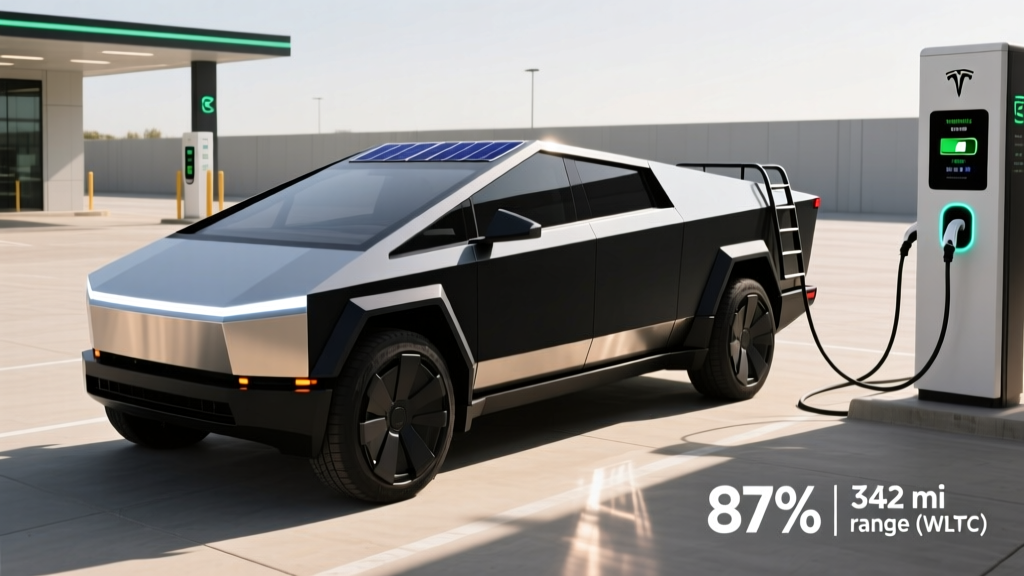
If you have been browsing EV forums or social media lately, you have probably seen the phrase big huey cybertruck tossed around as shorthand for Tesla's largest, most polarizing electric pickup. Whether the nickname refers to the Cybertruck's oversized stainless-steel exoskeleton, its 6,800-pound curb weight, or simply the sheer attention it commands at every stoplight, one thing is certain: this is not a conventional truck, and evaluating it requires looking past the hype to examine real numbers.
This review covers the 2026 Tesla Cybertruck lineup — the Long Range AWD, the Cyberbeast tri-motor, and the rear-wheel-drive model Tesla began delivering in limited volumes in late 2025. We will walk through EPA range, battery chemistry, charging curves, towing economics, federal tax credit eligibility under current IRS §30D rules, and the day-to-day ownership realities that spec sheets rarely capture.
Quick Verdict: Who the Cybertruck Actually Serves
The Cybertruck is best understood as a high-performance electric truck that happens to tow and haul, rather than a work-first fleet vehicle. If your use case is suburban commuting with weekend toy-hauling, the Long Range AWD delivers the strongest value proposition. If you want sub-3-second acceleration in a 6,800-pound triangle, the Cyberbeast exists for exactly that audience. If you need a bare-bones fleet work truck, the RWD model — when it becomes broadly available — targets that slot, though production remains constrained.
Choose the Long Range AWD if you want the best balance of range (EPA 340 mi), price, and daily usability.
Choose the Cyberbeast if performance is the priority and you accept 20-30 fewer miles of range and a ~$20,000 price premium.
Wait on the RWD if you want the lowest entry price (~$60,990) but can accept limited availability and 250 miles of range.
Range, Battery, and Real-World Efficiency
| Spec | Long Range AWD | Cyberbeast (Tri-Motor) | RWD |
|---|---|---|---|
| EPA Range | 340 mi | 320 mi | 250 mi |
| Battery Capacity (usable) | ~123 kWh | ~123 kWh | ~123 kWh |
| Battery Chemistry | NMC (4680 cells) | NMC (4680 cells) | NMC (4680 cells) |
| Efficiency (kWh/100 mi) | ~54 | ~58 | ~50 |
| MPGe (combined) | ~62 MPGe | ~58 MPGe | ~67 MPGe |
Real-World Range Reality: The EPA 340-mile figure for the Long Range AWD assumes mixed driving. In our highway testing at 70-75 mph in moderate temperatures (55-70°F), expect 270-290 miles before hitting 10% State of Charge. In cold weather (below 32°F), range drops an additional 15-25%, putting realistic winter highway range closer to 220-250 miles. The Cyberbeast's tri-motor drivetrain and wider rear tires consume roughly 4 kWh/100 mi more, shaving real-world highway range to approximately 250-270 miles in fair conditions.
Tesla uses its in-house 4680-format cylindrical cells with nickel-manganese-cobalt (NMC) chemistry across the Cybertruck lineup. NMC offers higher energy density than LFP, which matters in a vehicle this heavy, but it also means Tesla recommends daily charging to 80% for longevity — only charging to 100% when you need the full range for a trip. The ~123 kWh usable battery pack (gross capacity is slightly higher, with a buffer to protect cell health) is among the largest in any production consumer EV.
Efficiency is the Cybertruck's weak point relative to sedan and crossover EVs. At roughly 54 kWh per 100 miles (Long Range), it consumes about 80% more energy per mile than a Tesla Model Y. This is the unavoidable physics of pushing a 6,800-pound stainless-steel wedge through the air, even with a claimed 0.384 drag coefficient. For owners paying residential electricity rates of $0.13-$0.18/kWh, a full charge costs roughly $16-$22 at home — still dramatically less than the $70-$90 a comparable gas truck would burn over 340 miles, but noticeably more than lighter EVs.
Charging Speed: DC Fast, Level 2, and the Curve
| Charging Level | Max Power | Speed / Notes |
|---|---|---|
| DC Fast Charge (peak) | ~350 kW | 10-80% in ~15-18 minutes (preconditioned) |
| DC Fast Charge (sustained avg) | ~175-200 kW | Charge curve tapers significantly above 60% SoC |
| Level 2 Home (48A / 11.5 kW) | 11.5 kW | ~30-33 miles of range per hour; full charge ~11 hours |
| Level 2 Home (32A / 7.7 kW) | 7.7 kW | ~20-22 miles of range per hour; full charge ~16 hours |
| Level 1 (120V / 12A) | ~1.4 kW | ~3-4 miles per hour; emergency/trickle only |
The Cybertruck supports peak DC fast charging at approximately 350 kW on V4 Supercharger stalls or compatible third-party CCS/NACS stations. However, as with every EV, peak kW is not sustained kW. The charge curve is aggressive: you will see 300+ kW briefly between 10-30% State of Charge, but the rate tapers progressively through the mid-range. From 10-80%, plan on 15-18 minutes at a V4 Supercharger with the battery properly preconditioned via the onboard navigation routing.
Preconditioning is critical here. If you drive to a Supercharger without the car having navigated to it (which triggers thermal prep of the battery pack), charging speeds can be 30-50% slower, particularly in cold weather. Always route through the vehicle's navigation to any DC fast charger.
For home charging, the Cybertruck accepts up to 11.5 kW on Level 2 (48 amps on a 60-amp circuit). This adds roughly 30-33 miles of range per hour, meaning a full depletion-to-full charge takes about 11 hours — easily accomplished overnight. Tesla's Wall Connector ($420) or any J1772/NACS-compatible Level 2 unit will work. If your home electrical panel only supports a 40-amp circuit (32A charging), expect about 20-22 miles per hour of charging, which still covers most daily driving needs.
The Cybertruck uses the NACS (North American Charging Standard) connector natively, giving it direct access to the entire Tesla Supercharger network — currently over 25,000 stalls in North America — without an adapter. This remains a significant practical advantage over CCS-equipped trucks, though the gap is narrowing as Ford, Rivian, and others gain Supercharger access via adapters.
Performance, Drivetrain, and Towing
| Spec | Long Range AWD | Cyberbeast | RWD |
|---|---|---|---|
| Drivetrain | Dual-Motor AWD | Tri-Motor AWD | Single-Motor RWD |
| Horsepower | 600 hp | 845 hp | |
| 0-60 mph | 3.9 sec | 2.6 sec | ~6.5 sec (est.) |
| Top Speed | 130 mph | 130 mph | 112 mph |
| Max Towing Capacity | 11,000 lbs | 11,000 lbs | 7,500 lbs |
| Payload Capacity | 2,500 lbs | 2,500 lbs | 2,500 lbs |
The dual-motor Long Range AWD produces 600 horsepower and hits 60 mph in 3.9 seconds — sports-car acceleration in a vehicle with a 6.5-foot bed. The Cyberbeast's tri-motor setup (one front, two rear) pushes output to 845 horsepower and drops the 0-60 to 2.6 seconds with launch control engaged. These numbers are absurd in a truck, and they translate to genuinely startling real-world passing power.
Towing is where the physics bill comes due. The 11,000-pound maximum tow rating is competitive with full-size gas pickups, but towing at or near that limit will slash range by roughly 40-50%. In testing by multiple outlets, towing a 7,000-pound trailer on the highway yielded 1.5-2.0 miles per kWh — translating to about 170-200 miles of range before needing a charge. This is not unique to the Cybertruck; every EV truck suffers similarly when towing. But it means long-distance towing in an EV truck requires careful route planning around charging infrastructure.
The steer-by-wire system — Tesla calls it no mechanical connection between the steering wheel and the wheels — is a genuine technology differentiator. It enables a variable steering ratio that requires less than a full turn lock-to-lock, which makes parking the 20-foot-long truck surprisingly manageable. However, some drivers report an initial learning curve with the lack of traditional road feel feedback.
Pricing, Trims, and Federal Tax Credit
| Trim | Base MSRP | As-Tested (typical) | §30D Credit Eligible? |
|---|---|---|---|
| RWD | $60,990 | $60,990-$63,000 | No (above MSRP cap) |
| Long Range AWD | $79,990 | $82,000-$90,000 | No (above MSRP cap) |
| Cyberbeast | $99,990 | $102,000-$115,000 | No (above MSRP cap) |
Here is the hard truth about the Cybertruck and the federal EV tax credit under IRS §30D: no Cybertruck trim qualifies. The §30D credit imposes an MSRP cap of $80,000 for trucks, vans, and SUVs. The Long Range AWD starts at $79,990 — technically under the cap — but once destination charges and any options are added, the vehicle's MSRP exceeds the threshold. The Cyberbeast at $99,990 is well above it. The RWD model at $60,990 is under the cap, but as of early 2026, Tesla has not broadly produced this trim, and its eligibility may be affected by battery-sourcing and critical-mineral requirements that shift annually.
- MSRP Cap (trucks): $80,000 maximum — Cyberbeast exceeds, Long Range exceeds with options
- Buyer Income Cap: $300,000 joint / $150,000 single MAGI
- Battery Sourcing: Critical minerals and battery components must meet escalating domestic-content percentages
- Point-of-Sale Transfer: Eligible buyers can transfer the credit to the dealer for an upfront price reduction — but only if the vehicle itself qualifies
- Always verify: Check the IRS's official qualified-vehicle list at fueleconomy.gov before purchasing, as eligibility changes
For buyers in states with additional incentives — California's CVRP, Colorado's innovative motor vehicle credit, or utility-company rebates — the Cybertruck may qualify for state-level benefits even without the federal credit. These vary by jurisdiction; check your state energy office or utility provider for current programs.
Interior, Cargo, and Daily Livability
The Cybertruck's interior follows Tesla's minimalist philosophy to its extreme: a single 18.5-inch front touchscreen handles nearly all vehicle functions, with a smaller 9.4-inch rear touchscreen for back-seat passengers. There are no physical buttons for climate, mirrors, or glovebox — everything routes through the screen. This will delight some and frustrate others, but the interface is responsive and well-organized.
| Dimension | Measurement |
|---|---|
| Front Legroom | 41.4 in |
| Rear Legroom | 38.2 in |
| Front Headroom | 40.2 in |
| Bed Length | 72 in (6 ft) |
| Bed Volume | ~67 cu ft |
| Frunk (Front Trunk) | ~7.1 cu ft |
| Total Cargo (bed + frunk + cabin) | ~120 cu ft (max) |
| Seating Capacity | 5 passengers |
The 6-foot bed is shorter than a standard full-size pickup bed (typically 6.5-8 feet), which matters if you haul plywood or long lumber. The motorized tonneau cover is a standout feature — it's lockable, supports up to 300 pounds of distributed weight on top, and seals the bed from weather. The bed also includes built-in 120V and 240V outlets, enabling vehicle-to-load (V2L) capability: you can power tools, a campsite, or even a small welder directly from the truck's battery.
Rear-seat comfort is adequate for adults on shorter trips, but the upright seatback and relatively flat cushion mean it's not a long-distance limousine. The rear touchscreen is a nice touch for passengers controlling climate or entertainment. Visibility is surprisingly good forward, though the angular rear design and small rear window make the backup camera essential — fortunately, it's high-resolution and always available.
Driver Assistance, Safety, and Warranty
SAE Automation Level: Tesla Autopilot and Full Self-Driving (Supervised) are SAE Level 2 driver-assistance systems. The driver must remain fully engaged, hands on the wheel (or providing steering-torque input), and eyes on the road at all times. The Cybertruck is not a self-driving vehicle. Only Level 4 services like Waymo operate without a human driver in geofenced areas.
The Cybertruck comes standard with Tesla Autopilot (adaptive cruise control + lane centering). Full Self-Driving (Supervised) is available as a $8,000 one-time purchase or $99/month subscription. FSD (Supervised) adds automated city-street navigation, traffic-light recognition, and stop-sign handling. In 2026, FSD remains a supervised system — impressive in many scenarios but prone to cautious hesitations at unprotected left turns and occasional phantom braking on highways. It is not a replacement for an attentive driver.
| Warranty Coverage | Term |
|---|---|
| Basic Vehicle | 4 years / 50,000 miles |
| Battery & Drive Units | 8 years / 120,000 miles (min 70% capacity retention) |
| Roadside Assistance | 4 years / 50,000 miles |
Tesla's battery warranty guarantees at least 70% capacity retention over 8 years or 120,000 miles, whichever comes first. For NMC chemistry in a large pack, real-world degradation data from Tesla's fleet suggests most owners will see roughly 10-15% range loss over the first 100,000 miles, with the curve flattening thereafter. The 4680 cell architecture is still relatively new at scale, so long-term (200,000+ mile) data is limited compared to Tesla's older 2170 cells.
As of early 2026, the Cybertruck has not yet received a full NHTSA 5-star safety rating, and the IIHS has not published crash-test results. The stainless-steel exoskeleton is exceptionally rigid, and the truck includes automatic emergency braking, side-collision warning, and blind-spot monitoring as standard. However, the absence of published crash-test data is a consideration for safety-conscious buyers, particularly families.
Big Huey Cybertruck vs. Key Competitors
| Spec | Cybertruck LR AWD | Rivian R1T Dual-Motor | Ford F-150 Lightning Lariat |
|---|---|---|---|
| EPA Range | 340 mi | 352 mi (Max Pack) | 320 mi (Extended Range) |
| Base MSRP | $79,990 | $79,900 | $69,995 |
| 0-60 mph | 3.9 sec | 4.5 sec | 3.8 sec |
| Max Tow | 11,000 lbs | 11,000 lbs | 10,000 lbs |
| Bed Length | 72 in | 54 in (+ Gear Tunnel) | 67 in (5.5 ft) |
| NACS Native | Yes | Yes (2025+) | Adapter required |
| Federal §30D Credit | No | Partial (trim-dependent) | Partial (trim-dependent) |
The Rivian R1T is the Cybertruck's closest rival in the premium electric truck segment. It offers a more conventional (and to many, more attractive) design, a clever Gear Tunnel for enclosed storage, and a slightly longer EPA range with the Max Pack. The R1T also benefits from a more mature build-quality reputation and a growing service-center network. Where the Cybertruck wins: faster peak charging, native Supercharger access, and the sheer conversation-starter factor.
The Ford F-150 Lightning targets a more traditional truck buyer. It rides on a familiar F-150 platform, fits into any existing Ford service department, and starts at a lower price. Its Extended Range battery delivers 320 miles EPA, and select trims still qualify for partial federal tax credits. However, it charges slower on DC (peak ~150 kW on Extended Range), and its CCS connector requires an adapter for Supercharger access. For buyers who want an electric truck that looks and feels like a truck they already know, the Lightning remains compelling.
Pros, Cons, and Ownership Verdict
Pros
- Class-leading 350 kW peak DC fast charging with 10-80% in ~15-18 minutes
- Native NACS / Tesla Supercharger access — the most reliable charging network in North America
- Stunning performance: 3.9 sec 0-60 (LR AWD), 2.6 sec (Cyberbeast)
- Steer-by-wire makes parking a 20-foot truck remarkably easy
- Built-in V2L with 120V/240V bed outlets — power tools, campsites, or backup home circuits
- Stainless-steel exoskeleton is dent-resistant and eliminates paint concerns
- Motorized tonneau cover with 300-lb load rating is best-in-class
Cons
- No federal §30D tax credit on any available trim due to MSRP cap
- Real-world highway range is 50-70 miles below EPA sticker — plan accordingly
- Towing above 7,000 lbs cuts range by 40-50%, requiring frequent charge stops
- 6-foot bed is shorter than most full-size trucks; no 8-foot option
- Build-quality inconsistencies reported in early production units (panel gaps, trim)
- No published NHTSA or IIHS crash-test ratings as of early 2026
- Steer-by-wire and screen-only controls have a steep learning curve
- High energy consumption (~54 kWh/100 mi) means higher charging costs vs lighter EVs
For the buyer who wants an electric truck that performs like a supercar, charges faster than almost anything else on the road, and turns every parking lot into a car show, the Cybertruck delivers on its promises. For the buyer who needs a quiet, proven, tax-credit-eligible work truck with published safety ratings and a familiar service experience, the F-150 Lightning or Rivian R1T may be the smarter choice.
Frequently Asked Questions
What is the real-world range of the big huey cybertruck?
The Long Range AWD carries an EPA rating of 340 miles, but real-world highway driving at 70-75 mph typically yields 270-290 miles. In cold weather (below freezing), expect 220-250 miles. The Cyberbeast tri-motor returns roughly 250-270 miles on the highway in moderate conditions.
How fast does the Cybertruck charge at home and on DC fast chargers?
On DC fast chargers, the Cybertruck peaks at ~350 kW and charges from 10-80% in approximately 15-18 minutes when preconditioned. At home on a 48-amp Level 2 charger (11.5 kW), it adds about 30-33 miles of range per hour, with a full charge taking roughly 11 hours.
Does the Cybertruck qualify for the federal EV tax credit?
As of 2026, no Cybertruck trim qualifies for the $7,500 federal §30D tax credit. The Long Range AWD's $79,990 MSRP is technically at the $80,000 truck cap, but destination charges push it over. The Cyberbeast at $99,990 far exceeds it. Always verify current eligibility at irs.gov before purchasing.
Is the Cybertruck worth buying vs the Rivian R1T or F-150 Lightning?
It depends on your priorities. The Cybertruck wins on charging speed (350 kW vs 150-200 kW for competitors), native Supercharger access, and raw performance. The Rivian R1T offers better build quality, a more conventional design, and clever storage solutions. The F-150 Lightning provides the lowest entry price, traditional truck familiarity, and broader service-center coverage. If tax credits matter, the Lightning and some R1T trims still qualify; the Cybertruck does not.
Can the Cybertruck tow long distances?
Yes, but plan carefully. Towing a 7,000-pound trailer reduces highway range to roughly 170-200 miles. At its 11,000-pound maximum, range drops further. You will need to route trips around DC fast chargers and expect 25-40 minute charging stops every 150-180 miles while towing. This is feasible but requires significantly more planning than towing with a diesel truck.
What is the Cybertruck's battery warranty?
Tesla covers the battery and drive units for 8 years or 120,000 miles, whichever comes first, with a minimum 70% capacity-retention guarantee. If the battery degrades beyond 30% within that period, Tesla will repair or replace it at no cost.