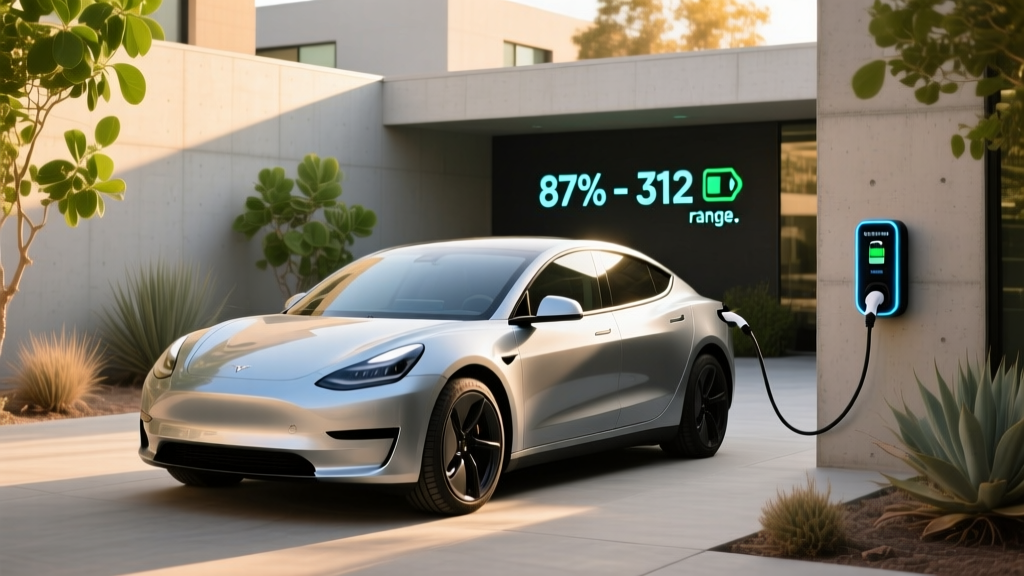
The phrase "big beautiful bill" has become shorthand for the sweeping energy legislation that reshaped federal EV incentives — and the subsequent political battles over whether to repeal, modify, or preserve them. For buyers in 2026, the question is practical, not political: does the EV tax credit still meaningfully lower your total cost of ownership, or have the tightening battery-sourcing rules and MSRP caps made it nearly impossible to claim?
We ran the numbers on a representative 2026 EV purchase — a Tesla Model Y Long Range (AWD) — against a comparable gas-powered compact SUV. Below is the unvarnished math on purchase price, federal and state incentives, fueling, maintenance, insurance, and depreciation over five years and 75,000 miles.
The Current State of the Federal EV Tax Credit (IRS §30D)
The federal clean vehicle credit under Internal Revenue Code §30D still offers up to $7,500 for qualifying new EVs, but the eligibility hurdles have grown significantly since the Inflation Reduction Act first restructured the rules. The credit is now split into two $3,750 halves: one tied to critical-mineral sourcing and one to battery-component manufacturing. As of 2026, both thresholds are stricter than in prior years, meaning fewer vehicles qualify for the full amount.
- Income caps: Modified AGI must not exceed $150,000 (single), $225,000 (head of household), or $300,000 (married filing jointly).
- MSRP caps: Vans, SUVs, and pickup trucks must have an MSRP at or below $80,000; sedans and other body styles must be at or below $55,000.
- Critical minerals: A specified percentage of applicable critical minerals must be extracted or processed in the U.S. or a free-trade-agreement country, or recycled in North America.
- Battery components: A specified percentage of battery components must be manufactured or assembled in North America.
- Foreign entity of concern (FEOC): Vehicles with battery components or critical minerals from a FEOC are disqualified entirely.
- Point-of-sale transfer: Buyers can transfer the credit to the dealer at purchase, reducing the purchase price upfront (subject to IRS registration and dealer enrollment).
Source: IRS — Credits for New Clean Vehicles. Rules are subject to legislative change; consult a tax professional for your specific situation.
In practice, the tightening FEOC and critical-mineral rules have disqualified several popular models that previously received the full $7,500. Before you commit to a purchase, verify the vehicle's current eligibility on fueleconomy.gov, which the DOE maintains as the authoritative lookup for qualifying vehicles and credit amounts.
5-Year Total Cost of Ownership: EV vs. Gas SUV
To make this comparison concrete, we modeled a 2026 Tesla Model Y Long Range AWD ($48,990 MSRP, 320-mile EPA range, 75 kWh usable battery) against a 2026 Toyota RAV4 AWD LE ($32,350 MSRP, 30 MPG combined). We assumed 15,000 miles per year (75,000 total), home Level 2 charging at $0.16/kWh for the EV, and $3.60/gallon regular unleaded for the RAV4.
| Cost Category | 2026 Tesla Model Y LR AWD | 2026 Toyota RAV4 AWD LE |
|---|---|---|
| Base MSRP | $48,990 | $32,350 |
| Federal Tax Credit (§30D) | –$7,500* | $0 |
| Effective Purchase Price | $41,490 | $32,350 |
| Fuel / Energy (75k mi) | $2,400 | $9,000 |
| Maintenance (5 yr) | $1,500 | $4,200 |
| Insurance (5 yr avg) | $12,500 | $9,000 |
| Estimated Depreciation | –$18,000 | –$13,000 |
| Net 5-Year Cost | $39,890 | $41,550 |
*Full $7,500 credit assumes buyer meets all income, MSRP, sourcing, and FEOC requirements. Actual credit may be $3,750 or $0 depending on eligibility.
The Model Y comes out roughly $1,660 ahead over five years — but only if you qualify for the full credit. Drop the credit to $3,750 and the EV falls about $2,090 behind. Eliminate it entirely and the gap widens to nearly $6,000. This is why verifying your specific eligibility matters more than any headline number.
Charging vs. Gas: The Per-Mile Math
The single largest operational advantage of an EV is energy cost. At a national average residential electricity rate of $0.16/kWh and an efficiency of 3.5 miles per kWh (approximately 115 MPGe combined for the Model Y LR), the cost to drive one mile is about $0.046. The RAV4 at 30 MPG combined and $3.60/gallon costs $0.12 per mile — nearly three times as much.
| EV (Home L2, $0.16/kWh) | EV (DC Fast, $0.40/kWh) | Gas SUV (30 MPG, $3.60/gal) | |
|---|---|---|---|
| Cost per mile | $0.046 | $0.114 | $0.120 |
| Annual cost (15k mi) | $690 | $1,710 | $1,800 |
| 5-year cost (75k mi) | $3,450 | $8,550 | $9,000 |
Note: DC fast charging at $0.40/kWh nearly erases the fuel-cost advantage. Home charging is where the economics work best. Public charging costs vary widely by network (Electrify America, EVgo, Tesla Supercharger) and time-of-use rates.
If you rely primarily on DC fast charging — say, apartment dwellers without home charging access — the savings narrow dramatically. At $0.40/kWh, you are paying almost as much per mile as the gas SUV. This is a critical consideration that gets glossed over in "EVs are cheaper to fuel" talking points.
Maintenance Savings: Where EVs Genuinely Win
EVs have far fewer moving parts than internal-combustion vehicles. There are no oil changes, no spark plugs, no timing belts, no exhaust systems, and no multi-speed transmissions. Regenerative braking significantly extends brake pad life — many EV owners report original brake pads lasting 80,000–100,000 miles.
| Service Item | EV Cost | Gas SUV Cost |
|---|---|---|
| Oil Changes (8–10 over 5 yr) | $0 | $600–$900 |
| Brake Pads & Rotors | $200–$400 | $800–$1,500 |
| Transmission Fluid / Service | $0 | $200–$400 |
| Coolant / Spark Plugs / Belts | $100–$200 | $500–$800 |
| Tire Rotation & Replacement | $1,200–$1,800 | $1,000–$1,500 |
| Cabin Air Filter / Wipers / Misc | $300–$500 | $300–$500 |
| Total Estimated | $1,500–$2,500 | $3,500–$5,000 |
The one area where EVs cost more: tires. EVs are heavier (the Model Y LR is approximately 4,400 lbs) and deliver instant torque, which accelerates tire wear. Budget for a tire replacement around 30,000–40,000 miles, and consider EV-specific tire compounds rated for higher load indexes.
Both the Tesla Model Y and the Toyota RAV4 carry strong warranties, but the EV's battery and drive unit coverage is notably longer. Tesla provides an 8-year/120,000-mile battery and drive unit warranty with a minimum 70% capacity retention threshold — a meaningful backstop against degradation anxiety.
The Insurance Reality: Expect to Pay More
This is where the EV cost narrative gets honest. EV insurance premiums are typically 15–30% higher than equivalent gas vehicles. The reasons are structural, not arbitrary:
- Higher repair costs: EV battery packs and power electronics are expensive to replace after collision damage. Even minor structural damage near the battery can trigger a total-write-off protocol at some insurers.
- Specialized labor: High-voltage system repairs require certified technicians, and the labor pool is still smaller than for conventional drivetrains.
- Higher vehicle values: A $49,000 EV costs more to insure than a $32,000 gas SUV, all else being equal.
- Parts availability: OEM EV body panels and structural components can have longer lead times, increasing rental-car and storage costs for insurers.
In our model, we estimated the Model Y at roughly $2,500/year for full coverage (national average for a driver with a clean record) versus $1,800/year for the RAV4. That is $3,500 more over five years. However, insurance rates vary enormously by state, zip code, driving history, and provider. Get quotes from at least three insurers before purchasing — some companies now offer EV-specific policies with discounts for safe driving data or bundled home-charging equipment.
Depreciation and Resale Value Trends
EV depreciation has been volatile. In 2023–2024, aggressive Tesla price cuts cascaded through the used-EV market, depressing resale values across all brands. By 2026, the market has stabilized somewhat, but EVs still depreciate faster on average than their gas counterparts in the first three years.
Based on current resale data, a 2026 Model Y LR purchased at $41,490 (after the $7,500 credit) can be expected to retain roughly 55–60% of its post-credit value after five years, implying depreciation of approximately $17,000–$19,000. The RAV4, historically one of the strongest-resale vehicles in its segment, retains closer to 60–65% of its purchase price, with depreciation around $12,000–$14,000.
Two factors work in the EV's favor going forward: (1) the purchase price was already reduced by the tax credit, so the absolute depreciation dollars are calculated on a lower basis, and (2) as battery longevity data accumulates (many 2018–2020 EVs are showing less than 10% degradation at 100,000+ miles), buyer confidence in used EVs is gradually improving.
Federal credits are only part of the picture. Depending on where you live, additional incentives can shift the math significantly:
- State rebates: States like California (CVRP up to $7,000 for income-qualified buyers), Colorado (up to $5,000 state credit), and Massachusetts (MOR-EV up to $3,500) stack on top of federal credits. Many states offer no additional incentive.
- Utility rebates: Hundreds of utilities offer $250–$1,500 rebates for home Level 2 charger installation, and some offer time-of-use rates that cut charging costs by 30–50% during off-peak hours.
- HOV lane access: Several states grant solo-carpool-lane access to EVs — a non-monetary benefit worth hundreds per year in congested metros.
- Registration fees: A growing number of states impose additional EV registration fees ($50–$225/year) to offset lost gas-tax revenue, which partially erodes operational savings.
Check afdc.energy.gov for current incentives in your state. Consult a tax professional for eligibility specifics.
The Real Decision Framework
- Choose the EV if: You qualify for the full or partial §30D credit, have access to home Level 2 charging (or affordable workplace charging), drive 12,000+ miles per year (amplifying fuel savings), and live in a state with additional rebates or favorable electricity rates. The 5-year math works in your favor.
- Choose the gas/hybrid if: You do not qualify for the federal credit (income or sourcing disqualification), rely entirely on expensive public DC fast charging, drive fewer than 8,000 miles per year, or need to minimize upfront cost. A hybrid like the RAV4 Hybrid (39 MPG combined) offers a strong middle ground with no charging requirement.
- Consider a PHEV if: You want electric commuting (25–45 miles) with gas flexibility for road trips, and your daily commute is under 40 miles round-trip. The Toyota RAV4 Prime (42-mile electric range, 38 MPG gas) is a compelling option that qualifies for partial incentives.
Frequently Asked Questions
How much does it really cost to own an EV over 5 years?
For a 2026 Tesla Model Y LR with the full $7,500 federal credit, our model shows a net 5-year cost of approximately $39,890 over 75,000 miles — roughly $1,660 less than a comparable gas SUV. Without the credit, the EV costs about $5,840 more. Your actual numbers depend on local electricity rates, insurance quotes, and state incentives.
Do I qualify for the federal EV tax credit?
You may qualify for up to $7,500 if your modified AGI is below the caps ($150k single / $300k married), the vehicle MSRP is within limits ($80k for SUVs/trucks, $55k for sedans), and the vehicle meets current critical-mineral and battery-component sourcing requirements. The FEOC restriction disqualifies vehicles with certain foreign-sourced battery materials. Verify eligibility at fueleconomy.gov and consult a tax professional.
How much do I save on fuel and maintenance?
Charging at home at $0.16/kWh saves approximately $5,550 in fuel costs over 75,000 miles compared to a 30 MPG gas SUV at $3.60/gallon. Maintenance savings add another $1,500–$2,500 over five years, primarily from eliminated oil changes and extended brake life. Combined operational savings typically total $7,000–$8,000.
Are EVs more expensive to insure?
Yes, typically 15–30% more than equivalent gas vehicles. Higher vehicle values, expensive battery repairs, and specialized labor drive the premium difference. In our model, the Model Y costs approximately $3,500 more to insure over five years. Shop multiple insurers — some offer EV-specific discounts.
How well do EVs hold their value?
EV depreciation has stabilized since the 2023–2024 market correction but still trails top-resale gas vehicles like the RAV4. Expect a mainstream EV to retain 55–60% of its post-incentive value after five years. Battery longevity data is improving buyer confidence in the used market, and calculating depreciation on the lower post-credit purchase price helps the absolute-dollar comparison.
Can I get the tax credit at the point of sale?
Yes. Since 2024, buyers can transfer the federal EV credit to the dealer at purchase, reducing the vehicle price upfront rather than waiting to claim it on their tax return. The dealer must be IRS-registered, and you must attest to meeting income requirements. If your actual tax liability is less than the credit transferred, you may owe the difference when filing — so accurate income estimation matters.
What if I don't qualify for the federal credit?
Look at the used-EV credit (§25E), which offers up to $4,000 or 30% of the sale price (whichever is lower) for qualifying pre-owned EVs priced at $25,000 or less, with lower income caps ($75k single / $150k married). Also check your state and utility incentives — some states offer credits regardless of federal eligibility. A PHEV or hybrid may also make more financial sense without the federal incentive.