What Does BEV Mean? The Battery Electric Vehicle Definition
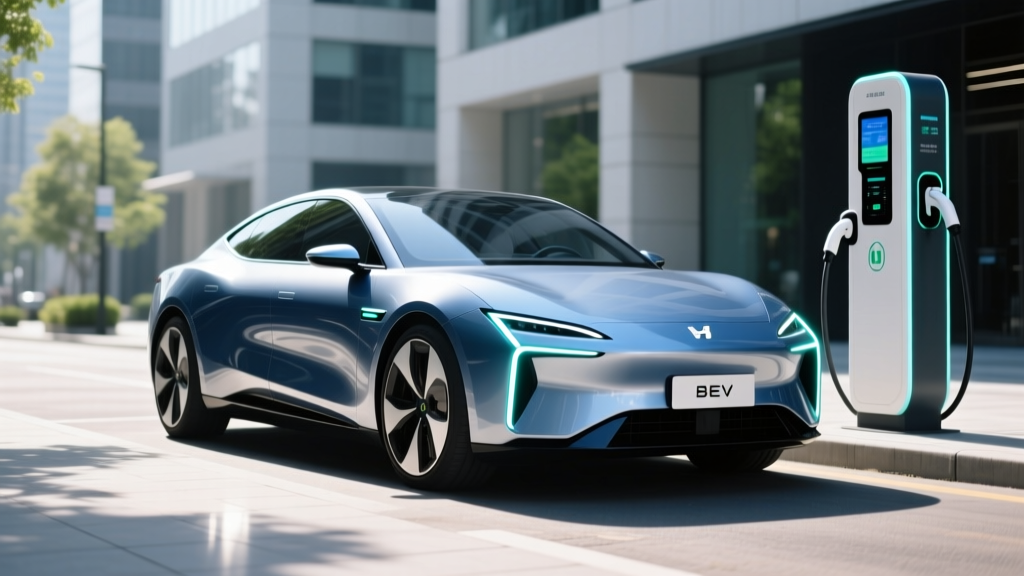
A BEV (Battery Electric Vehicle) is a vehicle powered entirely by an electric motor and a rechargeable battery pack — no gasoline engine, no tailpipe, no internal combustion. Unlike hybrids (HEVs) or plug-in hybrids (PHEVs), a BEV relies on 100% stored electrical energy for propulsion. When you see the term "BEV" in automotive discussions, it's the industry's way of distinguishing a fully electric car from any vehicle that still carries an internal combustion engine.
As of 2026, the BEV landscape includes everything from sub-$30,000 compacts to luxury SUVs and heavy-duty pickups. But understanding what a BEV actually entails — battery chemistry, real-world range, charging infrastructure, and total ownership cost — is essential before committing to one. This guide breaks down the BEV definition with the data-driven precision buyers need.
BEV: Battery only. Zero gasoline. Plug-in charging required.
PHEV: Battery + gas engine. Plug-in for short electric-only range (20–50 mi), then gas takes over.
HEV: Gas engine + small battery. Self-charging via regenerative braking. No plug.
How a BEV Works: Battery, Motor, and Energy Flow
Every BEV shares a common architecture: a high-voltage traction battery (measured in kWh, or kilowatt-hours — the total energy capacity) sends electricity to one or more electric motors that turn the wheels. When you decelerate, regenerative braking converts kinetic energy back into stored electricity, extending range and reducing brake wear.
Unlike a gas car that refuels in minutes at any station, a BEV's practicality depends on three variables:
- Battery capacity (kWh): Determines how far you can drive on a full charge. Larger packs = more range but more weight and cost.
- Charging speed (kW): How quickly you can replenish the battery. Measured in kilowatts (power), not kWh (energy).
- Efficiency (kWh/100mi or MPGe): How effectively the vehicle converts stored energy into miles driven.
BEV Battery Chemistry in 2026: LFP vs NMC Explained
Not all BEV batteries are the same. The two dominant chemistries in 2026 are LFP (Lithium Iron Phosphate) and NMC (Nickel Manganese Cobalt), and the choice affects range, longevity, cost, and charging behavior.
| Attribute | LFP (Lithium Iron Phosphate) | NMC (Nickel Manganese Cobalt) |
|---|---|---|
| Energy density | Lower — heavier pack for same range | Higher — lighter, more compact |
| Cycle life | 3,000–5,000+ cycles (excellent longevity) | 1,000–2,000 cycles |
| Can charge to 100% daily? | Yes — recommended for accurate SoC | No — 80% daily, 100% only for trips |
| Cold-weather performance | More range loss in freezing temps | Better cold-weather retention |
| Cost | Lower — no cobalt or nickel | Higher — commodity-priced metals |
| Common in (2026) | Tesla Model 3 RWD, Model Y RWD, base Chevy Equinox EV | Tesla Long Range, Hyundai Ioniq 5/6, Ford Mustang Mach-E Extended Range |
Why this matters: If you plan to own your BEV for 10+ years and charge at home nightly, LFP's superior cycle life and 100% daily charging tolerance make it a strong choice. If you need maximum range per charge and live in a cold climate, NMC's higher energy density and better cold retention may justify the higher cost.
Real-World BEV Range: What the EPA Sticker Doesn't Tell You
EPA-estimated range is the standard benchmark, but real-world BEV range varies significantly based on driving conditions. Here's what 2026 buyers should expect from popular BEV segments:
| BEV Segment | EPA Range | Real-World Highway (70 mph) | Cold Weather (20°F) |
|---|---|---|---|
| Compact sedan (e.g., Tesla Model 3 RWD) | 341 mi | ~275–295 mi | ~235–270 mi |
| Midsize crossover (e.g., Hyundai Ioniq 5 Long Range AWD) | 290 mi | ~240–260 mi | ~200–230 mi |
| Full-size SUV (e.g., Rivian R1S Dual-Motor Max) | 352 mi | ~290–310 mi | ~245–280 mi |
| Electric pickup (e.g., Ford F-150 Lightning Ext. Range) | 320 mi | ~255–280 mi | ~210–250 mi |
BEV Charging Speeds: DC Fast, Level 2, and Level 1 Compared
Charging speed is measured in kW (kilowatts) — the rate of power delivery. This is distinct from kWh (kilowatt-hours), which is the battery's total energy capacity. A 250 kW charger doesn't deliver 250 kWh; it delivers energy at a rate of 250 kilojoules per second.
| Charging Level | Power (kW) | Miles Added/Hour | Typical Use Case |
|---|---|---|---|
| Level 1 (120V household outlet) | 1.0–1.4 kW | 3–5 mi/hr | Overnight trickle, PHEVs, emergencies |
| Level 2 (240V home/public) | 7.2–19.2 kW | 25–65 mi/hr | Daily home charging, workplace, hotels |
| DC Fast Charge (public stations) | 50–350 kW | 150–1,000+ mi/hr (peak) | Road trips, rapid top-ups |
The Charge Curve Reality: Why Peak kW Is Misleading
Battery management systems throttle charging speed as the battery fills. A BEV rated for a "peak 250 kW" may only sustain that rate between 10–30% State of Charge (SoC), then taper progressively. The meaningful metric is 10–80% charge time, which accounts for the curve:
- Tesla Model 3 Long Range (2026): Peak 250 kW, 10–80% in ~25 minutes at a V4 Supercharger
- Hyundai Ioniq 5 (800V architecture): Peak 238 kW, 10–80% in ~18 minutes at a 350 kW station
- Chevy Equinox EV: Peak 150 kW, 10–80% in ~32 minutes
- Ford F-150 Lightning (Extended Range): Peak 150 kW, 10–80% in ~41 minutes
Preconditioning matters: Most BEVs with navigation-routed preconditioning (Tesla, Hyundai/Kia, Rivian) warm the battery before arriving at a DC fast charger. Without preconditioning, cold-soaked batteries can take 50%+ longer to reach peak charge rates.
BEV Pricing and the Federal Tax Credit (§30D) in 2026
The IRS §30D federal tax credit offers up to $7,500 for qualifying new BEVs, but eligibility depends on several strict criteria that eliminate many models and buyers:
- MSRP cap: Vans/SUVs/pickups ≤ $80,000; sedans/other ≤ $55,000
- Buyer income cap: AGI ≤ $150K (single), $225K (head of household), $300K (joint)
- Battery sourcing: Battery components must be manufactured or assembled in North America (phased percentages increase yearly)
- Critical minerals: Required percentage of critical minerals must be sourced from the US or FTA-partner countries
- Point-of-sale transfer: Buyers can apply the credit at purchase (reducing down payment) or claim on tax return
- Final assembly: Vehicle must undergo final assembly in North America
Rules are subject to change. Verify current eligibility at irs.gov before purchasing.
| 2026 BEV Model | Base MSRP | §30D Credit Eligible? | Effective Price (with credit) |
|---|---|---|---|
| Tesla Model 3 RWD | $38,990 | Yes (partial — varies by sourcing) | ~$31,490–$38,990 |
| Hyundai Ioniq 5 SE (AWD) | $46,650 | Yes (full $7,500 — GA assembly) | ~$39,150 |
| Chevrolet Equinox EV LT | $33,600 | Yes (full $7,500) | ~$26,100 |
| Ford Mustang Mach-E Premium | $44,995 | Yes (full $7,500 — Mexico assembly qualifies) | ~$37,495 |
| BMW i4 eDrive40 | $57,900 | No (MSRP exceeds $55K sedan cap; EU assembly) | $57,900 |
BEV Ownership: Warranty, Degradation, and Total Cost
Federal law mandates that BEV battery packs carry a minimum warranty of 8 years or 100,000 miles (whichever comes first) with a capacity retention threshold — typically 70% of original capacity. Some manufacturers exceed this:
- Hyundai/Kia: 10 years / 100,000 miles on battery and powertrain
- Tesla: 8 years / 100,000–120,000 miles depending on model and trim
- Rivian: 8 years / 175,000 miles on battery (Max Pack)
- Chevrolet: 8 years / 100,000 miles
Battery degradation in practice: Most 2026-era NMC packs lose approximately 5–8% capacity over the first 100,000 miles, then plateau. LFP packs degrade even more slowly — often under 5% at 150,000 miles — thanks to their superior cycle life. Catastrophic battery failure requiring full replacement is rare but costs $10,000–$22,000 out of warranty depending on pack size.
Total cost of ownership (TCO) favors BEVs for drivers who charge at home. Electricity costs average $0.13–$0.18/kWh nationally, translating to roughly $0.04–$0.06 per mile — compared to $0.12–$0.16/mile for a 28 MPG gas car at $3.50/gallon. Over 5 years and 75,000 miles, home-charging BEV owners save $4,000–$7,000 on fuel alone, offsetting higher purchase prices and insurance premiums (BEV insurance runs 10–20% higher on average).
Who Should Buy a BEV — And Who Shouldn't
- You have reliable home or workplace Level 2 charging access
- Your daily commute is under 80 miles round-trip
- You want minimal maintenance (no oil changes, fewer brake replacements)
- You qualify for the §30D tax credit or state incentives
- You take road trips 2–4 times per year and can plan DC fast-charge stops
- You live in an apartment without charging access and public infrastructure is sparse
- You regularly drive 300+ miles in a single day through charging-desert regions
- You frequently tow heavy loads in cold weather (range drops compound)
- Your budget can't absorb the upfront premium even after incentives
BEV Pros and Cons: The Honest Assessment
- Fuel cost 50–70% lower than gas (with home charging)
- Near-zero drivetrain maintenance
- Instant torque, smooth acceleration
- Eligible for $7,500 federal + state incentives
- One-pedal driving reduces brake wear
- Quiet cabin, low NVH
- Higher upfront purchase price (pre-incentive)
- Public charging reliability inconsistent in some regions
- 15–30% range loss in freezing temperatures
- Longer "refueling" time on road trips (20–40 min stops)
- Insurance premiums 10–20% higher
- Battery replacement cost if out of warranty
BEV Definition FAQ
What is the difference between a BEV and an EV?
"EV" (electric vehicle) is the umbrella term covering BEVs, PHEVs, and even fuel-cell vehicles. A BEV is specifically a battery-only electric vehicle with no gasoline engine. When people say "EV" in 2026, they usually mean BEV — but technically, a Toyota Prius Prime (PHEV) is also an EV.
Do BEVs require oil changes?
No. BEVs have no internal combustion engine, so there is no engine oil, oil filter, spark plugs, timing belt, or exhaust system to maintain. Routine maintenance is limited to tire rotation, cabin air filter replacement, brake fluid checks, and windshield washer fluid. Brake pads last 100,000+ miles thanks to regenerative braking.
How long do BEV batteries last?
Most 2026 BEV batteries are engineered to retain 70–80% of original capacity after 150,000–200,000 miles. LFP chemistry packs typically outlast NMC packs in cycle life. Federal warranty minimums are 8 years/100,000 miles, and most batteries outlive their warranty period without needing replacement.
Can I charge a BEV on a regular household outlet?
Yes — Level 1 charging on a standard 120V outlet adds 3–5 miles of range per hour. This works for PHEVs or BEVs with short daily commutes (under 30 miles), but a Level 2 (240V) home charger is strongly recommended for any BEV used as a primary vehicle. Level 2 installation costs $500–$2,000 depending on electrical panel capacity and run length.
Are BEVs truly zero-emission?
BEVs produce zero tailpipe emissions, but their total carbon footprint depends on how the electricity is generated. On a grid powered by coal or natural gas, upstream emissions exist. However, even on the US average grid mix, BEVs produce 50–70% fewer lifecycle emissions than comparable gas vehicles according to EPA analysis. As grids add more renewables, BEV emissions continue to drop. Source: fueleconomy.gov
What BEV connectors are used in 2026?
The North American Charging Standard (NACS), originally developed by Tesla, is now the dominant connector. Ford, GM, Rivian, Hyundai/Kia, BMW, and most other manufacturers have adopted NACS for 2025+ models. The CCS1 connector is being phased out but remains on some 2023–2024 models. CHAdeMO is effectively discontinued in the US market. Adapters are available for legacy vehicles to access NACS Superchargers.
Sources: EPA Fuel Economy, IRS §30D Clean Vehicle Credits, manufacturer specifications. Pricing and incentive data reflect 2026 model year and current IRS rules. Verify eligibility with a tax professional before purchase.