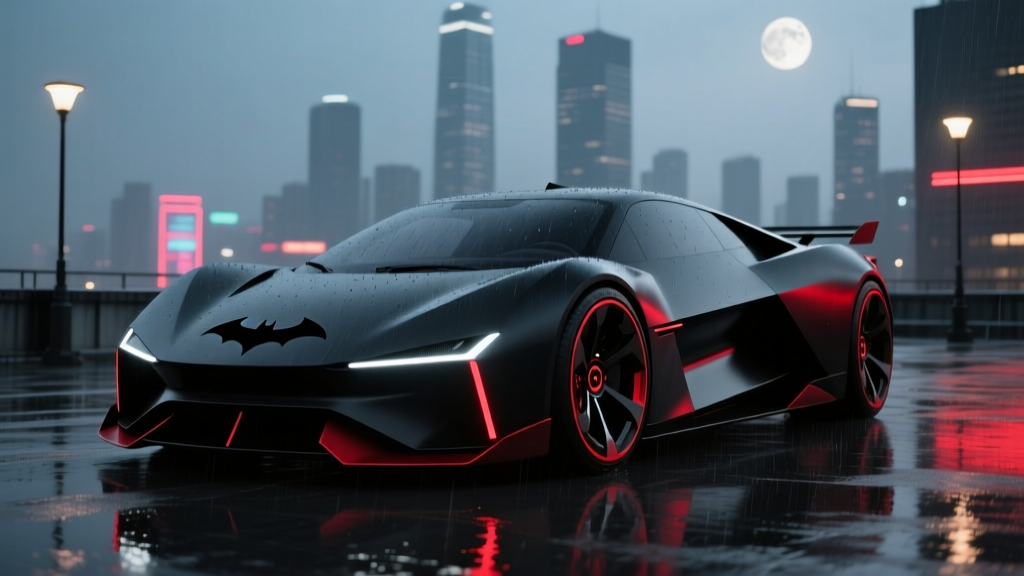
Quick Answer: There is no production vehicle officially called the "Batman Electric Car." However, the concept resonates because several 2026 EVs deliver Batmobile-adjacent performance: 0-60 mph times under 3.5 seconds, aggressive styling, and 300+ miles of EPA range. The closest real-world equivalents include the Tesla Model S Plaid (0-60 in 1.99s, 396 mi EPA), the Lucid Air Sapphire (0-60 in 1.89s, 427 mi EPA), and the Rivian R1T Tri-Motor for utility-minded buyers. If you're searching for a batman electric car because you want menacing design paired with extreme EV performance, this guide maps the real specs, costs, and ownership realities behind the fantasy.
What People Actually Mean by "Batman Electric Car"
The search term "batman electric car" spikes whenever a new superhero film drops or a viral render circulates. What buyers are actually looking for falls into three buckets:
- Extreme performance EVs — supercar acceleration with stealth-quiet electric drivetrains
- Aggressive, dark aesthetic — matte black finishes, angular bodywork, tinted everything
- Advanced tech and autonomy — vehicles that feel like they belong in Wayne Enterprises' R&D lab
No automaker licenses the Batman brand for a production car (Warner Bros. protects that IP aggressively). But the EV market in 2026 has closed the gap between comic-book fantasy and showroom reality. Let's look at what's actually available, what it costs, and whether you should buy one.
The Real EVs That Match Batmobile Specs
Here's how the top performance EVs stack up against the fictional Batmobile's commonly cited attributes: rapid acceleration, long range, advanced driver aids, and intimidation factor.
| Vehicle | EPA Range | Battery (kWh) | 0-60 mph | Peak DC Charge | 10-80% Time | Base MSRP |
|---|---|---|---|---|---|---|
| Tesla Model S Plaid | 396 mi | 100 kWh (NMC) | 1.99s | 250 kW | ~27 min | $89,990 |
| Lucid Air Sapphire | 427 mi | 118 kWh (NMC) | 1.89s | 300 kW | ~20 min | $249,000 |
| Porsche Taycan Turbo GT | 269 mi | 105 kWh (NMC) | 2.1s | 320 kW | ~18 min | $230,000 |
| Rivian R1T Tri-Motor | 328 mi | 141 kWh (NMC) | 2.9s | 200 kW | ~35 min | |
| BMW iX M70 | 296 mi | 111.5 kWh (NMC) | 3.6s | 200 kW | ~31 min | $111,500 |
Real-world range caveat: EPA estimates assume mixed driving at moderate temperatures. Expect 15-25% range reduction at sustained highway speeds above 75 mph, and 20-35% loss in freezing conditions (below 30°F). A Model S Plaid rated at 396 miles will realistically deliver 290-320 miles on a cold-weather highway trip.
🔋 Real-World Range Reality: The Lucid Air Sapphire's 427-mile EPA rating is class-leading, but its efficiency edge comes partly from lower curb weight and superior aerodynamics (Cd 0.197). In EPA testing, it achieves 131 MPGe combined. Expect roughly 340-370 miles in mixed real-world driving, and closer to 280-300 miles if you're driving aggressively — which, in a car with 1,234 horsepower, you will be.
Cost Breakdown: What a "Batman EV" Actually Costs to Own
The fantasy doesn't account for insurance premiums, electricity costs, or tire bills. Let's run the real numbers for a Tesla Model S Plaid — the most accessible Batmobile analog — compared to a gas-powered performance sedan like the BMW M5.
| Cost Category | Tesla Model S Plaid | BMW M5 (Gas) |
|---|---|---|
| Purchase Price (MSRP) | $89,990 | $119,900 |
| Federal Tax Credit (§30D) | $0 (exceeds income/MSRP caps) | $0 |
| Fuel/Energy (5 yrs, 75k mi) | $5,400 (home charging @ $0.14/kWh) | $14,250 (@ $3.80/gal, 16 MPG) |
| Maintenance (5 yrs) | $2,100 | $7,500 |
| Insurance (5 yrs, avg) | $18,500 | $14,000 |
| Tire Replacement (5 yrs) | $4,800 (high-performance rubber) | $4,200 |
| Total 5-Year Cost | $120,790 | $159,850 |
Key takeaway: The Model S Plaid saves roughly $39,000 over five years versus the M5, despite higher insurance premiums. EV insurance costs 15-30% more than comparable gas cars due to higher repair costs and battery replacement risk, according to IIHS data. But fuel and maintenance savings dominate the equation.
Note on the federal EV tax credit: At these price points, neither vehicle qualifies. The IRS §30D credit caps sedan eligibility at $55,000 MSRP and buyer income at $150,000 (single) or $300,000 (joint). Performance EVs in the $90K+ range are ineligible regardless of battery sourcing.
EV vs. Gas: Performance Reality Check
The Batmobile was always imagined as impossibly fast. Electric powertrains have made that performance mundane — in the best possible way.
| Metric | Tesla Model S Plaid (EV) | BMW M5 (Gas) | Advantage |
|---|---|---|---|
| 0-60 mph | 1.99 seconds | 3.3 seconds | EV by 1.3s |
| Quarter Mile | 9.23 seconds | 11.1 seconds | EV |
| Horsepower | 1,020 HP | 617 HP | EV |
| Top Speed | 200 mph | 190 mph | EV (slight) |
| Instant Torque | Yes (0 RPM) | No (needs revs) | EV |
| Track Laps Before Overheating | ~2-3 hard laps | 5+ laps | Gas |
| Refuel/Recharge Time | 27 min (10-80%) | 5 min (full tank) | Gas |
The electric advantage is brutal off the line. Three tri-motor EVs produce instant torque at zero RPM — no turbo lag, no transmission shift delays. But gas cars still hold advantages in sustained track use (better thermal management for repeated hard laps) and refueling speed. If your Batmobile fantasy involves daily stealth commuting and occasional drag-strip dominance, EV wins. If you're planning track days, a gas supercar still has cooling endurance advantages.
What a First-Time EV Buyer Must Know
If the "batman electric car" search is your entry point into EV ownership, here's what separates fantasy from practical reality:
Home Charging Is Non-Negotiable for Most Owners
Over 80% of EV charging happens at home. You'll need:
- Level 2 charger (240V): Adds 25-44 miles of range per hour. A full overnight charge for a 100 kWh battery takes 8-10 hours on a 48-amp circuit.
- Electrical panel capacity: Most homes need a 200-amp panel. Upgrading from 100-amp costs $1,500-$3,500.
- Installation: Expect $800-$2,500 for a licensed electrician to run a dedicated 60-amp circuit and mount a hardwired charger (or install a NEMA 14-50 outlet).
- Equipment: Quality Level 2 chargers (ChargePoint Home Flex, Tesla Wall Connector, Emporia Vue) run $400-$700.
Total home charging setup: $1,500-$5,000 depending on panel condition and run length from panel to garage.
Public Fast Charging: The Reality
DC fast chargers (150-350 kW) are essential for road trips. Here's what to expect:
- Tesla Superchargers: Most reliable network; 250 kW V3 stalls deliver 10-80% in ~27 minutes for the Model S.
- Electrify America / EVgo: Expanding rapidly, but reliability varies. Expect 15-20% of chargers to be out of service at any given time based on industry reports.
- Charging curve taper: No EV sustains peak charge rate. A "320 kW peak" Porsche Taycan charges at that rate only between 10-30% SoC, then tapers progressively. The 10-80% time matters more than peak kW.
Cold Weather Range Loss Is Real
Lithium-ion batteries lose efficiency in cold temperatures. At 20°F:
- Expect 20-35% range reduction depending on whether you precondition the battery
- Charging speeds drop significantly until the battery warms (preconditioning via navigation to a charger helps)
- Heat pumps (standard on Tesla, Lucid, most 2026 EVs) reduce cabin-heating energy draw by 30-50%
Myths vs. Facts: Batman EV Edition
| Myth | Fact |
|---|---|
| "EV batteries need replacing every 5 years" | Modern NMC and LFP batteries are warrantied for 8 years/100,000 miles with a minimum 70% capacity retention threshold. Real-world degradation averages 1-2% per year. Most batteries outlast the vehicle. |
| "You can't drive an EV in the rain or through puddles" | EV battery packs are sealed to IP67 or IP69K standards. They're fully waterproof for normal driving conditions. The Batmobile's waterfall cave entrance? Probably fine. |
| "Performance EVs are heavier and handle worse" | A Model S Plaid weighs 4,766 lbs — yes, heavy. But the low center of gravity (battery pack under the floor) and torque-vectoring tri-motor AWD produce cornering grip that rivals mid-engine sports cars. Skid pad: ~0.95g. |
| "EVs are worse for the environment than gas cars" | Manufacturing an EV produces 30-40% more emissions initially (battery production). But over a 150,000-mile lifetime, even on a coal-heavy grid, an EV produces 50-70% fewer lifecycle emissions (EPA lifecycle analysis). On renewable-heavy grids, the advantage is 70-85%. |
| "Self-driving means I can sleep behind the wheel" | Tesla Autopilot and FSD (Supervised) are SAE Level 2 systems — the driver must remain fully engaged, hands on or near the wheel, eyes on the road. Only Waymo and Zoox robotaxis operate at Level 4 (no driver needed), and only in geofenced urban areas. |
⚠️ SAE Automation Level Reality: Every consumer EV sold in 2026 — including Tesla with FSD, GM with Super Cruise, Ford with BlueCruise — is SAE Level 2. This means the car can steer, accelerate, and brake under certain conditions, but the driver is legally and practically responsible at all times. True "self-driving" (Level 4) exists only in commercial robotaxi fleets in limited cities.
Decision Framework: Should You Buy a "Batman" EV?
Choose a Tesla Model S Plaid if:
- You want the best performance-per-dollar in the EV space ($89,990 for a 1.99s car)
- You need access to the Supercharger network for road trips
- You value over-the-air updates and a mature software ecosystem
- You can charge at home and your commute is under 200 miles round-trip
Choose a Lucid Air Sapphire if:
- Budget is not a primary constraint ($249,000 MSRP)
- You want maximum range (427 mi EPA) alongside maximum performance
- You value exclusivity — fewer than 500 Sapphires were built for 2025-2026
- You prioritize interior luxury alongside performance
Choose a Porsche Taycan Turbo GT if:
- Track driving matters — Porsche's thermal management sustains performance longer
- You want the fastest charging in the segment (320 kW peak, 10-80% in ~18 min)
- Build quality and dealer service experience are top priorities
- Range is secondary (269 mi EPA is the trade-off)
Look elsewhere if:
- You can't install a Level 2 charger at home and lack reliable public charging nearby
- You regularly drive 400+ miles in a single day in cold weather — the charging stops will add up
- Your budget is under $50,000 — consider a Tesla Model 3 Performance ($54,990) or Hyundai Ioniq 5 N ($66,000) for a more accessible take on the performance-EV formula
Frequently Asked Questions
Is there an official Batman electric car I can buy?
No. No automaker produces a licensed Batman-branded vehicle. The cars used in films (the Tumbler in the Nolan trilogy, the 2022 Batmobile in The Batman) are custom-built props with no road-legal production equivalents. However, several 2026 EVs deliver comparable performance and styling aggression — see our spec table above.
What's the cheapest EV that feels like a Batmobile?
The Tesla Model 3 Performance at $54,990 delivers a 3.1-second 0-60 time, 315 miles of EPA range, and access to the Supercharger network. In Stealth Mode (reduced motor noise), it's eerily quiet under acceleration — the closest thing to a Batmobile on a budget. Note: it exceeds the $55,000 MSRP cap for the §30D federal tax credit for sedans, so no $7,500 credit applies.
How much does it cost to charge a performance EV at home?
A 100 kWh battery (Model S Plaid) charged from 10-90% at the US average residential rate of $0.16/kWh costs about $12.80. That's equivalent to roughly 300 miles of range. Compare that to $70-$80 for 300 miles of gas in a BMW M5 (at 16 MPG combined and $3.80/gallon). Annual home charging for 15,000 miles of driving: approximately $1,080 vs. $3,560 in gas.
Will a high-performance EV battery degrade faster?
Frequent hard acceleration and regular DC fast charging above 150 kW do accelerate degradation slightly, but modern battery management systems (BMS) actively protect the pack. Tesla reports average fleet degradation of about 12% after 200,000 miles. The 8-year/150,000-mile warranty (70% capacity retention minimum) provides a strong floor. For maximum longevity, charge to 80% daily, use DC fast charging for road trips only, and avoid leaving the car at 100% SoC for extended periods.
Do performance EVs qualify for any tax credits?
Under current IRS §30D rules, new EVs must have an MSRP under $55,000 (sedans) or $80,000 (SUVs/trucks/vans), and buyer income must be under $150,000 (single) or $300,000 (joint). Most "Batmobile" EVs — Model S Plaid, Lucid Air Sapphire, Taycan Turbo GT — exceed these caps and are ineligible. The used EV credit (§25E) offers up to $4,000 on vehicles under $25,000, which also excludes these models. Always verify eligibility with a tax professional before purchasing.
The batman electric car may not exist as a production vehicle, but the technology it represents — silent, instant, brutal acceleration wrapped in dark, aggressive design — is available today. The question isn't whether you can buy something that feels like a Batmobile. It's whether you're ready for the charging logistics, insurance premiums, and tire bills that come with it. Run the numbers, install a Level 2 charger, and the fantasy becomes a very fast, very real daily driver.