Quick Answer: The Baker Electric car was manufactured by the Baker Motor Vehicle Company of Cleveland, Ohio, from 1899 to 1915. It was one of the most popular electric vehicles of the early automotive era, offering 20–50 miles of range on lead-acid batteries at speeds up to 14 mph. No Baker Electric car is available for purchase new today — surviving examples exist only in museums and private collections. However, the Baker's story illuminates exactly why modern EVs (with 250+ miles of EPA range, lithium-ion batteries, and DC fast charging) finally solved the problems that killed the electric car a century ago.
If you've landed here searching for a "Baker Electric car," you're likely either a history enthusiast curious about early electric vehicles, or a modern EV shopper who stumbled onto the name. Either way, understanding what the Baker Electric was — and why it disappeared — provides a remarkably useful lens for evaluating today's EV market. The same fundamental questions buyers asked in 1905 (range, charging access, cost vs. gas, cold-weather performance) are the ones we answer with real data in 2026.
The Baker Electric Car: What It Was and Why It Mattered
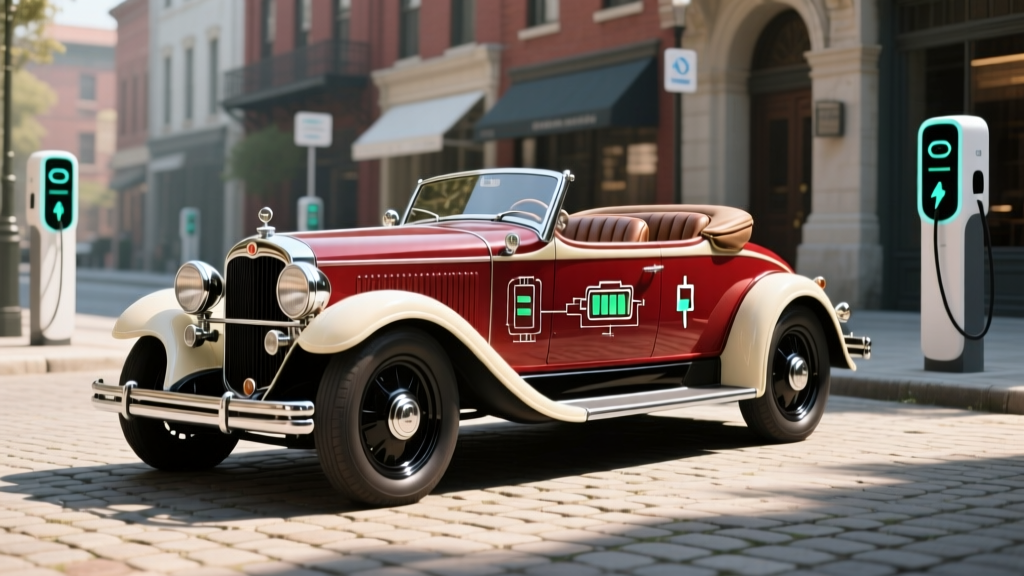
Walter C. Baker founded the Baker Motor Vehicle Company in Cleveland in 1899, at a time when electric cars outsold both gasoline and steam-powered vehicles in the United States. By 1906, Baker was the largest manufacturer of electric automobiles in the country, producing roughly 800 vehicles per year.
The Baker Electric wasn't a performance machine — it was a refined urban runabout aimed at affluent buyers, particularly women, who valued its quiet operation, lack of hand-cranking, and absence of exhaust fumes. Here's what the specs looked like at its peak:
| Specification | Baker Electric (~1907 Model C) |
|---|---|
| Motor | Single DC electric motor, ~3.5 hp |
| Battery | Lead-acid cells, ~40–60 kWh equivalent (extremely heavy) |
| Range | 20–50 miles (depending on speed and battery condition) |
| Top Speed | 12–14 mph |
| Charge Time | 8+ hours (residential DC or dedicated charging stations) |
| Price | $1,600–$3,000 (~$55,000–$100,000 in 2026 dollars) |
| Body Styles | Runabout, brougham, depot wagon, surrey |
The Baker's appeal was genuine but narrow. For city dwellers with access to electricity (still a luxury in the early 1900s), it was clean, simple, and reliable. Thomas Edison famously owned a Baker Electric and collaborated with Baker on early nickel-iron battery experiments. Clara Ford, wife of Henry Ford, drove a Baker Electric — even as her husband's Model T was reshaping the automotive landscape.
Why the Baker Electric Disappeared — and What It Teaches Modern Buyers
By 1915, Baker had ceased automobile production. The reasons map almost perfectly onto the concerns modern EV shoppers still raise:
- Range limitations: 20–50 miles was adequate for city errands but useless for the expanding road network. Gasoline cars could travel 150+ miles and refuel in minutes.
- Charging infrastructure gaps: Outside major cities, electricity was scarce. Rural America had no grid to speak of. This is the historical root of what we now call "charging deserts."
- Battery weight and cost: Lead-acid batteries were enormously heavy relative to their energy density, limiting performance and requiring expensive replacements every 1–3 years.
- The electric starter (1912): Cadillac's introduction of the electric starter eliminated gasoline cars' biggest drawback — dangerous hand-cranking — removing a key reason buyers chose electric.
- Price undercut: Ford's Model T, priced at $260 by 1925, made the $2,000+ Baker economically unviable for all but the wealthiest buyers.
These are not just history trivia. Every single one of these failure points has been directly addressed — or remains a relevant consideration — in the 2026 EV market.
Baker Electric vs. a 2026 EV: The Numbers That Changed Everything
To make the comparison concrete, here's how a representative Baker Electric stacks up against a popular 2026 EV — the Hyundai Ioniq 5 (Standard Range) — on the exact criteria buyers in any era care about:
| Criterion | Baker Electric (~1907) | 2026 Hyundai Ioniq 5 (Std Range RWD) |
|---|---|---|
| EPA Range | ~20–50 mi (no EPA existed) | 290 mi (EPA est.) |
| Real-World Highway Range | ~20 mi at top speed | ~240–260 mi (70 mph, moderate weather) |
| Cold-Weather Range | Severely reduced (lead-acid) | ~200–220 mi (20°F, heat pump equipped) |
| Battery Chemistry | Lead-acid | NMC lithium-ion, ~58 kWh usable |
| Battery Weight | ~1,000+ lbs | ~770 lbs (far higher energy density) |
| Top Speed | 14 mph | 115 mph (electronically limited) |
| 0–60 mph | N/A (never reached 60) | 7.2 seconds |
| "Fast Charge" Time | 8+ hours (no fast charging) | ~18 min 10–80% at peak 175 kW DC |
| Home Charge (Level 2) | 8–12 hours on 110V DC | ~5.5 hours (10.9 kW, 240V Level 2) |
| Base Price | ~$2,000 (~$70,000 adj.) | $42,600 MSRP |
| Federal Tax Credit | None | Up to $7,500 (§30D, income/sourcing rules apply) |
The transformation is staggering. A century of battery chemistry research — from lead-acid to nickel-metal hydride to today's NMC and LFP lithium-ion cells — turned the EV from an urban curiosity into a vehicle that outsells many gasoline cars on practicality alone. According to fueleconomy.gov, the average 2026 EV achieves 3–4 miles per kWh, meaning a 58 kWh battery delivers roughly 230–290 real-world miles.
Modern EV Ownership Costs: What Baker Buyers Would Have Dreamed Of
The Baker Electric's total cost of ownership was punishing. Lead-acid batteries degraded rapidly, replacement cells were expensive, and the vehicle's resale value collapsed as gasoline cars improved. Here's how a modern EV compares on the cost dimensions that matter to today's buyer:
| Cost Factor | 2026 EV (e.g., Ioniq 5) | 2026 Gas Sedan (e.g., Toyota Camry LE) |
|---|---|---|
| Purchase Price (MSRP) | $42,600 | $29,995 |
| Federal Tax Credit (§30D) | Up to –$7,500 (see IRS §30D rules) | $0 |
| Effective Price After Credit | ~$35,100 | $29,995 |
| Fuel/Energy (5 yr, 15k mi/yr) | ~$4,500 (home L2, $0.14/kWh avg) | ~$10,500 ($3.50/gal, 32 MPG avg) |
| Maintenance (5 yr) | ~$2,000 (no oil, fewer brakes) | ~$4,500 (oil, filters, brakes, belts) |
| Insurance (5 yr avg) | ~$11,000 (EVs often 15–25% higher) | ~$9,000 |
| 5-Year Total Cost | ~$52,600 | ~$53,995 |
The EV wins on 5-year total cost by a narrow margin in this scenario, but the real advantage grows with mileage, home solar charging, or state incentives. The critical caveat: insurance premiums for EVs remain higher on average due to battery replacement costs in collision claims, and upfront price gaps persist even after credits. These are the kinds of trade-offs Baker buyers faced in 1910 — just with far better outcomes today.
Real-World Ownership: What First-Time EV Buyers Must Know
If the Baker Electric's history teaches one lesson, it's that infrastructure determines adoption. Baker failed because most Americans lacked electricity. In 2026, most EV buyers still need to solve the home charging question before purchasing. Here's the practical framework:
Home Charging Access
Roughly 70–80% of EV charging happens at home. A Level 2 home charger (240V, 32–48 amps) adds 25–40 miles of range per hour and fully recharges most EVs overnight. Installation costs typically range from $500 (simple outlet near panel) to $2,500+ (panel upgrade, long conduit runs). Renters and condo dwellers face real barriers — this is the modern equivalent of the Baker's urban-only limitation.
Climate Impact on Range
Cold weather reduces EV range by 15–30% at 20°F, primarily due to battery chemistry resistance and cabin heating demands. EVs equipped with heat pumps (standard on most 2026 models from Hyundai, Tesla, BMW) recover 5–10% of that loss compared to resistive heaters. The Baker's lead-acid batteries suffered even worse cold-weather degradation — a problem modern chemistry has reduced but not eliminated.
Public Charging Reality
The U.S. now has over 70,000 public charging ports, but reliability varies widely. Networks like Tesla Supercharger (now open to NACS-equipped non-Tesla EVs) offer 95%+ uptime. Others, including some Electrify America and EVgo stations, still experience 10–20% failure rates in independent surveys. Planning road trips around verified chargers — using apps like A Better Routeplanner — remains essential.
Common EV Myths — Then and Now
The objections raised against the Baker Electric in 1905 sound remarkably familiar. Here's how the facts have changed:
| Myth | Then (1905) | Now (2026) |
|---|---|---|
| "EVs can't go far enough" | True — 20–50 mi max | Mostly false — 250–400 mi EPA on mainstream models |
| "Charging takes too long" | True — 8+ hours, no fast option | 10–80% in 18–25 min at 150–350 kW DC stations |
| "Batteries won't last" | True — lead-acid replaced every 1–3 years | NMC/LFP batteries warrantied 8 yr/100k mi; data shows ~10–15% degradation at 150k mi |
| "EVs are more expensive" | True — 3–5x a gas car | Partially true upfront, but TCO often breaks even within 3–5 years |
| "No infrastructure" | True — electricity was rare outside cities | Partially true in rural areas; urban/suburban coverage is strong |
Decision Framework: Is a Modern EV Right for You?
The Baker Electric was the right car for a very specific buyer in 1905 — wealthy, urban, short-distance, with electricity access. Use this framework to determine if a 2026 EV fits your situation:
Choose a BEV (battery electric vehicle) if:
- You can install a Level 2 charger at home (garage, driveway, or workplace)
- Your daily driving is under 80 miles round-trip (covers ~90% of U.S. commutes)
- You take road trips 4+ times per year but can plan around DC fast chargers
- You want the lowest per-mile energy cost (~$0.04/mi on home electricity vs. ~$0.12/mi on gasoline)
- You qualify for the §30D federal tax credit (income ≤$150k single / $300k joint; vehicle MSRP ≤$55k cars / $80k SUVs/trucks; battery sourcing rules apply — verify at irs.gov)
Choose a PHEV (plug-in hybrid) if:
- You lack reliable home charging but want some electric-only driving (typically 25–45 mi EPA electric range)
- You frequently drive in rural areas or regions with sparse DC charging
- You want EV-like commuting with zero range anxiety on long trips
Wait or reconsider if:
- You live in an apartment with no charging option and no workplace charger
- Your region has extreme cold (regularly below 0°F) and you need full rated range
- Your budget cannot absorb higher insurance premiums or a $35,000+ entry price after credits
What the Baker Electric Teaches Us About the EV Market Today
Walter Baker didn't fail because his technology was wrong — he failed because the supporting ecosystem (grid infrastructure, battery chemistry, manufacturing scale) hadn't caught up to the concept. The modern EV market exists because lithium-ion energy density improved roughly 300% since commercialization in 1991, because the U.S. electrical grid now reaches 99.9% of households, and because manufacturing scale has driven battery pack costs from $1,200/kWh in 2010 to approximately $115/kWh in 2026 (per BloombergNEF data).
The Baker Electric's legacy isn't just a museum piece — it's proof that the EV idea was always sound. What changed was the physics, the economics, and the infrastructure. For today's buyer, the question is no longer "can an electric car work?" but "does my specific situation make an EV the optimal choice?" The data, for most drivers with home charging access, now says yes.
Does anyone still make a Baker Electric car?
No. The Baker Motor Vehicle Company ceased automobile production in 1915 after merging with Detroit Electric and later shifting to industrial electric vehicles. Surviving Baker Electric cars are held by museums (including the NHTSA historical collections and private owners) and occasionally appear at auction for $50,000–$150,000+.
How far could a Baker Electric car travel on a charge?
Between 20 and 50 miles depending on speed, terrain, battery age, and temperature. At its top speed of 14 mph, range dropped significantly. This is roughly equivalent to a modern EV with a depleted battery — highlighting why lithium-ion chemistry's 250+ mile range was the breakthrough that made EVs viable for mainstream buyers.
Why did early electric cars lose to gasoline cars?
Three factors converged: the electric starter (1912) eliminated gasoline cars' worst drawback; Ford's Model T achieved mass-production pricing ($260 by 1925) that electrics couldn't match; and the expanding road network demanded range that lead-acid batteries couldn't provide. The rural electrical grid also lagged far behind gasoline distribution.
What's the closest modern equivalent to the Baker Electric's mission?
The Baker was an urban commuter vehicle for short trips — a role now filled by EVs like the Nissan LEAF (149–212 mi EPA, ~$29,000 MSRP) or the Mini Cooper SE (114 mi EPA, ~$31,000 MSRP). Both solve the Baker's range and charging limitations while serving the same fundamental use case: quiet, clean, low-cost city driving.
Are modern EV batteries as fragile as the Baker's lead-acid cells?
Not at all. Modern NMC and LFP lithium-ion batteries are warrantied for 8 years or 100,000 miles (federally mandated minimum) with a capacity retention threshold of 60–70%. Real-world data from fleet operators shows most lithium-ion packs retain 85–90% capacity at 150,000 miles. LFP chemistry, used in standard-range Tesla Model 3 and some Ford Mustang Mach-E trims, offers even longer cycle life with slightly lower energy density.