Quick Verdict: Can You Daily-Drive a Bagged Tesla?
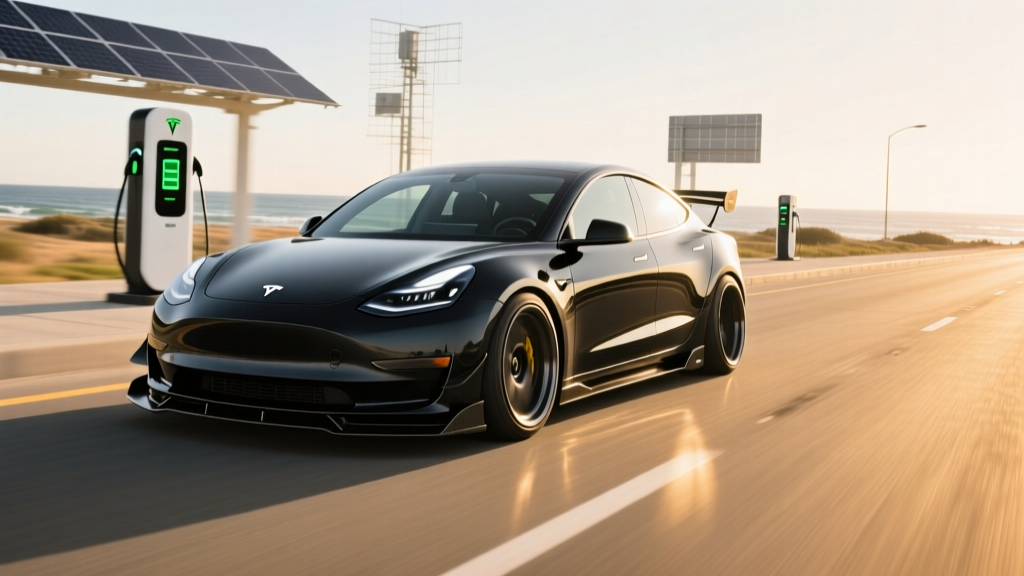
A bagged Tesla—typically a Model 3 or Model Y fitted with aftermarket air suspension—has become one of the most popular modifications in the EV aftermarket scene. The appeal is obvious: drop the ride height for a slammed show stance, raise it back up for speed bumps and driveways. But when you're modifying a vehicle whose efficiency, range, and tire wear are all tightly calibrated by the factory, the real-world trade-offs deserve a hard look before you spend $3,000–$6,000 on an air-ride kit.
This profile examines the 2026 Tesla Model 3 Long Range AWD as the most common platform for bagging, covering what lowering does to your EPA range, charging dynamics, tire wear, warranty exposure, and daily usability. We'll also cover the stock vehicle's full spec sheet so you know exactly what you're starting with.
2026 Tesla Model 3 Long Range AWD: Stock Specifications
Before modifying, here's what Tesla delivers from the factory. These figures are your baseline—any suspension change will interact with them.
| Specification | 2026 Model 3 Long Range AWD |
|---|---|
| EPA Estimated Range | 341 miles |
| Battery Capacity (Usable) | ~79 kWh (NMC chemistry) |
| Drivetrain | Dual-motor AWD |
| Horsepower | ~384 hp combined |
| 0–60 mph | 4.2 seconds |
| Efficiency | 132 MPGe combined / 25 kWh/100 mi |
| Max DC Fast Charge Rate | 250 kW (peak) |
| 10–80% DC Fast Charge Time | ~27 minutes |
| Level 2 Home Charging (11.5 kW) | ~44 miles per hour of charging |
| Cargo Volume | 23 cu ft (rear trunk + frunk combined) |
| Rear Legroom | 35.3 inches |
| Base MSRP | $47,740 (before incentives) |
| Battery Warranty | 8 years / 120,000 miles (70% capacity retention) |
| Basic Vehicle Warranty | 4 years / 50,000 miles |
The EPA sticker says 341 miles, but real-world results vary significantly. On a flat 70-mph highway loop in moderate temperatures (65–75°F), expect 290–310 miles before needing to charge. In cold weather (below 30°F), range can drop to 240–270 miles due to battery resistance and cabin heating demands. City driving with heavy regenerative braking use can push closer to the EPA figure or slightly above. Lowering the car via air suspension may improve aerodynamics marginally at highway speeds but typically costs more in increased rolling resistance from aggressive camber settings.
What Does "Bagged" Actually Mean on a Tesla?
In the EV aftermarket, "bagged" refers to replacing the factory coil-spring suspension with an air suspension system using air bags (air springs) at each corner. Popular kits for the Model 3 include offerings from Air Lift Performance, AccuAir, and BAGS (Bagged Auto Garage System). These systems let you:
- Lower the vehicle 1.5–3.0 inches below stock ride height for show or aesthetic purposes
- Raise the vehicle on demand via a phone app or in-cabin controller to clear obstacles
- Adjust ride stiffness through air pressure management (though damping is handled by separate shock/strut components)
A typical air-ride installation on a Model 3 runs $3,500–$6,000 for the kit plus professional installation, with premium setups featuring 3H/3P air management (height sensors and automatic leveling) pushing toward the upper end.
How Lowering Affects Range, Efficiency, and Tire Wear
This is where most bagged-Tesla owners report surprises. The Model 3's factory ride height and alignment are optimized for its efficiency targets. When you drop the car, several things change:
Aerodynamic Gains vs. Rolling Resistance Losses
A lower vehicle presents a smaller frontal area and reduced underbody turbulence, which theoretically improves aerodynamic drag. Tesla's own engineering already runs the Model 3 quite low. The marginal aero gain from an additional 1.5-inch drop is typically 1–3% at highway speeds—translating to maybe 5–10 miles of range on a full charge.
However, most bagged setups require aggressive negative camber (often -2° to -4°) to fit wider wheels or achieve the desired stance. Negative camber increases the tire's contact patch deformation, raising rolling resistance. In practice, owners running -3° or more of camber report 5–12% range loss compared to stock alignment, which can mean losing 20–40 miles of real-world range.
Tire Wear Acceleration
Aggressive camber is the number-one killer of tires on bagged EVs. Where a stock Model 3 might see 30,000–40,000 miles from a set of all-season tires, owners running heavy negative camber frequently report needing replacements at 12,000–18,000 miles. EV-specific tires like the Michelin Pilot Sport EV or Hankook iON evo are already more expensive than standard tires ($250–$350 per tire), making this a meaningful recurring cost.
Regenerative Braking and Weight Transfer
The Model 3's regenerative braking system is calibrated for the stock suspension geometry. Lowering the car changes weight transfer dynamics under deceleration, which can slightly alter the regen feel. Most owners don't report major issues, but some note a marginally less predictable transition between regen and friction braking on uneven surfaces when the car is at its lowest setting.
Charging Performance: Does Suspension Mod Affect It?
Short answer: No, your charging speed is unaffected by suspension modifications. The battery management system (BMS), thermal management, and charge controller operate independently of suspension geometry. Here's what you can expect from the stock Model 3 Long Range's charging system, whether bagged or not:
| Charging Level | Power / Rate | Speed |
|---|---|---|
| Level 1 (120V household) | ~1.4 kW | ~5 miles per hour |
| Level 2 (240V, 48A Wall Connector) | 11.5 kW | ~44 miles per hour |
| DC Fast Charge (Supercharger V3/V4) | 250 kW peak | 10–80% in ~27 min |
| DC Fast Charge (CCS adapter at EA/others) | Up to 250 kW (station dependent) | Varies by station capability |
Charging curve reality: The 250 kW peak is only sustained between roughly 10–30% State of Charge (SoC). From 30–60%, expect ~150–180 kW. From 60–80%, the rate tapers to ~80–100 kW. Above 80%, charging slows dramatically to protect the NMC battery—often below 40 kW. This is normal for all lithium-ion packs and is managed by the BMS. Preconditioning the battery (via navigation to a Supercharger) is essential for achieving peak charge rates, especially in cold weather.
Practical note for bagged owners: Some air-suspension setups lower the car enough that the charge port (rear driver-side on the Model 3) sits closer to ground level. At certain Supercharger stalls with short cable reach or high curbs, this can create minor ergonomic annoyance. It's rarely a dealbreaker but is worth noting.
Tax Credit Eligibility and Total Cost
The 2026 Tesla Model 3 Long Range AWD is eligible for the federal §30D EV tax credit, but eligibility depends on multiple factors that change periodically. As of the current IRS rules:
- MSRP cap: Sedans must be priced at or below $55,000. The Model 3 LR at $47,740 qualifies.
- Buyer income cap: Modified AGI must not exceed $150,000 (single), $225,000 (head of household), or $300,000 (joint filers).
- Battery sourcing requirements: A percentage of critical minerals and battery components must be sourced from the U.S. or free-trade-agreement countries. Tesla's supply chain has largely met these thresholds for U.S.-built Model 3 vehicles, but the exact credit amount (up to $7,500) can vary based on the specific build date and sourcing compliance. Check the EPA's qualified vehicle list for your specific VIN.
- Point-of-sale transfer: As of 2024+, you can transfer the credit to the dealer at purchase, reducing your out-of-pocket cost immediately rather than waiting for tax filing.
| Cost Item | Amount |
|---|---|
| Base MSRP (Model 3 LR AWD) | $47,740 |
| Common options (FSD transfer, paint, wheels) | +$1,500–$8,000 |
| As-tested typical price | $49,240–$55,740 |
| Max federal tax credit (§30D) | Up to $7,500 (if eligible) |
| Effective price after max credit | $40,240–$48,240 |
| Air suspension kit + install (aftermarket) | $3,500–$6,000 |
| Alignment + camber kit | $400–$800 |
| Total modified out-the-door (est.) | $44,140–$55,040 |
Important: Always confirm your specific tax credit eligibility with a tax professional and the IRS §30D guidelines. Sourcing requirements and credit amounts have shifted annually, and your individual tax situation determines whether you can claim the full amount.
Warranty Implications of Bagging Your Tesla
This is the most consequential decision factor for most buyers. Tesla's warranty language is specific: modifications that cause damage to covered components can void warranty coverage for those components.
Here's how this breaks down in practice:
What's Likely Still Covered
- Battery pack and drive units: Unless Tesla can demonstrate that the suspension mod directly caused battery or motor damage (extremely unlikely), the 8-year/120,000-mile battery warranty remains intact.
- Infotainment, electronics, and software: Air suspension doesn't touch these systems.
What's at Risk
- Suspension components: Control arms, bushings, subframe mounts—anything Tesla can argue was stressed by non-factory ride height or geometry.
- Half-shafts and CV joints: Altered driveline angles from lowering can accelerate wear. If a half-shaft fails and Tesla traces it to modified geometry, coverage may be denied.
- Steering rack: Changes to tie-rod angles can load the steering rack differently.
The Magnuson-Moss Warranty Act protects consumers from blanket warranty voids—Tesla must prove the modification caused the failure. But fighting a warranty denial is time-consuming and expensive. Many bagged-Tesla owners accept the suspension/steering/driveline risk as a trade-off for the aesthetic.
Pros and Cons of a Bagged Tesla Model 3
Pros
- Dramatic visual impact—best-in-class stance for EV shows and meets
- Adjustable ride height: slam for shows, raise for daily driving
- Modern air-ride kits with 3H height sensors offer preset memory (3+ ride heights)
- Minimal impact on battery/drivetrain warranty when installed properly
- Potential marginal aero improvement at highway speeds (1–3%)
- Strong aftermarket community support and proven kit reliability
Cons
- $3,500–$6,000 upfront cost plus ongoing maintenance (air lines, fittings, compressor)
- Accelerated tire wear from camber—replacements every 12K–18K miles vs. 30K+ stock
- Net range loss of 5–12% when running aggressive negative camber
- Suspension and steering warranty coverage at risk
- Air system can develop leaks over time—compressor and bag replacement costs
- Ride quality can suffer depending on kit quality and tuning
- Ground clearance concerns even at raised setting on steep driveways
Who Should (and Shouldn't) Bag Their Tesla?
Bag your Model 3 if:
- You attend car meets, shows, or EV events regularly and want maximum visual impact
- You're willing to budget $500–$800/year in extra tire costs
- You have a garage or covered parking (air systems dislike extreme cold and moisture)
- You understand and accept the suspension warranty risk
- You primarily drive in urban/suburban areas with manageable road conditions
Keep the stock suspension if:
- Range maximization is your priority (commuting, road trips, rideshare)
- You live in an area with harsh winters, potholes, or rough roads
- You want zero warranty risk on suspension and steering components
- You plan to keep the car 5+ years and want predictable maintenance costs
- You use your Tesla for towing (not common on Model 3, but relevant for Model Y owners)
Bagged Tesla vs. Key Alternatives
If the aesthetic appeal of a lowered EV is your goal but you're weighing options, consider these alternatives:
- Tesla Model 3 Performance with factory lowering springs: Tesla offers sport suspension on the Performance trim that sits ~0.4 inches lower. Aftermarket lowering springs (e.g., Eibach, H&R) can drop another 0.8–1.2 inches for $300–$500—no air system, no compressor maintenance, but a fixed ride height.
- BMW i4 M50: Available with factory adaptive M suspension. Aftermarket air-ride kits exist but are less common and more expensive due to lower aftermarket volume.
- Hyundai Ioniq 6: Its low-slung sedan shape already looks aggressive stock. Air-ride kits are available but the EV aftermarket ecosystem is smaller than Tesla's.
The Tesla Model 3 remains the most supported platform for bagging simply because of parts availability, installer familiarity, and community knowledge. If aftermarket support matters to you, Tesla wins here.
Frequently Asked Questions
What is the real-world range of a bagged Tesla Model 3?
Stock, the 2026 Model 3 Long Range AWD delivers an EPA-estimated 341 miles. In real-world highway driving, expect 290–310 miles at moderate temperatures. With a bagged setup running aggressive negative camber (-3° or more), owners typically see a 5–12% reduction, bringing real-world highway range to approximately 255–295 miles depending on camber, tire choice, and driving style. Cold weather compounds the loss further.
How fast does a bagged Tesla charge?
Suspension modifications do not affect charging speed. The Model 3 Long Range peaks at 250 kW on a V3/V4 Supercharger, achieving 10–80% in approximately 27 minutes with proper battery preconditioning. Home Level 2 charging at 11.5 kW adds about 44 miles per hour, meaning a full overnight charge (8–10 hours) easily replenishes the battery for daily use.
Does a bagged Tesla qualify for the federal EV tax credit?
The tax credit applies to the vehicle as purchased from the dealer, not to aftermarket modifications. If the Model 3 Long Range qualifies for up to $7,500 under §30D at the time of purchase (meeting MSRP, income, and battery-sourcing requirements), you receive that credit regardless of subsequent suspension modifications. The aftermarket air-ride kit itself is not eligible for any tax credit. Consult the IRS guidelines or a tax professional for your specific situation.
Is a bagged Tesla worth it vs. stock or coilover setups?
It depends on your priority. For adjustable ride height and show stance, air suspension is the only option that lets you raise and lower on demand—coilovers are fixed once set. For pure handling improvement, quality coilovers (e.g., KW V3, Bilstein B16) offer better damping control and are generally lighter and more reliable than air setups. For daily-driver practicality with mild lowering, a quality spring set ($300–$500) gives you 1–1.5 inches of drop with minimal maintenance overhead and negligible range impact.
What are the biggest maintenance costs of owning a bagged Tesla?
Beyond standard EV maintenance (tire rotation, cabin air filter, wiper fluid), bagged owners should budget for: tires ($1,000–$1,400 per set, replaced every 12K–18K miles with aggressive camber), air system maintenance (compressor rebuild or replacement every 5–7 years, ~$400–$800; air bag replacement if a leak develops, ~$200–$400 per corner), and alignment checks (recommended every 5,000 miles or after any ride-height change, ~$100–$150 per visit).
Can I bag a Tesla Model Y the same way?
Yes. Air-ride kits from the same manufacturers (Air Lift, AccuAir, BAGS) are available for the Model Y. The Model Y's taller ride height and SUV proportions mean the visual impact is different—more "slammed crossover" than "ground-hugging sedan." The same range, tire-wear, and warranty considerations apply. The Model Y Long Range's EPA range of 320 miles will see similar 5–12% reductions with aggressive camber.