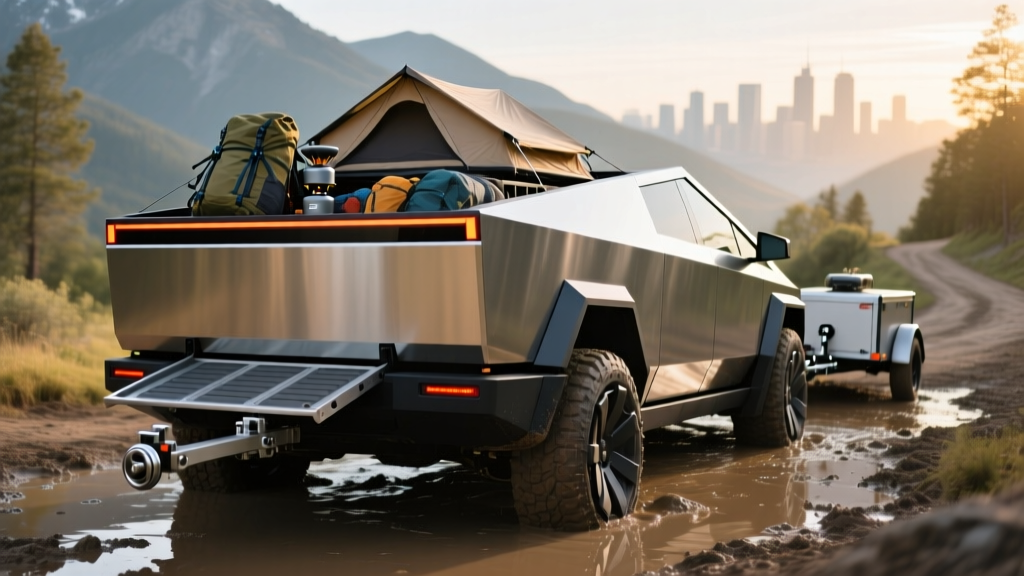
The Tesla Cybertruck is unlike any pickup on the road, and nowhere is that more obvious than the back of Cybertruck—the stainless-steel exoskeleton bed, motorized tonneau cover, and the vault-like storage system that defines its utility proposition. But does the bed actually work for real truck tasks? Can it tow? How does range hold up with a load? This 2026 profile answers those questions with hard data, covering the full AWD and Cyberbeast lineup from cargo dimensions to charging curves.
Quick Verdict: Utility Meets Polarizing Design
The Cybertruck's 6-foot composite bed with a powered roller cover is genuinely innovative for secure, weatherproof hauling, and the 499–845 hp powertrains deliver staggering performance. But the bed's 4-foot width between the wheel wells limits sheet goods, the sloped walls eat into usable volume, and real-world range drops sharply when towing. It's a compelling truck for tech-forward owners who prioritize security and acceleration over traditional bed flexibility.
| Spec | AWD | Cyberbeast |
|---|---|---|
| EPA Range | 340 mi | 320 mi |
| Battery (usable) | ~123 kWh, NMC | ~123 kWh, NMC |
| 0–60 mph | 4.1 sec | 2.6 sec |
| Horsepower | 600 hp | 845 hp |
| Drivetrain | Dual-motor AWD | Tri-motor AWD |
| Max DC Fast Charge | 250 kW | 250 kW |
| 10–80% DC Time | ~30 min | ~30 min |
| Level 2 Home Rate | 11.5 kW (~30 mi/hr) | 11.5 kW (~30 mi/hr) |
| MPGe (combined) | 70 MPGe | 68 MPGe |
| Towing Capacity | 11,000 lb | 11,000 lb |
| Payload | 2,500 lb | 2,500 lb |
| Base MSRP | $79,990 | $99,990 |
| Battery Warranty | 8 yr / 120,000 mi | 8 yr / 120,000 mi |
Range and Efficiency: EPA Sticker vs. Loaded Reality
The AWD Cybertruck carries an EPA-estimated 340 miles of range; the tri-motor Cyberbeast drops to 320 miles. Efficiency is rated at roughly 48 kWh/100 mi, which translates to 70 MPGe combined—competitive with other large electric pickups like the Rivian R1T and Ford F-150 Lightning, but far from the efficiency of a sedan or crossover.
EPA 340 mi (AWD) / 320 mi (Cyberbeast). Expect 270–290 mi on a highway road trip at 70–75 mph. With a 5,000-lb trailer, range can fall to 150–180 mi. Cold weather (below 32°F) typically knocks 15–25% off the sticker, landing around 250–270 mi for mixed driving. The 800V-class architecture helps mitigate some losses via efficient thermal management, but physics still governs a 6,800-lb stainless-steel wedge.
Charging the Cybertruck: DC Fast, Level 2, and NACS Native
As a native NACS vehicle, the Cybertruck plugs directly into Tesla Superchargers—now the largest and most reliable DC fast-charging network in the U.S. Peak rate is 250 kW on V3 Superchargers and up to 350 kW at V4 posts where available, though sustained rates depend on state of charge and battery temperature. Preconditioning engages automatically when the nav routes to a charger.
| Level | Power | Speed / Time |
|---|---|---|
| Level 1 (120V) | 1.4 kW | ~3–4 mi/hr |
| Level 2 (240V, 48A) | 11.5 kW | ~30 mi/hr (full in ~11 hr) |
| DC Fast (V3 Supercharger) | 250 kW peak | 10–80% in ~30 min |
| DC Fast (V4 Supercharger) | Up to 350 kW peak | 10–80% in ~22 min (where available) |
Home charging at 11.5 kW via a Tesla Wall Connector on a 60A circuit is the practical daily solution—most owners wake up with a full pack. For non-Tesla DC networks, the Cybertruck needs no adapter, since most U.S. networks have transitioned to NACS by 2026. For older CCS-only posts, Tesla sells a CCS-to-NACS adapter.
Performance: 0–60 in a Pickup That Defies Physics
The dual-motor AWD Cybertruck hits 60 mph in 4.1 seconds with 600 hp, which is already sports-sedan territory. The Cyberbeast, with its tri-motor setup and 845 hp, does it in 2.6 seconds—faster than a Porsche 911 Turbo S. Tesla's torque-vectoring rear axle and steer-by-wire steering make the truck surprisingly agile, though the 6,800-lb curb weight is always present in emergency maneuvers. Air suspension with adaptive damping adjusts ride height from 9 to 17 inches of ground clearance.
The Back of Cybertruck: Bed Dimensions, Payload, and the Vault
This is the section truck buyers care about most. The Cybertruck's bed is 6 feet long and 4 feet wide between the wheel wells—narrower than the 5-foot width typical in full-size pickups. The sloped, angular walls and composite construction give it a distinctive look but reduce usable volume compared to a conventional box. Total bed volume is approximately 57 cubic feet.
- Bed length: 72 in (6 ft)
- Bed width (max): 54 in
- Bed width (between wells): 48 in — a standard 4x8 sheet of plywood does not lie flat
- Payload: 2,500 lb
- Towing capacity: 11,000 lb (braked)
- Tonneau: Powered stainless-steel roller cover, lockable, supports ~300 lb on top
- Frunk: ~7 cu ft of front-trunk space
- "Vault" storage: Sealed under-bed compartments accessible from the sides
- 120V/240V bed outlets: Up to 9.6 kW of onboard power ( Powers tools, lights, or a campsite)
The powered tonneau is the standout feature: it rolls open and closed via the touchscreen or key fob, turning the bed into a lockable, weatherproof trunk. For contractors hauling tools or families with gear, this is a genuine advantage over an open bed. The tradeoff is vertical clearance—tall items like motorcycles or pallets require the cover to be fully open, and the sloped rear profile limits stacking height.
Interior Space, Tech, and Driver Assistance
Inside, the Cybertruck seats five, though the rear bench is tight for adults on longer trips—legroom is 38.4 inches up front and 34.7 inches in the rear, which trails the F-150 Lightning and Rivian R1T. Cargo behind the rear seats is limited; this is a bed-first truck, not a family hauler.
The 18.5-inch center touchscreen runs Tesla's latest software with navigation, streaming, and over-the-air updates. A 9.4-inch rear touchscreen controls climate and entertainment for back-seat passengers. The yoke-style steering wheel (a fixed-ratio steer-by-wire system) remains polarizing—some owners love the precision, others find it unintuitive for parking and low-speed maneuvers.
Driver assistance comes via Tesla Autopilot (SAE Level 2), with Full Self-Driving (Supervised) available as a $8,000 option or subscription. FSD handles highway lane changes, on-ramps, and some city streets, but the driver must remain fully engaged at all times. It is not a self-driving system—only Level 4 services like Waymo operate without a human in the loop.
Pricing, Trims, and the 2026 Federal Tax Credit Picture
The 2026 Cybertruck lineup has three tiers:
| Trim | Base MSRP | §30D Credit Eligible? | Effective Price (if eligible) |
|---|---|---|---|
| RWD (announced, late 2026) | ~$60,990 | Likely yes (MSRP under $80k cap) | ~$53,490 |
| AWD | $79,990 | Borderline — MSRP at $80k truck cap | ~$72,490 (if qualified) |
| Cyberbeast | $99,990 | No — exceeds $80k MSRP cap for trucks | $99,990 |
Under IRS §30D rules, trucks must have an MSRP at or below $80,000 to qualify for the up-to-$7,500 federal credit. The AWD trim sits right at that line; any dealer-installed options or destination charges that push the MSRP over $80,000 disqualify it. The Cyberbeast is categorically ineligible. Buyer income caps also apply ($300k joint / $150k single for new vehicles), and the battery must meet critical-mineral and component-sourcing thresholds that shift annually. Always verify current eligibility on IRS.gov and confirm with a tax professional before purchase. Point-of-sale transfer is available, letting dealers apply the credit as a down-payment reduction at signing.
Pros and Cons: The Honest Scorecard
Pros
- Powered lockable tonneau turns the bed into a secure vault
- Staggering performance: 2.6-sec 0–60 in Cyberbeast
- Native NACS with access to Tesla Supercharger network
- 11,000-lb towing and 9.6 kW onboard power
- Stainless-steel exoskeleton resists dents and corrosion
- Air suspension with up to 17 in ground clearance for off-road
Cons
- 48-in bed width between wells won't fit flat 4x8 sheets
- Range drops to ~150–180 mi when towing near max
- Rear seat legroom is tight for a full-size truck
- Yoke steer-by-wire polarizing and takes adaptation
- Cyberbeast ineligible for §30D tax credit; AWD is borderline
- Visibility compromised by thick A-pillars and angular rear
Who the Cybertruck Suits Best
The Cybertruck is ideal for tech-forward owners who want a daily-driver truck with unmatched acceleration, a secure lockable bed for tools or gear, and seamless Supercharger access for road trips. It's less suited for traditional truck buyers who need a flat-load floor for sheet goods, maximum rear-seat space for families, or predictable long-range towing without frequent charging stops. Contractors, adventure seekers, and EV enthusiasts will get the most from it; fleet buyers and rural users in charging deserts should look at the F-150 Lightning or Rivian R1T as alternatives.
What is the real-world range of the Cybertruck?
EPA rates the AWD at 340 mi and Cyberbeast at 320 mi. Real-world highway driving yields 270–290 mi; cold weather drops that to 250–270 mi; towing a 5,000-lb trailer can cut range to 150–180 mi.
How fast does the Cybertruck charge at home and on the road?
On a 240V Level 2 home charger at 11.5 kW, you get ~30 miles of range per hour, with a full charge in about 11 hours. DC fast charging peaks at 250 kW (V3 Supercharger), delivering a 10–80% charge in roughly 30 minutes. V4 Superchargers can hit 350 kW and 10–80% in ~22 min where available.
Does the Cybertruck qualify for the $7,500 federal EV tax credit?
The AWD trim at $79,990 MSRP is borderline eligible under the §30D truck cap of $80,000—any options that push MSRP over the cap disqualify it. The Cyberbeast at $99,990 is ineligible. Buyer income limits and battery-sourcing rules also apply. Verify at IRS.gov.
Is the Cybertruck worth buying vs. the F-150 Lightning or Rivian R1T?
Choose the Cybertruck if you prioritize a secure lockable bed, Tesla's Supercharger network, and extreme performance. Choose the F-150 Lightning for a conventional bed that fits 4x8 sheets flat, more rear-seat room, and lower starting prices. Choose the R1T for a more refined interior, better off-road capability with its quad-motor option, and a midsize footprint that's easier to park.
Can the back of the Cybertruck fit a sheet of plywood?
Not flat. The bed is only 48 inches wide between the wheel wells, so a standard 4x8-ft sheet must be angled or placed on top of the closed tonneau cover (which supports ~300 lb). This is a notable limitation vs. conventional full-size pickups.
What is the battery warranty on the Cybertruck?
Tesla covers the battery and drive unit for 8 years or 120,000 miles, whichever comes first, with a minimum 70% capacity retention threshold over that period. The full limited warranty details are available on Tesla's site.