The Short Answer: Can a Baby Get Locked Inside a Cadillac EV?
If you've searched "baby locked in Cadillac EV" after seeing a headline or social-media scare, here's the practical truth for 2026: modern Cadillac EVs like the Lyriq and Optiq are designed with multiple layers of interior-release, cabin monitoring, and thermal protection — but no vehicle is completely foolproof. A child can become trapped if doors are locked from the outside and interior handles are out of reach, just as with any car. Cadillac's EV-specific systems (rear-seat occupancy sensing, cabin overheat protection, OnStar emergency response) add protection that older gas cars lack, but parents must still treat every locked vehicle as a hazard and never leave a child unattended.
Why "Baby Locked in Cadillac EV" Searches Spiked
Searches for this phrase tend to surge after two kinds of events: (1) a local news story about a child accidentally locked in a vehicle, and (2) viral posts about EV door handles or electronic latches that look unfamiliar. Cadillac's EV lineup — the Lyriq (midsize SUV, EPA-estimated 314 miles range) and the Optiq (compact SUV, introduced for the 2025 model year) — uses electronic exterior door handles and available power interior releases that can confuse first-time EV owners accustomed to traditional mechanical levers.
The concern isn't unique to Cadillac or to EVs. The National Highway Traffic Safety Administration (NHTSA) reports that vehicular heatstroke has claimed roughly 1,000 child lives in the U.S. since 1998, overwhelmingly in conventional gas vehicles. What's different about EVs is the interface: flush door handles, button-operated interior releases, and large touchscreens replacing physical switches can create a brief learning curve for caregivers, rideshare drivers, and grandparents.
Cadillac EV Safety Systems That Address Lock-In Risk
GM equips its Ultium-platform EVs with a layered approach to occupancy detection and thermal management. Here's what's actually on board in the 2026 Lyriq and Optiq:
- Rear Seat Reminder: A dashboard and audible alert triggers when a rear door that was opened before the trip is not reopened after the vehicle is turned off. This is standard on all trims.
- Cabin Overheat Protection: If the vehicle is parked and locked, and interior temperature exceeds a set threshold (typically around 104°F/40°C), the climate system can activate to cool the cabin — provided the high-voltage battery has sufficient state of charge. This is an EV advantage: a gas car cannot run its A/C with the engine off.
- OnStar Automatic Response: If the vehicle detects an anomaly (e.g., a window break, airbag deployment, or certain OnStar-connected alerts), an advisor can attempt voice contact and dispatch emergency services.
- Interior Door Releases: Despite electronic exterior handles, interior door releases remain mechanically accessible — but they are button-style or electronic push-switches on some trims rather than traditional pull-levers, which very small children may not be able to operate.
- Child Safety Locks: Rear doors have standard electronic child-safety locks that disable interior handles when engaged — a feature parents deliberately use, but one that becomes dangerous if a child is accidentally left inside.
Myth vs. Fact: EV Lock-In Concerns
| Myth | Fact |
|---|---|
| "EVs trap you inside because the doors are all electronic." | Interior releases are required by FMVSS and remain operable without 12V or high-voltage power. Electronic exterior handles do not affect interior egress. |
| "If the battery dies, you can't open the doors." | Door releases use mechanical linkages or independent 12V circuits. A depleted traction battery does not lock occupants in. |
| "EVs overheat faster than gas cars in the sun." | Greenhouse heating is a function of glass area and color, not powertrain. However, EVs can actively cool a parked cabin; gas cars cannot. |
| "Cadillac's touchscreens replaced all the physical door buttons." | Physical interior door-release buttons remain on the Lyriq and Optiq. The touchscreen controls climate, media, and navigation — not primary door egress. |
EV vs. Gas Car: How Lock-In Risk Actually Compares
The core lock-in risk — a child left in a hot vehicle — is a human behavior problem, not a powertrain problem. But EVs do shift the risk profile in measurable ways:
| Factor | Cadillac Lyriq (EV) | Typical Gas SUV (e.g., Cadillac XT5) |
|---|---|---|
| Rear-seat reminder alert | Standard (door-logic based) | Standard on 2024+ models |
| Parked-cabin active cooling | Available (runs off HV battery) | Not possible (engine must run) |
| Interior release type | Electronic push-button + mechanical backup | Traditional mechanical lever |
| Remote unlock via app | Yes (myCadillac app, OnStar) | Yes, if equipped with telematics |
| Exhaust/CO risk if left idling in garage | None (no tailpipe) | Lethal within minutes |
| Silent operation (child may not hear vehicle running) | Vehicle is always "off" when parked — no idle noise | Engine noise may alert bystanders |
The EV's ability to run climate control while parked — without carbon monoxide risk and without idling an engine — is a genuine safety advantage. On a 95°F day, cabin temperature can exceed 130°F within 20 minutes according to NHTSA data. An EV with Cabin Overheat Protection engaged can meaningfully slow that temperature rise.
What Cadillac EV Owners Should Do Right Now
If you own or are considering a 2025–2026 Lyriq or Optiq, these steps directly reduce lock-in risk:
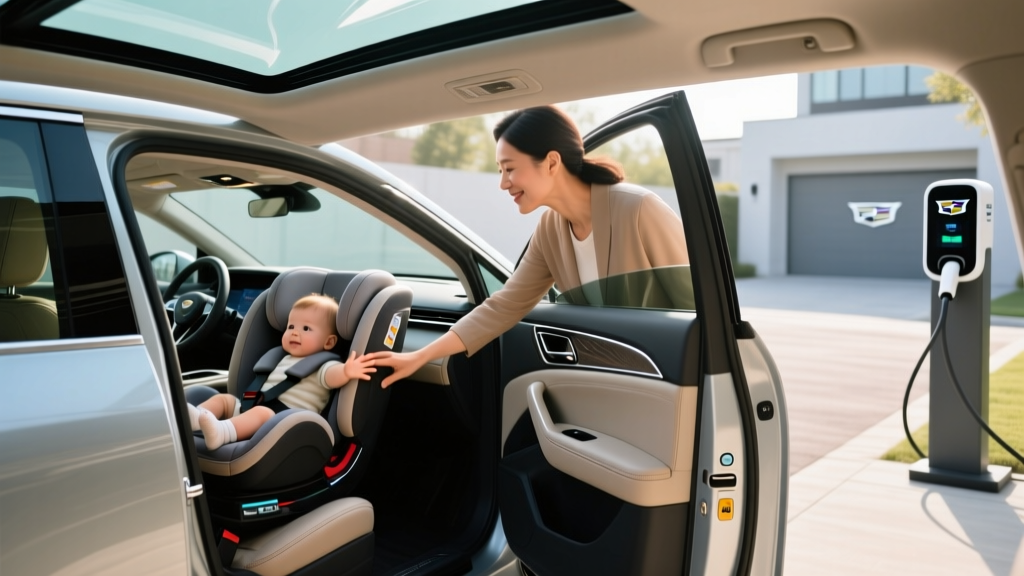
- Disable child-safety locks when not needed. If your child has outgrown the need for locked interior handles, turn them off so the rear doors can always be opened from inside.
- Teach every caregiver the interior release location. The Lyriq's rear-door release is a button on the door panel — show grandparents, babysitters, and older siblings where it is.
- Enable Rear Seat Reminder and never dismiss it. The alert fires even if you opened the rear door before driving. Treat it as a mandatory visual check.
- Keep the myCadillac app set up and logged in. If you ever lock your keys or a child inside, remote unlock takes seconds — faster than waiting for a locksmith or breaking a window.
- Enable Cabin Overheat Protection in vehicle settings, and ensure the HV battery maintains at least ~20% state of charge when parked in hot weather so the system has energy to run.
- Place a personal item (phone, wallet, left shoe) in the back seat as a physical forcing function — this low-tech habit works regardless of powertrain.
Real-World EV Ownership Considerations for Families
Lock-in safety is one piece of a broader ownership picture. If you're a parent evaluating a Cadillac EV, here's how the practical numbers stack up:
2026 Cadillac Lyriq vs. Gas SUV: Family Ownership Snapshot
| Factor | 2026 Lyriq (Luxury AWD) | 2026 Gas SUV (AWD, 22 MPG combined) |
|---|---|---|
| Base MSRP | ~$58,590 | ~$48,000 |
| Federal §30D tax credit (if eligible) | Up to $7,500 (subject to MSRP cap, income limits, battery sourcing — see IRS §30D rules) | $0 |
| EPA range / fuel economy | 314 mi / 89 MPGe combined | 22 MPG combined |
| Annual fuel/energy cost (15,000 mi) | ~$650 (home Level 2, $0.14/kWh avg) | ~$2,385 ($3.50/gal) |
| Annual maintenance | ~$300 (no oil, fewer brake jobs due to regen) | ~$900 |
| Insurance (avg annual) | ~$2,400 (EV premium) | ~$1,800 |
| 5-year total operating cost | ~$4,750 | ~$16,425 |
Energy and fuel costs are estimates based on national averages. Actual costs vary by electricity rate, driving pattern, and climate. Tax credit eligibility depends on buyer income, vehicle MSRP caps, and battery-component/critical-mineral sourcing requirements — always verify current-year rules at irs.gov.
For families, the Lyriq's 314-mile EPA range (expect ~260–280 miles in real-world highway driving, and potentially ~220–240 miles in sub-freezing cold) is sufficient for most school commutes, activities, and weekend trips without en-route charging. DC fast charging peaks at approximately 190 kW, delivering a 10–80% charge in roughly 30 minutes on a compatible CCS station — adequate for road-trip breaks with kids.
Decision Framework: Is a Cadillac EV Right for Your Family?
Choose the Cadillac Lyriq or Optiq if:
- You have access to home Level 2 charging (a 240V/48A circuit adds ~30 miles of range per hour — essential for daily family logistics).
- Your typical daily driving is under 200 miles, with occasional road trips under 400 miles between stops.
- You value Cabin Overheat Protection and the ability to pre-condition the cabin remotely before loading kids into car seats.
- You qualify for the federal §30D credit (buyer AGI under $150K single / $300K joint; vehicle MSRP under the $80,000 SUV cap).
Stick with a gas or hybrid SUV if:
- You live in an apartment or condo without reliable overnight charging access.
- You frequently drive 400+ miles in a single day in regions with sparse DC fast-charging infrastructure.
- You regularly tow more than 3,500 lbs (the Lyriq is rated for 1,500 lbs; a gas SUV or a larger EV like the Escalade IQ is needed for heavy towing).
- Your local climate routinely drops below 0°F and you lack garage parking — cold-weather range loss of 25–35% is real and affects trip planning.
Frequently Asked Questions
Can a child open the door from inside a Cadillac Lyriq?
Yes — the interior door release is a physical push-button on each door panel. However, if the electronic child-safety lock is engaged, the interior release is disabled. Always verify child-lock status in the vehicle settings before leaving a child in the rear seat, even briefly.
Does the Lyriq's Cabin Overheat Protection work if the car is locked?
Yes. When enabled, the system monitors interior temperature and can activate the A/C compressor using the high-voltage battery even when the vehicle is locked and parked. It requires sufficient battery state of charge (typically above ~20%).
What happens if the 12V battery dies — am I locked out or locked in?
The 12V battery powers electronics, but door handles have mechanical backup linkages. You will not be permanently trapped inside a Lyriq or Optiq due to a 12V failure. Externally, the myCadillac app or OnStar can send a remote-unlock command, and a physical key blade (inside the key fob) can access the driver's door.
Is the Cadillac Optiq safer than the Lyriq for families with infants?
Both share the Ultium platform and the same core safety architecture (Rear Seat Reminder, OnStar, available Super Cruise Level 2 driver assistance). The Optiq is smaller and may be easier to park in tight urban spaces, but the Lyriq offers more rear-seat room for rear-facing car seats. Neither is "self-driving" — NHTSA classifies Super Cruise as SAE Level 2, requiring full driver attention.
How do I check if my Lyriq qualifies for the $7,500 federal tax credit?
Eligibility depends on your adjusted gross income, the vehicle's MSRP (must be at or below the $80,000 SUV threshold), and battery-component/critical-mineral sourcing requirements that change annually. Check the latest rules at irs.gov and confirm with a tax professional. Point-of-sale transfer is available at participating dealers, reducing your purchase price at checkout.
Are electronic door handles on EVs less safe than traditional handles?
FMVSS standards require that occupants can exit without tools or keys, regardless of handle design. Electronic exterior handles on the Lyriq and Optiq are flush-mounted for aerodynamics but do not compromise interior egress. The learning curve is the real risk — anyone unfamiliar with the vehicle should be shown the interior release before riding.