What Are Axial Flux Electric Motors and Why Do They Matter?
The short answer: Axial flux electric motors generate rotational force parallel to the motor shaft (like a disc spinning), rather than around it (like a cylinder). This pancake-shaped design delivers 30-50% more torque density than conventional radial flux motors at similar weight, potentially unlocking longer range, faster acceleration, or smaller battery packs in the EVs you're shopping for. As of 2026, they appear primarily in high-performance and premium applications — including the Mercedes-AMG ONE hypercar and select next-generation powertrains from suppliers like YASA (now Mercedes-owned) and Magnax.
If you're evaluating your next EV purchase, you've likely encountered the term "axial flux" in spec sheets or press releases and wondered whether it translates into real-world advantages. The answer is nuanced: axial flux motors offer genuine engineering benefits, but they don't automatically make one EV better than another. Motor type is one variable among many — battery chemistry, thermal management, vehicle weight, and charging infrastructure matter just as much to your daily ownership experience.
This guide breaks down what axial flux electric motors actually do, where they show up in 2026 model-year vehicles, how they compare to the radial flux motors in most EVs on the road, and what this means for your wallet.
Axial Flux vs. Radial Flux: The Engineering Difference
Most EVs you can buy today — the Tesla Model Y, Hyundai Ioniq 5, Ford Mustang Mach-E — use radial flux motors. In these motors, the rotor spins inside a stator cylinder, with magnetic flux flowing outward from the center (radially). This design is mature, cost-effective to manufacture at scale, and well-understood by every major automaker.
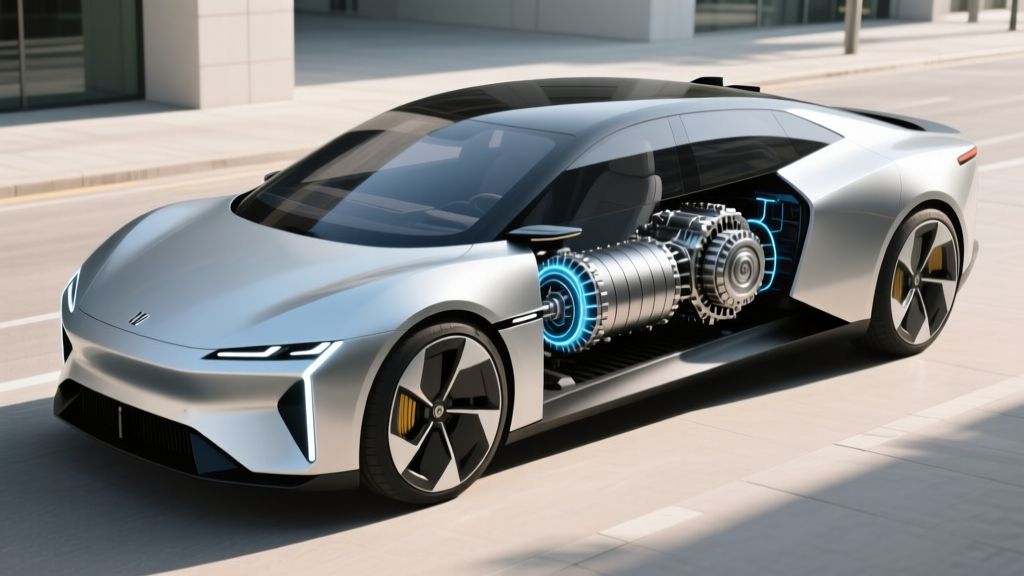
Axial flux motors flip the geometry. The rotor discs sit on either side of a flat stator, with magnetic flux flowing along the axis of rotation. Think of a thick pancake versus a soup can. This geometry creates several measurable advantages:
| Characteristic | Radial Flux Motor (Typical EV) | Axial Flux Motor |
|---|---|---|
| Shape | Cylindrical (longer, narrower) | Disc / pancake (shorter, wider) |
| Torque density | Baseline | 30-50% higher per kg |
| Weight (for equivalent output) | Baseline | 20-40% lighter |
| Peak efficiency | 93-96% | 95-97% |
| Manufacturing cost at scale | Lower (mature supply chain) | Higher (complex assembly) |
| Thermal management | Easier (more surface area) | More challenging (compact geometry) |
| Common 2026 applications | Most mass-market EVs | Performance EVs, hybrids, upcoming platforms |
The efficiency gap — typically 1-3 percentage points — sounds small, but in an EV consuming roughly 25-30 kWh per 100 miles of highway driving, a 2% efficiency gain translates to roughly 5-7 additional miles of real-world range from the same battery pack. Over a 300-mile EPA-rated vehicle, that's meaningful but not transformative on its own.
The weight savings, however, compound. A lighter motor reduces vehicle mass, which reduces energy consumption across all driving conditions. According to fueleconomy.gov data, every 100 lbs removed from a vehicle improves efficiency by approximately 1-2%. An axial flux motor saving 40-60 lbs over a comparable radial unit contributes to a virtuous cycle: lighter car, less energy needed, smaller battery possible, even lighter car.
Which 2026 EVs Use Axial Flux Motors?
As of the 2026 model year, axial flux motors remain concentrated in premium and performance segments. Here's where you'll find them:
- Mercedes-AMG models using YASA-derived axial flux technology (Mercedes acquired UK-based YASA in 2021 and has been integrating the technology into its AMG performance line)
- Ferrari SF90 Stradale / 296 GTB — plug-in hybrids using compact axial flux motors for their electric axle assist
- Select commercial and specialty EVs — companies like Magnax (Belgium) and Infinitum Electric (US) supply axial flux motors for applications where weight and packaging matter most
- Upcoming mass-market platforms — several automakers have announced next-generation EV architectures targeting 2027-2028 production that incorporate axial flux designs, though none are on sale as 2026 models
If you're shopping for a mainstream EV under $60,000 — a Tesla Model 3, Chevrolet Equinox EV, Hyundai Ioniq 5, or Volkswagen ID.4 — you're looking at radial flux motors. That's not a disadvantage; radial flux technology is highly refined and delivers excellent efficiency and reliability. The absence of an axial flux motor shouldn't disqualify any vehicle from your shortlist.
Real Costs: Motor Type vs. Total Ownership
Here's where practical EV buying meets powertrain engineering. Motor type influences efficiency and performance, but it's a secondary cost driver compared to battery size, charging habits, and insurance premiums.
| Cost Factor (5-Year Ownership) | Typical Radial Flux EV (e.g., 2026 Ioniq 5 SEL, ~$47,000 MSRP) | Hypothetical Axial Flux EV (Similar Class, ~$49,500 est. MSRP) |
|---|---|---|
| Purchase price (after §30D credit) | ~$39,500 (if eligible) | ~$42,000 (if eligible) |
| Home charging (Level 2 install) | $500-$2,000 | $500-$2,000 |
| Electricity cost (50,000 mi @ $0.14/kWh, 28 kWh/100mi) | $3,920 | $3,780 (est. 2% efficiency gain) |
| Maintenance (5 years) | $1,200-$1,800 | $1,200-$1,800 |
| Insurance (average) | $7,500-$9,500 | $7,800-$10,000 (premium powertrain surcharge) |
| Estimated 5-year total | ~$52,120-$56,520 | ~$55,280-$59,580 |
The efficiency savings from an axial flux motor — roughly $140 over 50,000 miles at average US electricity rates — are real but modest. They do not offset a higher purchase price or potential insurance premium increases associated with newer, lower-volume powertrain technology. The IRS §30D clean vehicle credit applies identically regardless of motor type; eligibility hinges on MSRP caps ($55,000 for sedans, $80,000 for SUVs/trucks/vans), buyer income limits ($150K single / $300K joint), and battery component/critical mineral sourcing requirements — not motor architecture.
Performance and Range: What the Numbers Actually Show
The strongest case for axial flux motors is in power-dense applications. When an automaker wants maximum acceleration from a compact, lightweight package — think dual-motor AWD performance trims — axial flux geometry delivers.
Consider the data:
- YASA's 750R axial flux motor produces approximately 750 Nm (553 lb-ft) of torque from a unit weighing roughly 12.2 kg (27 lbs)
- A comparably rated radial flux motor from a mainstream supplier typically weighs 35-50 kg (77-110 lbs) for similar peak torque output
- This weight advantage lets engineers either reduce battery size (saving cost and mass) or keep the battery the same and gain range
For a buyer, this translates to a specific scenario: if you're choosing between two similarly priced performance EVs and one uses axial flux motors, you may see a slight edge in 0-60 mph times (typically 0.1-0.3 seconds quicker for equivalent battery output) and marginally better highway efficiency. In real-world driving, expect highway range to land 5-10 miles higher than the EPA sticker on an axial flux-equipped vehicle versus its radial flux counterpart — useful, but not a deciding factor on its own.
Common Misconceptions About Axial Flux Motors
| Myth | Fact |
|---|---|
| "Axial flux motors give you significantly more range" | Efficiency gains of 1-3% translate to 5-10 real-world miles on a 300-mile EPA vehicle — helpful, not revolutionary |
| "They're more reliable than radial flux" | No long-term reliability advantage has been demonstrated; both motor types are essentially maintenance-free with no brushes or wearable contacts |
| "Every next-gen EV will use axial flux" | Manufacturing cost and supply chain maturity keep radial flux dominant for mass-market vehicles through at least 2028-2029 |
| "Axial flux means faster charging" | Charging speed is governed by battery chemistry, thermal management, and the charge curve — not motor type |
| "They eliminate range loss in cold weather" | Cold-weather range loss (15-30% at 20°F) is driven by battery chemistry and cabin heating demands, not motor geometry |
EV vs. Gas Comparison: Where Motor Type Fits In
For buyers cross-shopping EVs against gasoline vehicles, motor type is a third-order concern. The primary advantages of any EV — regardless of motor architecture — remain fuel cost savings, instant torque delivery, reduced maintenance, and home "refueling" convenience.
| Metric | 2026 EV (Radial Flux, e.g., Ioniq 5 SEL AWD) | 2026 Gas Crossover (e.g., Toyota RAV4 AWD) |
|---|---|---|
| MSRP | ~$47,000 | ~$33,000 |
| Fuel/energy cost per mile | $0.039 (home charging @ $0.14/kWh) | $0.14 (gas @ $3.30/gal, 28 MPG combined) |
| 5-year fuel cost (75,000 mi) | ~$2,925 | ~$10,500 |
| Maintenance (5 years) | $1,200-$1,800 | $3,000-$4,500 |
| 0-60 mph | 5.1 seconds | 8.0 seconds |
| Real-world range | ~230-260 mi (EPA 290 mi, highway/cold adjusted) | ~380 mi (14.5 gal tank) |
The $7,575 fuel savings and $1,200-$2,700 maintenance savings over five years close a significant portion of the EV's price premium — and these numbers hold regardless of whether the EV uses an axial flux or radial flux motor. The motor type simply doesn't move the needle on the EV-versus-gas decision.
Decision Framework: Should Axial Flux Influence Your Purchase?
Choose a vehicle with an axial flux motor if:
- You're shopping in the premium/performance EV segment ($70,000+) where this technology currently lives
- Weight savings and packaging efficiency matter for your use case (track driving, towing margin optimization)
- You value having the latest powertrain technology and accept potentially higher insurance costs and limited independent repair options
Don't prioritize axial flux motors if:
- You're buying a mainstream EV under $55,000 — the technology simply isn't available in this segment yet
- Your primary concerns are range, charging speed, and total cost of ownership — these are driven by battery size (kWh), charging architecture (peak kW and charge curve), and electricity rates
- You live in a cold climate where battery thermal management and heat pump availability matter far more than motor geometry for preserving winter range
- You lack reliable home charging access — no motor type compensates for dependence on public DC fast charging infrastructure
What First-Time EV Buyers Should Actually Focus On
Motor type — axial or radial flux — is an interesting engineering detail, but it should rank well below these factors in your purchase decision:
- Home charging feasibility: Can you install a Level 2 charger (240V, 32-48A, delivering 7.7-11.5 kW)? Installation costs range from $500 (simple NEMA 14-50 outlet near your panel) to $2,500+ (panel upgrade, long conduit runs). Without home charging, EV ownership becomes significantly less convenient.
- Real-world range for your driving patterns: EPA estimates assume mixed driving at moderate temperatures. For highway-heavy commutes, subtract 10-15%. For sub-30°F winters, subtract 20-30%. A 300-mile EPA vehicle may deliver 210-240 real-world miles in cold highway conditions.
- DC fast charging capability: Look for peak charge rate in kW (not just "fast charging" marketing). A 2026 EV charging at 200+ kW can add 150-200 miles in 15-20 minutes (10-80% SoC). Vehicles limited to 100-150 kW take noticeably longer on road trips.
- Battery warranty: Federal minimum is 8 years / 100,000 miles for capacity retention (typically guaranteed above 70% of original capacity). Most mainstream manufacturers match or exceed this.
- Tax credit eligibility: The §30D credit offers up to $7,500 but requires meeting MSRP caps, buyer income limits, and battery sourcing requirements that change annually. Check current rules at IRS.gov and verify eligibility at point of sale.
Frequently Asked Questions
Will axial flux motors become standard in all EVs?
Not in the near term. Manufacturing cost, supply chain maturity, and the proven reliability of radial flux motors keep them dominant in mass-market EVs. Axial flux adoption will grow in performance and premium segments through 2028-2030, with potential trickle-down to mainstream vehicles as production scales — similar to how permanent magnet synchronous motors gradually replaced induction motors over the past decade.
Do axial flux motors require special maintenance?
No. Like all modern EV traction motors, axial flux units have no brushes, commutators, or wearable mechanical contacts. They're essentially sealed, maintenance-free components expected to outlast the vehicle. Cooling systems (liquid coolant loops) require periodic fluid checks per manufacturer schedules, but this applies to all EV motor types.
Can I retrofit an axial flux motor into my current EV?
No. Traction motors are deeply integrated with the vehicle's inverter, reduction gearbox, thermal management system, and software controls. Motor swaps are not practical or supported by any manufacturer, and attempting one would void all powertrain warranties and likely create safety and regulatory compliance issues.
Does motor type affect regenerative braking performance?
Marginally. Regen effectiveness depends primarily on battery charge acceptance rate (how many kW the battery can absorb during deceleration) and the vehicle's software calibration. Both axial and radial flux motors can handle regen torque well within their operating envelope. You won't notice a difference in one-pedal driving feel attributable to motor type alone.
Which matters more for range: motor type or battery size?
Battery size (usable kWh) dominates range. A 10% larger battery delivers roughly 10% more range, all else equal. An axial flux motor's 1-3% efficiency improvement delivers a fraction of that benefit. When comparing EVs, prioritize usable battery capacity and EPA-rated efficiency (kWh/100mi or MPGe) over motor architecture.
Bottom line: axial flux electric motors represent a genuine engineering advancement in torque density and packaging efficiency, but their real-world impact on your EV ownership experience in 2026 is modest. Shop for range, charging speed, home charging feasibility, and total cost of ownership first. If an axial flux motor happens to be under the hood of the vehicle that checks those boxes, consider it a bonus — not a reason to pay a premium.