Quick Answer: What Is an Axial Flux Electric Motor?
An axial flux electric motor generates torque by passing magnetic flux parallel to the rotor's axis of rotation, unlike conventional radial flux motors where flux moves perpendicular to the shaft. The result: 30–50% more torque density and roughly 20–30% less weight for a given power output. In practical EV terms, an axial flux motor can deliver the acceleration of a larger, heavier radial motor while freeing up space for battery capacity or reducing overall vehicle mass — both of which improve real-world range.
As of 2026, axial flux motors are found in select high-performance and next-generation EVs from manufacturers like Mercedes-Benz (via YASA), Lucid, and several emerging platforms. They are not yet mainstream in affordable models, but their adoption is accelerating.
How Axial Flux Motors Differ From the Radial Motors in Most EVs
The vast majority of EVs on the road — from the Tesla Model Y to the Hyundai IONIQ 5 to the Ford F-150 Lightning — use radial flux permanent magnet synchronous motors (PMSM). In these motors, the rotor spins inside a stator, and magnetic flux travels outward from the center (radially) across an air gap. This design is mature, well-understood, and cost-effective at scale.
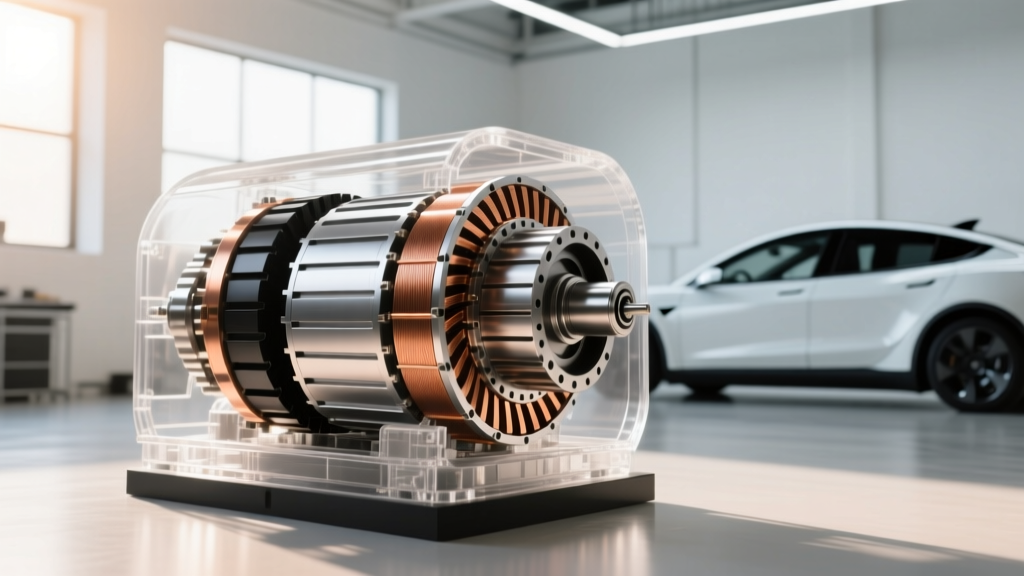
An axial flux motor flips the geometry. The rotor disc sits parallel to one or two stator discs, and magnetic flux travels along the axis of rotation. Think of a pancake rather than a cylinder. This geometry offers several engineering advantages:
- Shorter axial length: The motor is flatter, packaging more easily between axles or inside wheel hubs.
- Higher torque density: The larger effective radius of the rotor disc produces more torque per kilogram of motor mass.
- Lower inertia: A lighter, flatter rotor spins up and slows down faster, improving transient response and regenerative braking efficiency.
The trade-off is manufacturing complexity. Axial flux motors require tighter air-gap tolerances (often under 1 mm), more sophisticated cooling, and precision assembly that has historically driven up unit cost.
Common Misconceptions About Axial Flux EV Motors
| Myth | Fact |
|---|---|
| "Axial flux motors double your EV's range." | Motor efficiency gains are real but incremental — typically 1–3 percentage points over equivalent radial motors at peak. Range improvements come from weight savings and packaging, not magic efficiency leaps. |
| "They're brand-new, unproven technology." | Axial flux designs date back decades. YASA (now a Mercedes-Benz subsidiary) has been producing them since 2009, and they've been used in the Koenigsegg Regera, Ferrari SF90, and Mercedes-AMG ONE. |
| "Every EV will switch to axial flux by 2027." | Radial flux motors remain cheaper to manufacture at high volume. Axial flux is growing in premium and performance segments, but cost parity for economy EVs is still several years away. |
| "They eliminate the need for a transmission or gearbox." | Most axial flux EV motors still use single-speed reduction gears. The broader torque band can simplify gearing, but it doesn't eliminate it. |
Real-World Performance: Axial Flux vs. Radial Flux in EVs
Let's compare two concrete examples to ground this in numbers. The Mercedes-AMG EQS 53 uses YASA-derived axial flux motors on the rear axle, while the BMW iX xDrive50 uses conventional radial flux PMSMs. Both are luxury electric SUVs with similar battery capacities and pricing.
| Specification | Mercedes-AMG EQS 53 (Axial Flux Rear) | BMW iX xDrive50 (Radial Flux) |
|---|---|---|
| Motor type (rear) | Axial flux PMSM (YASA) | Radial flux PMSM (EESM front) |
| Total system power | 649 hp (overboost) | 516 hp |
| Peak torque | 700 lb-ft | 564 lb-ft |
| 0–60 mph | 3.4 sec | 4.4 sec |
| Battery (usable) | 107.8 kWh (NMC) | 105.2 kWh (NMC) |
| EPA range | 277 mi | 324 mi |
| Efficiency (combined) | 79 MPGe | 86 MPGe |
| Max DC charge rate | 200 kW | 200 kW |
| 10–80% DC charge | ~31 min | ~34 min |
| Curb weight | 5,888 lbs | 5,659 lbs |
| Base MSRP | $127,350 | $92,195 |
Notice something counterintuitive: the axial flux EQS 53 has lower EPA range despite a slightly larger battery. This is because the AMG is tuned for maximum performance, carrying more weight from luxury content and using its motor's torque advantage for aggressive acceleration profiles. The motor technology itself isn't the range limiter — vehicle tuning, weight, and aerodynamics dominate.
Where axial flux shines is in specific output. The YASA motor in the EQS 53 produces roughly 649 hp from a motor assembly weighing approximately 55 lbs per unit. A comparable radial flux motor producing that power would typically weigh 80–100 lbs. In a performance-focused vehicle, that weight savings can be redirected to battery capacity or simply improve handling dynamics.
What This Means for EV Range, Efficiency, and Daily Driving
For most buyers, the motor type matters less than the vehicle-level outcomes: EPA range, real-world efficiency, and charging speed. Here's how axial flux motors influence each:
Range Impact
An axial flux motor's weight advantage (20–30 lbs per motor in many applications) translates to roughly 1–3 miles of additional EPA range in a 4,500-lb vehicle, all else being equal. More significant is the packaging benefit: a flatter motor can allow engineers to fit a slightly larger battery in the same chassis envelope. Lucid's use of compact motor designs (a proprietary miniaturized radial/axial hybrid approach) in the Air sedan is one reason it achieves an EPA-estimated 516 miles with a 118 kWh battery pack.
Efficiency at Partial Load
Real-world driving rarely demands peak power. In typical commuting at 20–40% load, axial flux motors maintain slightly higher efficiency (often 95–97% vs. 93–95% for equivalent radial motors). Over 15,000 miles of annual driving, this might save 40–80 kWh — roughly $6–$12 in electricity costs at the national average of $0.16/kWh (EIA, 2025). Meaningful? Marginally. A deciding factor? No.
Cold-Weather Considerations
Motor type has minimal impact on cold-weather range loss, which is driven primarily by battery chemistry and cabin heating demand. Expect 20–35% range reduction at 20°F regardless of motor type. Axial flux motors do warm up slightly faster due to lower thermal mass, but the effect on overall winter range is negligible — perhaps 1–2 miles in a 250-mile EPA vehicle.
Cost of Ownership: Axial Flux EV vs. Radial Flux EV vs. Gas Car
The motor type itself doesn't appear on your insurance card or charging bill. But the vehicles that currently use axial flux motors tend to be premium-priced, which significantly affects total cost of ownership. Here's a five-year comparison using realistic 2026 figures:
| Cost Category | Mercedes-AMG EQS 53 (Axial Flux) | BMW iX xDrive50 (Radial Flux) | BMW X5 xDrive40i (Gas) |
|---|---|---|---|
| Purchase price (MSRP) | $127,350 | $92,195 | $70,200 |
| Federal tax credit (§30D) | $0 (MSRP & income cap exceeded) | $0 (MSRP cap exceeded for SUVs: $80K limit) | $0 |
| Estimated insurance (5 yr) | $18,500 | $14,200 | $11,800 |
| Energy/fuel cost (5 yr) | $5,850 (home L2 @ $0.16/kWh) | $5,400 | $13,500 (@ $3.60/gal, 22 MPG combined) |
| Maintenance (5 yr) | $2,200 | $2,400 | $5,800 |
| Estimated depreciation | $62,000 | $42,000 | $30,000 |
| 5-Year Total Cost | $215,900 | $156,195 | $131,300 |
Key takeaways from this comparison:
- Energy savings are real but modest in dollar terms. The AMG EQS 53 saves roughly $7,650 in fuel over five years compared to the gas X5 — but that saving is dwarfed by the $57,150 higher purchase price and $32,000 additional depreciation.
- Premium EVs with advanced motors don't qualify for §30D credits. The IRS §30D tax credit caps SUV MSRP at $80,000 and sedans at $55,000, with modified adjusted gross income limits of $300K (joint), $225K (head of household), and $150K (single). Neither luxury EV above qualifies.
- Maintenance savings apply regardless of motor type. Both EVs cost roughly $3,000–$3,600 less to maintain over five years than the gas X5 — no oil changes, fewer brake replacements (thanks to regenerative braking), and no transmission fluid.
Who Should Care About Axial Flux Motors — and Who Shouldn't
Decision Framework: Does Motor Type Matter for Your EV Purchase?
Choose an EV with an axial flux motor if:
- You're shopping in the $100K+ performance or luxury segment and want maximum specific output (hp per pound).
- You value cutting-edge powertrain engineering and are willing to pay a premium for it.
- Track-day capability or sustained high-speed performance matters to you — axial flux motors' lower thermal mass can sustain peak output longer in some implementations.
- You're considering a next-gen platform (e.g., upcoming models from Mercedes, or licensed YASA-technology startups) where axial flux is paired with 800V+ architectures for both performance and efficiency.
Don't prioritize motor type if:
- You're buying in the $30K–$60K mainstream segment — radial flux motors dominate here and will through at least 2029, offering excellent efficiency at lower cost.
- Your primary concern is EPA range or charging speed — these are determined more by battery capacity (kWh), chemistry (NMC vs. LFP), aerodynamics, and thermal management than motor topology.
- You need to maximize §30D tax credit eligibility — the most affordable EVs with the best credit-qualifying pricing all use radial flux motors.
- Home charging access is uncertain — motor type is irrelevant if you can't charge conveniently. Prioritize vehicles with strong Level 2 charging rates (7–11 kW onboard) and plan your home installation first.
First-Time EV Buyer Essentials: Motor Type in Context
If you're new to EV ownership, here's how axial flux motors fit into the bigger picture of what actually determines your ownership experience:
What Really Drives Range
Battery capacity (kWh) is the single biggest factor. A 100 kWh battery with a radial flux motor will out-range a 75 kWh battery with an axial flux motor every time. Vehicle weight, aerodynamic drag coefficient (Cd), tire rolling resistance, and HVAC load are the next-tier variables. Motor efficiency differences between topologies account for perhaps 2–5% of total energy consumption — meaningful to engineers, marginal to buyers.
What Really Drives Charging Speed
DC fast charging speed is determined by the battery's charge acceptance rate (C-rate), thermal management capability, and the charging network's output — not the motor. A vehicle with a 250 kW peak charge rate will charge at that rate whether it has an axial or radial motor. What matters: does the car precondition its battery when you navigate to a DC fast charger? Without preconditioning, cold batteries charge at a fraction of peak rate regardless of motor type.
What Really Drives Cost
Purchase price, insurance, and depreciation dominate EV ownership costs. Energy savings over gas are real — roughly $1,200–$1,800/year depending on local electricity rates and driving volume — but they don't close a $30K+ price gap. The §30D federal tax credit (up to $7,500, with point-of-sale transfer available in 2026) is the most impactful cost lever, but eligibility depends on MSRP caps, income limits, and battery component/critical mineral sourcing requirements that change annually.
Home Charging Reality Check
Not every buyer has access to a garage or dedicated parking spot with a 240V outlet. If you're considering an EV — regardless of motor type — verify your charging situation first:
- Level 1 (120V): Adds 3–5 miles of range per hour. Workable for plug-in hybrids with 30–40 mi electric range, but painfully slow for a 300-mile BEV.
- Level 2 (240V): Adds 20–40 miles per hour depending on vehicle onboard charger (typically 7–11.5 kW). A full home installation (charger + electrician + permit) runs $1,200–$3,500, potentially requiring a panel upgrade ($1,500–$4,000) on older homes.
- Public-only charging: Adds $0.30–$0.50/kWh at DC fast chargers, roughly doubling your per-mile energy cost vs. home L2 and adding 20–40 minutes of wait time per session.
The Road Ahead: Axial Flux Motor Adoption Through 2030
Several factors will determine whether axial flux motors expand beyond the premium segment:
- Manufacturing scale: Companies like YASA (Mercedes), Magnax (Belgium), and Infinitum Electric (US) are investing in automated production lines. If per-unit costs drop below $15/kW (from roughly $25–30/kW today), mainstream adoption becomes viable.
- In-wheel motor applications: Axial flux's flat form factor makes it the leading candidate for in-wheel hub motors, which could eliminate driveshafts and differentials entirely. Lordstown Motors attempted this but folded; newer entrants are taking a more cautious approach.
- Hybrid integration: PHEVs and EREVs (extended-range EVs) benefit from compact motors that fit alongside an internal combustion engine. Expect axial flux motors to appear first in next-gen PHEV platforms where packaging space is at a premium.
For 2026 buyers, the practical reality is this: axial flux motors are an engineering advantage worth paying for in the performance-luxury segment, but they're not a reason to delay a mainstream EV purchase. The best EV for you is the one that fits your budget, driving range needs, charging access, and tax-credit eligibility — regardless of whether its motor is shaped like a pancake or a cylinder.
Frequently Asked Questions
Are axial flux motors more reliable than radial flux motors?
There is no significant reliability advantage either way. Both are brushless electric motors with minimal wear components. The main failure points are bearings and insulation, which are well-engineered in both topologies. Mercedes-Benz warranties the YASA motors in the AMG EQS to the same powertrain standard (4 years/50,000 miles) as its radial flux counterparts.
Does an axial flux motor improve regenerative braking?
Slightly. The lower rotor inertia means the motor can spin down and reverse torque more quickly, potentially capturing 1–3% more energy during aggressive deceleration events. In practice, regenerative braking effectiveness is dominated by battery charge acceptance rate and software tuning, not motor geometry.
Which 2026 EVs use axial flux motors?
As of the 2026 model year, confirmed production vehicles include the Mercedes-AMG EQS 53, Mercedes-AMG ONE (hypercar, limited production), and the Koenigsegg Gemera. Lucid uses a miniaturized motor design that shares some axial flux principles but is technically a proprietary hybrid topology. Several Chinese OEMs (notably BYD and NIO) have announced axial flux platforms for 2027–2028 vehicles.
Will axial flux motors make EVs cheaper?
Not in the near term. Current axial flux motors cost 40–60% more to manufacture than equivalent radial flux units. Cost parity is projected for the early 2030s, assuming production volumes exceed 500,000 units annually. Until then, expect axial flux to remain a premium-segment differentiator.
Should I wait for an axial flux EV instead of buying now?
No — not unless you're specifically shopping above $100K and want the latest powertrain technology. The efficiency and weight advantages of axial flux motors translate to roughly 2–5 miles of real-world range in a typical vehicle. That's less than the range variation you'd see from switching to low-rolling-resistance tires or removing 100 lbs of cargo. Buy the EV that fits your needs today; motor topology will evolve in the background.