Quick Answer: Is the Awake Rävik Electric Surfboard Worth It?
The Awake Rävik is a premium electric surfboard (eFoil/surfboard platform) priced from approximately $12,000–$15,000 depending on configuration. It uses a swappable lithium-ion battery pack (roughly 2.4 kWh usable) delivering 40–60 minutes of ride time per charge at mixed throttle, with a 0–30 mph acceleration in under 3 seconds. Charging takes about 1.5–2 hours on the included AC charger. It is not an electric vehicle eligible for the federal §30D tax credit — that credit applies only to highway-capable, four-wheeled plug-in vehicles meeting IRS sourcing and MSRP requirements. The Rävik competes against gas-powered surfboards and other electric hydrofoil boards, offering near-silent operation, zero local emissions on the water, and dramatically lower per-session "fuel" costs, but with higher upfront pricing and limited ride duration compared to a tank of gas.
What Exactly Is the Awake Rävik?
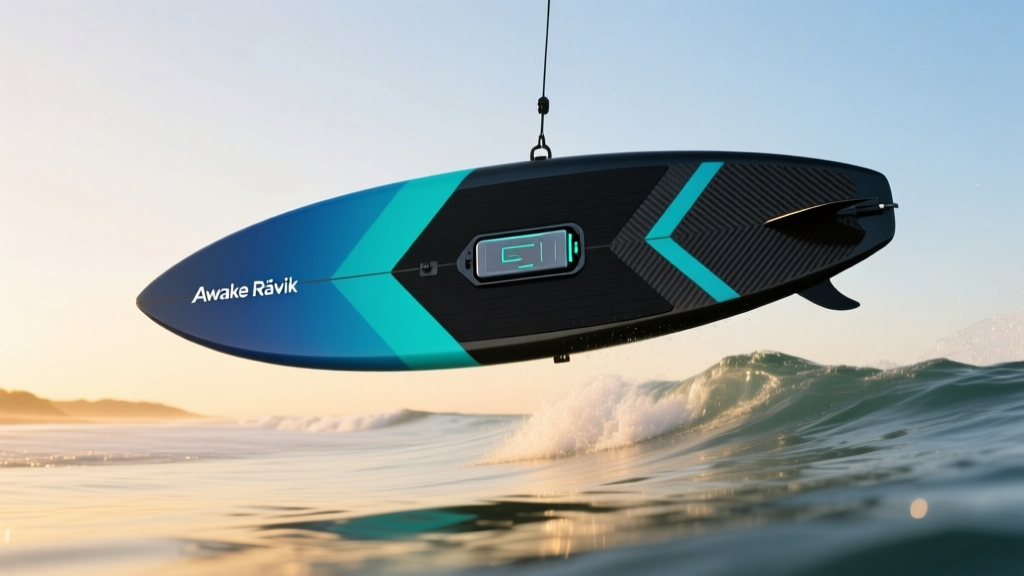
Awake Boards, based in Sweden, manufactures high-performance electric surfboards and eFoils. The Rävik line represents their surfboard platform — a motorized board designed for carving waves or flat-water riding without the noise, fumes, or maintenance of a gasoline two-stroke engine. Unlike a car-based EV, the Rävik is a recreational marine product. It sits outside the scope of EPA range ratings, NHTSA safety testing, and federal EV incentives, but its powertrain shares core EV concepts: a lithium-ion battery pack, a brushless electric motor, regenerative systems, and onboard thermal management.
At its core, the Rävik uses a high-output electric motor (roughly 10–12 kW peak output depending on model year and trim) paired with a removable battery. The board hull is constructed from carbon fiber or composite materials to keep weight manageable — typically 55–70 lbs for the board itself, plus roughly 20–25 lbs for the battery. The rider controls speed via a wireless handheld throttle, and the board planes on the water surface at speeds up to approximately 34–36 mph (55 km/h) at full output.
Battery, Range, and Ride Time: The Real Numbers
The most common buyer question is: How long can I actually ride? Unlike an EV measured in EPA miles, an electric surfboard is measured in ride minutes, which vary enormously based on rider weight, throttle usage, water conditions, and whether you're riding on the surface or on a hydrofoil attachment.
| Spec | Value |
|---|---|
| Battery Capacity (usable) | ~2.4 kWh (lithium-ion, NMC chemistry) |
| Battery Weight | ~20–25 lbs (9–11 kg) |
| Peak Motor Output | ~10–12 kW |
| Top Speed | ~34–36 mph (55 km/h) |
| 0–30 mph | Under 3 seconds |
| Ride Time (moderate throttle) | 40–60 minutes |
| Ride Time (full throttle) | 20–30 minutes |
| Charge Time (AC, included charger) | ~1.5–2 hours (0–100%) |
| Swappable Battery | Yes — hot-swap capable |
| Board Weight (without battery) | ~55–70 lbs |
Real-world caveat: Published ride times assume a ~175 lb rider at moderate, variable throttle on flat water. Heavier riders, aggressive riding, choppy conditions, or cold water (which increases battery internal resistance and reduces effective capacity) can cut ride time by 20–35%. This mirrors the cold-weather range loss seen in electric cars, where low temperatures reduce usable kWh by 10–30%.
The swappable battery design is the Rävik's biggest practical advantage. Riders who purchase a second battery pack ($2,000–$3,000) can swap in seconds and ride for 80–120 minutes total — functionally similar to how a dual-motor EV with a larger battery extends range, but with the convenience of a physical swap rather than waiting at a charger.
Awake Rävik vs. Gas-Powered Surfboards: Cost & Experience
The primary alternative to an electric surfboard like the Rävik is a gasoline-powered jet board from brands like Jetsurf or Lampuga. Here is how they compare on the metrics that matter:
| Factor | Awake Rävik (Electric) | Gas Jet Board (e.g., Jetsurf) |
|---|---|---|
| Upfront Cost | $12,000–$15,000 | $7,000–$12,000 |
| "Fuel" Cost Per Session (1 hr) | ~$0.15–$0.40 (electricity) | ~$8–$15 (premium gas + 2-stroke oil) |
| Noise Level | Near silent (~60 dB) | Loud (~90–100 dB) |
| Emissions on Water | Zero local | Exhaust + unburned fuel in water |
| Maintenance | Minimal (seals, impeller, battery care) | Engine rebuilds, carburetor, winterization |
| Top Speed | ~34–36 mph | ~35–40 mph |
| Session Duration (single fill/charge) | 40–60 min | 60–90 min per tank |
| Refuel/Recharge Time | ~2 min swap / 1.5–2 hr charge | ~2 min refuel |
| Winter Storage Complexity | Battery storage at ~50% SoC | Fogging, fuel stabilizer, antifreeze |
| Lake/Marina Restrictions | Allowed most places | Banned on some lakes (noise/emissions) |
The economic crossover point: If you ride roughly 40 sessions per year, a gas board costs approximately $400–$600 annually in fuel and $500–$800 in maintenance (spark plugs, carburetor service, impeller wear, winterization). That's $900–$1,400 per year in operating costs. The Rävik's electricity cost is approximately $6–$16 per year at the same usage, with negligible maintenance beyond occasional seal replacement and impeller inspection. Over five years, the Rävik saves roughly $4,000–$7,000 in operating costs — enough to offset a meaningful portion of its higher purchase price.
Total Cost of Ownership: The Full Breakdown
Let's model a realistic 5-year ownership scenario for the Awake Rävik compared to a gas jet board at equivalent usage (40 sessions/year, ~1 hour each):
| Cost Category | Awake Rävik (Electric) | Gas Jet Board |
|---|---|---|
| Purchase Price | $13,500 (mid-config) | $9,500 |
| Fuel/Energy (5 yrs) | $40–$80 | $2,000–$3,000 |
| Maintenance (5 yrs) | $300–$600 | $2,500–$4,000 |
| Spare Battery (if purchased) | $2,500 | $0 |
| Insurance (5 yrs) | $1,500–$2,500 | $1,200–$2,000 |
| Storage/Winterization | $500–$1,000 | $1,000–$1,500 |
| 5-Year Total | $18,340–$20,180 | $16,200–$20,000 |
The totals are remarkably close. The Rävik's higher purchase price is nearly recovered through five years of near-zero fuel and dramatically reduced maintenance. The deciding factors become qualitative: noise tolerance, environmental impact, lake restrictions, and the riding experience itself.
Important: The Awake Rävik does not qualify for the IRS §30D federal clean vehicle tax credit. That credit is limited to highway-capable, four-wheeled vehicles with a gross vehicle weight rating under 14,000 lbs, meeting battery sourcing and MSRP caps. Recreational marine products are excluded. Do not factor any federal EV incentive into your Rävik purchase decision.
Charging the Rävik: What You Need to Know
Charging an electric surfboard is simpler than charging an EV, but there are nuances:
- Charger type: The Rävik ships with a dedicated AC charger that plugs into a standard 120V household outlet (Level 1 equivalent). It delivers approximately 1.2–1.5 kW to the battery, filling the ~2.4 kWh pack in 1.5–2 hours.
- No DC fast charging: Unlike an EV that can accept 150–350 kW at a public DC fast charger, the Rävik's small battery and thermal constraints limit it to AC charging only. There is no "fast charge" option — this is a physics constraint of small-format lithium-ion packs.
- kW vs. kWh reminder: The charger delivers ~1.5 kW (power, the rate of energy flow). The battery holds ~2.4 kWh (energy, the total capacity). Dividing capacity by power gives approximate charge time: 2.4 kWh ÷ 1.5 kW ≈ 1.6 hours, plus overhead for the constant-voltage taper phase above 80% SoC.
- Electricity cost: At the US average residential rate of ~$0.17/kWh (per EIA data), a full charge costs approximately $0.41. Even at peak California rates of ~$0.35/kWh, it's under $1.00 per session.
- Battery storage: Lithium-ion NMC batteries degrade fastest when stored at 100% or 0% SoC for extended periods. For off-season storage, charge or discharge to approximately 50% SoC and store in a cool, dry environment (ideally 50–70°F). This mirrors EV battery best practices.
Common Misconceptions About Electric Surfboards
| Myth | Fact |
|---|---|
| "Electric surfboards are underpowered." | The Rävik's ~10–12 kW motor and sub-3-second 0–30 mph time outperform many gas boards off the line. Electric motors deliver instant torque — the same physics advantage EVs have over gas cars. |
| "The battery will die in 2 years." | NMC lithium-ion cells in marine applications, properly maintained (no deep discharge, no 100% storage, temperature-managed charging), typically retain 80%+ capacity after 500–800 full charge cycles. At 40 sessions/year, that's 12–20 years before significant degradation. |
| "You can't ride in saltwater." | The Rävik is designed for both fresh and saltwater use. Post-ride freshwater rinsing of the motor housing, seals, and connectors is required — identical to how outboard motors are maintained. |
| "It qualifies for the EV tax credit." | It does not. The IRS §30D credit requires a four-wheeled, highway-capable vehicle. Marine recreational products are excluded. |
| "Electric means no maintenance." | While far less than gas, electric surfboards still require impeller inspection, driveshaft seal replacement, battery connector cleaning, and firmware updates. Budget $60–$120/year in consumables. |
Who Should Buy the Awake Rävik? A Decision Framework
Choose the Awake Rävik (Electric) If:
- You ride on lakes with noise or emission restrictions (many alpine and reservoir lakes ban gas-powered watercraft entirely).
- You value near-silent operation for wildlife areas, early-morning sessions, or residential waterfronts.
- You want minimal maintenance — no carburetor rebuilds, no fuel stabilizer, no engine fogging for winter.
- You ride 30+ sessions per year, making the per-session fuel savings meaningful over time.
- You're willing to invest in a second battery pack for extended sessions.
- Environmental impact matters to you — zero unburned hydrocarbons in the water.
Choose a Gas Jet Board If:
- Upfront budget is under $10,000 and you cannot stretch to the Rävik's price.
- You need 90+ minutes of continuous full-throttle riding without swapping batteries.
- You ride in remote areas with no access to shore power for charging between sessions.
- You prioritize top-end speed above 36 mph for competition or racing use.
- You already own gas marine equipment and have winterization/maintenance workflows in place.
First-Time Buyer Checklist: What to Know Before You Purchase
If you've never owned a motorized watercraft — or if you're coming from an EV car and assuming the ownership experience translates directly — here are the practical realities:
- Budget for two batteries. A single battery gives 40–60 minutes. Most experienced riders consider a second pack essential. Factor $2,000–$3,000 into your purchase budget.
- Verify your shore power access. If you boat at a marina, confirm 120V AC outlet availability at your slip or dock. The charger draws ~12–15 amps — a standard 15A circuit is sufficient, but shared circuits with other equipment can trip breakers.
- Insurance is not optional. Most homeowner's policies do not automatically cover motorized watercraft above a certain horsepower or value. Expect $300–$500/year for a dedicated marine recreation policy.
- Registration requirements vary by state. Some states require motorized watercraft registration for any powered board; others exempt boards under a certain length or horsepower. Check your state's boating agency before your first ride.
- Plan for off-season battery care. If you live in a climate with a 4–6 month off-season, proper lithium-ion storage (50% SoC, climate-controlled, periodic voltage checks) is essential to avoid capacity loss. A battery stored at 0% SoC in freezing temperatures may suffer irreversible cell damage — a $2,500 mistake.
- Test ride before buying. The Rävik's riding dynamics differ significantly from a gas board. Electric throttle response is instant and linear; gas boards have a powerband lag. Dealers and demo events are the best way to evaluate fit.
Frequently Asked Questions
Does the Awake Rävik qualify for any federal or state EV incentives?
No. The IRS §30D clean vehicle credit applies only to four-wheeled, highway-capable plug-in vehicles. The Rävik is a recreational marine product and is not eligible for federal EV tax credits. Some states offer separate rebates for electric marine equipment or off-road electric recreation — check your state energy office or Alternative Fuels Data Center state law database for current programs.
How long does the Awake Rävik battery last before needing replacement?
With proper care (no deep discharges, 50% SoC storage, temperature-appropriate charging), the NMC lithium-ion battery should retain approximately 80% of its original capacity after 500–800 full charge cycles. At 40 sessions per year with partial discharges, most owners will see 10–15 years of usable life before capacity loss meaningfully reduces ride time. A replacement battery costs approximately $2,000–$3,000.
Can I charge the Rävik battery from a portable power station or solar generator?
Yes, provided the power station can output 120V AC at 15A continuous (approximately 1,500W). Popular units like the EcoFlow Delta Pro or Bluetti AC300 can fully charge a Rävik battery in a single cycle, making off-grid or remote lake charging feasible. A 2.4 kWh battery charge requires roughly 2.8–3.0 kWh from the power station (accounting for charger inefficiency).
Is the Awake Rävik suitable for beginners?
The Rävik offers multiple ride modes with adjustable throttle response and top-speed limits, making it accessible to beginners. However, it is a high-performance board — the instant electric torque requires respect. Awake recommends their beginner mode (limited to ~15 mph with soft throttle ramping) for new riders. Budget for a quality personal flotation device and consider a lesson if you have no prior board-sport experience.
How does cold water affect battery performance?
Cold water (below 55°F / 13°C) increases internal resistance in lithium-ion cells, reducing effective capacity by approximately 10–20%. You'll see shorter ride times and slightly reduced peak power. This is temporary — the battery returns to normal capacity at room temperature. Never charge a lithium-ion battery when its internal temperature is below freezing (32°F / 0°C), as this causes permanent lithium plating on the anode and irreversible capacity loss.
How does the Rävik compare to electric hydrofoils (eFoils)?
The Rävik is primarily a surface-riding electric surfboard, though some Awake configurations support hydrofoil attachments. Dedicated eFoils (like the Lift Foils or Fliteboard) prioritize flying above the water at lower speeds (~20–25 mph) with longer ride times (90–120 minutes) due to lower power draw. If your goal is the "flying" sensation, a dedicated eFoil may be a better fit. If you want high-speed surface carving with the option to foil, the Rävik's versatility is its advantage.