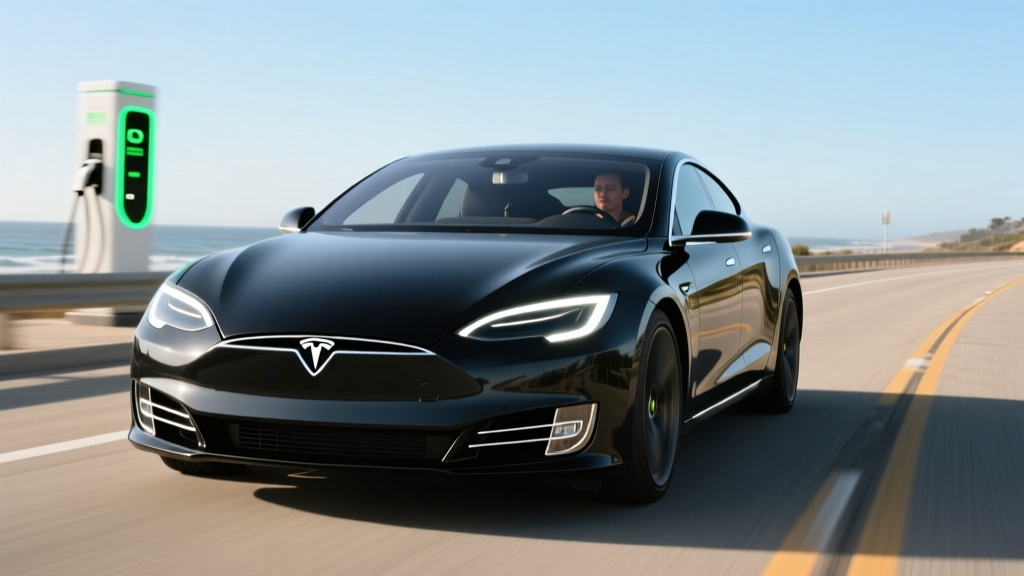
Shoppers researching the average cost of an electric car in 2026 face a tangled web of sticker prices, shifting federal tax credits, volatile insurance premiums, and fuel-cost math that changes depending on where you plug in. The EPA and industry data tell one story; real-world ownership often tells another.
This guide cuts through the noise with concrete numbers: what you'll actually pay to buy, charge, insure, maintain, and eventually sell an EV over five years. We'll use representative 2026 models — the Tesla Model Y Long Range, Hyundai Ioniq 5 SEL, and Chevrolet Equinox EV LT — to ground every figure in reality.
The Real Average Cost of an Electric Car: 2026 Market Snapshot
As of early 2026, the transaction-price average for a new electric vehicle in the U.S. sits near $46,500, down from peaks above $53,000 in 2023 as more affordable models like the Equinox EV, Volvo EX30, and refreshed Tesla Model 3 have entered the market. However, "average" masks a wide spread:
- Entry-level EVs (Chevy Equinox EV, Nissan Leaf): $28,000–$35,000 MSRP
- Mid-market crossovers (Tesla Model Y, Hyundai Ioniq 5, Ford Mustang Mach-E): $38,000–$52,000
- Premium/luxury EVs (BMW iX, Mercedes EQS, Rivian R1S): $70,000–$110,000+
The critical number isn't the sticker — it's the effective cost after incentives, which can knock $7,500 or more off the purchase price for eligible buyers. We'll unpack those rules below.
Federal Tax Credit: Who Actually Qualifies Under §30D in 2026?
The IRS §30D Clean Vehicle Credit offers up to $7,500 for qualifying new EVs and up to $4,000 for eligible used EVs. But "up to" carries heavy caveats. The credit splits into two $3,750 halves: one tied to critical-mineral sourcing and the other to battery-component manufacturing requirements. Both thresholds have tightened annually since the Inflation Reduction Act took effect.
2026 §30D Eligibility Checklist
- Income caps (modified AGI): $150,000 single / $225,000 head of household / $300,000 joint
- MSRP caps: $55,000 for sedans; $80,000 for SUVs, vans, and pickup trucks
- Critical minerals: A specified percentage must be extracted or processed in the U.S. or a free-trade-agreement country (threshold rises annually)
- Battery components: A specified percentage must be manufactured or assembled in North America (threshold rises annually)
- Foreign Entity of Concern (FEOC) restriction: Vehicles with battery components or critical minerals from FEOC entities are disqualified
- Point-of-sale transfer: Buyers can transfer the credit to the dealer at purchase, reducing the sale price upfront rather than waiting for a tax refund
- Seller reporting: Dealer must file a time-of-sale report via the IRS Energy Credits Online portal
What this means practically: A 2026 Tesla Model Y Long Range AWD at roughly $44,990 MSRP qualifies for the full $7,500 for buyers within income limits, bringing the effective price near $37,490 before destination fees. A Hyundai Ioniq 5 SEL (~$42,600) may qualify for $3,750 or $7,500 depending on its battery-sourcing compliance for the model year — always verify on fueleconomy.gov before purchasing, as eligibility shifts with supply-chain changes.
Source: IRS §30D Clean Vehicle Credit guidelines. Tax rules change; consult a tax professional for your specific situation.
5-Year Total Cost of Ownership: EV vs. Gas Car Head-to-Head
Sticker price is only the opening move. Here's a realistic five-year TCO comparison between a 2026 Tesla Model Y Long Range AWD (EPA 320 miles, 75 kWh usable battery, NMC chemistry) and a comparably equipped 2026 Toyota RAV4 AWD gas crossover (EPA 30 MPG combined).
| Cost Category | Tesla Model Y LR (EV) | Toyota RAV4 AWD (Gas) |
|---|---|---|
| Base MSRP | $44,990 | $36,500 |
| Federal tax credit (§30D) | −$7,500 | $0 |
| Effective purchase price | $37,490 | $36,500 |
| Fuel / charging (60,000 mi) | $3,600 | $7,000 |
| Maintenance (5 years) | $1,500 | $3,200 |
| Insurance (5 years) | $11,500 | $8,500 |
| Depreciation (est. 5-yr) | $17,000 | $13,000 |
| Total 5-Year Cost | $71,090 | $68,200 |
Assumptions: 12,000 miles/year; electricity at $0.16/kWh (national average blend of home and public charging); gasoline at $3.50/gallon; insurance sourced from industry averages. Your numbers will vary — especially insurance and charging costs, which we break down next.
Charging vs. Gas: The Per-Mile Cost Math
This is where EVs deliver their clearest advantage — but the savings depend heavily on how and where you charge.
| Scenario | Cost per kWh / Gallon | Cost per Mile | Annual Cost (12,000 mi) |
|---|---|---|---|
| Home Level 2 (national avg electricity) | $0.16/kWh | $0.048 | $576 |
| Home with solar / off-peak rate | $0.08/kWh | $0.024 | $288 |
| Public DC fast charging (avg) | $0.40/kWh | $0.12 | $1,440 |
| Gas car (30 MPG combined) | $3.50/gal | $0.117 | $1,400 |
The takeaway: If you charge primarily at home on a standard utility rate (~$0.16/kWh), an EV averaging 3.3 miles per kWh costs roughly $0.048 per mile — about 60% less than a 30 MPG gas car at $3.50/gallon. But if you rely exclusively on public DC fast chargers at $0.35–$0.50/kWh, your per-mile cost can actually exceed gasoline. Home charging access is the single biggest variable in EV economics.
For reference, the 2026 Model Y Long Range achieves approximately 3.3 mi/kWh (EPA combined), while the Ioniq 5 RWD delivers about 3.5 mi/kWh — among the more efficient crossovers available.
Maintenance Savings: Where EVs Genuinely Cost Less
EVs eliminate oil changes, spark plugs, timing belts, exhaust systems, and multi-speed transmissions. Regenerative braking significantly reduces brake-pad wear — many EV owners report original brake pads lasting 80,000–100,000+ miles.
| Service Item | EV | Gas Car |
|---|---|---|
| Oil changes | Not required | $250–$500/year |
| Brake pads (replacement interval) | 80,000–120,000+ mi | 30,000–50,000 mi |
| Transmission fluid / service | Minimal / sealed unit | $150–$300 at 60,000 mi |
| Coolant / spark plugs | Coolant only, long interval | $200–$400 combined |
| Cabin air filter | $30–$60/year | $30–$60/year |
| Tire rotation / replacement | Same (may wear faster due to torque/weight) | Same |
| Estimated 5-year total | $1,200–$1,800 | $2,800–$3,800 |
One honest caveat: EV tires can wear 10–20% faster than on comparable gas cars due to instant torque and heavier curb weight (the Model Y LR weighs ~4,400 lbs vs. the RAV4 at ~3,600 lbs). Budget for a tire set every 30,000–40,000 miles rather than 50,000+. EV-specific tires (e.g., Michelin Pilot Sport EV, Hankook iON) are optimized for lower rolling resistance and noise but carry a premium.
Insurance Costs: The Uncomfortable EV Reality
EV insurance premiums run 15–30% higher than equivalent gas vehicles on average. Several factors drive this:
- Higher repair costs: Battery packs, specialized high-voltage components, and aluminum/composite body panels cost more to replace after a collision
- Fewer qualified body shops: High-voltage safety certification limits the repair network, increasing labor rates
- Total-loss thresholds: Even minor battery-adjacent damage can trigger a total-loss declaration, inflating claim payouts
- Vehicle value: Higher MSRP means higher comprehensive/collision premiums
2026 averages (annual premium, full coverage):
- Tesla Model Y: ~$2,200–$2,800/year (Tesla Insurance can reduce this in eligible states)
- Hyundai Ioniq 5: ~$1,900–$2,400/year
- Chevy Equinox EV: ~$1,700–$2,100/year
- Comparable gas crossover: ~$1,500–$1,800/year
Shop quotes from at least three insurers before purchasing. Some carriers (Geico, Progressive, State Farm) now offer EV-specific discounts, and manufacturer-affiliated programs (Tesla Insurance, Hyundai's partnership offerings) can narrow the gap. Your driving record and ZIP code matter more than powertrain type.
Depreciation and Resale Value: What EVs Are Worth After 5 Years
EV depreciation has been volatile. Early EVs depreciated steeply due to battery-longevity fears and rapid technology obsolescence. As of 2026, the picture is more nuanced:
- Tesla Model Y / Model 3: Retain approximately 50–55% of MSRP after 5 years / 60,000 miles — competitive with many gas crossovers, aided by Supercharger network access and software updates
- Hyundai Ioniq 5 / Kia EV6: Retain roughly 45–50%, supported by strong 10-year/100,000-mile battery warranties that reassure second-hand buyers
- Chevrolet Equinox EV / Bolt EUV: Retain approximately 40–48%, with affordability helping demand in the used market
- Luxury EVs (Mercedes EQS, BMW iX): Depreciate 55–65% over 5 years — steeper than gas luxury counterparts, mirroring historical luxury-car depreciation patterns
Key depreciation factors: Battery state of health (SoH) is the dominant variable. Most 2026 EVs use liquid-cooled NMC or LFP packs that retain 85–92% capacity after 5 years / 60,000 miles. The federally mandated battery warranty minimum is 8 years / 100,000 miles (covering defects and capacity loss below ~70% SoH), which protects resale value. LFP chemistry models (increasingly common in standard-range trims from Tesla, Ford, and others) show even slower degradation but lower energy density.
State, Local, and Utility Incentives: The Variable Layer
Important: State and local incentives vary enormously by jurisdiction and change frequently. Always check your state's energy office, your utility provider's website, and the AFDC incentive database for current programs in your ZIP code.
Representative examples of non-federal incentives available in various regions as of 2026:
- California (CVRP): Up to $2,000 rebate for income-qualified buyers of new EVs (program funding varies)
- Colorado: State tax credit up to $5,000 for new EVs under $80,000 MSRP
- New York (Drive Clean Rebate): Up to $2,000 point-of-sale rebate (income and price caps apply)
- Utility rebates (varies): Many utilities (PG&E, ConEd, Xcel Energy, others) offer $300–$1,500 rebates for home Level 2 charger purchase and installation
- HOV lane access: Several states grant solo-occupant carpool-lane stickers for EVs — a significant non-monetary benefit in congested metros
- Property/sales tax exemptions: States like Washington, Oregon, and New Jersey exempt EVs from sales tax or offer reduced registration fees
Stacked together, a buyer in Colorado purchasing a $42,000 Ioniq 5 could combine the $7,500 federal credit + $5,000 state credit + $500 utility charger rebate for an effective price near $29,000 — dramatically reshaping the ownership math.
Decision Framework: Is an EV the Financially Smarter Choice?
Choose an EV if:
- You can install a Level 2 home charger (the economics collapse on public-only charging)
- You qualify for the §30D federal credit and/or meaningful state incentives
- Your daily commute is under 80 miles round-trip (well within any modern EV's range)
- You plan to own the vehicle 4+ years (absorbing the higher upfront cost through fuel/maintenance savings)
- You live in a region with moderate winters (cold weather reduces range 15–30%)
Stick with gas or consider a PHEV if:
- You live in an apartment or lack reliable home/workplace charging access
- Your income exceeds §30D caps and your state offers no incentives
- You regularly tow heavy loads or drive 400+ mile rural routes without DC fast-charger coverage
- You plan to keep the vehicle under 3 years (depreciation may offset savings)
Frequently Asked Questions
How much does it really cost to own an EV over 5 years?
For a mid-market EV like the Tesla Model Y Long Range purchased at an effective price of ~$37,490 (after the $7,500 federal credit), expect roughly $71,000 in total costs over 5 years / 60,000 miles including purchase, charging, insurance, maintenance, and depreciation. A comparable gas crossover comes in near $68,000. The EV wins on fuel and maintenance but loses on insurance and depreciation — the gap narrows to near-parity or EV-advantage in states with strong additional incentives or for buyers with cheap home electricity (solar, off-peak rates).
Do I qualify for the $7,500 federal EV tax credit?
You may, if your modified adjusted gross income falls under $150,000 (single) / $300,000 (joint), the vehicle's MSRP is under $55,000 (cars) or $80,000 (SUVs/trucks), and the specific model meets 2026 battery-sourcing and critical-mineral requirements. Eligibility varies by model and model year — verify on fueleconomy.gov and consult a tax professional. You can transfer the credit to the dealer at point of sale for an immediate price reduction.
How much do I actually save on fuel and maintenance?
Charging at home at $0.16/kWh, an efficient EV costs roughly $576/year in electricity vs. $1,400/year in gasoline for a 30 MPG vehicle — saving ~$824/year or about $4,100 over five years. Maintenance savings add another $1,200–$2,000 over five years. Combined, expect $5,300–$6,100 in operational savings, which partially offsets the EV's typically higher purchase price and insurance premiums.
Are EVs more expensive to insure?
Yes, typically 15–30% more than a comparable gas car. Higher repair costs, specialized parts, limited body-shop networks, and elevated vehicle values all contribute. A Model Y might cost $2,300–$2,800/year to insure vs. $1,600–$1,800 for a RAV4. Always pull quotes before purchasing — the gap varies significantly by insurer, state, and driving profile.
How well do EVs hold their value?
Mainstream EVs like the Tesla Model Y retain approximately 50–55% of MSRP after 5 years. Hyundai/Kia models retain 45–50%, while luxury EVs depreciate more steeply (55–65% loss). Battery health is the key variable — liquid-cooled packs with 8-year/100,000-mile warranties support resale confidence. LFP chemistry batteries are showing even slower degradation curves, which may improve long-term retention for standard-range models.