If you've been searching for the AVA bike electric program, you're likely weighing whether an electric vehicle (EV) makes financial and practical sense for your daily driving. The short answer: for most commuters driving under 40 miles round-trip with access to home charging, an EV purchased through an employer or fleet program like AVA's can slash annual fuel costs by 60–75% compared to a gas car, with total 5-year savings often exceeding $8,000–$12,000 depending on local electricity rates and incentives. However, real savings depend heavily on your charging access, climate, and driving patterns — and not every program delivers the same value. Below, we break down the exact numbers, compare EV ownership to gas and hybrid alternatives, and give you a decision framework to determine if an EV program is right for you.
Quick Verdict: Is an EV Program Worth It?
Yes, if: You have Level 2 home charging access, drive 10,000–15,000 miles/year, live in a moderate climate, and the program offers a vehicle at or below market MSRP with federal/state incentives applied. Think twice if: You rely exclusively on public DC fast charging, regularly drive 300+ miles in cold weather without charging stops, or the program locks you into a lease with high mileage penalties.
What the AVA Bike Electric Program Typically Offers
Employer-sponsored EV programs like AVA's generally fall into one of three structures: subsidized purchase (the employer negotiates fleet pricing or applies a direct rebate), salary-sacrifice lease (you pay for the vehicle from pre-tax income, reducing taxable wages), or company-car assignment (the employer owns the vehicle and you use it for commuting). Each structure has different tax implications under current IRS §30D clean vehicle credit rules.
For 2026, the federal EV tax credit remains up to $7,500 for qualifying new BEVs, but eligibility hinges on three moving targets:
- MSRP caps: Vans, SUVs, and pickups must be under $80,000; sedans and other body styles under $55,000.
- Buyer income limits: Modified AGI cannot exceed $150,000 (single), $225,000 (head of household), or $300,000 (joint).
- Battery sourcing requirements: Increasing percentages of critical minerals and battery components must be sourced from the U.S. or FTA partners — this narrows the eligible vehicle list each year.
If AVA's program uses a salary-sacrifice lease, you may not be able to claim the §30D credit directly (the leasing entity claims it and may pass savings through as a lower monthly payment). Always confirm the credit structure before signing.
EV vs Gas vs Hybrid: The Real Cost Comparison
Let's put concrete numbers behind the EV-versus-gas debate using a realistic commuter scenario: 12,000 miles/year, 5-year ownership, national average electricity at $0.16/kWh, and gasoline at $3.45/gallon (2026 averages).
| Metric | EV (e.g., 2026 Tesla Model 3 RWD) | Hybrid (e.g., 2026 Toyota Prius LE) | Gas (e.g., 2026 Honda Civic LX) |
|---|---|---|---|
| Base MSRP | $38,990 | $28,350 | $24,950 |
| EPA Efficiency | 132 MPGe (25 kWh/100mi) | 57 MPG combined | 36 MPG combined |
| Annual Fuel/Energy Cost | $480 | $726 | $1,150 |
| 5-Year Fuel/Energy Total | $2,400 | $3,630 | $5,750 |
| Estimated Maintenance (5yr) | $1,200 | $2,100 | $2,800 |
| Federal Tax Credit | Up to $7,500 (if eligible) | None (HEV) | None |
| Effective 5-Year Cost* | ~$32,690 | ~$34,080 | ~$33,500 |
*Effective cost = MSRP + 5yr fuel + 5yr maintenance – tax credit. Excludes insurance, depreciation, and financing. Insurance for EVs typically runs 10–20% higher than gas equivalents.
The EV wins on operating cost, but the higher MSRP and insurance premiums narrow the gap. The §30D credit is the swing factor — without it, the EV's 5-year cost climbs to ~$40,190, making the hybrid the clear economic winner. This is why confirming credit eligibility through your employer program is essential.
Real-World Range, Charging, and Climate Reality
EPA range stickers are optimistic for highway and cold-weather driving. Here's what real-world data shows for popular EVs in employer programs:
| Vehicle | Battery (kWh) | EPA Range | Real-World Highway (70mph) | Cold-Weather (20°F) | Peak DC Charge (kW) | 10–80% Time |
|---|---|---|---|---|---|---|
| 2026 Tesla Model 3 RWD | 60 (LFP) | 272 mi | ~230 mi | ~195 mi | 170 kW | ~25 min |
| 2026 Hyundai Ioniq 6 SE | 77.4 (NMC) | 361 mi | ~295 mi | ~250 mi | 240 kW | ~18 min |
| 2026 Chevy Equinox EV 3RS | 85 (NMC) | 319 mi | ~265 mi | ~225 mi | 150 kW | ~30 min |
Key takeaway: Expect 15–20% range loss at sustained highway speeds, and 25–35% loss in sub-freezing temperatures due to battery heating demands and reduced regenerative braking efficiency. If your commute is under 40 miles round-trip, even the worst-case scenario leaves ample buffer. If you regularly drive 200+ miles in winter, plan for one DC fast-charging stop.
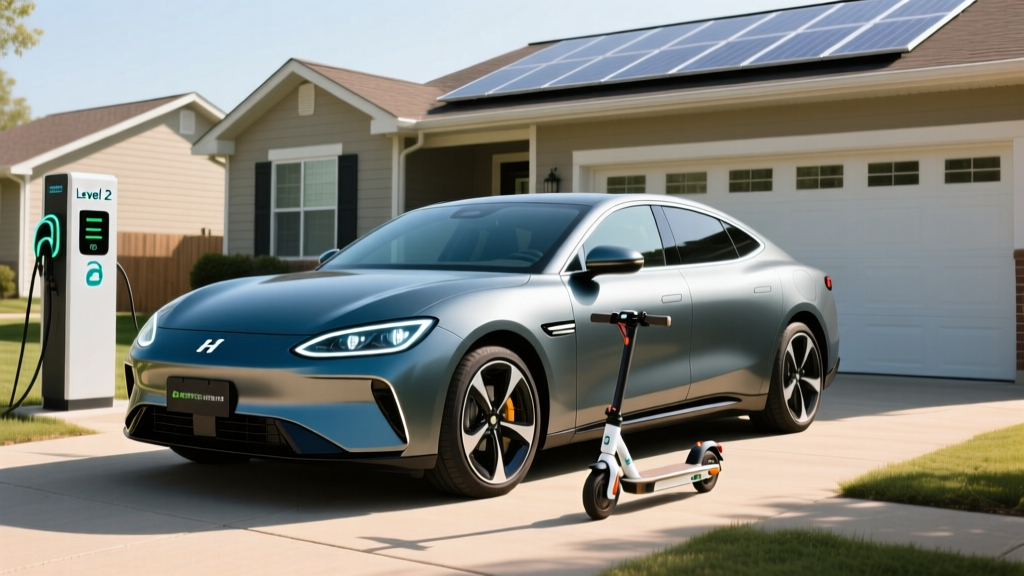
Charging infrastructure access is the single biggest ownership variable. Home Level 2 charging (240V, 32–48A) adds roughly 25–37 miles of range per hour and costs $600–$2,500 to install depending on your electrical panel. If you live in an apartment or lack a dedicated parking space with outlet access, you'll depend on public Level 2 or DC fast charging, which costs 2–4× more per kWh and adds friction to your routine.
Breaking Down the Full 5-Year Ownership Cost
Here's a more complete picture that includes the costs most buyers overlook:
| Cost Category | EV (Mid-Range Sedan) | Gas (Mid-Range Sedan) |
|---|---|---|
| Purchase Price (after credit) | $33,000–$38,000 | $24,000–$28,000 |
| Home Charger Install | $800–$2,500 | $0 |
| 5-Year Fuel/Energy | $2,200–$3,000 | $5,000–$6,500 |
| 5-Year Maintenance | $1,000–$1,500 | $2,500–$3,500 |
| 5-Year Insurance (avg) | $8,500–$10,500 | $7,000–$8,500 |
| Tire Replacement (5yr) | $1,200–$1,800 | $800–$1,200 |
| Estimated Depreciation | $12,000–$18,000 | $10,000–$14,000 |
| Total 5-Year Cost | $58,700–$75,300 | $49,300–$61,700 |
EVs cost more upfront and depreciate faster in the current market, but they save significantly on fuel and maintenance. The break-even point typically arrives around year 4–6 for drivers covering 12,000+ miles annually. Employer programs that negotiate below-MSRP pricing or absorb the home charger installation cost can shift this break-even to year 2–3.
EV tires wear 15–25% faster than gas-car tires due to higher vehicle weight (battery packs add 500–1,000 lbs) and instant torque delivery. Budget for a set of EV-rated touring tires ($200–$300 each) around 30,000–40,000 miles.
Common EV Myths — Corrected With Data
| Myth | Fact |
|---|---|
| "EV batteries need replacing every 5 years" | Modern NMC and LFP batteries retain 85–92% capacity at 100,000 miles. Federal law mandates 8-year/100,000-mile battery warranties with a 70% capacity retention threshold. Replacement costs $8,000–$18,000 but is rarely needed within the warranty period (fueleconomy.gov). |
| "EVs are worse for the environment because of electricity generation" | Even on coal-heavy grids, EVs produce 50–65% fewer lifecycle emissions than gas cars over 100,000 miles. On grids with 40%+ renewables, the advantage grows to 70–80% (Union of Concerned Scientists data). |
| "Charging takes too long for road trips" | Modern EVs with 200+ kW DC fast charging add 150–200 miles in 15–20 minutes. Combined with rest stops and meals, the time penalty on a 500-mile trip is roughly 30–45 minutes total. |
| "The electrical grid can't handle mass EV adoption" | Most EV charging occurs overnight during off-peak hours. A single EV adds roughly the same annual load as a central air conditioning unit. Utility managed-charging programs further smooth demand. |
| "EVs don't work in cold climates" | EVs start reliably in extreme cold (no cold-cranking amps needed). Range drops 25–35% in sub-freezing weather, but preconditioning the battery while plugged in recovers 10–15% of that loss. Norway, where EVs hold 80%+ market share, averages 35°F winters. |
Decision Framework: Should You Join the Program?
If-Then EV Decision Guide
IF you have a garage or driveway with 240V outlet access (or can install one) AND your daily round-trip commute is under 60 miles → THEN an EV through an employer program is likely your lowest total-cost option, especially with the §30D credit applied.
IF you live in an apartment without charging access AND no reliable Level 2 chargers exist within 5 minutes of your home → THEN a hybrid (HEV or PHEV) is the pragmatic choice. You'll get 45–57 MPG without charging dependency.
IF you regularly tow over 3,000 lbs or drive 250+ miles in winter conditions → THEN consider a PHEV like the Toyota RAV4 Prime (42 mi electric-only, then 38 MPG gas) or wait for next-generation solid-state battery EVs expected in 2028–2029.
IF the employer program offers a salary-sacrifice lease → THEN confirm: (a) who claims the §30D credit, (b) the annual mileage cap (typically 10,000–15,000), (c) the disposition fee at lease-end, and (d) whether you can purchase the vehicle at residual value.
IF your household has one EV and one gas car → THEN you've already solved the road-trip and cold-weather problem. Use the EV for 85% of daily driving and the gas car for long trips. This is the optimal two-car strategy for most families.
What First-Time EV Buyers Should Know Before Signing
1. Confirm the vehicle's §30D eligibility. Not all EVs qualify in 2026. The fueleconomy.gov tax credit tool is updated regularly — check it before committing. Battery sourcing rules have tightened, disqualifying several previously eligible models.
2. Understand kW vs kWh. This is the most common confusion point. kWh (kilowatt-hours) measures battery capacity — how much energy the car stores (like gallons in a gas tank). kW (kilowatts) measures power — how fast energy flows during charging (like gallons-per-minute at a pump). A 77 kWh battery charged at 11 kW (Level 2) takes about 7 hours from empty to full. The same battery at 200 kW (DC fast charger) reaches 80% in roughly 20 minutes.
3. Budget for home charging installation. A Level 2 home charger (hardwired, 48A) costs $400–$700 for the unit plus $500–$2,000 for electrician labor and permits. If your home's electrical panel is at capacity (common in older homes with 100A service), a panel upgrade to 200A adds $1,500–$3,500. Get a quote from a licensed electrician before committing to an EV.
4. Learn your charge curve. DC fast charging doesn't stay at peak speed. A vehicle rated for 240 kW peak may only sustain that rate between 10–40% state of charge, then taper to 100 kW by 60%, and 40 kW above 80%. This is why 10–80% charge time is the more useful metric than peak kW alone.
5. Check insurance costs before buying. EV insurance premiums run 10–20% higher than comparable gas cars due to higher repair costs (specialized body shops, battery replacement risk, sensor recalibration). Get quotes from your insurer for the specific EV model before finalizing your decision.
Frequently Asked Questions
Can I still get the $7,500 tax credit if my employer's EV program uses a lease?
Under current IRS rules, the §30D credit applies to purchases. For leases, the lessor (financing company) claims the commercial clean vehicle credit under §45W and may pass the savings through as a capitalized cost reduction (lower monthly payment). This is sometimes called the "lease loophole." Confirm with the program administrator whether the credit benefit is reflected in your lease terms.
How long do EV batteries actually last?
Data from fleets and long-term owners shows most modern LFP and NMC batteries retain 85–92% of original capacity at 100,000 miles and 78–88% at 150,000 miles. LFP chemistry (used in Tesla Model 3 RWD and standard-range Ford Mustang Mach-E) degrades more slowly than NMC but has lower energy density. Federal warranty mandates require 8 years/100,000 miles with at least 70% capacity retention.
What happens if I move to an apartment after joining the EV program?
If you lose home charging access, your options are: (a) rely on workplace Level 2 charging if available, (b) use public DC fast chargers 1–2 times per week at $0.30–$0.55/kWh (roughly double home charging cost), or (c) sell the EV and switch to a hybrid. Public-only charging is viable but adds 30–60 minutes of weekly time cost and roughly $600–$1,000 in additional annual energy cost versus home charging.
Is a PHEV a better choice than a full EV for a first-time buyer?
For buyers without reliable home charging, frequent long-distance drivers, or those in extreme cold climates (sustained below 10°F), a PHEV is the lower-risk entry point. You get 25–42 miles of electric-only range for daily commuting plus a gas engine for longer trips. The trade-off: you maintain both an electric powertrain and a gas engine, meaning maintenance costs are higher than a pure EV or pure gas car.
Will my EV's range improve with software updates?
Occasionally, yes. Tesla and some other manufacturers have delivered over-the-air updates that improve efficiency by 2–5% through better thermal management or regenerative braking algorithms. However, don't count on this — physical battery capacity does not increase via software. Range improvements from updates are modest and not guaranteed.