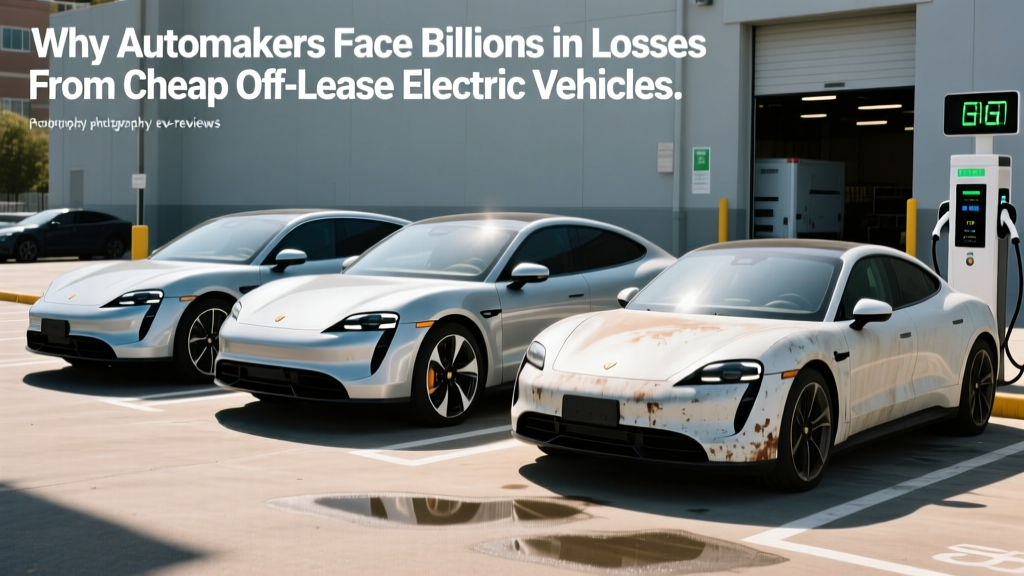
The used EV market is flooding with off-lease models priced 45–55% below their original MSRP, creating a paradox: incredible bargains for second-hand buyers, and massive balance-sheet pain for the manufacturers who guaranteed those lease residuals. In 2025 and 2026, a wave of 36-month leases originated during the 2022–2023 EV pricing bubble are maturing, and the vehicles coming back are worth far less than automakers projected. This isn't abstract accounting — it's reshaping what you pay for a new EV today, which models survive, and how the total cost of ownership actually stacks up.
For buyers, the silver lining is real. Off-lease EVs like the 2023 Hyundai Ioniq 5, Ford Mustang Mach-E, and BMW i4 are hitting dealer lots at steep discounts, and the used-EV federal tax credit (up to $4,000 under §25E) can stack on top. But understanding the full ownership math — from the §30D new-vehicle credit to insurance premiums to charging costs — is essential before you sign anything.
The Off-Lease EV Avalanche: What's Driving Automaker Losses
When automakers set lease residuals in 2022, the average EV transaction price exceeded $65,000 and demand appeared insatiable. By the time those leases mature in 2025–2026, the landscape has inverted:
- Price cuts cascaded: Tesla's aggressive Model Y and Model 3 price reductions in 2023–2024 dragged the entire segment downward. A vehicle with a $48,000 residual guarantee might now command $28,000–$32,000 on the used market.
- Early EV adopters churn quickly: Lease return rates for EVs run higher than for gas vehicles, flooding auction lanes simultaneously.
- Battery anxiety suppresses used demand: Despite data showing most modern NMC and LFP packs retain 90%+ capacity at 100,000 miles, used buyers still discount EVs over battery health uncertainty.
- Updated models obsolete predecessors: The 2025–2026 refreshes with NACS ports, heat pumps, and improved range make 2022–2023 models look dated.
Industry analysts estimate cumulative residual-value losses for major automakers could reach $10–$15 billion across the 2024–2027 period. Ford, GM, Hyundai/Kia, and BMW are all exposed. For consumers, this translates to two things: aggressive incentives on new EVs to move metal, and genuine bargains on certified pre-owned and off-lease inventory.
The Real 5-Year Cost to Own an EV: A Complete Breakdown
To understand whether an EV — new or off-lease — saves you money, we need hard numbers. Below is a 5-year/75,000-mile total cost of ownership (TCO) model comparing a representative 2026 mid-size electric crossover (similar to a Hyundai Ioniq 5 or Tesla Model Y RWD) against a comparable gas-powered SUV averaging 28 MPG combined.
| Cost Category | 2026 EV Crossover | Gas SUV (28 MPG) | Difference |
|---|---|---|---|
| Purchase Price (after incentives) | $37,500* | $38,000 | −$500 |
| Fuel/Energy (75,000 mi) | $5,625** | $9,375*** | −$3,750 |
| Maintenance | $1,800 | $3,750 | −$1,950 |
| Insurance (5 years) | $11,250 | $9,000 | +$2,250 |
| Depreciation (5 yr) | $18,750 | $14,250 | +$4,500 |
| Total 5-Year Cost | $74,925 | $74,375 | +$550 |
* Assumes $45,000 MSRP minus $7,500 §30D point-of-sale credit. Actual eligibility varies — see tax credit section below.
** Based on 3.5 miles/kWh at $0.15/kWh national average home electricity; public DC fast charging at $0.40/kWh assumed for 20% of miles.
*** Based on 28 MPG combined at $3.50/gallon.
The takeaway: at current pricing and energy costs, the 5-year TCO is nearly identical. The EV's fuel and maintenance savings are largely offset by higher insurance and steeper depreciation. But this equation shifts dramatically depending on your electricity rate, annual mileage, local incentives, and whether you buy new or off-lease.
Federal Tax Credits: §30D Rules You Must Verify Before Buying
The federal EV tax credit remains the single largest purchase-price reducer, but eligibility is a matrix of requirements that trip up many buyers. Under IRS §30D rules current for the 2026 tax year, the credit tops out at $7,500 for new vehicles and can be transferred to the dealer at point of sale as an immediate price reduction.
§30D New Clean Vehicle Credit — 2026 Eligibility Checklist:
- MSRP Caps: Vans, SUVs, and pickup trucks must have an MSRP ≤ $80,000. Sedans and other vehicles must be ≤ $55,000.
- Income Limits (Modified AGI): $300,000 joint filers / $225,000 head of household / $150,000 single filers. If your income exceeds these in the purchase year or the prior year, you do not qualify.
- Battery Component Sourcing: $3,750 of the credit requires a percentage of battery components to be manufactured or assembled in North America (the threshold increases annually).
- Critical Minerals Sourcing: The other $3,750 requires a percentage of critical minerals to be sourced from the U.S. or a free-trade-agreement partner (also escalating yearly).
- Final Assembly: The vehicle must undergo final assembly in North America.
- FEOC Restriction: Vehicles with battery components from a "foreign entity of concern" (effectively China-linked supply chains) are disqualified entirely.
- Point-of-Sale Transfer: You can elect to transfer the credit to the dealer, reducing your purchase price at closing rather than waiting for a tax refund.
As of early 2026, vehicles that reliably qualify for the full $7,500 include select trims of the Tesla Model Y (Austin-built), Ford F-150 Lightning, Chevrolet Equinox EV, and certain VW ID.4 units. Many Hyundai/Kia models built in Georgia now qualify following their U.S. plant ramp-up, but battery sourcing details vary by production batch — always verify the specific VIN on fueleconomy.gov before committing.
Used EV Credit (§25E): For off-lease bargains, the used-EV credit offers up to $4,000 (30% of the sale price, capped at $4,000) on vehicles priced under $25,000, with lower income caps ($150,000 joint / $112,500 HOH / $75,000 single). This is the key incentive making cheap off-lease EVs even cheaper.
Charging vs. Gas: The Per-Mile Cost Reality
The most consistent EV advantage is energy cost — but only if you charge at home. Here's how the math breaks down across common scenarios:
| Scenario | Rate Assumption | Cost Per Mile | Annual Cost (15k mi) |
|---|---|---|---|
| Home Level 2 (national avg) | $0.15/kWh, 3.5 mi/kWh | $0.043 | $643 |
| Home Level 2 (low-cost state, e.g., WA) | $0.10/kWh, 3.5 mi/kWh | $0.029 | $429 |
| Home Level 2 (high-cost state, e.g., CA) | $0.30/kWh, 3.5 mi/kWh | $0.086 | $1,286 |
| Public DC Fast Charging | $0.40/kWh, 3.0 mi/kWh* | $0.133 | $2,000 |
| Gas Vehicle (28 MPG) | $3.50/gallon | $0.125 | $1,875 |
| Gas Vehicle (22 MPG, truck/SUV) | $3.50/gallon | $0.159 | $2,386 |
* Highway driving efficiency drops to ~3.0 mi/kWh due to higher speeds and aerodynamic drag; DC fast charging also carries session fees at some networks.
The critical insight: home charging is the economic keystone. If you charge exclusively at home in an average-rate state, you'll spend roughly $640/year on energy versus $1,875 for gas — a $1,235 annual savings. But if you rely entirely on public DC fast charging in a high-rate state, your per-mile cost can actually exceed a gas vehicle. This is why EV ownership economics are deeply personal and geography-dependent.
Maintenance Savings: Where EVs Quietly Win
EVs eliminate the most frequent maintenance items that gas-car owners take for granted. Over 75,000 miles, the savings are substantial and predictable:
| Maintenance Item | Gas Vehicle (75k mi) | EV (75k mi) |
|---|---|---|
| Oil Changes | $750–$1,125 (10–15 changes) | $0 |
| Brake Pads/Rotors | $600–$1,200 (1–2 replacements) | $0–$300 (regen braking extends life 2–3×) |
| Transmission Fluid | $150–$300 | $0 (single-speed reduction gear) |
| Air Filters (engine) | $100–$200 | $0 (cabin filter only, ~$80) |
| Spark Plugs | $200–$400 | $0 |
| Coolant Flush | $150–$250 | $100–$150 (battery thermal loop) |
| Tire Rotation/Replacement | $1,200–$1,800 | $1,400–$2,200 (heavier vehicle, instant torque wears tires faster) |
| Total Estimated | $3,150–$5,275 | $1,580–$2,730 |
Net maintenance savings run $1,500–$2,500 over five years. The one area where EVs cost more is tires — the combination of heavier curb weight (battery mass) and instant torque accelerates tread wear by roughly 20–30%. Budget for a tire replacement around 35,000–40,000 miles rather than the 50,000–60,000 miles typical for gas vehicles.
Insurance: The Cost Most EV Buyers Underestimate
EV insurance premiums typically run 15–25% higher than equivalent gas vehicles. For our representative crossover, that means $2,250/year versus $1,800/year — a $2,250 gap over five years. Why?
- Higher repair costs: EV collision repairs require specialized high-voltage safety training, and battery pack damage often triggers total-loss declarations even from minor underbody impacts.
- Parts scarcity: Structural battery trays, integrated drive units, and proprietary sensors have longer lead times and fewer aftermarket alternatives.
- Total-loss frequency: Insurers are still calibrating battery repair protocols; many default to replacement rather than repair, inflating claim costs.
- Vehicle value: Higher MSRP means higher comprehensive and collision payouts.
However, premiums vary enormously by insurer, driver profile, and state. Some carriers now offer EV-specific policies with discounts for home charging or low annual mileage. Always get three quotes before assuming the worst — in some cases, the gap narrows to 5–8%.
Depreciation: The $10,000 Question and the Off-Lease Opportunity
Depreciation is where the automaker-loss story meets the buyer's wallet. Current EV depreciation curves are steep:
- Year 1: 20–25% loss (similar to gas vehicles)
- Year 2: 35–40% cumulative loss
- Year 3: 45–55% cumulative loss — this is where off-lease vehicles land
- Year 5: 55–65% cumulative loss for most mainstream EVs
Compare that to a typical gas SUV holding 45–50% of value at year 5. The gap is real, driven by battery longevity uncertainty, rapid tech obsolescence, and the price-cut cascade described above.
But here's the buyer's play: if you buy into the depreciation curve at year 3 — purchasing an off-lease EV that has already absorbed that 50% hit — your forward depreciation from that point is much more moderate. You're letting the original owner (and the automaker's residual guarantee) absorb the steepest drop. This is precisely why off-lease EVs represent some of the best value in the car market right now, even as they crater automaker balance sheets.
Beyond federal credits, many states and utilities offer additional rebates: California's CVRP has offered up to $2,000 for income-qualified buyers, Colorado provides a $5,000 state tax credit, and utilities like Con Edison, PG&E, and Xcel Energy offer $500–$1,500 rebates for home charger installation. These change frequently — check your state energy office and utility provider for current programs. Some states (Texas, Florida) offer no additional incentives. Always verify before budgeting.
The Ownership Decision: New, Off-Lease, or Gas?
Buy a NEW EV if: You qualify for the full $7,500 §30D credit, charge primarily at home, drive 12,000+ miles annually, and plan to keep the vehicle 7+ years (riding out the depreciation curve).
Buy an OFF-LEASE EV if: You want the steepest value proposition — a 2–3-year-old EV at 50% off MSRP, eligible for the $4,000 used-EV credit, with most of the battery warranty remaining (typically 8 yr/100,000 mi). This is where automaker losses become your gain.
Stick with GAS (or hybrid) if: You lack reliable home charging access, drive in extreme cold regularly (expect 25–35% range loss below 20°F), regularly tow heavy loads, or live in a charging-desert region where public infrastructure is unreliable.
Consider a PHEV if: You want 30–40 miles of electric commuting with a gas backup for road trips — the best of both worlds for one-car households without guaranteed charging.
Frequently Asked Questions
How much does it really cost to own an EV over 5 years?
For a new mid-size EV crossover at ~$45,000 MSRP with the $7,500 federal credit applied, expect roughly $72,000–$78,000 in total 5-year costs including purchase, energy, insurance, maintenance, and depreciation. An off-lease equivalent purchased at ~$25,000 can drop that to $52,000–$58,000 — competitive with or cheaper than a gas vehicle.
Do I qualify for the federal EV tax credit?
It depends on four factors: your modified adjusted gross income (under $150k single / $300k joint), the vehicle's MSRP (under $55k for cars, $80k for SUVs/trucks), the vehicle's battery sourcing compliance, and North American final assembly. Check the specific VIN on fueleconomy.gov and consult a tax professional for your situation.
How much do I save on fuel and maintenance?
With home charging at average electricity rates, expect $1,000–$1,300/year in fuel savings over a 28 MPG gas vehicle. Maintenance savings add another $300–$500/year. Combined, that's $1,300–$1,800 annually, or $6,500–$9,000 over five years — meaningful, but partially offset by higher insurance.
Are EVs more expensive to insure?
Yes, typically 15–25% more than an equivalent gas vehicle due to higher repair costs, specialized parts, and elevated total-loss frequency. On a $45,000 EV, expect to pay roughly $300–$500 more per year. Shop multiple insurers — the gap varies widely by carrier.
How well do EVs hold their value?
Current data shows mainstream EVs retaining 35–45% of value at 5 years, compared to 45–55% for comparable gas SUVs. However, buying at the 3-year mark (off-lease) means the steepest depreciation has already occurred, and your forward value retention is more predictable. Battery warranties (8 yr/100,000 mi for most manufacturers) also support used values.
Why are automakers losing billions on off-lease EVs?
They guaranteed high lease residual values in 2022–2023 when EV prices peaked. Tesla's subsequent price cuts, rapid technology updates, and consumer battery anxiety crashed used EV values 45–55%. Automakers must absorb the difference between the guaranteed residual and actual auction value — a loss of $5,000–$15,000 per returned lease vehicle, multiplied across hundreds of thousands of units.