The Short Answer: Does an Audi TT Electric Exist?
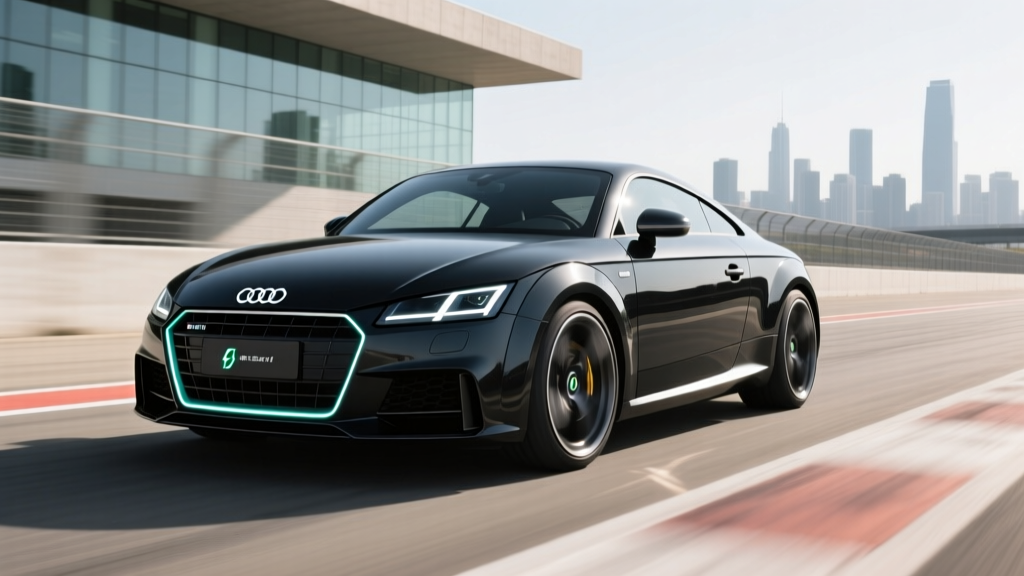
As of early 2026, there is no production Audi TT Electric available for purchase. Audi discontinued the internal-combustion TT after the 2023 model year and has signaled that a spiritual electric successor will arrive on the Volkswagen Group's PPE (Premium Platform Electric) architecture — but Audi has not confirmed a production model wearing the TT nameplate. What has been announced is a next-generation compact electric sports car concept that borrows TT design DNA, expected to enter production no earlier than late 2026 or 2027. If you're searching for an "Audi TT electric" to buy today, the closest current option is the Audi Q4 e-tron (starting ~$49,800) for an electric Audi, or the Porsche Taycan if you want a performance-oriented VW Group EV.
Why the Audi TT Went Electric — And What That Means
The Audi TT ended a 25-year production run in November 2023, with the final third-generation (8S) models rolling off the line at the Győr, Hungary plant. Audi CEO Gernot Döllner confirmed in late 2023 that the TT's successor would be electric, positioned as an "emotional" EV that carries forward the TT's compact, design-forward identity. This decision aligns with Audi's commitment to launch only all-electric models in most global markets by 2026 and phase out combustion engines entirely by 2033.
However, the transition from a lightweight, front-engine (or mid-engine in the case of the TT RS-badged variants) sports coupe to a battery-electric platform introduces real engineering trade-offs that prospective buyers need to understand:
- Weight: The last gas TT RS weighed roughly 3,373 lbs (curb). A comparable EV on the PPE platform will likely weigh 4,200–4,600 lbs due to the battery pack — a fundamental physics constraint that affects handling dynamics.
- Battery placement: The PPE platform positions the battery as a flat "skateboard" under the floor. This gives a low center of gravity (good for cornering) but raises the seating position compared to the original TT's low-slung cockpit.
- Powertrain options: PPE supports single-motor rear-wheel drive and dual-motor all-wheel drive (quattro). Expect a base model around 335 hp and a performance variant potentially exceeding 500 hp.
Expected Specs: What the PPE Platform Tells Us
While Audi has not published final specifications for a TT electric successor, we can make data-grounded projections based on the PPE platform — the same architecture underpinning the Audi Q6 e-tron and Porsche Macan Electric. Here's what platform data suggests:
| Specification | Estimated Base | Estimated Performance |
|---|---|---|
| Battery (usable) | ~83 kWh (NMC) | ~95 kWh (NMC) |
| EPA Range (est.) | 260–290 mi | 280–320 mi |
| Drivetrain | RWD, single motor | AWD, dual motor (quattro) |
| Horsepower | ~335 hp | ~500+ hp |
| 0–60 mph | ~5.5 sec | ~3.5 sec |
| Peak DC Charge Rate | 270 kW | 270 kW |
| 10–80% DC Charge | ~21 min | ~21 min |
| Level 2 AC Charge | 11 kW (standard) | 11 kW (standard) |
| Estimated Base MSRP | $55,000–$62,000 | $75,000–$85,000 |
Important context: These are projections, not confirmed figures. The Q6 e-tron, a larger SUV on the same platform, achieves an EPA-estimated 321 miles with its 95 kWh battery (fueleconomy.gov). A lower, lighter, more aerodynamic TT-style coupe could match or slightly exceed that — but sports-tuned suspensions and wider tires typically reduce efficiency by 5–10%.
Cost Breakdown: What Ownership Would Actually Cost
Let's model what owning an Audi TT electric successor would look like financially, compared to the last gas-powered TT (2023 TT 45 TFSI, ~$52,000 MSRP) and a current EV sports car benchmark (Porsche Taycan, ~$92,000 base). This assumes the EV variant lands around $60,000 MSRP.
| Category | TT Electric (Est. $60K) | Gas TT 45 TFSI ($52K) |
|---|---|---|
| Purchase Price | $60,000 | $52,000 |
| Federal Tax Credit (§30D) | $0–$7,500* | $0 |
| Effective Purchase | $52,500–$60,000 | $52,000 |
| Fuel/Energy (5 yr, 60K mi) | $4,200–$6,000 | $9,600–$11,400 |
| Maintenance (5 yr) | $1,800–$2,500 | $4,500–$6,000 |
| Insurance (5 yr avg) | $12,000–$15,000 | $9,000–$11,500 |
| Estimated Depreciation | $24,000–$30,000 | $20,000–$26,000 |
| 5-Year Total Cost | $70,500–$87,500 | $75,100–$89,500 |
* Federal §30D tax credit eligibility depends on MSRP caps ($55,000 for cars), buyer income limits ($150K single / $300K joint), and battery critical-mineral sourcing requirements per IRS guidelines. A $60,000 sports coupe would likely exceed the $55,000 MSRP cap for the sedan/car category, potentially disqualifying it from the full credit unless reclassified as an SUV — a distinction Audi may engineer for.
Key takeaway: The EV variant saves significantly on fuel and maintenance (no oil changes, fewer brake replacements due to regenerative braking, no timing belt or turbo servicing). But higher insurance premiums and potentially steeper depreciation on a niche EV sports car can erode those gains. Home charging at $0.13/kWh yields roughly $0.04/mile; public DC fast charging at $0.35–$0.50/kWh pushes that to $0.10–$0.15/mile — still below gasoline at ~$0.16–$0.19/mile (at 28 MPG combined and $3.50/gallon).
Charging Reality: What You'd Need at Home and on the Road
If Audi delivers a PPE-based TT electric successor, charging will be one of its strongest practical attributes. The PPE platform supports 800-volt architecture, enabling some of the fastest DC charging in the industry. Here's what that translates to in real-world terms:
| Level | Power | Miles Added per Hour | Use Case |
|---|---|---|---|
| Level 1 (120V) | 1.4 kW | ~4 mi/hr | Emergency / overnight trickle |
| Level 2 (240V, 48A) | 11.5 kW | ~35 mi/hr | Home daily charging |
| DC Fast (peak) | 270 kW | ~650 mi/hr (peak) | Road trips, 10–80% in ~21 min |
| DC Fast (sustained avg) | ~150–180 kW | ~400 mi/hr (avg) | Real-world average over session |
Home charging setup: To take advantage of 11 kW Level 2 charging, you'll need a 240V / 60-amp dedicated circuit with a hardwired wall connector (such as the Audi-branded charger or a ChargePoint Home Flex). Installation costs typically range from $800–$2,500 depending on panel proximity and local permitting. If your home electrical panel is at or near capacity (common in older homes with 100-amp service), a panel upgrade to 200 amps can add $1,500–$3,500.
Connector note: Audi has committed to adopting the NACS (North American Charging Standard / Tesla connector) for its North American models starting in 2025. A TT electric successor arriving in 2027 would almost certainly ship with a native NACS port, granting access to Tesla Supercharger stations (now open to non-Tesla EVs) in addition to Electrify America, EVgo, and other networks.
Common Misconceptions About an Electric Audi TT
| Myth | Fact |
|---|---|
| "The electric TT is available to order now." | No production Audi TT EV exists as of 2026. Audi has confirmed a spiritual successor is in development but has not opened orders or published final specs. |
| "It will be just as light as the gas TT." | Impossible with current battery technology. Expect 4,200–4,600 lbs vs. the gas TT's ~3,100–3,370 lbs. The EV's low center of gravity compensates somewhat, but mass affects braking distances, tire wear, and transient handling. |
| "It will definitely qualify for the $7,500 tax credit." | The §30D credit has a $55,000 MSRP cap for cars (not SUVs). If Audi prices the base model above $55K and it's classified as a car (not SUV), the credit is lost. Battery sourcing rules add further uncertainty. |
| "270 kW charging means I'll always charge that fast." | 270 kW is the peak rate, achievable only between ~10–30% state of charge under ideal battery temperature conditions. The charge curve tapers significantly above 50%, and the session average is typically 150–180 kW. Plan stops around 21–25 minutes for 10–80%. |
| "An EV sports car has no soul / driving engagement." | Subjective, but worth noting: EVs deliver instant torque (no turbo lag, no waiting for downshifts), and torque-vectoring dual-motor setups can rotate the car aggressively on corner exit. The missing element is engine sound and mechanical feedback — which some drivers value deeply. |
Decision Framework: Should You Wait or Buy Now?
Wait for the Audi TT Electric Successor If:
- You're not in a rush — production is likely 2027 at the earliest, with US deliveries potentially in late 2027 or 2028.
- You specifically want a compact, design-forward Audi coupe (not an SUV) with electric powertrain.
- You have reliable home charging and your daily commute is under 150 miles round-trip.
- You're willing to pay $55,000–$85,000 for a niche EV sports car and accept first-year model risk.
Buy Something Else Now If:
- You need a vehicle within 6 months — the TT electric successor is not orderable.
- You want a proven EV with established reliability data and resale history.
- Your budget is under $50,000 — no Audi EV currently fits that range new.
- You regularly drive 300+ miles between charges in rural areas without DC fast-charger access.
Current Alternatives to Consider Today:
- Porsche Taycan (2026): From ~$92,000, 246–318 mi EPA range, 800V architecture, 270 kW peak charging, the benchmark for electric sports car dynamics in the VW Group.
- Audi e-tron GT (2026): Shares the J1 platform with the Taycan, from ~$108,000, 238–278 mi range. More grand-tourer than sports coupe.
- BMW i4 M50: From ~$68,000, 227–270 mi range, 536 hp, a practical electric sportback with strong performance credentials.
- Used Audi TT RS (2022–2023): The last of the combustion TTs, 394 hp turbocharged 5-cylinder, appreciating as a future classic. No EV trade-offs, but no EV savings either.
Frequently Asked Questions
Has Audi officially confirmed the TT electric successor's name?
No. Audi has confirmed a compact electric sports car is in development as a spiritual successor to the TT, but the production name has not been announced. It may not carry the "TT" badge — Audi could introduce a new nameplate aligned with its EV naming convention (which uses "e-tron" designations).
Will the Audi TT electric be a hybrid or fully electric?
Fully electric. Audi ended the TT's production run without introducing a hybrid variant, and the company's strategy commits to all-electric new model launches. There will be no plug-in hybrid TT.
What platform will the electric TT successor use?
Audi has indicated the PPE (Premium Platform Electric) architecture, co-developed with Porsche. This is the same 800-volt platform underpinning the Q6 e-tron and Porsche Macan Electric, offering 270 kW peak DC charging and flexible motor configurations.
How does the expected weight compare to the gas TT?
Significantly heavier. The gas TT RS weighed approximately 3,373 lbs. An electric successor on the PPE platform with a ~95 kWh battery will likely weigh 4,200–4,600 lbs — roughly 1,000+ lbs more. This mass affects tire wear (expect higher replacement costs), braking distances, and the "tossability" that made the original TT feel nimble on back roads.
Should I put down a deposit when reservations open?
Proceed cautiously with first-year Audi EV models. The Q8 e-tron (formerly just "e-tron") experienced software issues and recalls in its early production years. Waiting 12–18 months after launch for software maturity and early reliability data is a prudent strategy unless you're comfortable with first-year risk and strong dealer support.
Will it have a manual transmission or simulate gear shifts?
Almost certainly no manual transmission. However, Hyundai's Ioniq 5 N has demonstrated that simulated gear shifts and synthetic engine sound can add engagement to an EV. Audi may implement similar features in a performance variant, though this has not been confirmed.