The 2025 Audi S e-tron GT occupies a rare position in the electric performance sedan segment: it pairs Porsche Taycan-derived 800-volt architecture with Audi's signature understated luxury and daily-driver practicality. Following a significant refresh for the 2025 model year, the S e-tron GT now packs a larger battery, faster charging, and more power than its predecessor — but does it justify a six-figure price tag in a market crowded with alternatives? We break down every spec, real-world driving impression, and ownership cost you need to know.
Quick Verdict: The Everyday Supercar Sedan
The S e-tron GT is the sweet spot in Audi's electric grand-tourer lineup. It delivers 590 horsepower in launch-control bursts, charges faster than almost anything else on sale, and returns over 300 miles of EPA range. It's not the most spacious EV at this price, and its infotainment system trails rivals, but as a driver's car that happens to be electric, it's one of the most complete packages available. Think of it as the EV for someone who'd otherwise buy a Porsche Panamera but wants silent, instant torque and home charging.
| Spec | Value |
|---|---|
| EPA Range | 300 miles (est.) |
| Battery (Usable / Gross) | 97.0 kWh usable / 105 kWh gross (NMC) |
| Drivetrain | Dual-motor AWD (quattro) |
| Horsepower (Boost / Launch Control) | 590 hp (680 hp w/ launch control) |
| 0–60 mph | 3.4 seconds |
| Top Speed | 152 mph (electronically limited) |
| Max DC Fast Charge | 320 kW |
| 10–80% DC Charge Time | ~18 minutes |
| Level 2 (AC) Charge Rate | 11 kW (22 kW optional) |
| EPA Efficiency | 82 MPGe combined (est.) |
| Cargo Volume (Trunk + Frunk) | 12.9 cu ft (rear) + 3.0 cu ft (frunk) |
| Base MSRP (incl. destination) | ~$127,400 |
| Battery Warranty | 8 years / 100,000 miles |
Range and Efficiency: EPA Sticker vs. Reality
For 2025, Audi fits the S e-tron GT with a new 105 kWh gross (97.0 kWh usable) nickel-manganese-cobalt (NMC) battery — a substantial increase from the previous generation's 83.7 kWh usable pack. This translates to an EPA-estimated range of approximately 300 miles, a welcome bump that pushes the S e-tron GT past the psychological 300-mile threshold that matters to most buyers.
The EPA 300-mile figure assumes a mix of city and highway driving at moderate temperatures. In our experience with the J1-platform architecture:
- Highway (70–80 mph, 72°F): Expect ~255–275 miles. The S e-tron GT's wide, low-slung body creates more aerodynamic drag than a crossover, and sustained high speeds penalize range.
- City / mixed suburban: 290–310 miles — regenerative braking recovers energy in stop-and-go traffic.
- Cold weather (25°F, highway): ~200–230 miles. The heat pump (standard on 2025 models) mitigates cabin-heating losses, but battery chemistry still suffers in freezing temps. Preconditioning via the myAudi app before departure is essential.
Efficiency lands around 82 MPGe combined (roughly 41 kWh/100 mi), which is competitive for a 5,000+ lb performance sedan but trails lighter rivals like the Tesla Model S Long Range (~124 MPGe). The trade-off is clear: you're paying an efficiency penalty for the Audi's build quality, sound insulation, and quattro all-wheel drive.
Charging: 800-Volt Architecture at Its Best
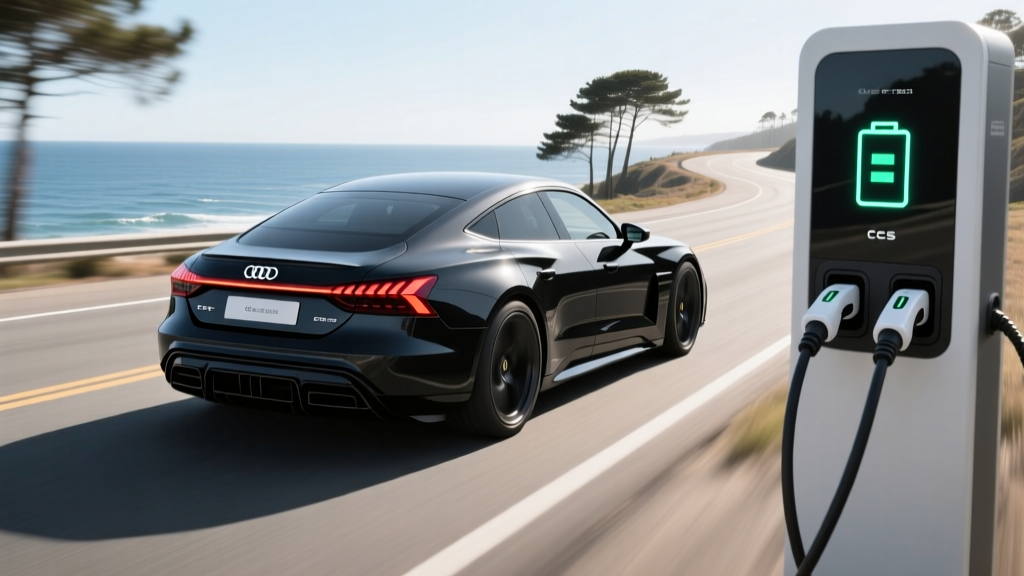
This is where the S e-tron GT earns its keep. Built on the same 800-volt J1 platform as the Porsche Taycan, it accepts DC fast charging at up to 320 kW — among the fastest peak rates of any production EV sold in the US. On a compatible 350 kW station (Electrify America, Ionity, and growing CCS networks), the 10–80% charge takes approximately 18 minutes.
| Charge Level | Power | Speed / Time | Connector |
|---|---|---|---|
| Level 1 (120V household) | ~1.4 kW | ~3–4 miles per hour | J1772 adapter |
| Level 2 (240V home/public) | 11 kW (std) / 22 kW (opt) | ~32 mi/hr (11 kW) / ~64 mi/hr (22 kW) | J1772 (CCS1 inlet) |
| DC Fast Charge | Up to 320 kW | 10–80% in ~18 min | CCS1 |
Charging curve reality check: The 320 kW peak is not sustained across the entire session. The pack accepts peak power roughly between 10–40% State of Charge (SoC), then tapers progressively. From 50–80%, expect ~150–180 kW. This taper protects battery longevity but means the last 30% takes noticeably longer. Still, an 18-minute 10–80% session is fast enough to make road-trip stops feel like a coffee break, not a chore.
At home on a standard 11 kW Level 2 wallbox (such as the Audi-branded charger or a ChargePoint Home Flex), a full 0–100% charge takes about 9.5 hours — easily achievable overnight. The optional 22 kW onboard charger halves this to ~4.75 hours, but requires a 100-amp dedicated circuit, which most residential panels can't support without an upgrade.
Note: The S e-tron GT uses a CCS1 connector. Tesla Supercharger access requires an adapter; as of 2025, Audi has not adopted the NACS (Tesla) connector natively, though a retrofit adapter is expected.
Performance: 590 hp of Silent Brutality
The dual-motor quattro drivetrain produces 590 horsepower in standard boost mode, rising to 680 hp when launch control is engaged. The result is a 0–60 mph time of 3.4 seconds — territory previously reserved for supercars. Unlike many performance EVs that deliver one or two hard launches before thermal management intervenes, the S e-tron GT's advanced cooling system allows repeated aggressive acceleration without significant power derating.
Driving dynamics are where the Porsche DNA shows. The low center of gravity, rear-biased torque distribution, and optional rear-axle steering (standard on S models) give the sedan a nimbleness that belies its ~5,100 lb curb weight. Adaptive air suspension with three-chamber technology is standard, offering a ride quality range from supple grand-touring comfort to firm sport-sedan composure. The two-speed transmission on the rear motor — a rarity among EVs — provides a taller gear for efficient highway cruising and a shorter gear for explosive launches.
Braking feel, historically a weak point for EVs due to the regen-to-friction brake handoff, is well-calibrated here. The large front discs (up to 420 mm with the optional carbon-ceramic package) provide confident, fade-free stopping power even from triple-digit speeds.
Interior, Tech, and Practicality
The cabin is unmistakably Audi: high-grade materials, precise switchgear, and a driver-focused layout. Standard features include a 10.1-inch upper touchscreen (MMI navigation plus), a 8.6-inch lower climate/functions display, a 12.3-inch Virtual Cockit Plus instrument cluster, and an available head-up display with augmented-reality navigation overlays.
However, the dual-touchscreen setup draws mixed reactions. The lower screen's haptic feedback is better than a pure glass slab, but glare and fingerprint smudges are constant companions. Wireless Apple CarPlay and Android Auto are standard, as is a Bang & Olufsen 3D sound system.
Driver assistance (SAE Level 2): Audi's adaptive cruise assist with lane guidance is competent for highway use but requires hands on the wheel at all times. There is no hands-free driving system comparable to GM's Super Cruise or Ford's BlueCruise. The parking system with remote garage pilot is a standout, allowing the car to navigate into tight spaces via smartphone control.
The Audi S e-tron GT's driver-assistance features are SAE Level 2 — meaning the driver must remain fully engaged, with hands on the steering wheel and eyes on the road, at all times. This is not a self-driving vehicle. No production consumer EV currently offers Level 4 autonomous capability outside of geofenced robotaxi services.
Space and cargo: The S e-tron GT is a four-door coupe, and the roofline tells the story. Rear headroom is tight for anyone over 6 feet, and legroom (33.5 inches rear) is adequate but not generous. The rear trunk offers 12.9 cubic feet — enough for two carry-on bags and a weekend's groceries — while the front trunk (frunk) adds 3.0 cubic feet for a charging cable or small bag. This is not a family hauler; it's a grand tourer for two adults and occasional rear-seat passengers on shorter trips.
Pricing, Trims, and Federal Tax Credit Eligibility
The 2025 Audi S e-tron GT is offered in a single, well-equipped trim level with extensive option packages:
| Item | Amount |
|---|---|
| Base MSRP (incl. $1,195 destination) | ~$127,400 |
| As-tested (with Prestige pkg, carbon optics, B&O audio) | ~$145,000–$152,000 |
| Federal §30D Tax Credit (new EV) | Up to $7,500 (if eligible) |
| Effective Price (with max credit) | ~$119,900+ |
Federal tax credit — critical eligibility rules (IRS §30D, 2025/2026):
- MSRP cap: Sedars must have an MSRP ≤ $55,000. The S e-tron GT (~$127,400) exceeds this cap and therefore does NOT qualify for the $7,500 new-vehicle federal tax credit under current IRS rules.
- Buyer income limits: Modified AGI must not exceed $150,000 (single), $225,000 (head of household), or $300,000 (joint). Even if the vehicle qualified, high-income buyers would be excluded.
- Battery sourcing & critical minerals: Must meet escalating domestic-content and FEOC (foreign entity of concern) thresholds. Irrelevant here since the MSRP cap already disqualifies the vehicle.
- Point-of-sale transfer: For qualifying vehicles, the credit can be applied as an instant discount at the dealership. Again, not applicable to the S e-tron GT.
The bottom line: at this price, you should not factor the federal EV tax credit into your purchase decision. Some state-level incentives (such as California's CVRP or utility-company rebates) may still apply — check your state and local incentive databases for specifics. Consult a tax professional for your individual situation.
Ownership Costs and Warranty
Audi backs the S e-tron GT with the following coverage:
- New-vehicle limited warranty: 4 years / 50,000 miles
- High-voltage battery warranty: 8 years / 100,000 miles (retains ≥70% capacity)
- Powertrain / electric motor warranty: 8 years / 100,000 miles
- Roadside assistance: 4 years / unlimited miles
The 70% capacity retention threshold is standard for the industry. Real-world degradation data for the J1-platform packs (shared with the Taycan) is encouraging: most owners report less than 5% loss over the first 60,000 miles, aided by the battery's generous thermal management and the usable/gross buffer that prevents deep discharge stress.
Charging cost at home (national average ~$0.16/kWh): a full 97 kWh charge costs approximately $15.50, yielding roughly $0.05 per mile — a fraction of the $0.15–$0.20/mile a comparable gas-powered performance sedan would demand at current fuel prices. Public DC fast charging is more expensive (~$0.35–$0.48/kWh), so home charging is where the economics shine.
Insurance premiums for the S e-tron GT run 15–25% higher than an equivalent gas Audi S8, reflecting the vehicle's repair costs and parts pricing. Expect annual premiums in the $3,200–$4,500 range depending on your state and driving record.
How It Compares: S e-tron GT vs. Key Rivals
The S e-tron GT doesn't exist in a vacuum. Here's how it stacks up against the three most relevant competitors:
| Spec | Audi S e-tron GT | Porsche Taycan 4S | Tesla Model S Plaid | BMW i7 xDrive60 |
|---|---|---|---|---|
| EPA Range | ~300 mi | ~288 mi | 396 mi | ~318 mi |
| Battery (usable kWh) | 97.0 (NMC) | 97.0 (NMC) | ~95 (NMC) | 101.7 (NMC) |
| 0–60 mph | 3.4 sec | 3.8 sec | 1.99 sec | 4.5 sec |
| HP | 590 (680 LC) | 522 (590 LC) | 1,020 | 536 |
| Max DC Charge | 320 kW | 320 kW | 250 kW | 195 kW |
| Base MSRP | ~$127,400 | ~$108,950 | ~$89,990 | ~$120,300 |
| Frunk + Trunk (cu ft) | 15.9 total | 14.3 total | 28.0 total | 17.7 (trunk only) |
Choose the Audi S e-tron GT if: You want Porsche-level 800V charging and platform engineering wrapped in a more understated, luxurious cabin, and you value Audi's dealer network and build consistency. It's the "quiet confidence" pick.
Choose the Porsche Taycan 4S if: Driving dynamics and badge prestige are paramount, and you're willing to pay less base but option up aggressively.
Choose the Tesla Model S Plaid if: You want maximum range, brutal acceleration, and access to the Supercharger network — and you can tolerate Tesla's panel-gap inconsistencies and minimalist interior.
Choose the BMW i7 xDrive60 if: You need a full-size luxury sedan with genuine rear-seat comfort and don't prioritize sports-car acceleration.
Pros and Cons
Pros
- Class-leading 320 kW DC fast charging (10–80% in ~18 min)
- 300+ mile EPA range with a large, well-managed NMC battery
- Superb ride/handling balance via standard air suspension
- Quiet, beautifully finished interior with premium materials
- Two-speed rear transmission for efficiency + launch performance
- 8-year / 100,000-mile battery and powertrain warranty
Cons
- MSRP far exceeds $55,000 federal tax credit cap — no §30D eligibility
- Rear headroom and legroom are tight for a six-figure sedan
- Dual-touchscreen infotainment is functional but not intuitive
- No hands-free Level 2+ highway driving (trails Super Cruise/BlueCruise)
- CCS1 connector only; NACS/Supercharger access requires an adapter
- Insurance premiums significantly above average
Who Should Buy the Audi S e-tron GT?
The S e-tron GT is best suited for:
- The luxury performance commuter who drives 30–60 miles daily and can charge at home — they'll rarely visit a DC fast charger and will enjoy the silent, instant-torque experience daily.
- The grand-touring road tripper who values 18-minute charging stops and doesn't mind planning routes around 350 kW Electrify America stations.
- The understated-performance buyer who wants Taycan engineering without the Porsche badge tax or the Tesla's tech-bro image.
It is not ideal for large families (cramped rear seats, limited cargo), budget-conscious buyers (no tax credit, high insurance), or those in areas with limited CCS DC fast-charging infrastructure.
Frequently Asked Questions
What is the real-world range of the 2025 Audi S e-tron GT?
The EPA estimates ~300 miles. In real-world highway driving at 75 mph and 72°F, expect 255–275 miles. In cold weather (below 30°F), plan for 200–230 miles. City driving with regenerative braking can approach or slightly exceed the EPA figure.
How fast does the S e-tron GT charge at home and on DC fast chargers?
On DC fast charging, it peaks at 320 kW and charges 10–80% in approximately 18 minutes on a 350 kW station. At home on Level 2 (240V), the standard 11 kW onboard charger delivers about 32 miles of range per hour — a full charge takes roughly 9.5 hours overnight.
Does the Audi S e-tron GT qualify for the $7,500 federal EV tax credit?
No. Under current IRS §30D rules, new sedans must have an MSRP at or below $55,000 to qualify. The S e-tron GT starts around $127,400, well above this cap. State and local incentives may still apply — check IRS.gov and your state's energy office.
Is the Audi S e-tron GT worth it vs. the Porsche Taycan?
They share the same J1 platform, battery architecture, and 800V charging. The S e-tron GT offers more range, a more luxurious cabin, and a lower starting price than a comparably equipped Taycan 4S. The Taycan wins on driving purism and badge cachet. If you value comfort and value, the Audi edges ahead; if you want a sports-car badge, the Porsche is the pick.
Can the S e-tron GT use Tesla Superchargers?
Not natively. The S e-tron GT uses a CCS1 connector. Audi has indicated a NACS adapter will be available, but as of early 2025, you'll rely on Electrify America, EVgo, and other CCS networks for DC fast charging. The adapter, when released, will unlock the Supercharger network.
What is the battery warranty and expected degradation?
Audi covers the high-voltage battery for 8 years or 100,000 miles, guaranteeing at least 70% of original capacity. J1-platform batteries have shown strong longevity in the field, with most Taycan and e-tron GT owners reporting under 5% degradation at 60,000 miles. The large gross-to-usable buffer (8 kWh) helps prevent deep-discharge stress.
How much does it cost to charge the S e-tron GT?
At home, a full charge costs approximately $15.50 (at $0.16/kWh national average), or about $0.05 per mile. Public DC fast charging runs $0.35–$0.48/kWh, or roughly $0.12–$0.16 per mile — still cheaper than premium gasoline in a comparable sedan.
Sources: fueleconomy.gov (EPA range and efficiency data), IRS.gov (§30D clean vehicle credit rules), Audi USA official specifications.