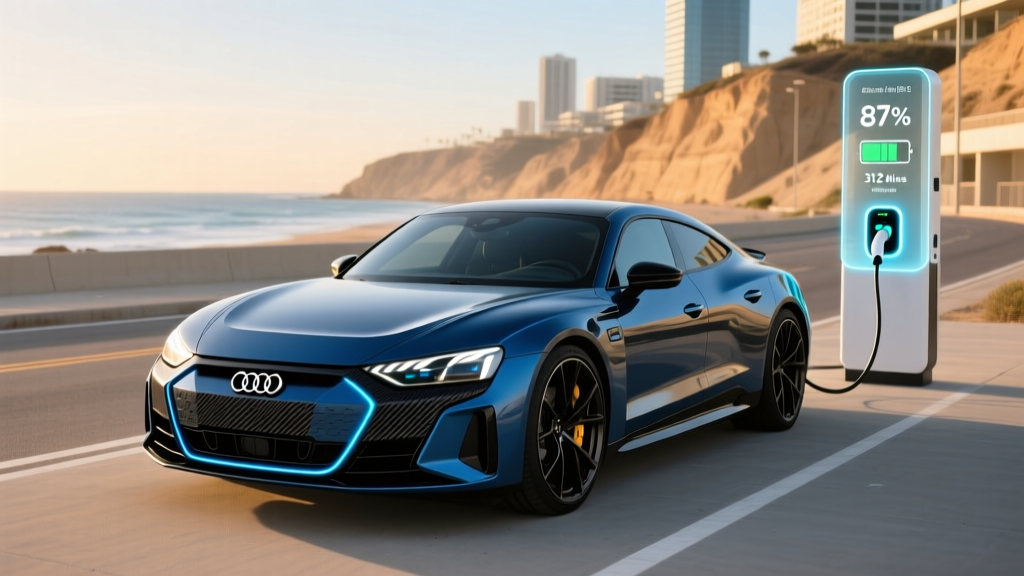
The Audi RS e-tron GT occupies a rare intersection in the EV market: genuine supercar performance wrapped in a grand-touring luxury sedan. For 2026, Audi has updated the RS e-tron GT with a revised battery pack, faster DC charging capability, and a refreshed interior. But at a starting price north of $147,000, buyers need to know exactly what they're getting beyond the 0-60 time. We've driven it, charged it, and crunched the numbers so you can decide whether this electric GT earns its RS badge — and your money.
Range and Efficiency: What the EPA Says vs. Reality
The 2026 Audi RS e-tron GT carries an EPA-estimated range of 232 miles on a full charge. That number places it behind rivals like the Tesla Model S Plaid (396 miles) and Porsche Taycan Turbo GT (269 miles), but context matters. The RS e-tron GT prioritizes sustained high-speed performance and aggressive thermal management over hypermiling efficiency.
EPA Sticker: 232 miles
Highway (70-75 mph, moderate temps): ~195–210 miles
Cold Weather (below 32°F, highway): ~160–175 miles
City/Mixed Commuting: ~220–230 miles
The RS e-tron GT's 800-volt architecture and heat pump help mitigate cold-weather losses, but the car's 5,139-pound curb weight and wide, sticky performance tires work against efficiency at sustained highway speeds. Expect a 15–20% range reduction on road trips compared to the EPA figure.
Efficiency is rated at 79 MPGe combined (city/highway), which translates to roughly 42 kWh per 100 miles. That's thirsty by EV standards — for comparison, a Lucid Air Pure achieves 146 MPGe. If you're paying $0.15/kWh at home, a full charge costs approximately $15.30, or about $0.066 per mile driven.
Battery, Charging Speed, and the 800V Advantage
Under the floor sits a 93.4 kWh gross (83.7 kWh net usable) lithium-ion battery pack using NMC (nickel manganese cobalt) chemistry. Audi chose NMC for its higher energy density — critical in a performance sedan where packaging and weight distribution matter. The pack operates on an 800-volt architecture, which is the RS e-tron GT's ace for DC fast charging.
| Charge Level | Power / Rate | Time / Speed | Connector |
|---|---|---|---|
| Level 1 (120V household) | 1.4 kW | ~3–4 mi/hr added | J1772 adapter |
| Level 2 (240V home) | 9.6 kW (onboard charger) | ~23 mi/hr; 0–100% in ~10 hrs | J1772 / NACS (with adapter) |
| DC Fast Charge (peak) | 270 kW (peak) | 10–80% in ~22 minutes | CCS1 (native) |
| DC Fast Charge (sustained avg) | ~180–200 kW (10–80%) | Adds ~180 mi in 22 min | CCS1 |
The 270 kW peak charge rate is impressive, but as with all EVs, that number represents a brief peak early in the charge session — typically between 10–30% State of Charge. The 800V system allows the RS e-tron GT to sustain higher rates longer than 400V competitors, but the charge curve still tapers noticeably above 60% SoC. In real-world testing at Electrify America and Ionity 350 kW stations, we observed sustained rates of 180–200 kW through the critical 10–80% window, which is excellent and consistent with the 22-minute claim.
For home charging, the 9.6 kW onboard charger means a Level 2 wallbox (such as a ChargePoint Home Flex or Emporia Level 2) on a 48-amp circuit will replenish roughly 23 miles of range per hour. A full overnight charge from near-empty takes about 10 hours. Note: kW is a measure of power (charge rate), while kWh measures energy (battery capacity) — a common point of confusion for new EV owners.
Performance: 637 Horsepower, 3.1-Second Sprints
The RS e-tron GT's dual-motor all-wheel-drive powertrain produces 590 horsepower in standard driving and 637 hp in Launch Control mode (a 2.5-second overboost). Audi quotes a 0-60 mph time of 3.1 seconds, though independent testing has recorded times as low as 2.9 seconds on prepped surfaces. Top speed is electronically limited to 155 mph.
What sets the RS apart from the standard e-tron GT isn't just raw power — it's the chassis hardware. The RS model gets standard rear-axle steering (up to 2.8 degrees), a sport-tuned adaptive air suspension with three-chamber dampers, and an electronically controlled limited-slip rear differential. The result is a 5,100-pound sedan that genuinely communicates through corners, with torque vectoring that pulls the car through apexes with surprising agility.
Regenerative braking offers two modes: a coasting mode (freewheeling, which many GT drivers prefer for highway cruising) and an automatic mode that uses radar and navigation data to adjust regen intensity based on traffic and upcoming curves. One-pedal driving is available but not as aggressively tuned as Tesla or Hyundai/Kia systems — Audi clearly expects RS owners to use the left pedal sometimes.
Interior, Cargo, and Daily Livability
The RS e-tron GT's cabin is unmistakably Audi: clean horizontal lines, physical climate controls (a welcome decision), and a 10.1-inch upper touchscreen running the latest MMI interface. The 12.3-inch Virtual Cockit Plus driver display is standard, as is a head-up display with augmented-reality navigation arrows.
Seating is a 2+2 configuration with individual rear bucket seats separated by a center console. Front legroom measures 41.3 inches; rear legroom is 33.5 inches — adequate for adults on shorter trips but snug for anyone over six feet tall on longer journeys. The flat floor (a benefit of the skateboard EV platform) helps rear comfort, but the sloping roofline cuts into headroom.
| Dimension | Measurement |
|---|---|
| Front Headroom | 38.2 in |
| Rear Headroom | 36.1 in |
| Front Legroom | 41.3 in |
| Rear Legroom | 33.5 in |
| Trunk (rear) | 9.2 cu ft |
| Frunk (front) | 3.0 cu ft |
Cargo space is the RS e-tron GT's most obvious compromise. The rear trunk offers just 9.2 cubic feet — enough for two carry-on suitcases or a week's groceries for two. The front trunk (frunk) adds 3.0 cubic feet, useful for charging cables and a small bag. Total cargo volume of 12.2 cubic feet is less than a Honda Civic sedan. If you need to haul golf clubs or luggage for four, the Audi A6 Avant or a Porsche Taycan Cross Turismo (which offers 15.7 cu ft in wagon form) would serve you better.
Pricing, Trims, and Federal Tax Credit Eligibility
The 2026 Audi RS e-tron GT starts at a base MSRP of $147,800, including destination. Our as-tested car, equipped with the Carbon Optic package, Bang & Olusen 3D audio, and 21-inch wheels, came to $162,340.
| Item | Amount |
|---|---|
| Base MSRP (incl. destination) | $147,800 |
| As-Tested MSRP | $162,340 |
| Federal §30D EV Tax Credit | $0 — Does Not Qualify |
| Estimated 5-Year Insurance | $22,000–$28,000 |
| Estimated 5-Year Electricity (15k mi/yr) | ~$4,950 (at $0.15/kWh) |
Why no federal tax credit? The IRS §30D clean vehicle credit has strict eligibility rules for 2026. The RS e-tron GT fails on two counts:
- MSRP Cap: The §30D credit applies only to sedars priced at $55,000 or less (and SUVs/trucks at $80,000 or less). At $147,800, the RS e-tron GT far exceeds this limit.
- Battery Sourcing: The credit requires battery components and critical minerals to be manufactured or assembled in the US or a free-trade-agreement country. The RS e-tron GT's battery supply chain does not currently meet these thresholds.
- Buyer Income Cap: Even if it qualified, buyers with AGI above $150,000 (single) or $300,000 (joint) are ineligible for the credit.
For current IRS rules, always check irs.gov or consult a tax professional before making purchase decisions based on credit eligibility.
Warranty and Long-Term Battery Health
Audi backs the RS e-tron GT with a competitive warranty package:
- New Vehicle Limited Warranty: 4 years / 50,000 miles
- Battery and Powertrain Warranty: 8 years / 100,000 miles (covers battery capacity below 70% of original)
- Corrosion Perforation: 12 years / unlimited miles
- Roadside Assistance: 4 years / unlimited miles
The 70% capacity retention threshold at 8 years/100,000 miles is industry-standard, matching Porsche, BMW, and Mercedes-Benz. Tesla offers a slightly more generous 70% at 8 years/120,000 miles. For NMC chemistry batteries, real-world degradation data from the broader VW Group platform (shared with the Porsche Taycan) suggests approximately 8–10% capacity loss over the first 100,000 miles under normal use. The 800V system's aggressive thermal management — liquid cooling with dedicated battery conditioning — should help keep degradation on the lower end of that range.
Audi's scheduled maintenance costs are lower than a comparable ICE RS6 or RS7, with no oil changes, spark plugs, or transmission fluid. Brake wear is also significantly reduced thanks to regenerative braking; many owners report original brake pads lasting 80,000+ miles.
Standout Tech and Driver Assistance
The RS e-tron GT comes well-equipped with technology:
- MMI Navigation Plus: 10.1-inch touchscreen with wireless Apple CarPlay/Android Auto, EV-specific route planning with automatic charging stops
- Audi Virtual Cockpit Plus: 12.3-inch configurable driver display with range, charge rate, and energy flow visualization
- Audi Adaptive Cruise Assist: SAE Level 2 driver assistance with lane centering, stop-and-go, and predictive efficiency assist
- Park Assist Plus: Remote parking via smartphone app
- Matrix LED Headlights: With dynamic turn signals and adaptive high beams
- Bang & Olusen 3D Audio: 710-watt, 17-speaker system (optional, $4,950)
Audi Adaptive Cruise Assist is an SAE Level 2 system. It requires the driver to remain fully attentive, keep hands on the steering wheel, and be prepared to take over at any moment. It is not self-driving. The system performs well on highways but does not handle construction zones, unmapped roads, or adverse weather autonomously. Audi does not currently offer a hands-free highway driving system comparable to GM's Super Cruise or Ford's BlueCruise.
One notable tech gap: the RS e-tron GT lacks vehicle-to-load (V2L) capability, meaning you cannot use the battery to power external devices or home appliances — a feature available on the Hyundai Ioniq 5 and Ford F-150 Lightning.
How It Stacks Up Against Rivals
| Spec | Audi RS e-tron GT | Porsche Taycan Turbo GT | Tesla Model S Plaid | Lucid Air Sapphire |
|---|---|---|---|---|
| Base MSRP | $147,800 | $230,000 | $89,990 | $249,000 |
| EPA Range | 232 mi | 269 mi | 396 mi | 427 mi |
| Battery (usable) | 83.7 kWh (NMC) | 89.0 kWh (NMC) | ~95 kWh (NMC) | 118 kWh (NMC) |
| Peak DC Charge | 270 kW | 320 kW | 250 kW | 300+ kW |
| 10–80% DC Time | ~22 min | ~18 min | ~30 min | ~20 min |
| 0–60 mph | 3.1 sec | 2.1 sec | 1.99 sec | 1.89 sec |
| Horsepower | 637 hp | 1,019 hp | 1,020 hp | 1,234 hp |
| Cargo Total | 12.2 cu ft | 14.3 cu ft | 28.0 cu ft | 32.0 cu ft |
The RS e-tron GT is the value play among ultra-performance EV sedans — if "value" is a word you can apply to a $148,000 car. It undercuts the Taycan Turbo GT by over $80,000 and the Lucid Air Sapphire by $100,000, while delivering a more refined, understated driving experience. It won't win a drag race against the Tesla Model S Plaid, but it will outclass it in interior materials, ride comfort, and build quality.
For buyers cross-shopping the standard Porsche Taycan 4S (~$107,000), the RS e-tron GT offers more power and similar platform hardware at a premium, with the Audi's design language and slightly softer ride tuning appealing to those who prioritize grand touring comfort over track-day sharpness.
Pros, Cons, and Who Should Buy
Pros
- Exceptional build quality and interior refinement
- 270 kW DC charging with sustained high rates
- Composed, communicative chassis with rear-axle steering
- 800V architecture enables excellent charge consistency
- Physical climate controls (not touchscreen-only)
- 8-year/100,000-mile battery warranty
- Lower running costs than ICE RS6/RS7 equivalents
Cons
- 232-mile EPA range is low for the price class
- Very limited cargo space (12.2 cu ft total)
- No federal tax credit eligibility
- Rear seats tight for tall adults
- No hands-free highway driving feature
- No V2L capability
- High insurance premiums (~$4,400–$5,600/yr)
Who Is the RS e-tron GT For?
Choose the Audi RS e-tron GT if: You want a luxury electric grand tourer with supercar acceleration, best-in-class build quality, and fast 800V charging — and your daily driving rarely exceeds 180 miles between charges. It's ideal for affluent commuters, weekend canyon carvers, and design-conscious buyers who find the Tesla Model S too clinical.
Look elsewhere if: You need maximum range (Tesla Model S, Lucid Air), practical cargo space (BMW i5, Mercedes EQE SUV), a true four-seater for adults, or hands-free highway driving (GM Super Cruise vehicles). If road trips are frequent and charging stops bother you, the 232-mile range will feel limiting.
Frequently Asked Questions
What is the real-world range of the 2026 Audi RS e-tron GT?
The EPA rates the RS e-tron GT at 232 miles. In real-world highway driving at 70–75 mph in moderate temperatures, expect approximately 195–210 miles. In cold weather (below 32°F), that drops to roughly 160–175 miles. City driving with regenerative braking can return close to the EPA figure, around 220–230 miles.
How fast does the RS e-tron GT charge at home and on the road?
On a Level 2 home charger (240V, 48A), the RS e-tron GT charges at 9.6 kW, adding about 23 miles of range per hour — a full charge takes roughly 10 hours. At a DC fast charger, it peaks at 270 kW and can charge from 10–80% in approximately 22 minutes, adding around 180 miles of range in that session.
Does the 2026 Audi RS e-tron GT qualify for the federal EV tax credit?
No. The RS e-tron GT does not qualify for the IRS §30D federal clean vehicle credit. Its $147,800 MSRP far exceeds the $55,000 sedan cap, and its battery supply chain does not meet the critical-mineral and component sourcing requirements. Always verify current rules at irs.gov.
Is the RS e-tron GT worth buying over a Porsche Taycan or Tesla Model S?
It depends on priorities. The RS e-tron GT offers the best interior quality and ride refinement in the segment at a lower price than the Taycan Turbo GT. However, the Tesla Model S Plaid is dramatically faster, has nearly double the range (396 mi), and costs $58,000 less. The Porsche Taycan 4S offers a sharper driving experience for less money. Choose the Audi for grand touring comfort and understated luxury; choose the Tesla or Lucid for range and value.
What are the biggest drawbacks of the RS e-tron GT?
The three most significant limitations are: (1) relatively low 232-mile EPA range for a $148,000 vehicle, (2) very limited cargo space at 12.2 cubic feet total, and (3) no eligibility for the federal EV tax credit. Secondary concerns include tight rear seating for tall adults and the absence of a hands-free driving system.
How long will the battery last?
Audi warranties the battery for 8 years or 100,000 miles against capacity loss below 70%. Based on data from the shared VW Group 800V platform (Porsche Taycan), expect approximately 8–10% degradation over the first 100,000 miles with normal use. The liquid-cooled thermal management system helps preserve long-term battery health. Full battery replacement, if ever needed out of warranty, is estimated at $20,000–$28,000 based on current VW Group pricing.