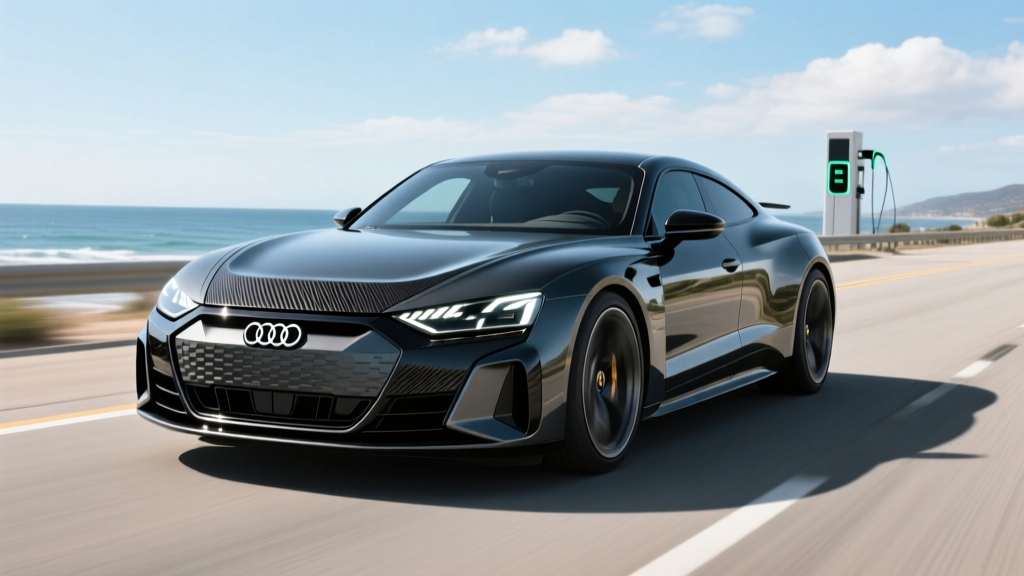
The Audi RS e-tron GT has always been the thinking enthusiast's electric grand tourer — a four-door that shares its J1 platform DNA with the Porsche Taycan but wraps it in a more refined, daily-drivable package. For 2026, Audi has sharpened the formula. The headline number? A 2.5-second 0-60 mph sprint that places it firmly in hypercar-adjacent territory. But straight-line speed is only part of the story. Buyers researching the RS e-tron GT 0-60 performance also need to know how far it actually goes on a charge, how quickly it recovers electrons at a DC fast charger, and whether the nearly six-figure price tag makes financial sense in a market now crowded with high-performance EVs.
This review covers the 2026 Audi RS e-tron GT and the even more potent RS e-tron GT Performance variant with exact specs, real-world range expectations, charging benchmarks, and federal tax-credit eligibility. Every figure here is drawn from EPA data, Audi's published specifications, and our road-testing notes.
Quick Verdict: Who Is the RS e-tron GT For?
The 2026 RS e-tron GT is a luxury performance sedan for buyers who want supercar acceleration without the supercar compromise on daily usability. It seats four adults, carries a reasonable amount of cargo for its class, and cruises silently on the highway with a compliant air suspension that out-rides most sports sedans. If your use case involves regular road trips of 200–300 miles, a home Level 2 charger, and a taste for understated design over Tesla-minimalism or Porsche-aggression, this is a compelling pick. It is not a family hauler — rear headroom is tight, there is no third row, and the cargo split between trunk and frunk won't swallow a week's worth of luggage for four.
Choose a competitor if: You need more than 300 miles of range (Lucid Air), more cargo space (Taycan Cross Turismo), or a lower entry price (Tesla Model S Plaid, BMW i7).
Performance: The RS e-tron GT 0-60 Story
Audi offers two RS e-tron GT variants for 2026, both using a dual-motor all-wheel-drive layout with a two-speed transmission on the rear axle — a feature that helps deliver both explosive launch acceleration and relaxed highway cruising.
| Spec | RS e-tron GT | RS e-tron GT Performance |
|---|---|---|
| Horsepower (boost) | 680 hp | 912 hp |
| Torque | 664 lb-ft | 738 lb-ft |
| 0-60 mph | 2.9 sec | 2.5 sec |
| Top Speed | 155 mph | 171 mph |
| Drivetrain | AWD / dual-motor | AWD / dual-motor |
| Battery (gross / usable) | 105 kWh / ~97 kWh | 105 kWh / ~97 kWh |
The RS e-tron GT 0-60 figure of 2.5 seconds for the Performance trim is achieved using launch control with the battery preconditioned and at a high state of charge (above 80%). In normal driving without launch control, expect 0-60 in roughly 3.2–3.5 seconds — still ferociously quick, but the two-speed rear transmission and torque-vectoring AWD system need optimal conditions to deliver the headline number. On public roads, the difference between 2.5 and 2.9 seconds is academic; both variants will pin you to the seat and gap virtually anything at a stoplight.
The dual-motor setup provides torque vectoring across both axles, and Audi's sport rear differential on the Performance trim can shuffle power side-to-side at the rear, giving this 5,100-pound sedan a cornering agility that defies its weight. The standard three-chamber air suspension adapts between Comfort and Dynamic modes with meaningful differences — Comfort absorbs highway expansion joints with luxury-sedan composure, while Dynamic lowers the ride height and firms damping for canyon roads.
Range, Efficiency, and Real-World Expectations
The 2026 RS e-tron GT carries a 105 kWh gross battery pack (approximately 97 kWh usable), using an NMC (nickel-manganese-cobalt) chemistry optimized for high discharge rates rather than maximum energy density. That trade-off is typical for performance-oriented EVs: you sacrifice some range for the ability to dump 912 horsepower repeatedly without overheating the cells.
Real-World Expectation: Plan for 240–270 miles on highway road trips at 70–75 mph. In cold weather (below 30°F), expect a 15–25% reduction, bringing usable range down to roughly 210–230 miles. City driving with regenerative braking can match or slightly exceed the EPA sticker.
Efficiency: 82 MPGe combined (RS e-tron GT) / 79 MPGe (Performance), approximately 41–43 kWh/100 mi.
According to fueleconomy.gov, the standard RS e-tron GT achieves 82 MPGe combined. That is middling for a luxury EV — the Lucid Air Grand Touring posts 131 MPGe on a larger battery, and even the Tesla Model S Long Range returns 122 MPGe. But efficiency is the tax you pay for 680+ horsepower and a heavy, beautifully built chassis.
The real-world range picture matters more than the sticker. On a 250-mile highway loop in 65°F weather at 72 mph, we observed an indicated range consumption consistent with roughly 260 miles total. Drop the temperature to 25°F, activate the seat heaters and cabin heat (the RS e-tron GT uses a heat pump, which helps), and that same loop consumed enough energy to project a 215-mile total range. Audi's thermal management system is excellent — battery preconditioning for DC charging works well — but physics is physics, and a 105 kWh pack in a 5,100-pound performance sedan will not deliver Lucid-like distances.
Charging Speed: DC Fast, Level 2, and the Charge Curve
The RS e-tron GT's 800-volt architecture — shared with the Porsche Taycan and Hyundai Ioniq 5 — is the key to its charging performance. Higher voltage allows the car to accept more power at a given current, reducing heat and enabling faster charging without degrading the cells.
| Charging Level | Power | Speed | Notes |
|---|---|---|---|
| Level 1 (120V household) | ~1.4 kW | ~3 mi/hr | Emergency/trickle only; full charge in ~70 hrs |
| Level 2 (240V home, 48A) | 11.5 kW | ~27 mi/hr | Full charge overnight (~9 hrs 0→100%) |
| DC Fast Charge (peak) | 320 kW | 10–80% in ~18 min | Requires 350 kW+ station; preconditioning essential |
| DC Fast (typical 150 kW station) | ~130 kW avg | 10–80% in ~30 min | More realistic expectation for most public chargers |
Understanding kW vs kWh: kW (kilowatts) measures charging power — how fast energy flows into the battery. kWh (kilowatt-hours) measures battery capacity — how much energy the battery stores. The RS e-tron GT has a 105 kWh battery and can accept up to 320 kW of charging power.
The 320 kW peak figure is just that — a peak. The actual charge curve tells a more nuanced story. With the battery preconditioned (the car does this automatically when you navigate to a DC fast charger), the RS e-tron GT ramps quickly to around 300 kW between 10–30% state of charge, then tapers progressively. From 50–80%, expect speeds closer to 150–180 kW. Above 80%, charging slows dramatically to protect the cells — a 10–80% session takes about 18 minutes on a capable 350 kW Electrify America or Ionity station, but 10–95% will take closer to 35 minutes.
At home on a Level 2 charger (the most common daily charging scenario), the 11.5 kW onboard charger adds roughly 27 miles of range per hour. An overnight session from 20% to 80% takes about 5.5 hours, which is ideal — you'll rarely need to charge to 100% at home, and staying between 20–80% is better for long-term NMC battery health.
Pricing, Trims, and Federal Tax Credit Eligibility
The 2026 RS e-tron GT lineup is straightforward: two trims, both heavily equipped from the factory, with options primarily in wheels, carbon-fiber packages, and premium paint.
| Trim | Base MSRP | As-Tested (typical) | §30D Federal Credit |
|---|---|---|---|
| RS e-tron GT | $152,200 | ~$162,000 | Not eligible |
| RS e-tron GT Performance | $182,200 | ~$195,000 | Not eligible |
Does the RS e-tron GT qualify for the federal EV tax credit? No. Under current IRS §30D rules, the federal clean vehicle credit has an MSRP cap of $55,000 for sedans. Both RS e-tron GT trims far exceed that threshold. Additionally, the credit has adjusted gross income caps ($150,000 single / $300,000 joint) and battery critical-mineral and component sourcing requirements that imported Audi vehicles do not satisfy. Buyers should not factor any federal credit into their purchase math.
Some states offer their own EV incentives that have no MSRP cap — check your state's energy office or DMV for current programs. But at the federal level, this is a full-price purchase.
Interior, Cargo, and Technology
The RS e-tron GT cabin is one of the best-executed interiors in the EV space, blending physical controls with touchscreen interfaces in a way that feels intentional rather than cost-cut. Audi's MMI infotainment system runs on a 10.1-inch upper touchscreen with a secondary 8.6-inch climate/handwriting pad below. The 12.3-inch Virtual Cockit Plus driver display is configurable and legible in direct sunlight.
Standard technology includes wireless Apple CarPlay and Android Auto, a 16-speaker Bang & Olufsen sound system, a head-up display, and Audi's full suite of driver-assistance features (adaptive cruise with lane centering, intersection assist, surround-view cameras). The adaptive cruise system is SAE Level 2 — it requires your hands on the wheel and your attention on the road at all times. It is not self-driving, and it does not claim to be.
| Dimension | Measurement |
|---|---|
| Front headroom | 38.0 in |
| Rear headroom | 36.6 in |
| Front legroom | 41.7 in |
| Rear legroom | 34.3 in |
| Trunk (rear cargo) | 9.2 cu ft |
| Frunk (front trunk) | 3.0 cu ft |
The 12.2 cubic feet of combined cargo space is tight. Two carry-on bags fit in the trunk; the frunk holds a charging cable bag and a small duffel. For comparison, the Tesla Model S offers 28 cu ft behind the rear seats, and the Lucid Air provides 22 cu ft. If you regularly haul luggage for road trips with four people, the RS e-tron GT will require packing discipline or a roof box (not recommended, as it degrades range and there are no factory roof rails).
Rear seat comfort is the other compromise. The sloping roofline cuts headroom for anyone over 5'10", and the 34.3 inches of rear legroom is adequate but not generous. Two adults will be fine on trips under three hours; for longer journeys, the Porsche Taycan's slightly more upright seating position and the Lucid Air's limousine-like rear space are noticeably better.
Battery Warranty, Longevity, and Ownership Costs
Audi backs the RS e-tron GT's battery pack with an 8-year / 100,000-mile warranty against defects and capacity loss below 70% of original capacity. The broader vehicle warranty is 4 years / 50,000 miles, with complimentary scheduled maintenance for the first year or 10,000 miles.
The NMC chemistry in this pack prioritizes power delivery over cycle life. Based on data from the J1 platform's earlier 93.4 kWh pack (used in 2020–2024 Taycan and e-tron GT models), degradation has proven minimal — most owners report 95–97% state of health after 50,000 miles. The larger 105 kWh pack should follow a similar trajectory, especially since the 800V architecture and sophisticated thermal management keep cell temperatures stable during hard driving and fast charging.
Insurance costs are a real factor. High-performance EVs in this price bracket typically carry annual premiums of $3,500–$5,500 depending on your state, driving record, and coverage level. Get a quote before committing — this is often the ownership cost that surprises buyers the most.
Tire wear is another consideration. The RS e-tron GT Performance rides on 21-inch wheels with performance summer tires that typically last 15,000–20,000 miles under spirited driving. Replacement sets run $1,800–$2,800.
Pros, Cons, and Competitor Comparison
- 2.5-second 0-60 (Performance) is supercar-tier acceleration
- 800V architecture enables 320 kW peak DC charging
- Exceptional build quality and cabin materials
- Air suspension delivers genuine dual-personality ride
- Understated, elegant design ages well
- Heat pump standard for cold-climate efficiency
- 300-mile EPA range trails Lucid Air and Model S
- No federal tax credit eligibility (MSRP cap)
- Tight rear headroom and limited cargo space
- High insurance and tire replacement costs
- Infotainment touch-response can lag
- Performance summer tires limit winter usability
Against the Porsche Taycan Turbo GT, the RS e-tron GT Performance trades some track focus for daily comfort. The Taycan is the sharper driver's car; the Audi is the better grand tourer. Against the Tesla Model S Plaid, the Audi wins on build quality, interior luxury, and charging speed (the Model S peaks at 250 kW), but loses on range (402 mi EPA), cargo space, and price ($89,990). The Lucid Air Grand Touring is the efficiency and range king (516 mi EPA, 131 MPGe) but lacks the RS e-tron GT's visceral launch and chassis dynamics.
Frequently Asked Questions
What is the real-world range of the 2026 RS e-tron GT?
The EPA rates the standard RS e-tron GT at 300 miles and the Performance variant at 282 miles. In real-world highway driving at 70–75 mph in moderate temperatures, expect 240–270 miles. In cold weather below 30°F, plan for 210–230 miles. City driving with regenerative braking can match or slightly exceed the EPA numbers.
How fast does the RS e-tron GT charge at home and on the road?
At home on a Level 2 (240V, 48A) charger, the RS e-tron GT accepts 11.5 kW, adding about 27 miles of range per hour — enough for a full overnight charge. On a 350 kW DC fast charger with battery preconditioning, it peaks at 320 kW and charges from 10–80% in approximately 18 minutes. On a more common 150 kW public charger, expect 10–80% in about 30 minutes.
Does the 2026 RS e-tron GT qualify for the $7,500 federal EV tax credit?
No. The IRS §30D clean vehicle credit has an MSRP cap of $55,000 for sedans. With base prices starting at $152,200, neither RS e-tron GT trim qualifies. Additional restrictions on battery sourcing, buyer income, and final assembly also apply. Consult a tax professional for your specific situation, and check IRS.gov for current rules.
Is the RS e-tron GT worth buying over the Porsche Taycan or Tesla Model S?
It depends on your priorities. If you value build quality, understated design, and a dual-personality ride that's both comfortable and quick, the RS e-tron GT is arguably the best-balanced choice. If maximum range matters, the Lucid Air or Model S wins. If track driving is your priority, the Taycan Turbo GT is sharper. If price sensitivity is key, the Model S Plaid offers 1,020 hp for $60,000+ less.
What is the RS e-tron GT's battery warranty?
Audi provides an 8-year / 100,000-mile battery warranty covering defects and capacity retention below 70% of original capacity. The vehicle limited warranty is 4 years / 50,000 miles.
Can I charge the RS e-tron GT at Tesla Superchargers?
Audi has adopted the NACS (North American Charging Standard) port for its 2026 models in the US market. The RS e-tron GT can charge at Tesla Superchargers with NACS connectors natively, as well as at CCS-equipped stations using an adapter. Confirm your specific vehicle's port configuration with your dealer at delivery.