The Short Answer on the Audi R8 Electric
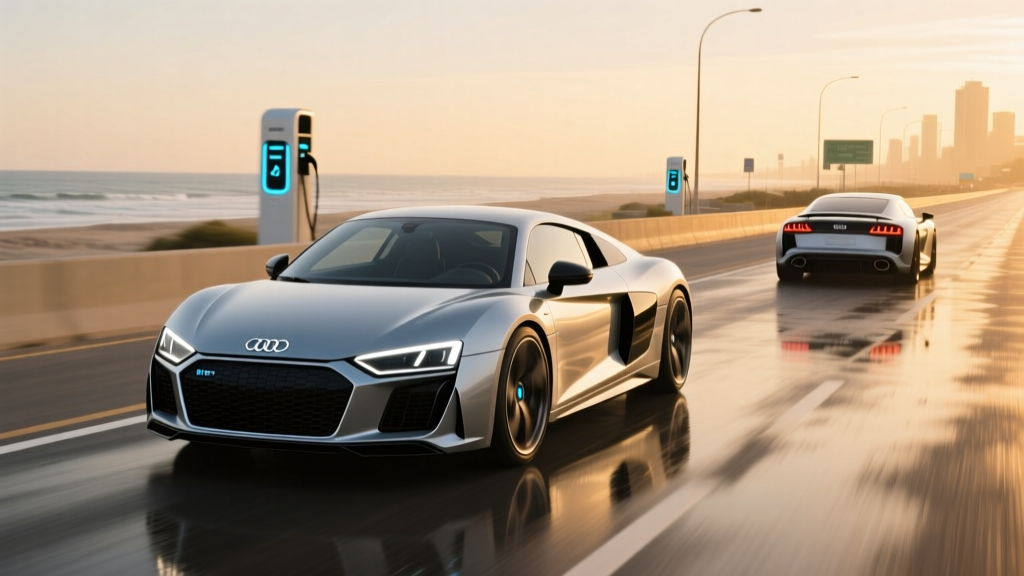
As of early 2026, Audi has not released a production electric R8. The last R8 V10 rolled off the line in 2024, and Audi's next-generation electric sports car — widely expected to inherit the R8's halo-car mantle — remains in the announced/prototype stage, likely sharing the Porsche-Macan-EV/PPE platform or the upcoming SSP Sport architecture. If you're searching for an "Audi R8 electric" today, you're either looking at concept speculation, the discontinued 2015 R8 e-tron (a limited-run, ~$1M, 152-mile-range experiment), or the closest current equivalent: the Audi RS e-tron GT (EPA 232 mi, 640 HP, ~$149,900 MSRP). This guide covers what we know about a future electric R8 successor, benchmarks it against the RS e-tron GT as the closest proxy, and runs the ownership math against the outgoing gas R8 V10.
What the Audi R8 Electric Actually Is (and Isn't) in 2026
The original Audi R8 e-tron, produced in extremely limited numbers around 2015-2016, featured a 92 kWh battery, roughly 152 miles of NEDC range, and 456 HP. It was never sold in the US market and was discontinued after fewer than 100 units were built. It is not a realistic purchase target.
For 2026, Audi's electric sports-car strategy pivots around two realities:
- The RS e-tron GT (and its updated variants) is Audi's current high-performance electric flagship, built on the J1 platform shared with the Porsche Taycan.
- A future R8 successor has been hinted at by Audi executives, potentially riding on the SSP Sport platform (Volkswagen Group's next-gen performance EV architecture), but no official specs, pricing, or release date have been confirmed.
If you're a buyer researching "Audi R8 electric" with purchase intent, the RS e-tron GT is the actionable vehicle. Let's break it down with hard numbers.
RS e-tron GT: The Closest Proxy — Full Spec Breakdown
| Specification | 2026 Audi RS e-tron GT | Outgoing Audi R8 V10 Performance (2023) |
|---|---|---|
| Powertrain | Dual-motor AWD, 93.4 kWh battery (83.7 kWh usable), NMC chemistry | 5.2L naturally aspirated V10, 7-speed dual-clutch |
| Horsepower | 640 HP (launch control) | 602 HP |
| 0-60 mph | 3.1 seconds | 3.0 seconds |
| EPA Range | 232 miles | ~320 miles (16.4 gal tank, ~14/19 city/hwy) |
| Real-World Highway Range | ~185-200 miles (70+ mph sustained) | ~280-300 miles |
| Peak DC Fast Charge | 270 kW (800V architecture) | N/A |
| 10-80% DC Charge Time | ~23 minutes (under ideal conditions) | ~4 minutes (gas fill-up) |
| Level 2 Charge Rate | 11 kW (AC onboard charger) | N/A |
| Base MSRP | $149,900 | $208,100 (final model year) |
| Federal EV Tax Credit | $0 — exceeds §30D MSRP cap ($55,000 for sedans/sports cars) | N/A |
| Battery/Powertrain Warranty | 8 years / 100,000 miles (high-voltage battery) | 4 years / 50,000 miles (powertrain) |
| MPGe (combined) | 79 MPGe | 16 MPG combined |
Real-World Range Reality Check
The RS e-tron GT's EPA rating of 232 miles drops to approximately 185-200 miles at sustained highway speeds above 70 mph, and further to 155-175 miles in freezing temperatures (below 32°F) without preconditioning. The 800V architecture helps at the charger, but the J1 platform's charge curve tapers significantly above 80% SoC — expect the final 20% to take nearly as long as the first 60%.
Ownership Cost Breakdown: Electric GT vs. Gas V10
The purchase price gap is massive. But does the electric flagship save money over five years? Here's the math, assuming 10,000 miles/year, electricity at $0.16/kWh (national average for public + home blended), and premium gasoline at $4.80/gallon.
| Cost Category (5-Year) | RS e-tron GT | R8 V10 Performance |
|---|---|---|
| Purchase Price (MSRP) | $149,900 | $208,100 |
| Federal Tax Credit | $0 (MSRP exceeds §30D cap) | $0 |
| Estimated Insurance (5 yr total) | $18,500 - $24,000 | $20,000 - $28,000 |
| Fuel / Energy (50,000 mi) | $4,800 (~300 Wh/mi × 50k mi × $0.16/kWh) | $16,800 (~50k mi ÷ 15 MPG × $4.80/gal) |
| Maintenance (5 yr est.) | $2,500 - $3,500 (tires, cabin filter, brake fluid) | $8,000 - $12,000 (oil, DCT service, brakes, spark plugs) |
| Estimated Depreciation (5 yr) | $65,000 - $80,000 (~50% residual) | $70,000 - $85,000 (~60% residual — halo-car demand) |
| Total 5-Year Cost | ~$240,700 - $262,200 | ~$322,900 - $354,900 |
Key takeaway: The RS e-tron GT saves roughly $12,000 in energy and maintenance over five years compared to the R8 V10. However, the R8 V10's stronger residual value (driven by collector demand for the final naturally aspirated V10) partially offsets its higher running costs. The electric car wins on total cost, but this is a luxury segment where buyers prioritize driving character over spreadsheet optimization.
Charging Reality: What Ownership Actually Looks Like
The RS e-tron GT's 270 kW peak charge rate is impressive on paper, but real-world charging requires context:
- Home Level 2 (11 kW): A full charge from 10% takes approximately 8-9 hours. You need a dedicated 60A circuit (48A continuous draw). Expect $1,200-$3,000 for a quality Level 2 unit (e.g., ChargePoint Home Flex or Tesla Wall Connector) plus $800-$2,500 for electrician installation, depending on panel capacity and run length.
- DC Fast Charging (270 kW peak): The 800V system sustains high charge rates longer than 400V competitors, but you'll only see 270 kW at compatible Electrify America or Ionity stalls, and only between ~10-40% SoC. By 60%, the rate drops to ~150 kW; by 80%, it's under 50 kW.
- Connector: The RS e-tron GT uses CCS1 in North America. Audi has not yet announced a NACS transition timeline for this model, though future SSP-platform vehicles are expected to adopt NACS.
For buyers without reliable home charging access — apartment dwellers, street parkers — this car becomes significantly less practical. Public DC charging at $0.35-$0.50/kWh pushes the energy cost closer to $7,500-$10,000 over five years, eroding much of the gas-vs-electric savings.
Common Misconceptions: Myth vs. Fact
| Myth | Fact |
|---|---|
| "The Audi R8 electric is available to buy in 2026." | No production R8 EV exists. The RS e-tron GT is Audi's closest electric performance car. A future R8 successor is unconfirmed. |
| "Electric sports cars can't match V10 acceleration." | The RS e-tron GT's 3.1-second 0-60 is within 0.1 seconds of the R8 V10 Performance. Instant electric torque makes the real-world feel even closer. |
| "270 kW charging means a full charge in 20 minutes." | Peak rate only applies at low SoC. A 10-80% charge takes ~23 minutes under ideal conditions; 10-100% takes 40+ minutes due to taper above 80%. |
| "I'll get the $7,500 federal tax credit." | The RS e-tron GT's $149,900 MSRP far exceeds the §30D cap of $55,000 for sedans/sports cars. No federal credit applies. Check IRS §30D rules for details. |
| "EV batteries need replacing every few years." | Audi warranties the high-voltage battery for 8 years/100,000 miles against degradation below 70% capacity. J1-platform batteries have shown minimal degradation in real-world use over 100k+ miles. |
Decision Framework: Should You Buy, Wait, or Look Elsewhere?
Choose the RS e-tron GT if:
- You want a usable, daily-drivable Audi electric performance car today
- You have home Level 2 charging and drive under 200 miles between charges
- You value instant torque, 800V fast charging, and a near-silent powertrain over engine sound
- You're spending $140,000-$170,000 on a luxury GT and want lower running costs than a V10
Wait for a future R8 electric successor if:
- You specifically want a mid-engine-style two-seat sports car, not a four-door GT
- You want next-gen battery chemistry (potential LFP or solid-state) with better energy density
- You're willing to wait 2-4+ years for SSP Sport platform vehicles with potentially 300+ mile range
Consider alternatives if:
- Porsche Taycan Turbo S — sharper handling, 256 kW peak charge, EPA 222 mi, ~$190,500 MSRP
- Tesla Model S Plaid — 1,020 HP, 0-60 in 1.99s, EPA 396 mi, ~$89,990 MSRP (far more range, lower price, less luxury finish)
- Used R8 V10 (2020-2023) — collector-grade naturally aspirated V10, no EV charging hassles, strong residual value
Frequently Asked Questions
Will Audi ever make a true electric R8?
Audi executives have hinted at a future electric sports car, potentially using the SSP Sport platform. However, no official confirmation, specs, or timeline has been announced as of 2026. The R8 nameplate may or may not carry over. If Audi does produce one, expect 600+ HP, 250-300+ mile EPA range, and a price well above $150,000.
How does the RS e-tron GT compare to the Tesla Model S Plaid?
The Model S Plaid offers dramatically more range (EPA 396 mi vs 232 mi), faster acceleration (1.99s vs 3.1s 0-60), and a much lower price (~$89,990 vs $149,900). The RS e-tron GT counters with superior interior materials, 800V charging architecture, Porsche-derived chassis tuning, and Audi's dealer/service network. They serve different buyer priorities.
What does it cost to charge the RS e-tron GT at home?
At the US average residential rate of ~$0.16/kWh, a full charge of the 83.7 kWh usable battery costs approximately $13.40. For 10,000 miles of annual driving at ~300 Wh/mi, expect roughly $480-$960/year in home electricity costs, depending on your local rate and time-of-use plan.
Do I need to upgrade my electrical panel for a Level 2 charger?
Possibly. The RS e-tron GT's 11 kW onboard charger draws up to 48 amps continuous, requiring a 60A dedicated circuit. If your home has a 100A main panel that's already near capacity, a panel upgrade to 200A could add $1,500-$3,500 to your installation cost. Always have a licensed electrician evaluate your panel before purchasing a charger.
Is the RS e-tron GT eligible for any state incentives?
Federal §30D credit is unavailable due to the MSRP cap. However, some states offer rebates or HOV lane access for EVs regardless of price. California's Clean Air Rebate, Colorado's tax credit, and various utility company incentives may apply. Check your state's energy office and your local utility for current programs — rules vary by jurisdiction and change frequently.
Sources: EPA Fuel Economy — Audi RS e-tron GT, IRS §30D New Clean Vehicle Credit, Audi USA — RS e-tron GT