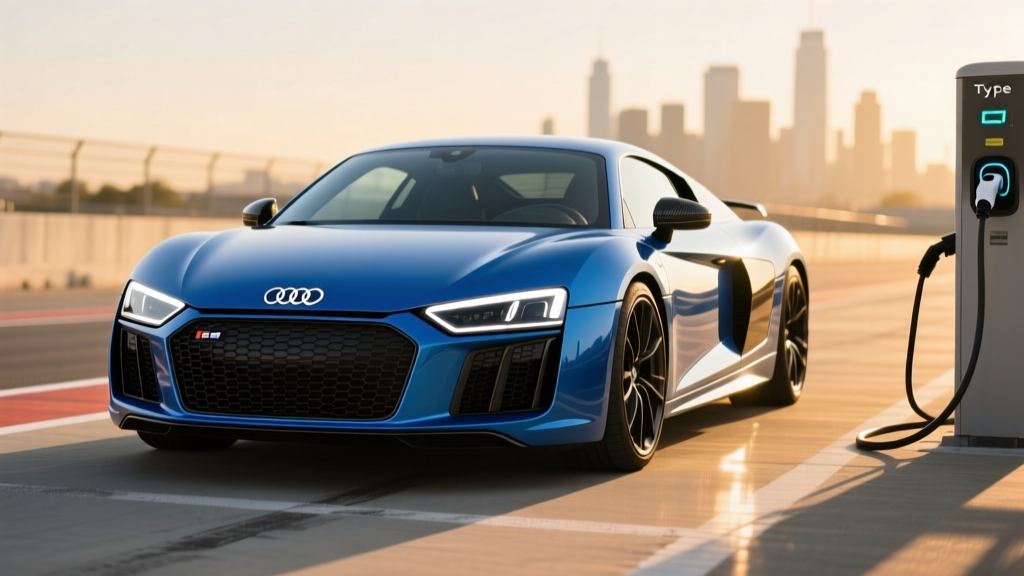
The Audi R8 e-tron occupies a strange corner of electric-vehicle history. Produced in limited numbers across two brief production runs (2015–2016 and a final batch in 2019), this all-electric supercar was Audi's first serious attempt at a high-performance BEV. It was never a volume seller — fewer than 200 units were built worldwide — and Audi officially discontinued the R8 e-tron and the entire R8 lineup after the 2023 model year. If you're researching this car in 2026, you're almost certainly looking at the used market or studying how Audi's early electric performance efforts shaped today's RS e-tron GT.
This review covers the R8 e-tron's definitive specs, real-world range expectations, charging behavior, and whether tracking down one of these rare machines makes sense versus modern electric performance alternatives.
Audi R8 e-tron: Full Specifications
| Specification | Value |
|---|---|
| EPA Range | 154 miles (92 kWh battery variant) |
| Battery Capacity | 92 kWh usable (NMC lithium-ion) |
| Battery Chemistry | NMC (Nickel Manganese Cobalt) |
| Drivetrain | Rear-wheel drive, dual rear motors |
| Horsepower | 456 hp (340 kW) |
| Torque | 679 lb-ft (920 Nm) |
| 0–60 mph | 3.9 seconds |
| Top Speed | 155 mph (electronically limited) |
| Max DC Fast Charge | 50 kW (CCS) |
| 10–80% DC Charge Time | ~70 minutes (50 kW peak) |
| Level 2 AC Charge Rate | 7.2 kW (~22 miles/hour) |
| EPA Efficiency | 79 MPGe combined (43 kWh/100mi) |
| Cargo Volume | ~4.0 cu ft (front trunk only) |
| Passenger Capacity | 2 |
| Curb Weight | ~4,079 lbs (1,850 kg) |
| Original MSRP (2016) | ~$1,000,000 (European lease program) |
| Battery Warranty (Original) | 8 years / 62,000 miles |
Real-World Range: What to Actually Expect
Real-World Highway (70 mph): ~115–125 miles
Real-World City/Mixed: ~130–145 miles
Cold Weather (below 32°F): ~95–110 miles (25–35% reduction typical for NMC cells without a heat pump)
The R8 e-tron's range was modest even at launch, and by 2026 standards it's firmly in the "short" category. The 92 kWh NMC battery pack was sizable, but the car's weight (~4,079 lbs), supercar aerodynamics (high drag coefficient relative to sedans), and performance-tuned powertrain consumed energy aggressively.
In practice, highway driving at sustained 70+ mph speeds dropped range significantly. The R8 e-tron lacked the heat pump that modern Audis like the e-tron GT use for cabin heating, meaning cold-weather driving hit the battery harder — both for cabin warmth and because NMC cells lose efficiency at low temperatures without active thermal preconditioning.
If you're evaluating a used R8 e-tron today, battery degradation is a real factor. After 8–10 years, expect State of Health (SoH) to be somewhere between 80–90% depending on charging habits and climate, which would put effective range closer to 100–130 miles in mixed driving.
Charging Speed and Infrastructure
The R8 e-tron's charging capabilities reflect its era. Built before the 150–350 kW DC fast-charging era, it topped out at 50 kW on a CCS connector — acceptable in 2015, but painfully slow by 2026 standards.
| Charge Level | Power | Time (10–80%) | Miles Added/Hour |
|---|---|---|---|
| Level 1 (120V household) | 1.4 kW | ~48 hours | ~4 mi/hr |
| Level 2 (240V, 32A) | 7.2 kW | ~8.5 hours | ~22 mi/hr |
| DC Fast Charge (CCS) | 50 kW peak | ~70 minutes | ~85 mi/hr (peak) |
The DC fast-charging curve tapered noticeably past 60% State of Charge (SoC), meaning the final 20% of a charge took disproportionately longer. For road trips, this meant planning 45-minute stops every 100–110 miles — workable, but a far cry from the 18-minute 10–80% sessions modern 800V platforms deliver.
Level 2 home charging at 7.2 kW was reasonable for overnight replenishment. A full charge from near-empty took roughly 12 hours, so daily top-ups were the practical pattern.
Performance and Driving Dynamics
The R8 e-tron's performance credentials were genuinely impressive at launch and remain respectable. Twin rear-mounted electric motors produced 456 hp and a massive 679 lb-ft of torque — available instantly from zero RPM. The 3.9-second 0–60 mph time put it in sports-car territory, though not supercar territory by modern standards (the Tesla Model S Plaid hits 60 in under 2 seconds, and the Porsche Taycan Turbo S does it in 2.4).
Notably, the R8 e-tron was rear-wheel drive only, unlike the AWD Quattro setups Audi later used in the e-tron SUV and RS e-tron GT. This gave it a more traditional sports-car feel but limited traction in wet or cold conditions.
The car featured torque vectoring between the two rear motors, an adaptive air suspension, and Audi's Virtual Cockpit digital instrument cluster. Regenerative braking was adjustable but did not offer true one-pedal driving in the way modern EVs do — you still needed the brake pedal for full stops.
Pricing, Tax Credits, and Used Market Reality
The R8 e-tron was never officially sold in the United States as a retail purchase. In Europe, it was offered primarily through a lease program at approximately €1 million (~$1.1M USD equivalent). A handful of units have appeared on the collector/enthusiast used market globally, typically priced between $300,000–$600,000 depending on mileage, provenance, and condition.
Insurance costs are extreme. As a limited-production electric supercar with carbon-fiber bodywork and a replacement battery that would cost well over $40,000, annual premiums typically run $8,000–$15,000+ through specialty insurers.
Interior, Technology, and Practicality
The R8 e-tron's cabin mirrored the standard R8's driver-focused layout but substituted the V10's drama with electric silence. The 12.3-inch Virtual Cockpit handled all instrumentation and infotainment — no central touchscreen, which was a deliberate Audi design choice of that era.
Notable tech included:
- Audi Virtual Cockpit with integrated navigation and energy-flow displays
- Matrix LED headlights
- Carbon-fiber reinforced polymer (CFRP) body panels
- Adaptive air suspension with lift function
- Rear-view camera and front/rear parking sensors
What it lacked (by 2026 standards): adaptive cruise control, lane-keeping assist, over-the-air updates, Apple CarPlay/Android Auto, any SAE Level 2+ driver-assistance system, and DC fast charging above 50 kW.
Practicality was minimal. The front trunk ("frunk") offered roughly 4 cubic feet — enough for a weekend bag. There was no rear seat, no rear cargo area (the battery occupied the space where the R8 V10's engine sat), and ground clearance was low even with the air suspension's lift mode.
Battery Longevity and Warranty Considerations
The 92 kWh NMC pack was liquid-cooled, which helped manage thermal degradation. Audi originally warranted the battery for 8 years or 62,000 miles against defects and capacity loss below a defined threshold (typically 70% State of Health).
By 2026, every R8 e-tron is well past its original battery warranty period. This is the single biggest risk factor for buyers. A replacement battery pack, if one could even be sourced (Audi built so few that spare parts supply is extremely limited), would likely cost $40,000–$60,000. Before purchasing, a full battery health diagnostic showing current SoH percentage and cell-balance data is essential.
NMC chemistry in this era typically showed 10–15% degradation over the first 100,000 miles with normal use. However, the R8 e-tron's low production numbers mean there's limited fleet data — most examples have very low mileage, which paradoxically can also cause issues if the car sat for long periods at high or low SoC.
R8 e-tron vs. Modern Electric Performance Cars
The honest question for anyone researching the R8 e-tron is whether it's a collector's piece or a driver's car. Compared to current electric performance vehicles, the spec sheet tells the story:
| Spec | Audi R8 e-tron (2016) | Audi RS e-tron GT (2025) | Porsche Taycan Turbo S (2025) | Tesla Model S Plaid (2025) |
|---|---|---|---|---|
| EPA Range | 154 mi | 232 mi | 246 mi | 396 mi |
| Battery | 92 kWh NMC | 93.4 kWh NMC | 93.4 kWh NMC | 100 kWh |
| 0–60 mph | 3.9 sec | 3.1 sec | 2.4 sec | 1.99 sec |
| Max DC Charge | 50 kW | 270 kW | 320 kW | 250 kW |
| 10–80% Time | ~70 min | ~22 min | ~18 min | ~20 min |
| Drivetrain | RWD | AWD | AWD | AWD |
| Starting Price | ~$1M (original) | $164,900 | $197,500 | $89,990 |
The RS e-tron GT is the spiritual successor — it shares the J1 800V platform with the Taycan, delivers dramatically faster charging, nearly 100 more miles of range, and costs a fraction of what the R8 e-tron commanded. For driving enjoyment and daily usability, any of these modern alternatives is objectively superior.
The R8 e-tron's value proposition is historical significance: it was Audi's first production electric performance car, built in extremely limited numbers, with a carbon-fiber body and a story. It's a collector vehicle, not a daily driver.
- Rare collector vehicle with historical EV significance
- Carbon-fiber body and supercar styling
- Instant torque delivery (679 lb-ft from 0 RPM)
- Liquid-cooled NMC battery with decent thermal management
- Unique conversation piece at any car event
- 154-mile EPA range; ~100 miles real-world in cold weather
- 50 kW max DC charging — 70 minutes for 10–80%
- Out of warranty; battery replacement ~$40K–$60K if available
- No federal tax credit eligibility
- No modern ADAS features or OTA updates
- Extremely limited parts and service network
- RWD only — limited all-weather capability
Who Should Consider the Audi R8 e-tron?
The R8 e-tron suits exactly one buyer profile: a collector or automotive historian who wants a rare, early-production electric supercar as part of a curated garage. It is not a commuter, not a road-trip car, not a family vehicle, and not a sensible daily driver.
If you want an electric Audi with performance credentials and daily usability in 2026, the RS e-tron GT ($164,900) or the upcoming next-generation e-tron GT on the PPE platform are the answers. If you want a weekend toy with electric novelty, a used Tesla Roadster (original) or even a BMW i8 (PHEV) offer better support networks.
Frequently Asked Questions
What is the real-world range of the Audi R8 e-tron?
The EPA rated the 92 kWh variant at 154 miles. In real-world mixed driving, expect 130–145 miles. Highway driving at 70+ mph drops this to roughly 115–125 miles, and cold weather (below 32°F) can reduce range to 95–110 miles due to the lack of a heat pump and NMC cell behavior at low temperatures.
How fast does the R8 e-tron charge?
On a DC fast charger, it peaks at 50 kW (CCS connector), taking approximately 70 minutes from 10–80%. On a Level 2 home charger at 7.2 kW, expect about 22 miles of range per hour of charging, or roughly 8.5 hours for a 10–80% session. Level 1 (standard 120V outlet) adds about 4 miles per hour.
Does the Audi R8 e-tron qualify for the federal EV tax credit?
No. The R8 e-tron was discontinued in 2019 and was never sold new in the US market. The §30D new clean vehicle credit applies only to new purchases from active programs. The §25E used-EV credit has a $25,000 sale-price cap that the R8 e-tron far exceeds. Consult IRS guidelines for current rules.
Is the R8 e-tron worth buying vs. the RS e-tron GT?
For driving, daily use, and ownership practicality, no — the RS e-tron GT is superior in every measurable spec (232 vs. 154 miles range, 270 vs. 50 kW charging, 3.1 vs. 3.9 sec 0–60, full warranty, modern ADAS, and a $164,900 price). The R8 e-tron is worth considering only as a rare collector item with historical significance.
What battery does the R8 e-tron use, and how long will it last?
It uses a 92 kWh NMC (Nickel Manganese Cobalt) lithium-ion pack with liquid cooling. Original warranty was 8 years / 62,000 miles. By 2026, all examples are out of warranty. NMC cells from this era typically retain 80–90% capacity after 10 years with moderate use, but a pre-purchase battery health check (State of Health percentage and cell balance) is critical. Replacement cost, if parts can be sourced, is estimated at $40,000–$60,000.
Was the Audi R8 e-tron ever sold in the United States?
No. Audi offered the R8 e-tron exclusively in select European markets, primarily through a lease program. A small number of units have been privately imported to the US under show-and-display exemptions, but there was never an official US retail launch.
Sources: Audi AG historical press releases; fueleconomy.gov (EPA ratings); IRS.gov (§30D and §25E credit rules).