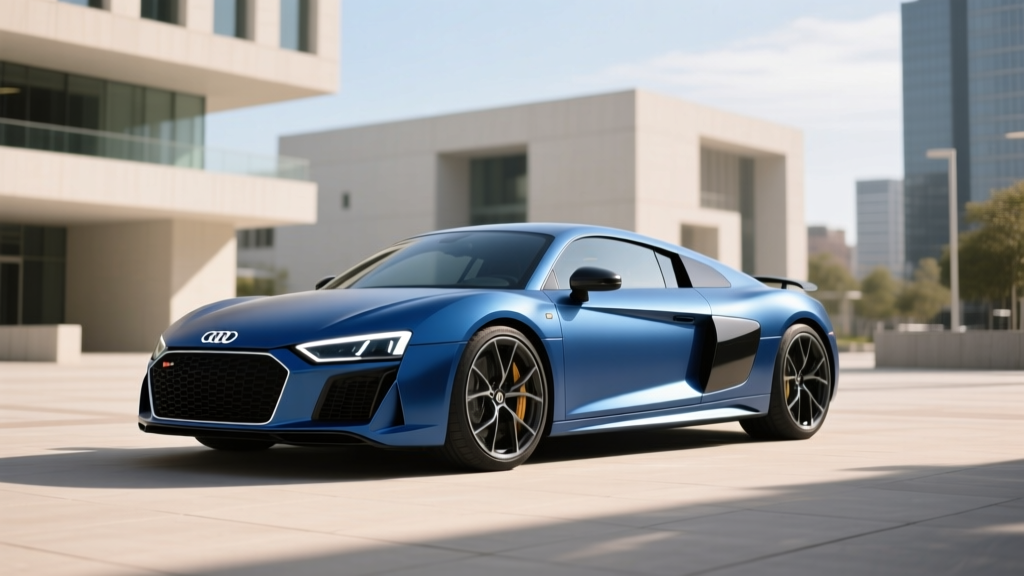
The Audi R8 e-tron occupies a strange corner of electric-vehicle history. Conceived as a halo EV supercar, it launched in Europe for the 2015 model year, was briefly available in limited numbers, and was discontinued by 2017 — well before the modern EV boom made battery-electric performance cars mainstream. If you're searching for an "R8 e-tron" today, you're likely looking at the used market or researching Audi's electrification lineage. This profile covers the definitive 2015–2016 specification, real-world ownership data, and what this car's short life tells us about where Audi's EV strategy actually landed.
Quick Verdict: A Pioneering EV Supercar Ahead of Its Time
The R8 e-tron was never a volume play. Audi built fewer than 100 units before pulling the plug, citing low demand and high production costs. It was a technology demonstrator — a proof that a battery-electric platform could deliver supercar performance without compromising the R8's mid-engine proportions. In 2026 terms, its 205-mile EPA-equivalent range and 92 kWh battery were respectable for a low-volume performance car, but its charging architecture (limited to 50 kW DC) and six-figure price made it impractical for all but the most committed early adopters. Today, it's a collector's curiosity rather than a viable daily driver.
Range, Battery, and Efficiency
| Attribute | Value |
|---|---|
| EPA-equivalent range | ~205 miles (NEDC: 451 km / 280 mi) |
| Battery capacity (usable) | 92 kWh |
| Battery chemistry | NMC (Nickel Manganese Cobalt) |
| Max DC fast charge | 50 kW (CCS Combo 2) |
| 10–80% DC charge time | ~70 minutes (estimated) |
| Level 2 AC charge rate | 7.2 kW (~20 mi/hr) |
| Level 1 AC charge rate | ~2.3 kW (~6 mi/hr) |
| Efficiency | ~73 MPGe / 46 kWh/100 mi |
| Drivetrain | Rear-wheel drive, dual-motor |
| 0–60 mph | 3.9 seconds |
| Horsepower | 451 hp (335 kW) |
| Torque | 679 lb-ft (920 Nm) |
| Top speed | 130 mph (electronically limited); 155 mph with limiter removed |
| Curb weight | ~3,880 lbs (1,760 kg) |
| Cargo (rear compartment) | ~4.2 cu ft (118 liters) |
| Passenger capacity | 2 |
| Base MSRP (2015, Europe) | €1,000,000 (~$1,100,000 USD at the time) |
| Production years | 2015–2016 (discontinued 2017) |
| Units produced | Fewer than 100 |
Real-World Range Expectations
Sticker: ~205 miles (EPA-equivalent; original NEDC rating was 280 mi / 451 km).
Real-world highway (70 mph, moderate climate): Expect ~160–175 miles. The R8 e-tron's aerodynamic drag and performance tuning penalize highway efficiency more than city driving.
Cold weather (below 32°F / 0°C): Expect ~130–150 miles. The NMC pack lacks the sophisticated heat-pump thermal management found in 2024+ EVs, so cold-weather range loss is significant — typically 25–35%.
Aggressive driving: Track or canyon use will cut range to well under 100 miles. This was a car you drove to events, not across states.
The 92 kWh NMC battery was substantial for 2015 — larger than the Tesla Model S 85's usable capacity at the time. But energy density was lower than modern packs, contributing to the car's 3,880-lb curb weight. For context, a 2026 Porsche Taycan Turbo GT carries a similarly sized pack but achieves far better efficiency through improved motor design, silicon-carbide inverters, and active thermal management.
Charging: DC Fast and Home Level 2
| Level | Power | Connector | Miles Added per Hour | Notes |
|---|---|---|---|---|
| Level 1 (120V) | 2.3 kW | Type 2 (EU) / J1772 adapter | ~6 mi/hr | Full charge in ~40+ hours |
| Level 2 (240V) | 7.2 kW | Type 2 (EU) / J1772 adapter | ~20 mi/hr | Full charge in ~13 hours |
| DC Fast | 50 kW peak | CCS Combo 2 | ~130 mi/hr (peak) | 10–80% in ~70 min; no 150+ kW support |
Charging is where the R8 e-tron shows its age most clearly. The 50 kW DC fast-charge ceiling was adequate for 2015 infrastructure but is painfully slow by 2026 standards. A modern Porsche Taycan or Hyundai Ioniq 5 can accept 250–350 kW, completing a 10–80% charge in 18–22 minutes. The R8 e-tron requires over an hour for the same session, and the charge curve tapers significantly above 80% SoC, making top-ups above 90% impractical on the road.
Home Level 2 charging at 7.2 kW is the realistic daily use case. Plug in overnight, and you'll recover the full 92 kWh in roughly 13 hours — sufficient for a daily commute and local drives, but not for back-to-back road-trip days. The onboard charger does not support 11 kW or 22 kW three-phase AC charging, which limits flexibility at European public AC stations.
Performance and Driving Dynamics
The R8 e-tron's dual rear-mounted electric motors produced 451 hp and a massive 679 lb-ft of torque, available from 0 rpm. The 3.9-second 0–60 mph time was quick for 2015 but not class-leading — the contemporaneous Tesla Model S P85D hit 60 in 3.5 seconds, and the gasoline R8 V10 did it in 3.5 seconds as well. Where the e-tron excelled was instantaneous torque delivery and a near-silent, vibration-free acceleration character that felt alien in a supercar body.
Rear-wheel drive was a deliberate choice. Audi's engineering team prioritized driving feel and weight distribution over the quattro all-wheel-drive system that defined the ICE R8. The result was a car that felt more like a traditional mid-engine sports car under power, with predictable oversteer characteristics when lifting off the throttle. Torque vectoring between the two rear motors provided a limited-slip differential effect.
However, the 3,880-lb curb weight — roughly 500 lbs heavier than the V10 R8 — was impossible to hide. The car felt planted and stable at speed but lacked the agility and turn-in sharpness of its gasoline sibling. Reviewers at the time noted that the R8 e-tron was more of a grand tourer than a track weapon, best enjoyed on sweeping autobahn sections rather than tight technical circuits.
Interior, Tech, and Cargo
The R8 e-tron's cabin was carried over from the second-generation R8, with minor EV-specific adaptations. The 12.3-inch Audi Virtual Cockpit digital instrument cluster displayed energy flow, battery state of charge, and range alongside traditional speed and navigation data. There was no central touchscreen — infotainment was controlled via the MMI rotary dial on the center console, which felt dated even in 2015.
Notable tech features included:
- Audi Virtual Cockpit with EV-specific displays (energy consumption, regen level, SoC)
- Matrix LED headlights with dynamic turn signals
- Carbon-fiber reinforced polymer (CFRP) body panels and structural elements
- Active aerodynamics with adjustable rear spoiler
- Bespoke 20-inch aerodynamic wheels with low-rolling-resistance tires
Notable drawbacks:
- No Apple CarPlay or Android Auto (pre-dates widespread adoption)
- No DC fast-charge capability above 50 kW
- Limited rear visibility due to the battery pack occupying the traditional engine bay
- No front trunk (frunk) — the battery and power electronics filled the space where the V10 would sit
- Cargo space limited to a small rear shelf (~4.2 cu ft), barely enough for a weekend bag
Pricing, Tax Credits, and Used Market Reality
The R8 e-tron was never officially sold in the United States. Audi limited production to European markets, and fewer than 100 units were built before the program was canceled in 2017. The original MSRP was approximately €1,000,000 (roughly $1.1 million USD at 2015 exchange rates), making it one of the most expensive production EVs of its era.
| Item | Value |
|---|---|
| Original MSRP (2015, Europe) | ~€1,000,000 (~$1.1M USD) |
| U.S. availability | Never officially sold in the U.S. |
| Federal §30D tax credit (if imported today) | Not eligible — vehicle is used, discontinued, and does not meet current battery-sourcing or MSRP-cap requirements |
| Used market (2026, Europe) | €400,000–€700,000 depending on mileage and condition (collector pricing) |
Federal tax credit eligibility under IRS §30D is a non-starter for the R8 e-tron. The credit applies only to new vehicles purchased from a licensed dealer, subject to MSRP caps ($55,000 for sedans, $80,000 for SUVs/trucks/vans), buyer income limits ($150,000 single / $300,000 joint), and strict battery-component and critical-mineral sourcing requirements. The R8 e-tron meets none of these criteria. Even the used-EV credit (§25E, up to $4,000) requires the vehicle to be sold by a licensed dealer for under $25,000 — far below the R8 e-tron's collector-market pricing. For full details on current credit rules, see the IRS clean vehicle credit page.
Warranty and Long-Term Ownership
Audi originally provided a standard 3-year/36,000-mile bumper-to-bumper warranty and an 8-year/100,000-mile battery warranty (capacity retention above 70% of original). However, with fewer than 100 units in existence and the program discontinued nearly a decade ago, factory warranty support is effectively limited to Audi's goodwill and the resources of specialized European EV service centers.
Long-term ownership of an R8 e-tron in 2026 carries significant risk:
- Battery replacement: No new 92 kWh NMC packs are in production for this model. A custom rebuild or cell-level repair by a specialist would likely cost $25,000–$40,000+.
- Parts availability: Unique components (motors, power electronics, CFRP body panels) are not shared with any current Audi model.
- Software and diagnostics: Audi's diagnostic tools for the e-tron platform are proprietary and not widely available outside authorized dealerships, most of which have no experience with this specific model.
- Charging adapter compatibility: European CCS Combo 2 connectors require an adapter for North American CCS1 or NACS stations, adding friction to public charging.
Pros and Cons
Pros
- Instant 679 lb-ft torque from 0 rpm — effortless acceleration
- Exotic CFRP construction and supercar styling
- Ultra-rare collector piece (fewer than 100 built)
- Silent, vibration-free grand-touring experience
- Historically significant as Audi's first production EV supercar
Cons
- Only 50 kW DC fast charging — over an hour for 10–80%
- Real-world range closer to 160 mi highway, 130 mi in cold
- Never sold in the U.S.; no dealer support network
- No federal tax credit eligibility
- Heavier and less agile than the gasoline R8 V10
- Dated infotainment with no smartphone integration
- Battery replacement cost and parts scarcity
Who Is the R8 e-tron For?
The R8 e-tron is not a practical EV purchase in 2026. It is a collector's item — relevant to Audi historians, EV technology archivists, and enthusiasts who want a piece of pre-Tesla-domination electric performance history. If you're looking for a usable electric sports car or grand tourer, the Porsche Taycan, Audi e-tron GT, or Tesla Model S Plaid deliver superior range, charging speed, technology, and dealer support at a fraction of the R8 e-tron's collector-market price.
For context, a 2026 Audi RS e-tron GT offers 590 hp, a 232-mile EPA range, 270 kW DC fast charging (10–80% in ~22 minutes), and a starting MSRP around $145,000 — with full U.S. dealer support and modern ADAS features. The R8 e-tron's only advantage is exclusivity and historical significance.
Frequently Asked Questions
What is the real-world range of the Audi R8 e-tron?
The EPA-equivalent range is approximately 205 miles, but real-world highway driving yields closer to 160–175 miles. In cold weather (below freezing), expect 130–150 miles. Aggressive driving can drop range below 100 miles.
How fast does the R8 e-tron charge?
DC fast charging peaks at 50 kW, requiring roughly 70 minutes for a 10–80% charge. Home Level 2 charging at 7.2 kW adds about 20 miles of range per hour, with a full charge taking approximately 13 hours. These speeds are slow by 2026 standards.
Can I buy an R8 e-tron in the United States?
Audi never officially sold the R8 e-tron in the U.S. market. A small number may have been privately imported under EPA/DOT show-or-display exemptions, but there is no formal U.S. dealer support, parts network, or warranty coverage.
Does the R8 e-tron qualify for the federal EV tax credit?
No. The IRS §30D new clean vehicle credit requires a new vehicle purchased from a licensed dealer, subject to MSRP caps, buyer income limits, and battery-sourcing rules. The R8 e-tron is discontinued, was never sold new in the U.S., and far exceeds all MSRP caps. The used-EV credit (§25E) also does not apply, as it requires a sale price under $25,000. Consult a tax professional for your specific situation.
Is the R8 e-tron worth buying vs. modern EV sports cars?
As a daily driver or performance car, no. A 2026 Porsche Taycan, Audi RS e-tron GT, or Tesla Model S Plaid offers more range, faster charging, modern infotainment, ADAS, and full dealer support. The R8 e-tron's value is purely as a rare collector's item — fewer than 100 were built, and it represents a specific moment in Audi's EV history.
What happened to the R8 e-tron program?
Audi discontinued the R8 e-tron in 2017 after producing fewer than 100 units. The company cited low demand, high production costs, and a strategic pivot toward volume EV models (the e-tron SUV, later the Q8 e-tron and e-tron GT). Audi has not announced a direct successor, though the RS e-tron GT serves as its current electric performance flagship.
What battery chemistry does the R8 e-tron use?
The R8 e-tron uses an NMC (Nickel Manganese Cobalt) lithium-ion battery with 92 kWh of usable capacity. NMC offers higher energy density than LFP (Lithium Iron Phosphate) but is more sensitive to thermal stress and degrades faster if frequently charged to 100% or exposed to extreme temperatures.
Sources and Further Reading
- Audi Media Center: Audi R8 e-tron official press release (2015)
- IRS Clean Vehicle Credits: IRS §30D new vehicle credit rules
- EPA Fuel Economy: fueleconomy.gov (for MPGe and range methodology)