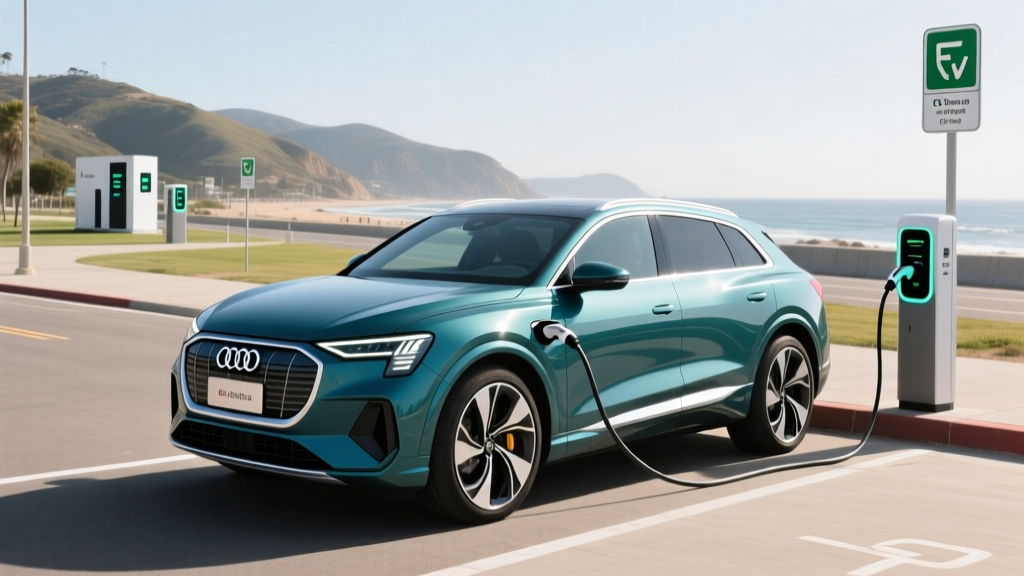
The Audi Q8 e-tron occupies an unusual position in the luxury EV SUV segment. It doesn't chase headline-grabbing range numbers or sub-four-second 0-60 sprints. Instead, it delivers a refined, quiet, and exceptionally well-built electric crossover that prioritizes ride comfort and cabin quality over spec-sheet dominance. For 2026, Audi continues to refine the formula with updated software, improved charging logistics via the expanding NACS adapter ecosystem, and pricing that undercuts rivals like the BMW iX and Mercedes EQE SUV.
But refinement alone doesn't sell EVs in 2026. Buyers want to know: what's the real range when you're driving 75 mph on the interstate in January? How quickly does it actually charge on a road trip? And does it qualify for the federal tax credit? This review answers those questions with exact numbers and owner-relevant context.
Spec Sheet: 2026 Audi Q8 e-tron at a Glance
| Specification | Value |
|---|---|
| EPA Range | 285 miles (SUV) / 300 miles (Sportback) |
| Battery (Usable / Gross) | 106 kWh usable / 114 kWh gross |
| Battery Chemistry | NMC (Nickel Manganese Cobalt) |
| Drivetrain | Dual-motor AWD (quattro) |
| Horsepower / Torque | 402 hp / 490 lb-ft (Boost mode) |
| 0-60 mph | 5.5 seconds |
| Max DC Fast Charge Rate | 170 kW (peak) |
| 10-80% DC Charge Time | ~31 minutes |
| Level 2 Home Charge Rate | 11.5 kW (~25 miles/hour) |
| Efficiency | 81 MPGe combined / 41 kWh/100 mi |
| Cargo Volume (rear seats up) | 28.5 cu ft (SUV) / 24.8 cu ft (Sportback) |
| Cargo Volume (rear seats folded) | 56.4 cu ft (SUV) |
| Battery Warranty | 8 years / 100,000 miles |
| Base MSRP (Premium Plus) | $75,600 |
Range and Efficiency: What the EPA Number Doesn't Tell You
The 2026 Q8 e-tron SUV carries an EPA-estimated 285 miles of range, while the sleeker Sportback variant squeezes out 300 miles thanks to its lower drag coefficient. Both draw from the same 114 kWh gross battery pack (106 kWh usable), which uses NMC lithium-ion cells manufactured by LG Energy Solution. Audi reserves approximately 8 kWh as a buffer to protect long-term battery health — a conservative but proven approach.
EPA Sticker: 285 mi (SUV) / 300 mi (Sportback)
Highway driving (70-80 mph, 65°F): ~245-260 mi
City / mixed suburban (moderate speeds, regen active): ~270-285 mi
Cold weather (below 30°F, cabin heat on): ~210-235 mi
The Q8 e-tron's efficiency of 41 kWh/100 mi is on the higher side for this class — its 5,800-lb curb weight and luxury-oriented thermal management system consume more energy than a Tesla Model X or even the BMW iX xDrive50. If your commute is mostly highway, budget for 240-250 miles between charges.
On the efficiency front, the Q8 e-tron's 81 MPGe combined rating (per fueleconomy.gov) trails segment leaders. The BMW iX xDrive50 achieves 87 MPGe, and the Tesla Model X Long Range hits 102 MPGe. You're paying a weight and aerodynamic penalty for the Audi's superior ride isolation and cabin materials.
Charging Speed: DC Fast Charging and Home Setup
The Q8 e-tron peaks at 170 kW on DC fast chargers, which is competitive but not class-leading. More importantly, Audi's thermal management system sustains that rate unusually well. Where some EVs spike to a peak and immediately taper, the Q8 e-tron holds above 150 kW through most of the 10-80% window, completing it in approximately 31 minutes on a suitably powerful station (250 kW+).
| Charge Level | Power | Speed | Notes |
|---|---|---|---|
| Level 1 (120V outlet) | 1.4 kW | ~3 mi/hr | Emergency/trickle only |
| Level 2 (240V, 48A) | 11.5 kW | ~25 mi/hr | Full charge in ~10 hours |
| DC Fast Charge (peak) | 170 kW | ~200 mi in 30 min | 10-80% in ~31 min |
For home charging, the onboard charger accepts up to 11.5 kW on Level 2, which means a full overnight replenishment on a 48-amp, 240V circuit. Most owners will need a dedicated 60-amp circuit installed. Expect to add 25 miles of range per hour of Level 2 charging — enough to fully replenish overnight even after a heavy driving day.
A critical 2026 update: Audi now offers a NACS adapter for the Q8 e-tron, granting access to Tesla's Supercharger network (now open to non-Tesla EVs at many locations). This dramatically improves road-trip charging reliability, as Electrify America and other CCS-native networks still suffer from inconsistent uptime in certain corridors.
Performance and Driving Dynamics
The dual-motor quattro powertrain produces 402 horsepower and 490 lb-ft of torque in Boost mode (activated via the drive select system or kick-down). The 0-60 mph sprint takes 5.5 seconds — brisk but not thrilling by 2026 EV standards. The BMW iX M60 does it in 3.6 seconds, and even the base iX xDrive50 hits 4.4 seconds.
Where the Q8 e-tron excels is in how it delivers that performance. The adaptive air suspension is standard and works beautifully, filtering out road imperfections while maintaining composure through corners. The steering is precise if not communicative, and the regenerative braking system offers three levels of intensity adjustable via steering-wheel paddles. There's no true one-pedal driving mode — Audi deliberately chose to let the vehicle coast freely when you lift off the accelerator, which some drivers prefer for highway efficiency.
Towing capacity is rated at 4,000 pounds with the factory tow package, making it viable for light trailers or a pair of jet skis but not a large boat or camper.
Interior, Technology, and Cargo Space
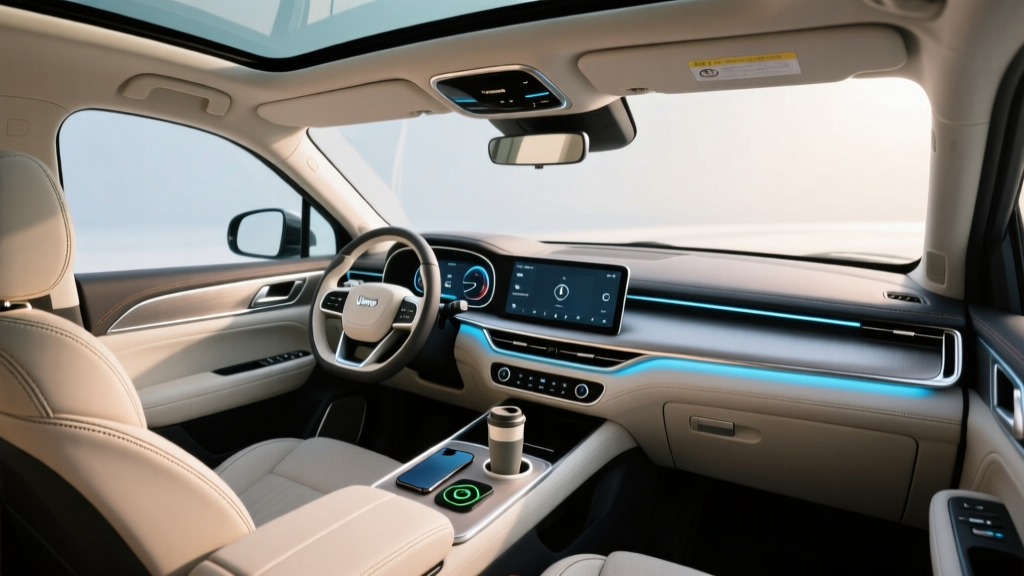
The cabin is where the Q8 e-tron makes its strongest case. Audi's dual-touchscreen MMI setup (10.1-inch upper, 8.6-inch lower) is responsive and visually clean, though some buyers will miss physical climate controls. The 12.3-inch Virtual Cockit Plus digital instrument cluster remains one of the best in the business, and the available head-up display with augmented-reality navigation is genuinely useful.
Driver assistance comes via Audi's Adaptive Cruise Assist with Lane Guidance, which is a Level 2 SAE system — meaning you must keep your hands on the wheel and eyes on the road at all times. It performs competently on highways but doesn't match the hands-free capability of GM's Super Cruise or Ford's BlueCruise on mapped roads.
Audi Adaptive Cruise Assist is a driver-assistance system, not a self-driving feature. You remain fully responsible for vehicle operation. Do not confuse this with Level 4 robotaxi services like Waymo.
Cargo space is generous: 28.5 cubic feet behind the second row in the SUV body style, expanding to 56.4 cu ft with seats folded. The Sportback sacrifices about 4 cu ft due to its sloping roofline. There's also a small front trunk (frunk) offering roughly 2.1 cu ft — enough for charging cables and a small bag but not much else. Rear-seat legroom measures 38.1 inches, which is competitive with the BMW iX (38.9 in) and better than the Mercedes EQE SUV (36.7 in).
Pricing, Trims, and Federal Tax Credit Eligibility
The 2026 Q8 e-tron is offered in three trims for the SUV body style:
- Premium Plus: $75,600 — includes air suspension, 20-inch wheels, full LED matrix headlights, leather, dual-screen MMI, and Adaptive Cruise Assist
- Prestige: $81,200 — adds head-up display, Bang & Olussen 3D audio, power rear sunshades, Night Vision Assistant
- S line (appearance package): adds $3,500 to either trim for sport bumpers, black optics, and unique wheels
The Sportback body style adds approximately $3,000 to each trim. Destination charges are $1,195.
The Q8 e-tron does not currently qualify for the full $7,500 federal EV tax credit due to battery component and critical mineral sourcing requirements under IRS §30D. Audi's battery cells are manufactured by LG Energy Solution, and the pack's critical mineral and component sourcing does not fully meet the 2026 thresholds set by the IRS clean vehicle credit rules.
Key §30D requirements for 2026:
- MSRP cap: $80,000 for SUVs (Q8 e-tron base qualifies)
- Buyer income cap: $300,000 MFJ / $150,000 single
- Battery sourcing: critical minerals and components must meet escalating domestic/free-trade thresholds
- Point-of-sale transfer available for qualifying vehicles
Tax credit rules change frequently. Consult a tax professional and verify current eligibility on IRS.gov before purchasing. Some state and utility incentives may still apply regardless of federal eligibility.
How It Compares: Q8 e-tron vs. Key Rivals
| Attribute | Audi Q8 e-tron | BMW iX xDrive50 | Tesla Model X LR |
|---|---|---|---|
| EPA Range | 285 mi | 324 mi | 335 mi |
| Battery (usable) | 106 kWh | 105.2 kWh | 100 kWh |
| DC Fast Charge (peak) | 170 kW | 195 kW | 250 kW |
| 0-60 mph | 5.5 sec | 4.4 sec | 3.8 sec |
| Base MSRP | $75,600 | $87,250 | $79,990 |
| Federal Tax Credit | Not eligible | Not eligible | Partial ($3,750)* |
| Efficiency (MPGe) | 81 | 87 | 102 |
*Tesla Model X credit eligibility varies by build date and sourcing; verify on IRS.gov.
The Q8 e-tron's advantage is price and ride quality. It's $11,000+ cheaper than the iX at the base level and offers a noticeably smoother, quieter ride. The trade-off is range (40 fewer miles than the iX, 50 fewer than the Model X) and charging speed. If road trips are frequent, the BMW and Tesla are more practical. If daily comfort and build quality are paramount, the Audi wins.
Ownership Costs and Warranty
Audi covers the Q8 e-tron's battery with an 8-year/100,000-mile warranty guaranteeing at least 70% capacity retention. The limited vehicle warranty is 4 years/50,000 miles, and complimentary maintenance covers 2 years/20,000 miles.
Insurance costs run higher than average for this segment — expect $2,800-$3,400 annually depending on your profile, per industry data. Depreciation has historically been steep on the e-tron lineage; the Q8 e-tron retained roughly 52-56% of its value after 3 years as of late 2025, trailing Tesla and Porsche but tracking similarly with Mercedes EQ models.
Charging costs are moderate. At a national average of $0.16/kWh for home electricity, a full charge costs about $17. At public DC fast chargers averaging $0.40/kWh, a 10-80% session runs roughly $30. For a driver covering 12,000 miles annually, expect roughly $700-$900/year in home charging — versus $1,800+ in gasoline for a comparable Audi Q5.
Pros, Cons, and the Verdict
- Exceptional ride quality with standard air suspension
- Premium cabin materials and quietness
- Sustained DC charging curve (minimal taper to 80%)
- Competitive base pricing in luxury EV SUV class
- NACS adapter access to Supercharger network
- Generous cargo space and practical frunk
- Below-average EPA range for the class (285 mi)
- Heavy — 5,800 lbs impacts efficiency and tire wear
- No federal tax credit eligibility (2026 sourcing rules)
- 170 kW peak charge rate trails BMW iX and Tesla
- No hands-free driving mode (Level 2 only)
- Dual-screen climate controls are distracting while driving
Choose the Q8 e-tron if: You prioritize ride comfort, cabin quietness, and build quality over maximum range. You mostly drive locally or on moderate-length trips (under 200 miles). You value Audi's design language and dealer experience. You have reliable home Level 2 charging.
Look elsewhere if: You frequently road-trip 300+ miles and need maximum range between stops. You want hands-free highway driving (consider BMW iX with Highway Assistant or Cadillac Lyriq with Super Cruise). Federal tax credit eligibility is a deal-breaker for your budget.
Frequently Asked Questions
What is the real-world range of the 2026 Audi Q8 e-tron?
The EPA rates it at 285 miles (SUV) and 300 miles (Sportback). In real-world highway driving at 70-80 mph in moderate temperatures, expect 245-260 miles. In cold weather below 30°F with cabin heating, range drops to approximately 210-235 miles. City driving with regenerative braking active can get you close to the EPA sticker.
How fast does the Q8 e-tron charge at home and on the road?
On a Level 2 home charger (240V, 48A), it charges at 11.5 kW, adding roughly 25 miles of range per hour — a full charge takes about 10 hours overnight. On DC fast chargers, it peaks at 170 kW and charges from 10-80% in approximately 31 minutes. The sustained charging curve is excellent, with minimal taper until above 80% state of charge.
Does the 2026 Q8 e-tron qualify for the $7,500 federal EV tax credit?
As of 2026, the Q8 e-tron does not qualify for the full federal §30D tax credit due to battery sourcing requirements. The MSRP and buyer income thresholds are met at the base trim, but the critical mineral and battery component sourcing rules eliminate eligibility. Always verify current status on IRS.gov before purchasing, as sourcing compliance can change with new model-year battery supply chains.
Is the Q8 e-tron worth buying over the BMW iX or Tesla Model X?
It depends on your priorities. The Q8 e-tron is the most comfortable and quietest of the three, and it's significantly cheaper than the BMW iX at the base level. However, it gives up 40-50 miles of EPA range and charges more slowly. If daily luxury and ride quality matter most, the Audi is the best choice. If range and charging speed for road trips are critical, the BMW iX or Tesla Model X are stronger options.
What is the battery warranty on the Q8 e-tron?
Audi provides an 8-year/100,000-mile battery warranty that guarantees at least 70% of original capacity retention. The standard vehicle warranty is 4 years/50,000 miles. If the battery degrades below 70% capacity within the warranty period, Audi will repair or replace it at no cost.
Can I use Tesla Superchargers with the Q8 e-tron?
Yes. For 2026, Audi offers a NACS (North American Charging Standard) adapter that allows the Q8 e-tron to access Tesla's Supercharger network. This is a significant advantage for road-trip charging reliability. The adapter plugs into the Q8 e-tron's native CCS port and connects to NACS-equipped Supercharger stalls.