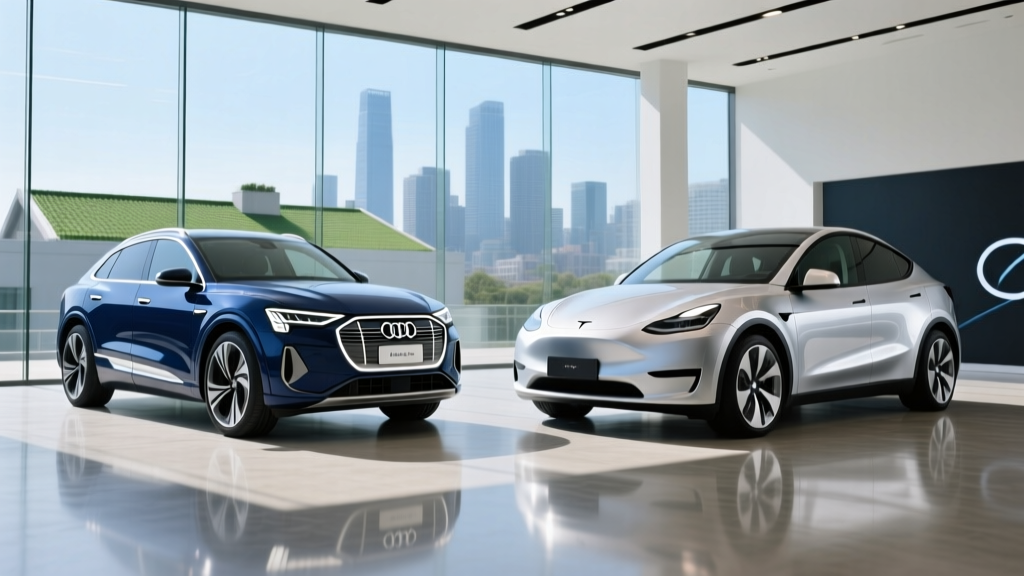
Audi's flagship electric SUV enters the 2026 model year with meaningful refinements that sharpen its competitive edge against Tesla's dominant market position. The Q8 e-tron retains its 114 kWh gross battery pack (106 kWh usable) but benefits from revised thermal management software that improves DC fast-charging consistency and cold-weather performance. For buyers cross-shopping luxury electric SUVs, the question isn't whether the Q8 e-tron can match Tesla's efficiency — it can't — but whether Audi's build quality, ride comfort, and dealer experience justify the efficiency trade-off.
2026 Audi Q8 e-tron: What's New This Year
The 2026 Q8 e-tron carries over the mechanical hardware introduced with the 2024 rename (formerly just "e-tron"), but Audi has pushed several over-the-air and model-year updates:
- Revised battery preconditioning algorithm: The SUV now begins heating the pack earlier when a DC fast-charger is routed in navigation, resulting in more consistent peak charge rates in ambient temperatures below 40°F.
- Updated infotainment (MIB4): Faster processor, wireless wireless Android Auto and Apple CarPlay, and a new "charging planner" that preheats the battery based on learned driving habits.
- Standard adaptive air suspension: Previously optional on Premium Plus, now included on all trims, improving ride quality and allowing a 0.6-inch lower ride height at highway speeds for reduced drag.
- New exterior colors and wheel designs: Magnet Gray and Siam Beige Metallic join the palette; 21-inch aero wheels are now available (previously 22-inch max).
The powertrain remains a dual-motor, all-wheel-drive setup producing 402 horsepower and 490 lb-ft of torque in standard Boost mode. The 0-60 mph sprint takes 5.5 seconds — respectable but not Tesla-quick.
Range, Efficiency, and Real-World Expectations
Real-World Expectation: 240–265 miles highway; 210–230 miles in freezing weather with cabin heating
Efficiency: 83 MPGe combined / 41 kWh per 100 miles
The Q8 e-tron's EPA-rated 285 miles applies to the base Premium trim riding on 20-inch wheels. Step up to the Prestige trim with 21-inch aero wheels, and you lose roughly 8 miles of range due to increased rolling resistance and weight. The Sportback variant (coupe-like roofline) gains approximately 10 miles of range thanks to a lower drag coefficient (0.26 vs 0.28 Cd).
In real-world highway testing at 70–75 mph in moderate temperatures (55–70°F), expect 240–265 miles before hitting a 10% state of charge. In sub-freezing conditions with the cabin heater active, that figure drops to 210–230 miles. This is a larger cold-weather penalty than Tesla's heat-pump-equipped Model X, which typically loses 15–20% range in similar conditions versus the Audi's 20–25% loss.
The Q8 e-tron's efficiency of 41 kWh/100 miles is notably worse than the Tesla Model X's 34 kWh/100 miles. Over 12,000 annual miles and at a national average electricity cost of $0.16/kWh, that difference translates to roughly $135 more per year in electricity costs for the Audi — not a deal-breaker, but a reflection of the Q8 e-tron's heavier curb weight (5,765 lbs vs 5,185 lbs for the Model X).
| Spec | Value |
|---|---|
| EPA Range | 285 miles (20" wheels) |
| Battery (gross / usable) | 114 kWh / 106 kWh (NMC) |
| Drivetrain | Dual-motor AWD |
| Horsepower / Torque | 402 hp / 490 lb-ft |
| 0–60 mph | 5.5 seconds |
| Efficiency | 83 MPGe / 41 kWh/100mi |
| Cargo Volume (rear seats up) | 28.5 cu ft |
| Cargo Volume (rear seats folded) | 57.0 cu ft |
| Rear Legroom | 38.2 inches |
| Curb Weight | 5,765 lbs |
| Towing Capacity | 4,000 lbs (braked) |
| Battery Warranty | 8 years / 100,000 miles (70% capacity retention) |
Charging Speed: DC Fast and Home Level 2
The Q8 e-tron supports a peak DC fast-charge rate of 170 kW via its CCS1 connector (NACS adapter required for Tesla Superchargers). Audi's revised preconditioning software helps the SUV reach that peak rate more reliably, but the charge curve still tapers significantly above 80% state of charge.
| Charging Level | Power | Speed / Time |
|---|---|---|
| Level 1 (120V household) | 1.4 kW | ~4 miles per hour |
| Level 2 (240V home/public) | 11.5 kW (48A) | ~28 miles per hour; full charge in ~10 hours |
| DC Fast Charge (peak) | 170 kW | 10–80% in ~31 minutes |
| DC Fast Charge (sustained 10–60%) | ~145 kW avg | Adds ~180 miles in 20 minutes |
The 10–80% time of 31 minutes is competitive with other luxury EVs but trails the Tesla Model X, which accomplishes the same feat in roughly 22 minutes at a V3 Supercharger thanks to its 250 kW peak rate. The Q8 e-tron's charge curve is relatively flat between 10% and 55% SoC (sustaining 150–170 kW), then tapers to ~100 kW by 70% and ~50 kW by 85%.
For home charging, the Q8 e-tron's 11.5 kW onboard charger is a strong point. On a 48-amp Level 2 circuit, you'll add roughly 28 miles of range per hour — enough to fully replenish the 106 kWh usable battery overnight. Most owners charging from 20% to 80% daily will need only 5–6 hours on Level 2.
Pricing, Trims, and Federal Tax Credit Eligibility
The 2026 Q8 e-tron starts at $74,400 (including $1,195 destination) for the Premium trim. The Prestige trim adds $7,500, and the Sportback body style adds $3,400 to any trim. A well-equipped Prestige with options lands in the $88,000–$92,000 range.
| Trim | MSRP | §30D Credit Eligible? | Effective Price |
|---|---|---|---|
| Premium (SUV) | $74,400 | No (MSRP cap: $80K SUV) | $74,400 |
| Premium Plus (SUV) | $79,900 | Yes (under $80K cap) | $72,400 (if eligible) |
| Prestige (SUV) | $85,400 | No (exceeds $80K cap) | $85,400 |
| Premium (Sportback) | $77,800 | Yes (under $80K cap) | $70,300 (if eligible) |
Critical tax-credit caveat: Under current IRS §30D rules, the Q8 e-tron qualifies for up to $7,500 only on trims priced below the $80,000 SUV MSRP cap. The Premium Plus trim at $79,900 squeaks under; the Prestige at $85,400 does not. Additionally, the buyer must meet income caps ($150K single / $300K joint AGI) and the vehicle's battery components and critical minerals must satisfy North American sourcing requirements. Audi has not publicly confirmed whether the Q8 e-tron's battery sourcing meets the 2026 critical-mineral thresholds — verify with your dealer and a tax professional before relying on the credit. The credit can now be transferred to the dealer at point of sale, reducing your out-of-pocket cost immediately.
Interior, Tech, and Driver Assistance
The Q8 e-tron's cabin is where Audi differentiates from Tesla. Material quality is a tier above: standard leather upholstery, genuine aluminum trim, soft-touch surfaces on every contact point, and triple-zone climate control. The dual-screen MMI setup (10.1-inch upper, 8.6-inch lower) is less minimalist than Tesla's single-screen approach but offers redundant physical controls for climate and volume — a preference split among buyers.
Notable tech features:
- Virtual Cockpit Plus: 12.3-inch driver display with dedicated EV range/charge screens
- Matrix-design LED headlights: Adaptive high beams with glare-free zone masking (Prestige standard, Premium Plus optional)
- Audi adaptive cruise with lane guidance: SAE Level 2 system that requires hands-on-wheel; less aggressive than Tesla's Autopilot but smoother in stop-and-go traffic
- Remote parking assist: Allows the SUV to park itself in tight spaces via the myAudi app (requires clear line of sight)
The biggest tech drawback is the absence of a true hands-free driving system comparable to GM's Super Cruise or Ford's BlueCruise. Audi's system is competent but requires continuous steering-wheel contact, and it lacks automatic lane-change functionality that Tesla's Autopilot offers.
Q8 e-tron vs Tesla Model X: The Head-to-Head
| Attribute | Audi Q8 e-tron Premium Plus | Tesla Model X LR |
|---|---|---|
| EPA Range | 285 miles | 348 miles |
| Battery (usable) | 106 kWh (NMC) | ~100 kWh (NMC) |
| Peak DC Charge Rate | 170 kW | 250 kW |
| 10–80% DC Time | ~31 min | ~22 min |
| 0–60 mph | 5.5 sec | 3.8 sec |
| Horsepower | 402 hp | 670 hp |
| Cargo (seats up) | 28.5 cu ft | 37.1 cu ft (5-seat) |
| Base MSRP | $79,900 | $79,990 |
| Federal Credit Eligible | Yes (under $80K cap) | Yes (under $80K cap) |
The Tesla Model X wins on range, charging speed, performance, and cargo space. The Audi wins on ride quality, cabin quietness, material finish, and dealer service infrastructure. If you prioritize driving dynamics and road-trip efficiency, the Model X is the better EV. If you value luxury-car isolation and prefer a traditional dealership experience, the Q8 e-tron earns its premium.
Who Should Buy the Q8 e-tron?
Choose the Q8 e-tron if:
- You want a luxury SUV with superior ride comfort and cabin quietness
- Your daily commute is under 100 miles round-trip (range is sufficient)
- You prefer dealership service over Tesla's mobile-ranger model
- You value physical climate controls and a traditional instrument cluster
- You need a 4,000-lb towing capacity for a small boat or camper trailer
Look elsewhere if:
- You regularly drive 300+ miles between charging stops (Tesla's Supercharger network and 348-mile range are better suited)
- You want the fastest DC charging in the luxury segment
- You prioritize one-pedal driving — the Q8 e-tron's regen is mild even in its strongest mode
- You want hands-free highway driving (consider GM's Super Cruise-equipped Cadillac Lyriq or Ford's BlueCruise)
Pros
- Exceptional ride quality with standard air suspension
- Quiet, well-insulated cabin at highway speeds
- 11.5 kW Level 2 charging is among the fastest in class
- Premium Plus trim qualifies for §30D credit (under $80K cap)
- 4,000-lb towing capacity
Cons
- 285-mile EPA range trails key competitors by 50+ miles
- 170 kW peak DC rate means longer road-trip stops
- Heavy curb weight (5,765 lbs) hurts efficiency
- No hands-free driving option
- Cold-weather range loss worse than heat-pump-equipped rivals
Frequently Asked Questions
What is the real-world range of the 2026 Audi Q8 e-tron?
Expect 240–265 miles on the highway in moderate weather, dropping to 210–230 miles in freezing temperatures with cabin heating active. The EPA's 285-mile estimate assumes a mix of city and highway driving at moderate speeds.
How fast does the Q8 e-tron charge at home and on the road?
On a 48-amp Level 2 home charger, the Q8 e-tron adds roughly 28 miles of range per hour, fully charging overnight in about 10 hours. On a DC fast charger, it peaks at 170 kW and charges from 10% to 80% in approximately 31 minutes.
Does the 2026 Q8 e-tron qualify for the $7,500 federal tax credit?
Only the Premium Plus trim ($79,900 MSRP) falls under the IRS §30D $80,000 SUV cap. Buyer income limits ($150K single / $300K joint) and battery-sourcing requirements also apply. Confirm eligibility with your dealer and tax advisor before purchase. The credit can be applied at point of sale.
Is the Q8 e-tron better than the Tesla Model X?
It depends on priorities. The Model X offers 63 more miles of EPA range, faster DC charging (22 vs 31 minutes to 80%), and significantly more power. The Q8 e-tron counters with a quieter, more comfortable cabin, standard air suspension, and a traditional dealership service model.
Can I charge the Q8 e-tron at Tesla Superchargers?
Yes, but you'll need a CCS-to-NACS adapter. Audi includes a NACS adapter with new 2026 models. Charging speed will be limited to the Q8 e-tron's 170 kW peak rate even at a 250 kW V3 Supercharger.
What is the battery warranty?
Audi covers the Q8 e-tron's high-voltage battery for 8 years or 100,000 miles, whichever comes first, against defects and capacity loss below 70% of original capacity. The general vehicle warranty is 4 years / 50,000 miles.
For official efficiency data, consult fueleconomy.gov. For tax-credit rules, see the IRS §30D guidance. For safety ratings, check NHTSA.