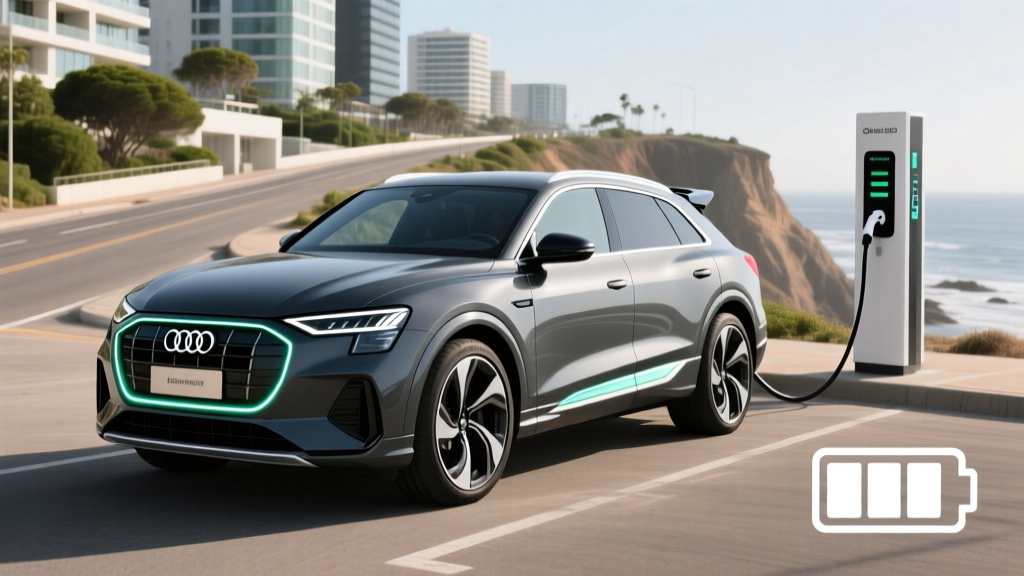
The Audi Q8 e-tron occupies a specific niche in the luxury EV market: it doesn't chase record-breaking range or headline-grabbing acceleration. Instead, it delivers what traditional Audi buyers actually want — a quiet, well-built, premium cabin with genuine long-distance capability and DC fast charging that ranks among the best in its class. For 2026, Audi continues the nameplate transition from the original e-tron, refining the package with updated infotainment and sustained production at the Brussels plant.
If you're cross-shopping the BMW iX, Mercedes EQE SUV, or Tesla Model X, the Q8 e-tron's pitch is straightforward: superior charge-curve management, a refined ride, and an interior that feels like a flagship Audi rather than a tech-company experiment. But with an EPA range that trails some rivals and a starting price that climbs quickly with options, it demands a careful look at the numbers before you sign.
2026 Audi Q8 e-tron Specs at a Glance
| Specification | Q8 e-tron Premium Plus | Q8 e-tron Prestige | SQ8 e-tron |
|---|---|---|---|
| EPA Range | 285 mi | 285 mi | 253 mi |
| Battery (usable) | 106 kWh (NMC) | 106 kWh (NMC) | 106 kWh (NMC) |
| Max DC Charge Rate | 170 kW | 170 kW | 170 kW |
| 10–80% DC Time | ~31 min | ~31 min | ~31 min |
| Level 2 Rate | 19.2 kW (AC) | 19.2 kW (AC) | 19.2 kW (AC) |
| 0–60 mph | 5.5 sec | 5.5 sec | 4.4 sec |
| Horsepower | 402 hp | 402 hp | 496 hp (boost) |
| Drivetrain | quattro AWD | quattro AWD | quattro AWD |
| MPGe (combined) | 80 MPGe | 80 MPGe | 73 MPGe |
| Base MSRP | $75,600 | $82,300 | $97,400 |
Range and Efficiency: The Real-World Picture
Real-World Expectation: ~240–260 mi highway; ~200–220 mi in cold weather (below 32°F); up to ~280 mi mixed city driving with regen
The Q8 e-tron's 285-mile EPA figure places it squarely in the middle of the luxury electric SUV segment. The BMW iX xDrive50 edges ahead at 307 miles, while the Mercedes EQE 350+ SUV posts 305 miles with its single-motor configuration. The Q8 e-tron trades some range for standard dual-motor quattro all-wheel drive across every trim — a choice Audi buyers typically prefer.
The 106 kWh usable battery pack (approximately 114 kWh gross) uses NMC (nickel manganese cobalt) lithium-ion chemistry. This is the standard choice for performance-oriented luxury EVs, offering higher energy density than LFP but with different long-term degradation characteristics. The pack operates with a substantial buffer — Audi reserves roughly 8 kWh at the top and bottom of the state-of-charge window to protect cell longevity.
In real-world driving, expect highway range to fall to around 240–260 miles at sustained 70–80 mph speeds, as the Q8 e-tron's 5,700-pound curb weight and upright SUV profile work against it at velocity. Cold weather (below freezing) can knock 15–25% off that figure, landing you in the 200–220 mile territory on a full charge. The standard heat pump — a welcome inclusion — mitigates cabin-heating energy draw, but battery chemistry itself slows in the cold. If your daily commute is under 60 miles round-trip, range will rarely be a concern. For road trips, you'll be planning stops every 200–230 miles to maintain a comfort buffer.
Efficiency registers at 80 MPGe combined (approximately 42 kWh/100 mi) for the standard Q8 e-tron. The performance-oriented SQ8 e-tron drops to 73 MPGe. Neither figure leads the segment — the iX and EQE SUV both post higher efficiency numbers — but the Q8 e-tron prioritizes the driving refinement and charge speed over squeezing every last mile from the pack.
Charging Speed: Where the Q8 e-tron Excels
This is the Q8 e-tron's strongest technical argument. Audi engineered the thermal management system to sustain high charge rates longer than most competitors, and it shows on the road.
| Charging Level | Power | Speed / Notes |
|---|---|---|
| Level 1 (120V household) | ~1.4 kW | ~3–4 mi/hr — emergency/trickle only |
| Level 2 (240V home, 48A) | 11.5 kW | ~22–25 mi/hr; 0–100% in ~9.5 hours |
| Level 2 (240V home, 80A) | 19.2 kW | ~37–40 mi/hr; 0–100% in ~5.5 hours |
| DC Fast Charge (peak) | 170 kW | 10–80% in ~31 min; tapers significantly above 85% |
| DC Fast Charge (350 kW station) | 170 kW (max accepted) | Vehicle-limited to 170 kW regardless of station capability |
At a 350 kW Electrify America or similar CCS station, the Q8 e-tron pulls its 170 kW peak quickly and — critically — holds above 120 kW through approximately 70% state of charge before tapering. Many competitors spike to a high peak then drop off sharply after 40–50% SoC. The Q8 e-tron's flatter charge curve means the 10–80% time of roughly 31 minutes is genuinely achievable in real-world conditions, not just a laboratory best case.
The charge curve matters more than peak kW. A vehicle that peaks at 250 kW but sustains it for only 5 minutes may actually charge slower overall than the Q8 e-tron's steadier 170 kW pull. On a road trip, expect to add roughly 150–170 miles in a 20-minute stop — enough to comfortably continue your journey.
At home on a 48-amp Level 2 circuit (the most common residential installation on a 60-amp breaker), the Q8 e-tron charges at 11.5 kW, adding about 23 miles per hour. An overnight charge from 20% to full takes roughly 7–8 hours. If your electrical panel supports an 80-amp circuit (100-amp breaker), the onboard charger can accept up to 19.2 kW — cutting that time to about 5.5 hours. Most homeowners will find the 48-amp setup perfectly adequate, but the 19.2 kW capability is a differentiator if you're planning a panel upgrade anyway.
The Q8 e-tron uses the CCS1 connector standard. As of 2026, Audi has not adopted the NACS (Tesla) connector on the Q8 e-tron, though a CCS-to-NACS adapter is available for Supercharger access. This is a consideration if Tesla Supercharger reliability in your area significantly outperforms Electrify America or other CCS networks.
Performance and Driving Dynamics
The standard Q8 e-tron's dual-motor quattro powertrain delivers 402 horsepower and 490 lb-ft of torque, reaching 60 mph in 5.5 seconds. That's brisk but not supercar territory — Audi positions this as a refined luxury cruiser, not a performance flagship. The SQ8 e-tron steps up to 496 hp (in boost mode) and a 4.4-second 0–60 time for buyers who want the extra punch.
Where the Q8 e-tron earns its badge is ride quality. The standard adaptive air suspension soaks up road imperfections with a composure that rivals the best in the segment. Steering is precise if light, and the cabin remains whisper-quiet at highway speeds — a hallmark of Audi's acoustic engineering. Regenerative braking offers multiple levels selectable via steering-wheel paddles, though the Q8 e-tron does not offer true one-pedal driving to a complete stop in its default mode. You'll still use the brake pedal in stop-and-go traffic, which some drivers prefer for a more natural feel.
Towing capacity is rated at 4,000 pounds when properly equipped — adequate for a small boat trailer or light camper but less than the Rivian R1S or Tesla Model X. If towing is a priority, the Q8 e-tron isn't the segment leader here.
Interior, Cargo, and Technology
The Q8 e-tron's cabin is where Audi's investment shows most clearly. Materials are exemplary — available Valcona leather, open-pore wood trim, and aluminum accents create an environment that feels genuinely premium. The dual-touchscreen MMI response setup (10.1-inch upper, 8.6-inch lower) handles infotainment and climate controls, though the lower screen's reliance on touch for climate adjustment draws the usual criticism about distraction. Haptic feedback helps, but physical knobs remain superior for blind operation.
The 12.3-inch Virtual Cockit Plus digital instrument cluster is among the best in the industry, offering configurable navigation, range, and media layouts. Wireless Apple CarPlay and Android Auto are standard. Audi's MMI navigation includes route planning with integrated charging stops — a feature that calculates SoC at arrival and suggests optimal charge points on longer trips.
Cargo space measures 28.5 cubic feet behind the second row and 57.0 cubic feet with the rear seats folded. That's competitive with the BMW iX (35.5/77.9 cu ft — the iX wins on volume) and slightly behind the Mercedes EQE SUV (28.0/55.0 cu ft — roughly even). The Q8 e-tron does not offer a front trunk (frunk); the space under the hood houses power electronics. Rear-seat legroom is generous at 39.1 inches, accommodating adults comfortably on longer journeys.
Driver Assistance and Safety
Audi's Adaptive Cruise Assist with lane guidance provides competent Level 2 highway driving support, managing speed, following distance, and lane centering. It works well on divided highways but requires continuous driver supervision. The system is smoother and less intrusive than some competitors, intervening gently rather than aggressively. However, it does not match the hands-free capability of GM's Super Cruise or Ford's BlueCruise on mapped highways, nor does it approach Tesla's FSD (Supervised) feature set in terms of urban driving ambition.
Standard safety technology includes automatic emergency braking with pedestrian detection, lane departure warning, rear cross-traffic alert, and a surround-view camera system. The Q8 e-tron earned top marks from the IIHS in crashworthiness testing. Park assist with trailer assist is available on higher trims — a genuinely useful feature given the Q8 e-tron's size.
Pricing, Trims, and Federal Tax Credit Eligibility
| Trim | Base MSRP | Destination | Total Before Credit | Est. After §30D Credit* |
|---|---|---|---|---|
| Q8 e-tron Premium Plus | $75,600 | $1,195 | $76,795 | $69,295 |
| Q8 e-tron Prestige | $82,300 | $1,195 | $83,495 | $75,995 |
| SQ8 e-tron Premium Plus | $97,400 | $1,195 | $98,595 | $91,095 |
| SQ8 e-tron Prestige | $103,100 | $1,195 | $104,295 | $96,795 |
*Federal tax credit estimates assume full §30D eligibility. Actual credit varies based on battery sourcing, buyer income, and MSRP caps. Consult a tax professional.
- MSRP Cap: SUVs/vans/pickups must have MSRP ≤ $80,000. The Q8 e-tron Premium Plus ($75,600) qualifies; Prestige and all SQ8 trims exceed the cap and do NOT qualify.
- Buyer Income Cap: Modified AGI ≤ $150,000 (single), $225,000 (head of household), $300,000 (married filing jointly).
- Battery Sourcing: Critical minerals and battery components must meet phased-in domestic/free-trade sourcing thresholds. Audi's Brussels-built pack sourcing should be verified at point of sale via the dealer's IRS compliance documentation.
- Point-of-Sale Transfer: Eligible buyers can transfer the credit to the dealer at purchase for an immediate price reduction rather than waiting for tax filing.
- Final Assembly: Vehicle must undergo final assembly in North America. As of 2026, the Q8 e-tron is assembled in Brussels, Belgium — this disqualifies all trims from the new-vehicle §30D credit. A leased Q8 e-tron may qualify under the commercial vehicle credit (§45W), which has no assembly requirement. Confirm with your dealer and tax advisor.
This is the critical detail many buyers miss: because the Q8 e-tron is assembled in Belgium, it does not qualify for the new-vehicle §30D tax credit regardless of trim price. The IRS assembly requirement is a firm disqualifier. However, leasing the vehicle may allow the dealer to claim the commercial clean vehicle credit (§45W) and pass savings to you via reduced lease payments. This lease loophole is a legitimate strategy that Audi dealers frequently use — but structure the deal carefully and confirm the savings appear in writing before signing.
Warranty and Battery Longevity
Audi backs the Q8 e-tron with a 4-year/50,000-mile limited warranty and an 8-year/100,000-mile battery and powertrain warranty. The battery warranty guarantees that the pack will retain at least 70% of its original capacity during the coverage period. If degradation exceeds 30% within eight years or 100,000 miles, Audi will repair or replace the battery to bring it back above that threshold.
NMC chemistry in the Q8 e-tron's pack is well-proven, and Audi's conservative buffer management (reserving capacity at the top and bottom of the charge window) is designed to minimize calendar and cycle degradation. Real-world data from earlier e-tron models suggests degradation of roughly 5–8% over the first 100,000 miles under normal use — well within the warranty threshold. Owners who frequently DC fast charge or regularly charge to 100% and let the vehicle sit may see slightly higher degradation. For daily driving, charging to 80–85% and using DC fast charging primarily on road trips will maximize pack life.
Who the Q8 e-tron Is For — and Who Should Look Elsewhere
- You value a premium, quiet cabin and refined ride over maximum range
- DC fast charging speed matters for regular road trips (170 kW sustained is excellent)
- You want standard quattro AWD without stepping up to a performance trim
- Your daily driving is under 200 miles and you have reliable home charging
- You plan to lease and can leverage the §45W commercial credit pathway
- Maximum EPA range is your top priority (BMW iX xDrive50: 307 mi; consider the Rivian R1S Dual-Motor for 390+ mi)
- You need hands-free highway driving (GM Super Cruise or Ford BlueCruise vehicles)
- You need the new-vehicle §30D purchase credit — the Belgium assembly disqualifies the Q8 e-tron
- Towing is a priority (Rivian R1S tows 7,700 lb; Tesla Model X tows 5,000 lb)
- You want a frunk for additional cargo flexibility
Pros and Cons
- Best-in-class DC charge curve sustainability — 170 kW peak with minimal early taper
- Genuinely premium interior materials and build quality
- Standard adaptive air suspension delivers excellent ride comfort
- Virtual Cockpit Plus is one of the best digital instrument clusters available
- 19.2 kW Level 2 onboard charger capability (with 80A circuit)
- Quiet cabin at highway speeds
- 285-mile EPA range trails BMW iX and Mercedes EQE SUV
- Belgium assembly disqualifies from new-vehicle §30D federal tax credit
- No front trunk (frunk)
- Touchscreen climate controls less intuitive than physical buttons
- No hands-free Level 2 driving mode (unlike Super Cruise/BlueCruise)
- Curb weight near 5,700 lb impacts efficiency and tire wear
Frequently Asked Questions
What is the real-world range of the Audi Q8 e-tron?
The EPA rates the Q8 e-tron at 285 miles. In real-world highway driving at 70–80 mph, expect 240–260 miles. In cold weather below freezing, that can drop to 200–220 miles. City driving with regenerative braking can approach the EPA figure, reaching around 270–280 miles in mild conditions.
How fast does the Q8 e-tron charge at home and on the road?
On a DC fast charger, the Q8 e-tron peaks at 170 kW and charges from 10–80% in approximately 31 minutes. At home on a standard 48-amp Level 2 circuit, it charges at 11.5 kW (~23 mi/hr), fully replenishing overnight. With an 80-amp circuit, the 19.2 kW onboard charger cuts that to about 5.5 hours for a full charge.
Does the Audi Q8 e-tron qualify for the $7,500 federal EV tax credit?
For a new-vehicle purchase, no. The Q8 e-tron is assembled in Brussels, Belgium, and IRS §30D requires final assembly in North America. However, leasing may allow the dealer to claim the §45W commercial clean vehicle credit and pass savings to you through reduced lease payments. Consult your dealer and a tax professional for specifics.
Is the Q8 e-tron worth buying versus the BMW iX or Tesla Model X?
It depends on your priorities. The BMW iX offers more range (307 mi EPA), more cargo space, and a more distinctive design — but the Q8 e-tron's charge curve is more consistent, and its cabin materials edge out the iX for traditional luxury. The Tesla Model X offers more range and Supercharger access but at a significantly higher price. If DC charging reliability and interior refinement top your list, the Q8 e-tron is compelling. If range or tax-credit eligibility is paramount, the iX is the stronger pick.
What battery chemistry does the Q8 e-tron use?
The Q8 e-tron uses an NMC (nickel manganese cobalt) lithium-ion battery with 106 kWh of usable capacity. NMC offers higher energy density than LFP chemistry, which is important in a heavy luxury SUV, but requires the standard 80% daily charge limit recommendation for longevity. The 8-year/100,000-mile warranty covers degradation below 70% capacity.
Can the Q8 e-tron use Tesla Superchargers?
Not natively — the Q8 e-tron uses the CCS1 connector. However, Audi offers a CCS-to-NACS adapter that enables access to Tesla's Supercharger network. This expands your charging options significantly, particularly in areas where Electrify America or other CCS networks have gaps. Confirm adapter compatibility and any speed limitations with your dealer.
Sources: EPA Fuel Economy, IRS Clean Vehicle Credits, Audi USA