Quick Answer: Is the Audi Q8 e-tron Right for You?
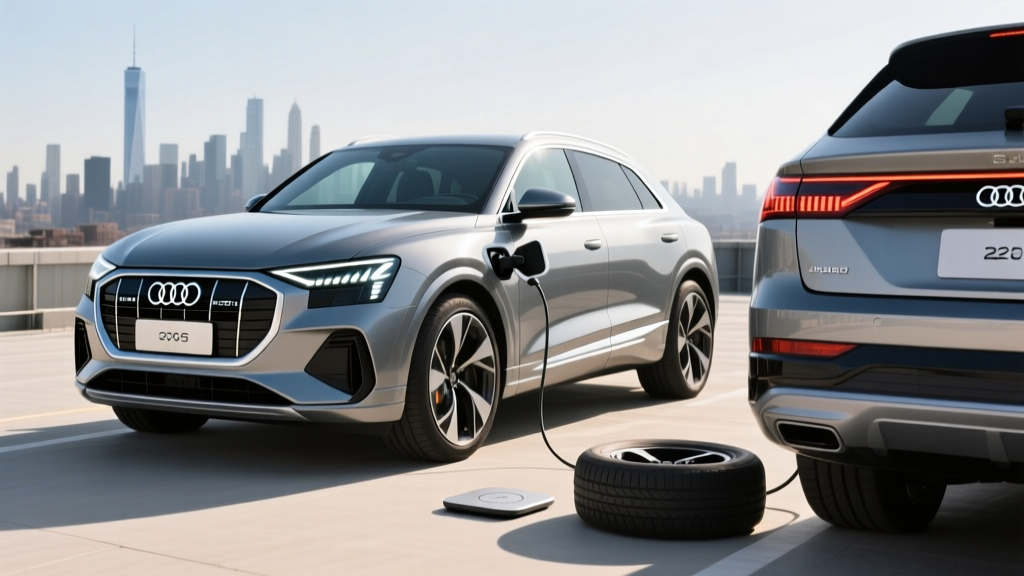
The 2026 Audi Q8 e-tron delivers an EPA-estimated 300 miles of range (Sedan variant) or 285 miles (Sportback), with peak DC fast charging at 170 kW (10-80% in ~31 minutes). Starting around $75,600 before destination, it qualifies for a partial or full $7,500 federal tax credit depending on battery sourcing and your income. It's best for luxury SUV buyers who prioritize build quality, a refined ride, and reliable Electrify America charging access — but its efficiency (2.0-2.2 kWh/mile) trails rivals like the Tesla Model X and BMW iX, meaning higher electricity costs over time. If you have Level 2 home charging and drive under 250 miles daily, the Q8 e-tron is a compelling luxury EV. If you road-trip frequently in cold climates or lack home charging, consider the trade-offs carefully before buying.
Range and Efficiency: EPA vs. Real-World Expectations
The 2026 Audi Q8 e-tron uses a 114 kWh gross battery pack (approximately 106 kWh usable) with NMC (nickel-manganese-cobalt) chemistry. Here's what the EPA rates and what you should actually expect:
| Variant | EPA Range | Real-World Highway | Cold Weather (20°F) | Efficiency (kWh/100mi) |
|---|---|---|---|---|
| Q8 e-tron Sedan (Premium Plus) | 300 mi | ~255-270 mi | ~210-230 mi | 46-48 |
| Q8 e-tron Sportback | 285 mi | ~240-260 mi | ~200-220 mi | 48-50 |
| SQ8 e-tron (performance) | 255 mi | ~215-235 mi | ~180-200 mi | 52-55 |
Real-World Range Note: The Q8 e-tron's 6,000+ lb curb weight and luxury insulation work against efficiency. On a 75 mph highway drive in moderate temperatures, expect to consume roughly 48 kWh/100mi, yielding about 255-270 miles from a full charge. In winter conditions (20-30°F) with cabin heating, range drops 20-30% even with the standard heat pump. This is typical for heavy luxury EVs, but it means the Q8 e-tron uses more electricity per mile than lighter competitors.
Charging Speed and Infrastructure
The Q8 e-tron's 170 kW peak DC fast-charge rate is moderate by 2026 standards, but Audi's charge curve management is among the best in the industry — it sustains high rates longer before tapering.
| Charging Level | Power (kW) | Miles Added Per Hour | Time (10-80%) | Typical Use |
|---|---|---|---|---|
| Level 1 (120V household) | 1.4 kW | ~3 mi/hr | ~60+ hours | Emergency/trickle only |
| Level 2 (240V home/public) | 11.5 kW (max) | ~28 mi/hr | ~9.5 hours | Overnight home charging |
| DC Fast Charge (CCS) | 170 kW (peak) | ~200 mi/hr (peak) | ~31 minutes | Road trips, Electrify America |
Charge Curve Reality: The 170 kW peak rate holds from roughly 10-30% State of Charge, then tapers progressively. Expect an average of about 120-130 kW across the full 10-80% session, which is why the 31-minute figure is realistic. The Q8 e-tron uses a CCS1 connector natively; with Audi's included NACS adapter (standard for 2026), you can also access Tesla Supercharger V3/V4 stalls, though at reduced speeds (~150 kW max on most V3 posts).
Preconditioning the battery via the myAudi app before arriving at a DC charger is essential in cold weather — it can cut your 10-80% charge time by 10-15 minutes by warming the pack to optimal temperature.
Pricing, Trims, and Federal Tax Credit Eligibility
The 2026 Audi Q8 e-tron lineup spans three main trims, all built on VW Group's MLB Evo platform:
| Trim | MSRP (before destination) | Key Features | §30D Credit Eligibility |
|---|---|---|---|
| Premium Plus Sedan | $75,600 | Matrix LED, air suspension, 28-speaker B&O | Up to $7,500* |
| Prestige Sedan | $82,300 | Head-up display, Night Vision, rear-seat entertainment | Up to $7,500* |
| SQ8 e-tron Prestige | $96,400 | 496 hp, sport tuning, carbon-fiber trim | Up to $7,500* |
*Destination charge adds ~$1,195.
- MSRP Cap: SUVs/vans capped at $80,000. The Q8 e-tron Sedan and Sportback qualify; the SQ8 e-tron may exceed the cap depending on final classification.
- Income Limits (2026): Modified AGI must not exceed $300,000 (joint filers), $225,000 (head of household), or $150,000 (single). Per IRS §30D rules.
- Battery Sourcing: The $7,500 credit splits into two halves — $3,750 for critical minerals and $3,750 for battery component assembly. Audi sources NMC cells primarily from LG Energy Solution and SK On; eligibility for each half varies by production batch. Check the VIN-specific lookup at fueleconomy.gov before purchasing.
- Point-of-Sale Transfer: You can transfer the credit to the dealer at purchase, reducing your out-of-pocket cost immediately — no waiting for tax filing.
Total Cost of Ownership: Q8 e-tron vs. Gas Audi Q8
Comparing the 2026 Q8 e-tron Premium Plus to the gas-powered Audi Q8 55 TFSI (similarly equipped, ~$73,000 MSRP) over 5 years and 75,000 miles:
| Cost Category | Q8 e-tron (EV) | Q8 55 TFSI (Gas) | Difference |
|---|---|---|---|
| Purchase Price (after credit) | $68,100 (est.) | $73,000 | EV saves $4,900 |
| Fuel/Energy (75k mi) | $5,400 (home + DC mix) | $13,500 (17 mpg, $3.80/gal) | EV saves $8,100 |
| Maintenance | $2,200 | $5,800 | EV saves $3,600 |
| Insurance (5-yr avg) | $14,500 | $12,000 | EV costs $2,500 more |
| Depreciation (est.) | $34,000 | $30,000 | EV costs $4,000 more |
| Total 5-Year Cost | $124,200 | $134,300 | EV saves ~$10,100 |
Assumptions: Electricity at $0.14/kWh average (home) and $0.40/kWh (DC public, ~20% of miles). Gas at $3.80/gallon. The Q8 e-tron's higher insurance premiums (typical for luxury EVs) and steeper depreciation partially offset fuel and maintenance savings. If you charge exclusively at home, your energy savings widen substantially.
Real-World Ownership: What First-Time EV Buyers Need to Know
Home Charging Is Essential
The Q8 e-tron's 11.5 kW onboard charger means a full Level 2 charge (0-100%) takes about 10 hours. A Level 2 home charger (240V, 48-amp circuit) costs $1,200-$2,500 installed depending on panel proximity and permit requirements. Without home charging, relying on public DC fast charging at $0.35-$0.50/kWh erases much of the fuel-cost advantage. Confirm your electrical panel has capacity (ideally 200A service) before committing to the vehicle.
Driving Patterns That Work Best
The Q8 e-tron excels as a daily luxury commuter and weekend trip vehicle when your typical day is under 200 miles and you can charge overnight. For 300+ mile road trips, plan one 25-35 minute DC fast-charge stop. Electrify America stations (included free for 2 years/1,000 kWh with purchase) are generally reliable along major corridors, but rural routes in the Mountain West and parts of the Southeast still have gaps.
Cold-Weather Ownership
If you live in climates with sustained sub-30°F winters (Upper Midwest, Northeast, Mountain states), expect 20-30% range loss and slower DC charging unless you precondition. The Q8 e-tron's heat pump helps cabin efficiency, but battery chemistry limits still apply. Garage parking and a Level 2 charger are strongly recommended in these regions.
Common Misconceptions About the Q8 e-tron
| Myth | Fact |
|---|---|
| "It charges as fast as a Tesla" | Peak 170 kW vs. Tesla Model X at 250 kW. The Q8 e-tron's 10-80% takes ~31 min vs. ~20 min for the fastest rivals. |
| "The battery will need expensive replacement soon" | Audi warranties the battery for 8 years/100,000 miles against dropping below 70% capacity. NMC packs in this class typically retain 85-90% after 100k miles based on real-world fleet data. |
| "I'll get the full $7,500 tax credit automatically" | Credit depends on your income, the vehicle's MSRP classification, and battery sourcing at time of manufacture. Verify VIN eligibility before signing. |
| "Regenerative braking means I never use the brake pedal" | The Q8 e-tron's regen is moderate (~0.2g max deceleration). It does not offer true one-pedal driving like some competitors — you'll still use the friction brakes regularly. |
Performance, Tech, and Daily Driving
The standard Q8 e-tron produces 402 horsepower and 490 lb-ft of torque (in Boost mode), reaching 0-60 mph in 5.4 seconds. The SQ8 e-tron bumps this to 496 hp and 718 lb-ft, with a 4.4-second 0-60 time. Both use a dual-motor quattro all-wheel-drive system.
Interior quality is a genuine Audi strength: the 12.3-inch Virtual Cockit Plus, 10.1-inch upper MMI touchscreen, and 8.6-inch lower haptic-feedback display are well-integrated. The available adaptive air suspension delivers a ride quality that rivals the BMW iX and surpasses the Tesla Model X on rough pavement. Cargo space is 28.5 cubic feet behind the rear seats (57 cu ft folded) — competitive but not class-leading.
Driver assistance includes Audi's Adaptive Cruise Assist with lane centering, which is an SAE Level 2 system. It requires continuous driver supervision and is not autonomous driving.
Decision Framework: Should You Buy the Audi Q8 e-tron?
Choose the Q8 e-tron If:
- You have Level 2 home charging (or can install it for under $2,500)
- Your daily driving is under 200 miles with occasional 300-mile road trips
- You value interior build quality, ride refinement, and brand prestige over maximum range or fastest charging
- You qualify for the federal tax credit (income under $300k joint, vehicle MSRP eligible)
- You want complimentary Electrify America charging for the first 2 years
Look Elsewhere If:
- You lack home charging access and would rely on expensive public DC charging daily
- You regularly drive 350+ mile trips in cold weather (range and charging taper become painful)
- You prioritize maximum range per dollar — the Hyundai Ioniq 5 or Tesla Model X offer better efficiency
- You want the fastest DC charging available — the Porsche Macan EV (270 kW) or Lucid Gravity charge significantly faster
- Your budget is under $65,000 after incentives — consider the Genesis GV70 Electrified or Cadillac Lyriq instead
Frequently Asked Questions
What is the real-world range of the Audi Q8 e-tron?
EPA-rated at 300 miles (Sedan), expect 255-270 miles in real-world highway driving at moderate temperatures, and 210-230 miles in cold winter conditions. The Sportback variant rates at 285 miles EPA with proportionally lower real-world figures.
How long does it take to charge the Q8 e-tron at home?
On a Level 2 (240V) home charger at 11.5 kW, a full 0-100% charge takes approximately 10 hours. Most owners charge from 20-80% overnight, which takes about 6 hours and adds roughly 170 miles of range.
Does the Audi Q8 e-tron qualify for the $7,500 federal tax credit?
It can, but eligibility depends on your income (under $300,000 for joint filers), the vehicle's MSRP staying under the $80,000 SUV cap, and battery sourcing compliance at the time of manufacture. Always verify the specific VIN at fueleconomy.gov before purchasing.
How does the Q8 e-tron compare to the BMW iX?
The BMW iX xDrive50 offers more range (EPA ~324 mi), faster charging (up to 200 kW), and better efficiency (~43 kWh/100mi) at a similar price point (~$87,000). The Q8 e-tron counters with a more traditional luxury interior aesthetic, standard air suspension, and a slightly lower starting price. Both are strong choices — the iX wins on efficiency, the Q8 e-tron on ride comfort.
What is the battery warranty on the Q8 e-tron?
Audi provides an 8-year/100,000-mile battery warranty guaranteeing the pack will retain at least 70% of its original capacity. The general vehicle warranty is 4 years/50,000 miles.
Can the Q8 e-tron use Tesla Superchargers?
Yes, with the included NACS adapter (standard for 2026 models), the Q8 e-tron can access Tesla Supercharger V3 and V4 stations. Expect peak charge rates of about 150 kW on V3 posts — slightly below its native CCS peak of 170 kW on Electrify America stations.