Quick Verdict: Audi Q6 e-tron vs Tesla Model Y
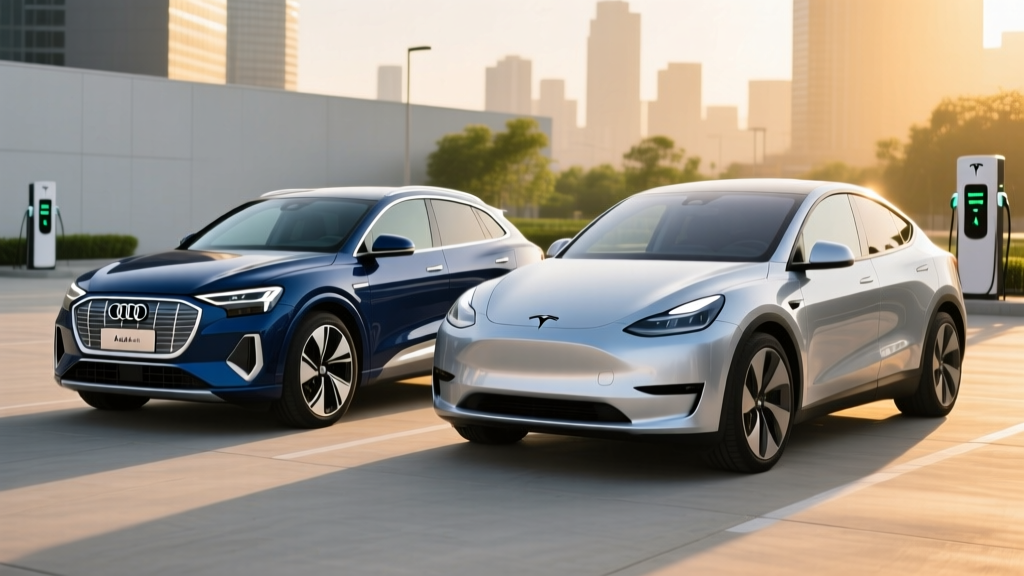
The Audi Q6 e-tron and Tesla Model Y target the same luxury electric crossover buyer, but they get there through fundamentally different philosophies. The Q6 e-tron leans into premium materials, 800-volt architecture, and a refined ride. The Model Y counters with lower pricing, access to the Supercharger network, and software integration that no legacy automaker has matched. For 2026, both remain top contenders — but which one earns your garage space depends heavily on how you drive, where you charge, and what you value in a daily EV.
Choose the Audi Q6 e-tron if: You prioritize build quality, ride refinement, and 800V DC fast charging that peaks at 270 kW. You're willing to pay a premium for a quieter cabin and more traditional luxury cues.
Choose the Tesla Model Y if: You want the lowest total cost of ownership, the most reliable public charging network (Supercharger), and class-leading cargo space — and you don't mind a minimalist interior.
Range & Efficiency: Real-World Expectations
EPA range stickers tell only part of the story. Both vehicles use NMC (nickel manganese cobalt) battery chemistry, which offers higher energy density than LFP but is more sensitive to extreme cold.
| Metric | 2026 Audi Q6 e-tron Premium Plus | 2026 Tesla Model Y Long Range AWD |
|---|---|---|
| EPA Range | 321 miles | 310 miles |
| Battery (usable) | 94.4 kWh (NMC) | 78.1 kWh (NMC) |
| Efficiency | 97 MPGe / 35 kWh/100mi | 111 MPGe / 28 kWh/100mi |
| Drivetrain | Dual-motor AWD | Dual-motor AWD |
Real-world range reality: The Q6 e-tron's 321-mile EPA figure drops to approximately 260–280 miles at sustained highway speeds (70–75 mph) and can fall to 220–240 miles in sub-freezing temperatures due to battery heating demands and cabin HVAC load. The Model Y's lighter platform and superior heat pump efficiency yield roughly 255–275 highway miles and 230–250 in cold weather. Tesla's efficiency advantage (28 vs 35 kWh/100mi) is significant — it means fewer stops on road trips and lower electricity costs per mile.
Charging Speed: 800V vs 400V Architecture
This is where the Audi's PPE (Premium Platform Electric) 800-volt architecture flexes. Higher voltage allows faster DC charging without pushing excessive current through the cables, which reduces heat and sustains peak power longer.
| Charging Level | Audi Q6 e-tron | Tesla Model Y |
|---|---|---|
| Max DC Fast Charge | 270 kW (peak) | 250 kW (peak) |
| 10–80% DC Time | ~21 minutes | ~27 minutes |
| Sustained DC Rate (10-60%) | ~220 kW avg | ~175 kW avg |
| Level 2 Home (kW) | 11.5 kW (48A) | 11.5 kW (48A) |
| Level 2 Miles/Hour | ~31 mi/hr | ~37 mi/hr |
| Connector (US) | NACS (2026 models) | NACS (native) |
Charging curve reality check: The Q6 e-tron's 270 kW peak is impressive, but like all EVs, it doesn't sustain that rate across the full session. From 10–60% SoC, the Audi holds an average of roughly 220 kW before tapering sharply past 80%. The Model Y peaks at 250 kW but tapers earlier, averaging around 175 kW through the same window. On a road trip, the Audi saves roughly 5–7 minutes per charge stop — meaningful on a 600-mile drive, less so for daily use.
Both vehicles now use the NACS connector natively for 2026, meaning the Q6 e-tron accesses Tesla Superchargers without an adapter. Home Level 2 charging on a 48-amp circuit adds roughly 31–37 miles per hour of charging — enough to fully replenish either vehicle overnight on a standard 240V/60A circuit.
Performance & Driving Dynamics
| Metric | Audi Q6 e-tron Premium Plus | Tesla Model Y LR AWD |
|---|---|---|
| Horsepower | 422 hp (456 hp launch control) | 384 hp |
| 0–60 mph | 4.9 sec (4.6 w/ launch control) | 4.8 sec |
| Top Speed | 130 mph | 125 mph |
| Curb Weight | ~5,100 lbs | ~4,400 lbs |
| Towing Capacity | 4,400 lbs | 3,500 lbs |
On paper, the 0–60 times are nearly identical. In practice, the Model Y feels quicker off the line due to its 700-pound weight advantage and Tesla's instant torque mapping. The Q6 e-tron trades outright agility for a noticeably more composed ride — its adaptive air suspension absorbs road imperfections that the Model Y transmits directly to the cabin. If you're comparing these as a daily commuter on rough pavement, the Audi's damping quality is a tangible upgrade.
The Audi's 4,400-lb towing capacity outclasses the Tesla's 3,500-lb rating, making the Q6 e-tron the better pick for light trailer or boat duty. Note that towing cuts range by 30–50% in both vehicles — plan charging accordingly.
Interior, Cargo & Technology
These cabins reflect two distinct approaches to luxury EV design:
| Dimension | Audi Q6 e-tron | Tesla Model Y |
|---|---|---|
| Cargo (rear seats up) | 25.5 cu ft | 30.2 cu ft |
| Cargo (rear seats folded) | 53.9 cu ft | 72.1 cu ft |
| Front Headroom | 40.0 in | 41.0 in |
| Rear Legroom | 36.2 in | 41.6 in |
| Frunk | 2.3 cu ft | 4.1 cu ft |
| Infotainment Display | 14.5" OLED + 10.9" passenger | 15.4" touchscreen (single) |
| Driver Assist | Adaptive Cruise + Lane (Level 2) | Autopilot / FSD Supervised (Level 2) |
SAE Level 2 — not self-driving: Both Audi's adaptive cruise assist and Tesla's FSD (Supervised) are SAE Level 2 systems. You must keep your hands on the wheel and eyes on the road at all times. Neither vehicle is autonomous. Only Level 4 services like Waymo operate without a human driver.
The Model Y dominates on interior volume — 72.1 cubic feet with seats folded is hatchback-SUV territory, and the 41.6 inches of rear legroom accommodates tall passengers comfortably. The Audi sacrifices some cargo and rear space for a more premium cockpit: genuine leather, open-pore wood, and an OLED passenger display that the Tesla simply doesn't offer.
Tesla's FSD (Supervised) remains the most capable consumer Level 2 system for highway lane changes and navigation-on-autopilot, though NHTSA continues to scrutinize its real-world safety record. Audi's system is more conservative but predictable — it won't attempt ambitious maneuvers, which many drivers prefer for daily commuting.
Pricing, Trims & Federal Tax Credit
| Trim / Config | MSRP | Est. After §30D Credit |
|---|---|---|
| Audi Q6 e-tron Premium (RWD) | $63,800 | Not eligible (MSRP cap) |
| Audi Q6 e-tron Premium Plus (AWD) | $68,300 | Not eligible (MSRP cap) |
| Audi Q6 e-tron Prestige (AWD) | $73,100 | Not eligible (MSRP cap) |
| Tesla Model Y Long Range AWD | $47,990 | ~$40,490 (if eligible*) |
| Tesla Model Y Performance | $52,490 | ~$44,990 (if eligible*) |
Critical tax credit note: Under IRS §30D rules, SUVs must have an MSRP at or below $80,000 to qualify for the up-to-$7,500 federal credit. However, the credit also requires meeting battery component and critical mineral sourcing thresholds that change annually. As of 2026, many imported battery components disqualify otherwise eligible vehicles. The Audi Q6 e-tron (built in Ingolstadt, Germany) does not qualify for §30D due to its assembly location outside North America. The Tesla Model Y (built in Fremont, CA and Austin, TX) may qualify, but the exact credit amount depends on the current year's sourcing requirements.
- MSRP cap: ≤ $80,000 for SUVs/vans/pickups; ≤ $55,000 for sedans
- Buyer income cap: AGI ≤ $300,000 (joint) / $225,000 (head of household) / $150,000 (single)
- Battery sourcing: Critical minerals and component percentages must meet escalating annual thresholds
- Assembly: Final assembly must occur in North America (disqualifies most Audi, BMW, Mercedes imports)
- Point-of-sale transfer: Eligible buyers can apply the credit at purchase, reducing the financed amount
Always verify current eligibility at IRS.gov before purchasing — these rules shift with supply-chain changes and annual threshold increases.
Ownership Costs & Warranty
| Factor | Audi Q6 e-tron | Tesla Model Y |
|---|---|---|
| Battery Warranty | 8 yr / 100,000 mi (70% retention) | 8 yr / 120,000 mi (70% retention) |
| Powertrain Warranty | 8 yr / 100,000 mi | 8 yr / 120,000 mi |
| Bumper-to-Bumper | 4 yr / 50,000 mi | 4 yr / 50,000 mi |
| Est. Insurance (annual avg) | $2,800–$3,400 | $2,200–$2,800 |
| Est. 5-Year Electricity Cost | ~$3,150 (at $0.14/kWh) | ~$2,520 (at $0.14/kWh) |
| Scheduled Maintenance (5 yr) | ~$600 | ~$400 |
The Model Y's efficiency advantage compounds over time. At the US average residential electricity rate of $0.14/kWh and 12,000 miles/year, the Tesla costs roughly $504/year to fuel versus $630 for the Audi. Over five years, that's $630 in electricity savings — modest, but it adds to the Tesla's already significant price advantage.
Insurance premiums for the Q6 e-tron run 15–25% higher than the Model Y, reflecting Audi's higher repair costs, aluminum-intensive body structure, and lower production volume. Get quotes from your insurer before committing — the gap can be $500–$800/year.
Pros & Cons
Audi Q6 e-tron
Pros:
- 800V architecture: 10–80% in ~21 min at 270 kW peak
- Superior ride quality with adaptive air suspension
- Premium interior materials (leather, wood, OLED displays)
- 4,400-lb towing capacity
- NACS connector for Supercharger access (2026)
Cons:
- No federal §30D tax credit (non-NA assembly)
- Lower efficiency (35 kWh/100mi) = higher charging cost
- Less cargo and rear legroom than Model Y
- $15,000–$20,000 more expensive before incentives
- Conservative driver-assist system
Tesla Model Y
Pros:
- Best-in-class efficiency (28 kWh/100mi)
- Massive cargo space: 72.1 cu ft folded
- Native Supercharger network access
- May qualify for up to $7,500 federal credit
- Lowest total cost of ownership in the segment
Cons:
- Firm ride transmits road harshness
- Minimalist interior lacks traditional luxury feel
- No physical buttons — all controls via touchscreen
- Slower peak DC charge rate (250 kW vs 270 kW)
- FSD subscription ($99/mo) adds cost
Who Should Buy Which?
Audi Q6 e-tron is best for: Luxury-first buyers who want a refined, quiet ride, premium materials, and don't mind paying $65,000+ without a federal credit. Ideal if you tow a small trailer, value air suspension comfort on rough roads, and primarily charge at home where the efficiency gap matters less.
Tesla Model Y is best for: Value-conscious buyers who want the most range, cargo space, and charging convenience per dollar. The clear pick for families (rear legroom wins), road-trippers (Supercharger network + efficiency), and anyone who wants the lowest 5-year cost of ownership. If you qualify for the §30D credit, the effective price drops to the low $40Ks — a segment below the Audi.
Frequently Asked Questions
What is the real-world range of the Audi Q6 e-tron vs Tesla Model Y?
Expect roughly 260–280 highway miles from the Q6 e-tron (EPA 321) and 255–275 from the Model Y (EPA 310). In cold weather below 32°F, both lose 15–25% range. The Tesla's superior heat pump gives it a slight cold-weather edge.
How fast does each EV charge at home and on the road?
On DC fast chargers, the Q6 e-tron charges 10–80% in about 21 minutes (270 kW peak), while the Model Y takes about 27 minutes (250 kW peak). At home on a 48-amp Level 2 charger, the Audi adds ~31 miles/hour and the Tesla adds ~37 miles/hour due to its higher efficiency.
Does the Audi Q6 e-tron qualify for the federal EV tax credit?
No. The Q6 e-tron is assembled in Germany, which disqualifies it from the IRS §30D credit regardless of MSRP. The Tesla Model Y, assembled in the US, may qualify for up to $7,500 depending on current battery-sourcing rules and buyer income limits. Always check fueleconomy.gov for the latest eligibility data.
Is the Tesla Model Y worth buying over the Audi Q6 e-tron?
If your priority is value, efficiency, cargo space, and charging infrastructure, the Model Y is the stronger buy — especially with the federal credit. If you prioritize ride quality, interior luxury, and faster DC charging, the Q6 e-tron justifies its premium. Neither is objectively "better" — they serve different buyer priorities.
Can the Audi Q6 e-tron use Tesla Superchargers?
Yes. Starting with 2026 model-year vehicles, the Q6 e-tron ships with a native NACS charge port, granting direct access to Tesla's Supercharger network without an adapter. This significantly improves the Audi's road-trip charging convenience compared to earlier CCS-only models.