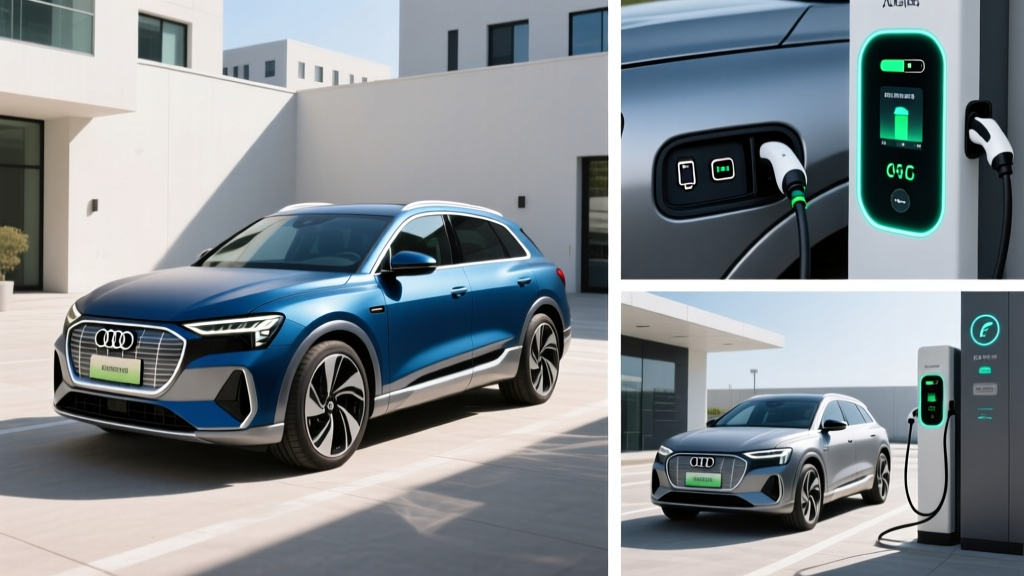
The 2026 Audi Q6 e-tron Sportback arrives as Audi's first electric vehicle built on the Premium Platform Electric (PPE) architecture co-developed with Porsche. With its sloping roofline, 100-kWh battery pack, and class-leading DC fast-charging capability, the Q6 e-tron Sportback targets luxury EV buyers who want something between the Tesla Model Y and the BMW iX — but with distinctly Audi engineering DNA. We've spent time with the specs, the charging curves, and the real-world ownership equation to tell you exactly what this EV delivers and where it falls short.
2026 Audi Q6 e-tron Sportback at a Glance
| Specification | Q6 e-tron Sportback (RWD) | SQ6 e-tron Sportback (AWD) |
|---|---|---|
| EPA Range | 321 miles | 308 miles |
| Battery (usable) | 94.9 kWh (NMC) | 94.9 kWh (NMC) |
| Horsepower | 358 hp (launch control: 382 hp) | 509 hp (launch control: 543 hp) |
| 0–60 mph | 5.8 sec | 4.2 sec |
| Drivetrain | Rear-wheel drive | Dual-motor AWD (quattro) |
| Max DC Fast Charge | 270 kW | 270 kW |
| 10–80% DC Charge | ~21 minutes | ~21 minutes |
| Level 2 Home Charging | 11.5 kW (~30 mi/hr) | 11.5 kW (~30 mi/hr) |
| MPGe (combined) | 100 MPGe | 93 MPGe |
| Efficiency | 34 kWh/100 mi | 36 kWh/100 mi |
| Base MSRP | $65,095 | $72,095 |
| Battery/Powertrain Warranty | 8 yr / 100,000 mi | 8 yr / 100,000 mi |
Real-World Range: What the EPA Number Doesn't Tell You
Real-World Expectation: ~270–290 miles on mixed highway driving at 70–75 mph; ~240–260 miles in sustained cold weather (below 30°F) without preconditioning.
The Q6 e-tron Sportback's 321-mile EPA rating for the rear-wheel-drive model is competitive with the best in the luxury midsize electric SUV segment. But as with any EV, the sticker number assumes a mix of city and highway driving at moderate temperatures with climate control at reasonable levels.
On highway-heavy routes at sustained 70–75 mph speeds, expect to see roughly 270–290 miles of usable range before needing to find a charger. The Sportback's aerodynamic silhouette — that sloping roofline isn't just for style — helps it punch slightly above its weight on the highway compared to the boxier standard Q6 e-tron SUV.
Cold weather is the great equalizer for all EVs. In sustained sub-30°F conditions, lithium-ion chemistry becomes less efficient, and cabin heating draws heavily from the pack. Without using the standard heat pump effectively (precondition the cabin while plugged in), expect a 15–25% range reduction, bringing usable range down to roughly 240–260 miles. The Q6 e-tron's standard heat pump helps mitigate this — it scavenges waste heat from the powertrain to warm the cabin more efficiently than resistive heating alone.
The 94.9 kWh of usable capacity (from a ~100 kWh gross pack) uses NMC (nickel-manganese-cobalt) chemistry. NMC offers higher energy density than LFP, which is why Audi can pack this much capacity into the Sportback's footprint. The trade-off: NMC cells are more sensitive to sustained high state-of-charge storage, so daily charging to 80% is recommended for longevity, with 100% reserved for road trips.
Charging Speed: The PPE Platform Advantage
Charging performance is where the PPE platform's 800-volt electrical architecture separates the Q6 e-tron Sportback from competitors still running 400-volt systems. Here's the full charging picture:
| Charging Method | Power | Speed / Time | Notes |
|---|---|---|---|
| Level 1 (120V household) | ~1.4 kW | ~4 miles per hour | Emergency/trickle only; ~90+ hours for full charge |
| Level 2 (240V home, 48A) | 11.5 kW | ~30 miles per hour; ~10 hours 10–100% | Requires NEMA 14-50 outlet or hardwired wallbox |
| DC Fast Charge (peak) | 270 kW | 10–80% in ~21 minutes | Requires 350 kW-capable station (Electrify America, EVgo) |
| DC Fast Charge (sustained) | ~150–170 kW avg | ~150 miles added in 10 min | Peak rate tapers above ~60% SoC |
The headline 270 kW peak charge rate is legitimate — on a compatible 350 kW DC fast charger with adequate cooling and a preconditioned battery, the Q6 e-tron Sportback will accept peak power in the early portion of the charge session. However, as with all EVs, the charge curve tapers as the battery fills. Expect sustained rates of roughly 150–170 kW through the 10–80% window, which is still excellent. The 21-minute 10–80% time is among the fastest in the luxury electric SUV segment and competitive with the Hyundai Ioniq 5 and Kia EV6, which share similar 800V architectures.
One practical note: preconditioning the battery before arriving at a DC fast charger is essential to hitting peak rates. The Q6 e-tron's navigation system will automatically begin preconditioning when you route to a compatible fast charger — use it. Arriving cold on a winter day can cut peak charge rates by 30–50%.
For home Level 2 charging, the onboard 11.5 kW AC charger means a full overnight replenishment is straightforward with a 48-amp Level 2 wallbox on a 60-amp circuit. Budget-conscious buyers should note that a Level 2 home charger installation typically costs $500–$2,000 depending on electrical panel proximity and local permitting, with the charger hardware itself running $400–$700 for a quality unit like a ChargePoint Home Flex or Emporia Vue.
Performance and Driving Dynamics
The standard Q6 e-tron Sportback's single rear motor delivers 358 horsepower (382 hp with launch control engaged) and a 5.8-second 0–60 mph time. That's brisk enough for confident highway merging and passing, and the RWD layout gives the Sportback a more balanced, slightly tail-happy character that driving enthusiasts will appreciate over typical front-biased electric crossovers.
Step up to the SQ6 e-tron Sportback and the dual-motor quattro all-wheel-drive system produces 509 hp (543 hp with launch control), dropping the 0–60 time to 4.2 seconds. The SQ6 also adds adaptive air suspension, sport-tuned damping, and a more aggressive torque split that can bias power rearward under hard acceleration.
Both models feature Audi's updated adaptive cruise control with lane centering — a Level 2 SAE driver-assistance system. This means the driver must remain attentive and keep hands on the wheel. It is not self-driving. The system performs well on divided highways but does not handle construction zones, unmapped intersections, or complex urban scenarios without immediate driver takeover.
Interior, Cargo, and Technology
The Q6 e-tron Sportback's cabin is built around Audi's new E3 1.2 electronics architecture, featuring an 11.9-inch digital instrument cluster, a 14.5-inch central OLED touchscreen, and an available 10.9-inch front passenger display. The infotainment system runs Android Automotive OS with native Google Maps navigation, Google Assistant voice control, and access to the Google Play Store for streaming and utility apps.
Cargo capacity behind the second row measures approximately 26.5 cubic feet — competitive with the BMW iX but less than the Tesla Model Y's 30.2 cubic feet. Fold the rear seats and you get roughly 54 cubic feet, sufficient for a week's luggage for four or a large furniture-store haul. The sloping Sportback roofline does eat into maximum vertical cargo height compared to the standard Q6 e-tron SUV, so if you regularly haul tall items, the SUV variant is the better pick.
Passenger space is generous for a midsize luxury SUV: front legroom measures 41.1 inches, and rear legroom comes in at 38.0 inches — adequate for adults on longer trips, though the raked roofline reduces rear headroom by about an inch compared to the upright Q6 e-tron. A panoramic glass roof is standard, and the electrochromic dimming option lets you control light and heat without a physical shade.
Notable tech features include plug-and-charge capability at Electrify America stations (no app or RFID card required — just plug in and billing starts automatically), over-the-air software updates, and Audi's Virtual Cockpit Plus with augmented-reality head-up display that overlays navigation arrows onto the road ahead.
Pricing, Trims, and Federal Tax Credit Eligibility
| Trim | Base MSRP | Est. As-Tested | §30D Credit Eligibility |
|---|---|---|---|
| Q6 e-tron Sportback Premium (RWD) | $65,095 | $68,500–$72,000 | Eligible — up to $7,500 (see caveats below) |
| Q6 e-tron Sportback Premium Plus (RWD) | $68,595 | $73,000–$78,000 | Eligible — up to $7,500 |
| SQ6 e-tron Sportback Prestige (AWD) | $72,095 | $80,000–$88,000 | Eligible — up to $7,500 |
The Q6 e-tron Sportback's MSRP falls under the IRS §30D federal tax credit cap for SUVs ($80,000), making all trims potentially eligible for up to $7,500 in federal tax credits. However, eligibility is not automatic — several conditions must be met:
- Buyer income caps: Modified adjusted gross income must not exceed $300,000 (joint filers), $225,000 (head of household), or $150,000 (single filers).
- MSRP cap: Vehicle MSRP must not exceed $80,000 for SUVs. All current Sportback trims qualify, but a fully loaded Prestige with options could approach the limit — verify the window sticker.
- Battery sourcing requirements: The $7,500 credit is split into two halves — $3,750 for critical minerals and $3,750 for battery component sourcing. Audi has confirmed the Q6 e-tron's battery meets current-year sourcing requirements for the full credit, but IRS guidance can shift. Verify at irs.gov before purchase.
- Point-of-sale transfer: As of 2024, buyers can transfer the credit to the dealer at the point of sale, effectively reducing the purchase price by $7,500 upfront rather than waiting to claim it on a tax return. This option is available for the Q6 e-tron Sportback.
With the full $7,500 credit applied, the effective starting price of the Q6 e-tron Sportback Premium drops to approximately $57,595 — a significant value proposition in the luxury electric SUV space. Always consult a tax professional to confirm your personal eligibility.
How It Compares: Q6 e-tron Sportback vs. Key Rivals
The Q6 e-tron Sportback competes in a crowded segment. Here's how the numbers stack up against its three most relevant rivals:
| Spec | Audi Q6 e-tron Sportback | BMW iX xDrive50 | Tesla Model Y LR | Genesis GV60 AWD |
|---|---|---|---|---|
| EPA Range | 321 mi | 324 mi | 330 mi | 264 mi |
| Battery (usable) | 94.9 kWh | 105.2 kWh | 75 kWh | 74 kWh |
| Max DC Charge | 270 kW | 200 kW | 250 kW | 233 kW |
| 0–60 mph | 5.8 sec | 4.6 sec | 5.0 sec | 5.3 sec |
| Base MSRP | $65,095 | $87,250 | $48,590 | $60,550 |
| Cargo (behind 2nd row) | 26.5 cu ft | 35.5 cu ft | 30.2 cu ft | 24.0 cu ft |
The Q6 e-tron Sportback occupies a clear niche: it's more affordable than the BMW iX, significantly more premium than the Tesla Model Y, and offers faster DC charging than both. The Genesis GV60 is a closer value rival but trails on range. If cargo space is paramount, the iX wins handily. If budget is the primary concern, the Model Y is hard to beat. But for buyers who want 800V-class charging, a premium badge, and a sportback silhouette without crossing $80,000, the Audi makes a compelling case.
Pros and Cons
Pros
- 270 kW DC fast charging — among the fastest in the luxury EV segment
- 321-mile EPA range provides genuine road-trip capability
- 800V architecture future-proofs charging compatibility
- Premium cabin with Android Automotive OS and AR head-up display
- Falls under $80K MSRP cap for full $7,500 federal tax credit
- Standard heat pump for improved cold-weather efficiency
- Plug-and-charge at Electrify America — no app friction
Cons
- Sportback roofline reduces rear headroom and max cargo height
- Less cargo volume than BMW iX and Tesla Model Y
- Rear visibility is compromised by the raked rear window
- No front trunk (frunk) — all storage is in the rear cargo area
- Driver-assist system is competent but not class-leading vs. Tesla Autopilot or GM Super Cruise
- Real-world highway range drops to ~270–290 miles at sustained speed
Who Should Buy the Audi Q6 e-tron Sportback?
Choose the Q6 e-tron Sportback if: You want a luxury-badged electric SUV with top-tier DC charging speed, a sportback design, and genuine 300+ mile range — and you prioritize cabin quality and charging convenience over maximum cargo volume.
Look elsewhere if: You need maximum cargo space (BMW iX or Tesla Model Y), you want the lowest possible purchase price (Model Y), or you require hands-free highway driving on mapped routes (GM Super Cruise on the Cadillac Lyriq).
Best use case: Professional commuters and road-tripping couples who charge at home overnight and want stress-free DC fast charging on longer drives. The 21-minute 10–80% charge time makes 200-mile highway legs followed by a quick stop genuinely practical.
Frequently Asked Questions
What is the real-world range of the Audi Q6 e-tron Sportback?
The EPA rates the RWD model at 321 miles and the AWD SQ6 at 308 miles. In real-world mixed highway driving at 70–75 mph, expect approximately 270–290 miles. In sustained cold weather below 30°F, plan for 240–260 miles unless you precondition the battery and cabin while plugged in.
How fast does the Q6 e-tron Sportback charge?
On a 350 kW DC fast charger, it peaks at 270 kW and charges from 10–80% in approximately 21 minutes. At home on a Level 2 (240V, 48A) wallbox, the 11.5 kW onboard charger adds roughly 30 miles of range per hour, fully replenishing the battery in about 10 hours.
Does the Q6 e-tron Sportback qualify for the federal EV tax credit?
Yes — all current trims fall under the $80,000 MSRP cap for SUVs. Buyers must meet income limits ($150K single / $300K joint) and the vehicle must meet battery-sourcing requirements, which Audi confirms it does for the current tax year. The credit can be transferred to the dealer at point of sale for an upfront price reduction. Verify current rules at irs.gov.
Is the Audi Q6 e-tron Sportback worth buying over the Tesla Model Y or BMW iX?
It depends on priorities. The Model Y wins on price and cargo space. The BMW iX wins on interior volume and straight-line performance. The Q6 e-tron Sportback wins on DC charging speed, build quality, and striking design — and it qualifies for the full federal credit, which the BMW iX (above $80K) does not. For luxury buyers who road-trip regularly and value fast charging, the Audi is a strong pick.
What is the battery warranty on the Q6 e-tron Sportback?
Audi covers the high-voltage battery and electric powertrain for 8 years or 100,000 miles, whichever comes first. The warranty guarantees the battery will retain at least 70% of its original capacity during that period — consistent with industry standards from BMW, Mercedes, and Tesla.
Does the Q6 e-tron Sportback have a frunk?
No. Unlike the Tesla Model Y or Ford Mustang Mach-E, the Q6 e-tron Sportback does not offer a front trunk. All cargo storage is in the rear compartment. This is a common trade-off on PPE-platform vehicles, where the front space is occupied by power electronics and HVAC components.