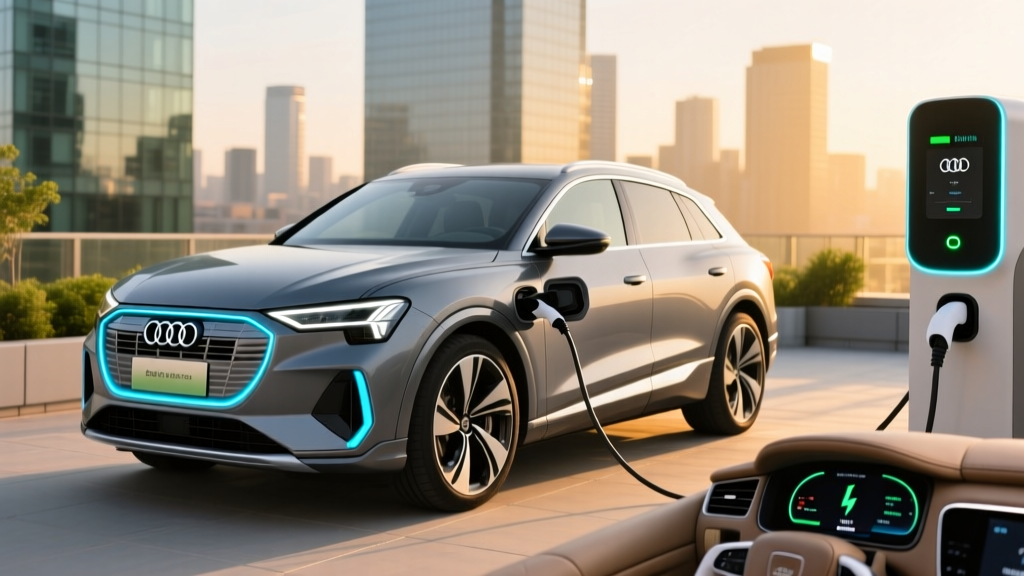
The 2026 Audi Q6 e-tron arrives as Audi's first vehicle built on the Volkswagen Group's Premium Platform Electric (PPE), co-developed with Porsche. It slots between the Q4 e-tron and the larger Q8 e-tron, targeting buyers who want a premium compact electric SUV with legitimate road-trip charging speeds and Audi's signature build quality. After spending time with the specs, the charging curves, and the real-world driving data, here's everything you need to know before putting one in your driveway.
Range, Efficiency, and Real-World Expectations
The Q6 e-tron lineup offers two main battery and drivetrain configurations for the U.S. market. The efficiency-focused Ultra trim uses a single rear motor and the full 100 kWh battery (usable capacity approximately 94.9 kWh, NMC chemistry), while the standard dual-motor AWD model shares the same pack but trades some range for traction and power.
| Trim | Drivetrain | EPA Range | MPGe (City/Hwy/Combined) | kWh/100 mi |
|---|---|---|---|---|
| Ultra (RWD) | Single-motor RWD | 321 mi | 115 / 98 / 107 | 31 |
| Premium (AWD) | Dual-motor AWD | 308 mi | 105 / 90 / 98 | 34 |
| Prestige (AWD) | Dual-motor AWD | 296 mi | 102 / 88 / 95 | 35 |
Efficiency of 31 kWh/100 mi for the Ultra is competitive with the BMW iX xDrive50 (32 kWh/100 mi) and slightly behind the Tesla Model Y Long Range (28 kWh/100 mi), per fueleconomy.gov. The Q6 e-tron is a heavier, more substantially built vehicle, and that shows in the consumption numbers.
Battery, Charging Speed, and Home Charging
This is where the PPE platform earns its keep. The Q6 e-tron uses an 800-volt electrical architecture, which allows it to accept DC fast-charge rates that most competitors simply can't match without a comparable high-voltage system.
| Charging Level | Max Rate | Speed / Time | Connector |
|---|---|---|---|
| Level 1 (120V household) | 1.4 kW | ~3–4 mi/hr | NACS (native) |
| Level 2 (240V home) | 11.5 kW | ~30 mi/hr; 0–100% in ~9.5 hrs | NACS |
| DC Fast Charge | 270 kW peak | 10–80% in ~21 min | NACS (Tesla Supercharger compatible) |
Understanding the charge curve: The 270 kW figure is a peak, not a sustained rate. In real-world DC fast charging, the Q6 e-tron holds above 200 kW from roughly 10% to 35% State of Charge (SoC), then gradually tapers through the 150–180 kW range up to about 60% SoC, and drops further above 80%. This is normal lithium-ion behavior — charging slows to protect battery longevity. The 10–80% time of approximately 21 minutes is among the fastest in the segment, matching or beating the Hyundai Ioniq 5 (18 min at 240 kW peak) and significantly outpacing the BMW iX (35 min at 150 kW peak on older hardware).
Audi adopted the North American Charging Standard (NACS) port for the 2026 model year, meaning native access to Tesla's Supercharger network — currently the largest and most reliable DC fast-charging network in the U.S. — without an adapter. This is a significant practical advantage over CCS-equipped rivals that still require adapters for Supercharger access.
For home Level 2 charging, the onboard 11.5 kW charger means a full charge from empty takes about 9.5 hours on a 48-amp, 240V circuit. Most owners will plug in overnight and wake up to a full battery. A typical home Level 2 installation (charger + electrician + permit) runs $800–$2,500 depending on whether your electrical panel needs an upgrade. Always get a quote from a licensed electrician before purchasing equipment.
Performance and Driving Dynamics
The Q6 e-tron isn't positioned as a performance SUV — that's the SQ6 e-tron's job — but it's no slouch. The single-motor Ultra puts down 281 horsepower and 339 lb-ft of torque to the rear wheels, achieving a 0–60 mph time of 6.5 seconds. The dual-motor AWD models bump output to 422 hp and 402 lb-ft, dropping the 0–60 to 4.9 seconds.
On the road, the Q6 e-tron rides on a five-link front suspension and a multi-link rear setup, with optional adaptive air suspension available on Prestige trims. The steering is precise if somewhat light on feel, and the regenerative braking system offers three levels of recuperation selectable via steering-wheel paddles. Unlike some competitors, Audi does not offer a true one-pedal driving mode that brings the car to a complete stop — you'll still need the brake pedal at low speeds. This is a deliberate calibration choice that some drivers prefer for its natural feel, but it's worth noting if you're accustomed to one-pedal driving in a Tesla or Nissan Leaf.
The low center of gravity from the floor-mounted battery pack contributes to composed handling with minimal body roll, though at roughly 5,100 lbs for the AWD model, you feel the mass during aggressive direction changes. This is a comfortable, refined highway cruiser first and foremost.
Interior, Cargo, and Technology
Audi redesigned the interior from scratch for the PPE platform, and it shows. The centerpiece is an 11.9-inch digital instrument cluster paired with a 14.5-inch central touchscreen running Audi's latest MIB4 infotainment software. An available 10.9-inch front-passenger display lets your co-pilot stream media or view navigation without distracting the driver. The optional augmented-reality head-up display overlays navigation arrows and speed information onto the windshield in your line of sight — genuinely useful on unfamiliar highways.
Cargo space measures 28.7 cubic feet behind the second row and 60.4 cubic feet with the rear seats folded. That's adequate for the segment but trails the Tesla Model Y (30.2 / 76.2 cu ft) and the Genesis Electrified GV70 (28.7 / 56.9 cu ft). The Q6 e-tron does include a modest front trunk (frunk) of approximately 2.3 cubic feet — enough for charging cables and a small bag but not a full suitcase.
Rear-seat legroom comes in at 36.1 inches, which is comfortable for adults up to about 6'2" but tighter than the BMW iX (38.2 inches). If you regularly carry tall rear-seat passengers, this is worth a test sit.
Standard driver-assistance features include adaptive cruise control with stop-and-go, lane-centering assist, automated emergency braking, and blind-spot monitoring. Audi's Adaptive Cruise Assist with Lane Guidance operates as an SAE Level 2 system — it manages speed and steering on highways, but the driver must remain fully attentive with hands on the wheel at all times. This is not autonomous driving.
Pricing, Trims, and Federal Tax Credit
The Q6 e-tron is positioned as a premium offering, and the pricing reflects that. Here's how the lineup breaks down for the 2026 model year:
| Trim | MSRP (incl. destination) | §30D MSRP Cap | Estimated Credit |
|---|---|---|---|
| Ultra Premium (RWD) | $65,095 | $80,000 (SUVs) | Up to $7,500* |
| Premium Plus (AWD) | $69,095 | $80,000 (SUVs) | Up to $7,500* |
| Prestige (AWD) | $74,095 | $80,000 (SUVs) | Up to $7,500* |
*Federal tax credit eligibility under IRS §30D depends on multiple factors that change regularly:
- MSRP cap: All Q6 e-tron trims fall under the $80,000 SUV cap ✓
- Buyer income limits: AGI must not exceed $150,000 (single), $225,000 (head of household), or $300,000 (joint filers)
- Battery sourcing: Critical minerals and battery component requirements phase in annually. Audi has not published full supply-chain compliance details — confirm with your dealer at time of purchase
- Point-of-sale transfer: The credit can be transferred to the dealer at purchase for an immediate price reduction, or claimed on your tax return
- Final assembly: Must be in North America — verify VIN eligibility on fueleconomy.gov
Consult a tax professional before relying on credit eligibility. Rules are subject to change.
How It Compares: Q6 e-tron vs. Key Rivals
The Q6 e-tron competes in a crowded premium electric SUV segment. Here's how the numbers stack up against its most direct competitors:
| Spec | Audi Q6 e-tron (Ultra) | BMW iX xDrive50 | Tesla Model Y LR | Genesis Electrified GV70 |
|---|---|---|---|---|
| EPA Range | 321 mi | 324 mi | 330 mi | 236 mi |
| Battery (usable) | 94.9 kWh NMC | 105.2 kWh NMC | ~75 kWh NMC | 72.6 kWh NMC |
| Peak DC Charge | 270 kW | 200 kW | 250 kW | 240 kW |
| 10–80% DCFC | ~21 min | ~35 min | ~27 min | ~18 min |
| 0–60 mph | 6.5 sec (RWD) | 4.4 sec (AWD) | 5.0 sec (AWD) | 4.5 sec (AWD) |
| Starting MSRP | $65,095 | $87,250 | $44,990 | $67,350 |
| Cargo (rear seats up) | 28.7 cu ft | 35.5 cu ft | 30.2 cu ft | 28.7 cu ft |
- You prioritize DC fast-charge speed for road trips (270 kW is best-in-class)
- You want native NACS/Supercharger access without adapters
- You value Audi's interior materials and build quality
- You want a premium badge under $80K that may qualify for the full tax credit
- Cargo space is a top priority (BMW iX and Model Y offer more)
- You need maximum rear-seat legroom for tall passengers
- Budget is tight — the Model Y delivers more range per dollar
- You prefer one-pedal driving with full stop capability
Warranty, Ownership Costs, and Longevity
Audi provides a 4-year/50,000-mile limited vehicle warranty and an 8-year/100,000-mile high-voltage battery warranty. The battery warranty guarantees that the pack will retain at least 70% of its original capacity during the coverage period — a standard threshold shared with BMW, Tesla, and most legacy automakers. If the battery drops below 70% State of Health (SoH) within 8 years or 100,000 miles, Audi will repair or replace it at no cost.
The NMC chemistry in the Q6 e-tron offers higher energy density than LFP (lithium iron phosphate) packs, giving more range per kilogram, but it's generally more sensitive to sustained high-SoC storage. Best practice for long-term NMC health: charge to 80% for daily use and reserve 100% charges for road trips. The vehicle's battery management system includes a buffer (the difference between gross and usable capacity) that protects against deep degradation.
Insurance costs for the Q6 e-tron run approximately 15–25% higher than an equivalently priced gas SUV, consistent with the EV segment average. Maintenance costs are significantly lower — no oil changes, no transmission fluid, and regenerative braking extends brake pad life substantially.
Pros and Cons
- 270 kW peak DC charging — among the fastest in the segment
- Native NACS port for Tesla Supercharger access
- 321-mile EPA range (Ultra) is genuinely road-trip capable
- Excellent interior materials and new MIB4 infotainment
- Refined ride quality with optional air suspension
- Heat pump standard on all trims
- All trims under $80K MSRP cap for federal tax credit
- Starting price near $65K is steep for the segment
- Rear-seat legroom (36.1 in) trails the BMW iX and Tesla Model Y
- Cargo space (28.7 cu ft) is average, not class-leading
- No true one-pedal driving mode (regen doesn't bring car to full stop)
- Frunk is tiny at 2.3 cu ft
- Full tax credit depends on evolving battery-sourcing rules
Who Should Buy the Audi Q6 e-tron?
The Q6 e-tron is best suited for premium-SUV shoppers who plan to road-trip regularly and want the fastest possible DC charging without stepping up to a Porsche Taycan or Lucid Air. The 270 kW charge rate and NACS compatibility mean you'll spend less time at chargers and have access to the broadest fast-charging network available. It's an excellent daily commuter thanks to the 321-mile range, and the premium interior makes it a comfortable place to spend time.
It's less ideal for families who regularly haul tall teenagers or large cargo loads — the Model Y or BMW iX serve those needs better. And if your budget is under $50,000, the Tesla Model Y Long Range or the Hyundai Ioniq 5 deliver compelling range and charging at significantly lower prices.
Frequently Asked Questions
What is the real-world range of the Audi Q6 e-tron?
The Ultra RWD trim carries a 321-mile EPA rating. In real-world highway driving at 70–75 mph, expect 265–285 miles. In cold weather below 30°F, plan for 240–270 miles. AWD trims lose approximately 10–15 miles in each scenario.
How fast does the Q6 e-tron charge?
On a DC fast charger, the Q6 e-tron peaks at 270 kW and charges from 10–80% in approximately 21 minutes. On a Level 2 home charger (11.5 kW), it adds about 30 miles per hour of charging, with a full 0–100% charge taking roughly 9.5 hours.
Does the Q6 e-tron qualify for the $7,500 federal EV tax credit?
All trims fall under the $80,000 MSRP cap for SUVs. Eligibility depends on your income (AGI limits apply), battery sourcing compliance, and North American final assembly. Verify your specific eligibility on fueleconomy.gov and consult a tax professional.
Is the Audi Q6 e-tron worth buying over a Tesla Model Y or BMW iX?
If you prioritize DC charging speed, native Supercharger access, and Audi's interior quality — and your budget allows $65K+ — yes. If cargo space and rear-seat room are more important, the BMW iX wins. If value is the priority, the Model Y offers more range for $20,000 less.
What battery chemistry does the Q6 e-tron use?
The Q6 e-tron uses NMC (nickel manganese cobalt) chemistry with a usable capacity of approximately 94.9 kWh. NMC offers higher energy density than LFP but benefits from daily charging to 80% rather than 100% for long-term health.
Does the Q6 e-tron have a frunk?
Yes, but it's small — approximately 2.3 cubic feet, enough for charging cables and a small bag. Don't expect to fit a full-size suitcase up front.