The 2026 Audi Q6 e-tron arrives as the brand's first vehicle built on the Premium Platform Electric (PPE) architecture co-developed with Porsche. Positioned between the smaller Q4 e-tron and the flagship Q8 e-tron, this mid-size luxury electric SUV targets buyers who want German build quality, rapid 800-volt charging, and a usable real-world range — without stepping into six-figure territory. After spending time with the specs, EPA data, and real-world driving reports, here is everything you need to know before configuring one.
Quick Verdict: Who Should Buy the Audi Q6 e-tron?
The Q6 e-tron is best suited for luxury SUV buyers who prioritize charging speed and highway refinement over maximum cargo space or third-row seating. If your routine includes frequent DC fast-charging road trips and you value a quiet, well-damped ride with a modern interior, the Q6 e-tron earns a spot on your shortlist. It is less ideal for buyers needing three rows (look at the Rivian R1S or Kia EV9) or those chasing the lowest cost per mile (the Hyundai Ioniq 5 remains a value benchmark).
Choose the Q6 e-tron if: You want 800V-class charging in a luxury badge, need 300+ miles of range, and prefer a refined highway cruiser.
Look elsewhere if: You need a third row, want a sub-$50,000 entry price, or prioritize sporty handling over comfort.
Range, Battery, and Real-World Efficiency
The 2026 Q6 e-tron is powered by a 100 kWh gross battery pack (approximately 94.9 kWh usable) using NMC (nickel manganese cobalt) lithium-ion chemistry. Audi does not currently offer an LFP variant in this model, which is typical for the premium European segment where energy density and cold-weather performance take priority over the lower cost of LFP cells.
| Specification | Q6 e-tron (RWD) | Q6 e-tron quattro (AWD) | SQ6 e-tron (Performance) |
|---|---|---|---|
| EPA Range | 321 miles | 308 miles | 284 miles |
| Battery (usable) | 94.9 kWh NMC | 94.9 kWh NMC | 94.9 kWh NMC |
| MPGe (combined) | 110 MPGe | 104 MPGe | 95 MPGe |
| Efficiency | 30 kWh/100mi | 32 kWh/100mi | 35 kWh/100mi |
| Drivetrain | Rear-wheel drive | Dual-motor AWD | Dual-motor AWD |
| Horsepower | 358 hp (launch: 456 hp) | 416 hp (launch: 456 hp) | 509 hp |
| 0–60 mph | 5.2 sec | 4.7 sec | 4.3 sec |
EPA vs. Real-World Range: The RWD Q6 e-tron carries a 321-mile EPA estimate (source: fueleconomy.gov). In real-world mixed driving at 70–75 mph highway speeds, expect approximately 270–290 miles before needing a charge. In freezing temperatures (below 30°F), range can drop to 230–260 miles due to cabin heating demand and reduced battery efficiency. City driving with regenerative braking can push closer to or slightly above the EPA figure. The quattro AWD variant's 308-mile EPA rating translates to roughly 255–280 miles in mixed real-world use.
The Q6 e-tron's efficiency of 30 kWh/100 miles (RWD) places it in the middle of the luxury EV SUV pack — behind the more aerodynamic Tesla Model Y but competitive with the BMW iX and Mercedes EQE SUV. The 800-volt architecture's primary benefit is not efficiency but charging speed, which we cover next.
Charging: DC Fast Charge and Home Level 2
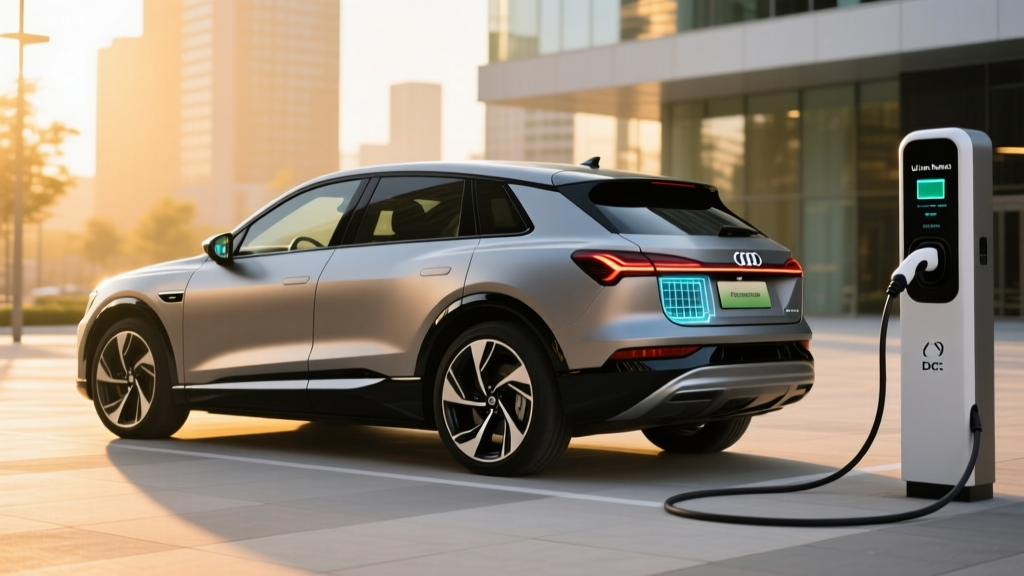
This is where the PPE platform's 800-volt architecture pays dividends. The Q6 e-tron accepts up to 270 kW peak DC fast charging, making it one of the fastest-charging luxury SUVs available. Audi quotes a 10–80% charge time of approximately 21 minutes under ideal conditions at a 350 kW charger.
| Charging Level | Max Power | Speed / Time | Connector |
|---|---|---|---|
| Level 1 (120V) | 1.4 kW | ~4 mi/hr added | NACS (J3400) |
| Level 2 (240V, 48A) | 11.5 kW | ~32 mi/hr added | NACS (J3400) |
| DC Fast Charge | 270 kW peak | 10–80% in ~21 min | NACS (J3400) |
Charging curve reality check: The 270 kW figure is a peak, not a sustained rate. In practice, the Q6 e-tron sustains roughly 200–240 kW through the 10–50% SoC window before tapering to approximately 150 kW by 60% and further declining above 80%. This taper is normal and protects battery longevity. A typical 10–80% session at a functioning Electrify America or Tesla Supercharger (with NACS adapter) will take 21–25 minutes. At chargers capped at 150 kW, expect 30–35 minutes for the same session.
For home charging, the onboard charger accepts up to 11.5 kW on Level 2, meaning a full 0–100% charge takes roughly 9–10 hours on a 48-amp hardwired home station. A standard 40-amp circuit (common in older installations) will deliver about 9.6 kW, extending a full charge to roughly 11 hours. Most owners charging overnight will wake up with a full battery regardless.
Connector note: The 2026 Q6 e-tron comes equipped with the NACS (J3400) charge port natively for the US market, granting direct access to Tesla's Supercharger network without an adapter. CCS1 adapters are available for legacy Electrify America and other CCS-only stations.
Interior, Cargo Space, and Technology
The Q6 e-tron's cabin marks a generational leap over the outgoing Q8 e-tron in terms of screen real estate and software architecture. The dashboard features Audi's new E3 1.2 electronics platform with an 11.9-inch digital instrument cluster, a 14.5-inch central OLED touchscreen, and an available 10.9-inch front passenger display. An augmented-reality head-up display projects navigation prompts onto the windshield with impressive clarity.
Cargo and passenger dimensions:
- Rear cargo (behind 2nd row): 28.7 cu ft
- Cargo (2nd row folded): 60.4 cu ft
- Frunk (front trunk): 2.3 cu ft (enough for a charging cable bag)
- Rear legroom: 38.0 inches
- Front legroom: 41.1 inches
- Seating: 5 passengers (no third-row option)
The 28.7 cu ft rear cargo area trails the Hyundai Ioniq 5 (27.2 cu ft but with a more usable shape) and significantly trails the Genesis Electrified GV70's 28.7 cu ft — though the Audi's boxier shape makes stacking luggage easier. The frunk is small by modern EV standards; Tesla's Model Y offers a far larger front trunk.
Driver assistance: The Q6 e-tron comes with Audi's Adaptive Cruise Assist (lane centering + stop-and-go cruise), which operates at SAE Level 2 — meaning the driver must keep hands on or near the wheel and remain fully engaged. It is not a self-driving system. An available Automatic Park Assist handles parallel and perpendicular parking without driver steering input, though speed remains low. Audi has not announced a hands-free highway driving system comparable to GM's Super Cruise or Ford's BlueCruise for this model year.
Pricing, Trims, and Federal Tax Credit Eligibility
| Trim | MSRP (incl. destination) | Est. After §30D Credit* |
|---|---|---|
| Q6 e-tron Premium (RWD) | $63,995 | $56,495 |
| Q6 e-tron Premium Plus (quattro) | $68,795 | $61,295 |
| Q6 e-tron Prestige (quattro) | $73,495 | $65,995 |
| SQ6 e-tron Premium Plus | $74,195 | $66,695 |
*Tax credit estimates assume full eligibility under IRS §30D rules. Actual credit depends on battery critical-mineral sourcing, buyer income limits ($150K single / $300K joint AGI), and MSRP caps ($80,000 for SUVs). Consult a tax professional.
All Q6 e-tron trims fall under the $80,000 MSRP cap for SUVs, which is the threshold for §30D eligibility. However, the full $7,500 credit is not guaranteed. Under current rules, the credit is split into two $3,750 halves: one tied to critical-mineral sourcing (must be extracted or processed in the US or a free-trade-agreement country) and one tied to battery-component manufacturing (must be manufactured or assembled in North America). Audi's battery cells are sourced from suppliers including CATL and LG Energy Solution, and the PPE battery pack is assembled in multiple global locations. Buyers should verify current-year sourcing compliance on the IRS qualified vehicle list before assuming the full credit. The point-of-sale transfer option allows eligible buyers to apply the credit as an immediate discount at the dealership.
Warranty and Battery Longevity
Audi backs the Q6 e-tron with the following coverage:
- Battery warranty: 8 years / 100,000 miles (retains at least 70% of original capacity)
- Powertrain warranty: 8 years / 100,000 miles
- Bumper-to-bumper: 4 years / 50,000 miles
- Complimentary maintenance: 2 years / 20,000 miles
The 70% capacity-retention threshold at 8 years/100K miles is industry-standard and matches BMW, Mercedes, and Hyundai/Kia. NMC chemistry in the Q6 e-tron typically shows 5–8% degradation over the first 50,000 miles based on fleet data from similar PPE/NMC packs, with degradation slowing significantly after the initial formation period. To maximize longevity, avoid routinely charging to 100% on DC fast chargers; setting a daily charge limit of 80% on the vehicle's built-in scheduler is the single most effective habit.
Pros, Cons, and How It Compares
Pros
- 270 kW peak DC charging — among the fastest in the luxury SUV segment
- Refined ride quality and excellent highway noise isolation
- Native NACS port for direct Supercharger access
- Modern E3 1.2 infotainment with AR head-up display
- 321-mile EPA range (RWD) is competitive for the class
- All trims under the $80K §30D MSRP cap
Cons
- Small frunk (2.3 cu ft) wastes front-trunk potential
- No hands-free highway driving system available
- Rear cargo space (28.7 cu ft) trails key rivals
- Base price above $63K — expensive before options
- Full §30D credit not guaranteed due to battery sourcing rules
- Third-row seating not available in any configuration
Key competitor comparison: Against the BMW iX xDrive50 ($70,900, 307 mi EPA, 200 kW peak charging), the Q6 e-tron offers faster charging and a lower starting price but slightly less rear-seat room and a less driver-focused chassis. Against the Genesis Electrified GV70 ($67,450, 236 mi EPA, 240 kW peak), the Audi delivers substantially more range and a more modern interior, though the Genesis offers a more luxurious material palette and a smoother ride at lower speeds. The Tesla Model Y Long Range ($48,990, 320 mi EPA, 250 kW peak) remains the efficiency and value leader but cannot match the Audi's cabin quality or ride refinement.
Ownership Costs and Who This EV Suits Best
Charging the Q6 e-tron at home on the US average electricity rate of $0.17/kWh costs approximately $16.14 for 300 miles of range (at 30 kWh/100mi). The equivalent gasoline SUV at 24 mpg combined and $3.50/gallon would cost $43.75 for the same distance — a per-mile savings of roughly 60% with home charging. DC fast charging at $0.40/kWh raises the cost to about $36 for 300 miles, still below gasoline but narrowing the gap.
Insurance premiums for the Q6 e-tron are projected at $2,800–$3,400 annually depending on state, driving record, and coverage level — roughly 15–20% above an equivalently priced gasoline Audi Q5 due to higher repair costs for EV-specific components.
Best use cases:
- Daily commuter: Excellent — 300+ mile range means charging 2–3 times per week at most on Level 2.
- Family hauler: Good for two-child families; the lack of a third row limits larger households.
- Road-trip vehicle: Very strong — 270 kW charging and Supercharger access make long-distance travel efficient.
- Towing: Rated for 4,400 lbs (quattro); adequate for small boat trailers or light campers but not heavy-duty towing.
Frequently Asked Questions
What is the real-world range of the Audi Q6 e-tron?
The EPA rates the RWD Q6 e-tron at 321 miles and the quattro AWD at 308 miles. In real-world highway driving at 70–75 mph, expect 270–290 miles (RWD) or 255–280 miles (quattro). Cold weather below freezing can reduce range by 15–25%, bringing the RWD down to approximately 230–260 miles.
How fast does the Q6 e-tron charge at home and on DC fast chargers?
On a DC fast charger, the Q6 e-tron peaks at 270 kW and charges from 10–80% in approximately 21 minutes under ideal conditions. At home on a 48-amp Level 2 station (11.5 kW), a full charge takes about 9–10 hours, adding roughly 32 miles of range per hour.
How much does the Q6 e-tron cost after the federal tax credit?
The base Q6 e-tron Premium RWD starts at $63,995. If you qualify for the full $7,500 §30D credit, the effective price drops to approximately $56,495. Eligibility depends on your income (under $150K single / $300K joint), the vehicle's battery sourcing compliance, and the MSRP cap ($80K for SUVs). Verify current-year eligibility on the IRS qualified vehicle list before purchasing.
Does the Audi Q6 e-tron qualify for the federal EV tax credit?
The Q6 e-tron is on the IRS qualified vehicles list, but the amount — $3,750 or the full $7,500 — depends on whether the battery meets both critical-mineral and battery-component sourcing requirements for the current tax year. Because these rules tighten annually, confirm the exact credit amount for your model year at irs.gov before finalizing your purchase.
Is the Q6 e-tron worth buying over the BMW iX or Tesla Model Y?
If you value charging speed, a native NACS port, and Audi's interior design language, the Q6 e-tron is a strong choice. The BMW iX offers a more engaging drive and slightly more space; the Tesla Model Y offers better efficiency and a significantly lower price. For luxury buyers who road-trip frequently and want the fastest possible DC charging sessions, the Q6 e-tron's 270 kW capability is a genuine differentiator.
What is the battery warranty on the Q6 e-tron?
Audi covers the high-voltage battery for 8 years or 100,000 miles, guaranteeing at least 70% of original capacity retention. The powertrain carries the same 8-year/100,000-mile coverage.