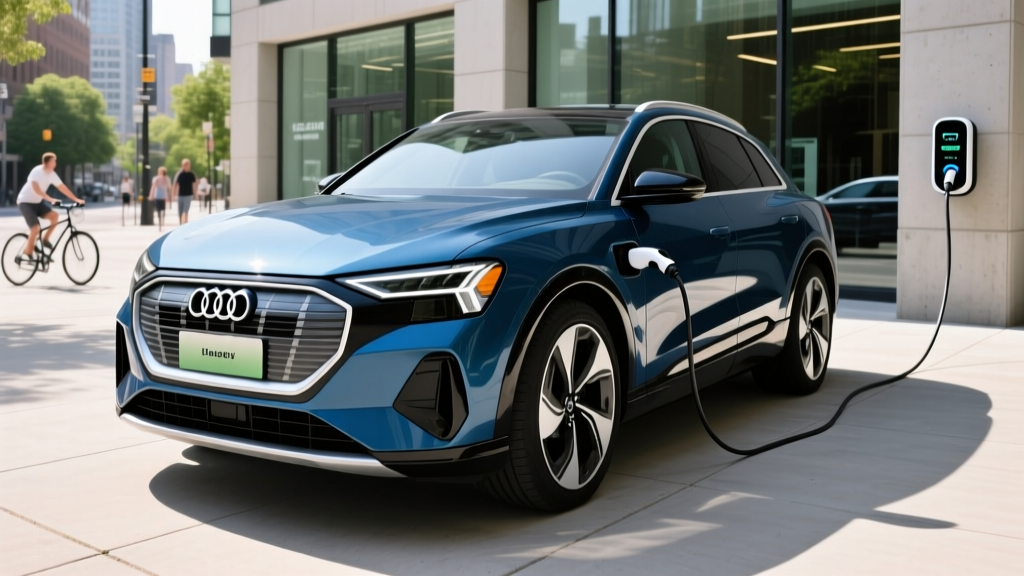
Quick Verdict: Is the 2026 Audi Q6 e-tron Worth It?
The 2026 Audi Q6 e-tron is Audi's first vehicle on the dedicated PPE (Premium Platform Electric) architecture co-developed with Porsche. It delivers an EPA-estimated 321 miles of range (RWD, 100 kWh battery), peaks at 270 kW DC fast charging (10–80% in roughly 21 minutes), and starts at $63,800 MSRP. It qualifies for the $7,500 federal tax credit under current §30D rules, effectively dropping the base price to around $56,300. It's a strong luxury midsize EV SUV, but real-world highway range drops to ~270 miles, cold weather cuts that further, and home charging installation adds $1,200–$3,000+ to ownership costs.
Range, Battery & Efficiency: What the EPA Number Doesn't Tell You
The Q6 e-tron comes in two battery configurations for 2026. The standard Q6 e-tron uses a 100 kWh usable battery pack (NMC chemistry), while the SQ6 e-tron performance variant uses the same pack with higher output tuning. Here are the official EPA figures:
| Trim | Drivetrain | Battery (usable kWh) | EPA Range | Combined MPGe | 0–60 mph | HP |
|---|---|---|---|---|---|---|
| Q6 e-tron Premium | RWD | 100 kWh (NMC) | 321 mi | 103 MPGe | 6.2 sec | 335 |
| Q6 e-tron Premium Plus | quattro AWD | 100 kWh (NMC) | 308 mi | 96 MPGe | 5.0 sec | 456 |
| SQ6 e-tron | quattro AWD | 100 kWh (NMC) | 288 mi | 89 MPGe | 4.3 sec | 509 |
Real-World Range Reality Check
EPA 321 mi (RWD) — Expect ~270–290 miles at sustained highway speeds (70–75 mph) in mild weather. In cold weather (below 32°F), plan for ~230–260 miles due to battery heating demands and reduced regenerative braking efficiency. The quattro AWD trims lose 13–33 miles of EPA range but gain traction and performance. The Q6 e-tron includes a heat pump as standard equipment, which mitigates cold-weather range loss compared to resistive heating systems.
Per fueleconomy.gov, the RWD Q6 e-tron achieves 103 MPGe combined, which translates to roughly 33 kWh per 100 miles in mixed driving. That's competitive with the BMW iX xDrive50 (87 MPGe combined) and slightly below the Tesla Model X (102 MPGe combined), but the Audi's 800-volt architecture gives it a decisive charging-speed advantage over most rivals.
Charging Speed: 800-Volt Architecture in Practice
The Q6 e-tron's 800-volt electrical architecture is the single biggest ownership differentiator. It enables DC fast charging at up to 270 kW, meaning you can add roughly 160 miles of range in 10 minutes under ideal conditions at a capable charger (350 kW Electrify America or compatible station).
| Charging Level | Power | Connector | Time (10–80%) | Miles Added/Hour |
|---|---|---|---|---|
| Level 1 (120V household) | 1.4 kW | NACS (2026 models) | ~72 hours | ~4 mi/hr |
| Level 2 (240V home) | 11.5 kW | NACS (2026 models) | ~9.5 hours | ~33 mi/hr |
| DC Fast Charge | Up to 270 kW peak | NACS (2026 models) | ~21 min (10–80%) | ~450+ mi/hr (peak) |
Charging curve reality: The 270 kW figure is a peak, not a sustained rate. In practice, the Q6 e-tron holds above 200 kW from roughly 10% to 40% state of charge, then tapers progressively. The 10–80% time of ~21 minutes assumes a preconditioned battery and a charger capable of delivering 350 kW. At a 150 kW station, expect 10–80% in roughly 35–40 minutes.
For 2026, Audi has adopted the NACS (Tesla-style) connector on the Q6 e-tron, granting native access to Tesla Supercharger stations (17,000+ locations) without an adapter. This is a significant advantage over CCS-only vehicles for road-trip charging reliability.
Ownership Costs: Q6 e-tron vs. Gas Luxury SUV
The real question for buyers isn't just the sticker price — it's the five-year cost of ownership. We compared the Q6 e-tron Premium Plus quattro ($68,400 MSRP) against a comparable Audi Q5 45 TFSI Premium Plus ($53,600 MSRP) to show where the EV saves and where it costs more.
| Cost Category | Q6 e-tron Premium Plus (EV) | Q5 45 TFSI Premium Plus (Gas) |
|---|---|---|
| MSRP | $68,400 | $53,600 |
| Federal Tax Credit (§30D) | −$7,500 | $0 |
| Effective Purchase Price | $60,900 | $53,600 |
| Fuel/Energy (5 yrs, 12k mi/yr) | $3,600 (home L2 @ $0.15/kWh) | $10,500 (@ $3.50/gal, 25 MPG) |
| Maintenance (5 yrs) | ~$1,500 | ~$3,800 |
| Insurance (5 yrs, avg) | ~$12,500 | ~$10,200 |
| Home Charger Install | $1,200–$3,000 | $0 |
| 5-Year Total Cost | ~$79,700–$81,500 | ~$78,100 |
Key takeaway: With the §30D credit applied, the Q6 e-tron's five-year cost is roughly comparable to the gas Q5. The EV pulls ahead in years 6–10 as fuel and maintenance savings compound, while the gas vehicle faces increasing repair costs. However, if you cannot install a home charger and must rely entirely on public DC fast charging ($0.35–$0.50/kWh), your energy costs nearly double to ~$6,000–$7,200 over five years — erasing much of the savings advantage.
Insurance note: EV insurance premiums run 15–25% higher than comparable gas vehicles due to battery replacement costs and specialized repair requirements. Get a quote before purchasing — the $2,300 five-year premium gap is real.
Federal Tax Credit Eligibility: §30D Rules for 2026
The Q6 e-tron currently qualifies for the full $7,500 federal tax credit under IRS §30D, but eligibility depends on your specific situation. Per irs.gov, you must meet all of the following:
- Income caps: Modified AGI ≤ $150,000 (single), ≤ $225,000 (head of household), ≤ $300,000 (married filing jointly)
- MSRP cap: Vehicle MSRP must not exceed $80,000 for SUVs (the Q6 e-tron qualifies — base MSRP is $63,800; fully loaded Premium Plus and Prestige trims must stay under $80,000)
- Battery sourcing: Critical minerals and battery components must meet phased-in percentages (2026: ≥80% critical minerals from US/FTA partners, ≥100% battery components manufactured or assembled in North America)
- Point-of-sale transfer: You can transfer the credit to the dealer at purchase, reducing your out-of-pocket cost immediately rather than waiting for tax filing
- One credit per VIN: The credit is tied to the vehicle, not the buyer — a used Q6 e-tron does not qualify for the new-vehicle credit
Caveat: Battery sourcing requirements tighten annually. Verify current eligibility on fueleconomy.gov before purchasing, as supply chain changes can affect qualification mid-year. Consult a tax professional for your specific situation.
Real-World Ownership: What First-Time EV Buyers Need to Know
Common Q6 e-tron Misconceptions
| Myth | Fact |
|---|---|
| "321 miles means I'll always get 321 miles" | Highway driving at 75 mph yields ~270–290 mi; cold weather drops it to ~230–260 mi. Plan trips using 80% of EPA range as your buffer. |
| "270 kW charging means it charges at that speed the whole time" | Peak rate applies only from ~10–40% SoC. Above 80%, charging slows dramatically to protect battery health. The 10–80% time (~21 min) is the useful metric. |
| "I don't need a home charger" | Public DC charging costs 2–3× more than home Level 2 and adds wear from repeated high-rate charging. Home charging is essential for cost savings and battery longevity. |
| "The battery will need replacing in 5 years" | Audi warrants the battery for 8 years / 100,000 miles (retaining ≥70% capacity). NMC degradation data shows typical loss of 8–12% over 100,000 miles under normal use. |
| "It qualifies for the tax credit no matter what" | You must meet income caps, and the vehicle's MSRP must stay under $80,000. High-option trims with packages could push MSRP above the cap. |
Home Charging Setup
The Q6 e-tron's onboard charger accepts up to 11.5 kW on Level 2 (48 amps). To maximize this, you need a 60-amp dedicated circuit with a hardwired Level 2 charger or a NEMA 14-50 outlet on a 50-amp breaker (which delivers ~9.6 kW). Installation costs vary:
| Item | Cost Range |
|---|---|
| Level 2 charger (ChargePoint, Wallbox, Tesla Universal) | $400–$750 |
| Electrician labor (standard install, panel nearby) | $500–$1,500 |
| Electrical panel upgrade (if 100A → 200A needed) | $1,500–$3,500 |
| Permit & inspection | $100–$300 |
| Total (typical, no panel upgrade) | $1,000–$2,550 |
Always hire a licensed electrician and pull a permit — unpermitted electrical work can void homeowner's insurance and create fire risk.
Driving Patterns That Favor the Q6 e-tron
The Q6 e-tron excels for owners who:
- Commute 30–80 miles round-trip and charge overnight at home
- Have garage or carport access for Level 2 installation
- Take road trips along corridors with reliable DC fast charging (Interstate 5, I-95, I-80 with Electrify America/Supercharger coverage)
- Value quiet, smooth acceleration and low center-of-gravity handling
It's less ideal if you:
- Rely exclusively on street parking with no charging access
- Regularly tow heavy loads (rated for 4,400 lbs, but towing cuts range by 30–50%)
- Frequently drive in extreme cold (below 0°F) on long trips without reliable fast-charger access
Decision Framework: Should You Buy the Q6 e-tron?
Choose the Q6 e-tron if:
- You want a luxury EV SUV with genuine road-trip capability (321 mi range + 270 kW charging + NACS Supercharger access)
- You qualify for the §30D credit (income under caps, MSRP under $80K)
- You can install a Level 2 home charger
- You value Audi's build quality, interior materials, and virtual cockpit technology
- Your daily driving is under 100 miles and you want to virtually eliminate fuel stops
Consider the Audi Q5 (gas) or Q5 TFSI e (PHEV) instead if:
- You cannot install a home charger and live in an area with sparse public charging
- You regularly tow over 3,000 lbs
- Your budget is firm at $50,000–$55,000 and you don't qualify for the tax credit
- You frequently drive in remote areas far from DC fast chargers
Consider the Tesla Model Y or BMW iX instead if:
- You want the lowest price per mile of range (Model Y Long Range: ~$50,000, 320 mi EPA)
- You want a more spacious rear seat and cargo area (iX offers 35.5 cu ft cargo vs. Q6 e-tron's 28.7 cu ft)
Frequently Asked Questions
Does the 2026 Audi Q6 e-tron use NACS or CCS?
For 2026, the Q6 e-tron uses the NACS connector natively, providing direct access to Tesla Supercharger stations without an adapter. This replaces the CCS connector used on earlier Audi EVs like the e-tron GT.
How long will the Q6 e-tron battery last?
Audi warrants the high-voltage battery for 8 years or 100,000 miles, guaranteeing at least 70% capacity retention. Based on NMC chemistry degradation data from similar platforms (Porsche Taycan, Hyundai Ioniq 5), expect 8–12% capacity loss over 100,000 miles under normal use. Many EV batteries exceed 150,000 miles before falling below 80% capacity. Battery replacement, if needed out of warranty, currently costs $15,000–$22,000 for a pack this size.
Can the Q6 e-tron charge at Tesla Superchargers?
Yes. With the native NACS port on 2026 models, the Q6 e-tron can charge at any Tesla Supercharger V3 (150 kW) or V4 (up to 250 kW) station. You'll use the Tesla app or in-car navigation to initiate sessions. Charging speed will be limited by the Supercharger's output, not the Q6's 270 kW capability.
Is the Q6 e-tron eligible for the $7,500 tax credit in 2026?
Yes, the Q6 e-tron currently qualifies for the full $7,500 §30D credit, provided you meet the income caps ($150K single / $300K joint) and the vehicle's MSRP stays under $80,000. The credit can be transferred to the dealer at point of sale for an immediate price reduction. Verify eligibility at purchase time on fueleconomy.gov, as battery sourcing rules evolve.
What is the Q6 e-tron's cargo space?
The Q6 e-tron offers 28.7 cubic feet of cargo space behind the rear seats and 60.4 cubic feet with the rear seats folded. It does not have a front trunk (frunk) — the space under the hood houses electronics and the HVAC system. This is competitive with the BMW iX but less than the Tesla Model Y (30.2 / 72.1 cu ft).
How does the Q6 e-tron compare to the Porsche Macan EV?
Both use the PPE platform, but the Macan EV is tuned for sportier handling with a lower ride height and less cargo space. The Macan 4 EV starts at $78,800 (above the §30D MSRP cap for cars, though it may qualify under SUV rules — verify at purchase) with 308 miles EPA range and 270 kW charging. The Q6 e-tron offers more interior space, a lower starting price, and confirmed tax credit eligibility.