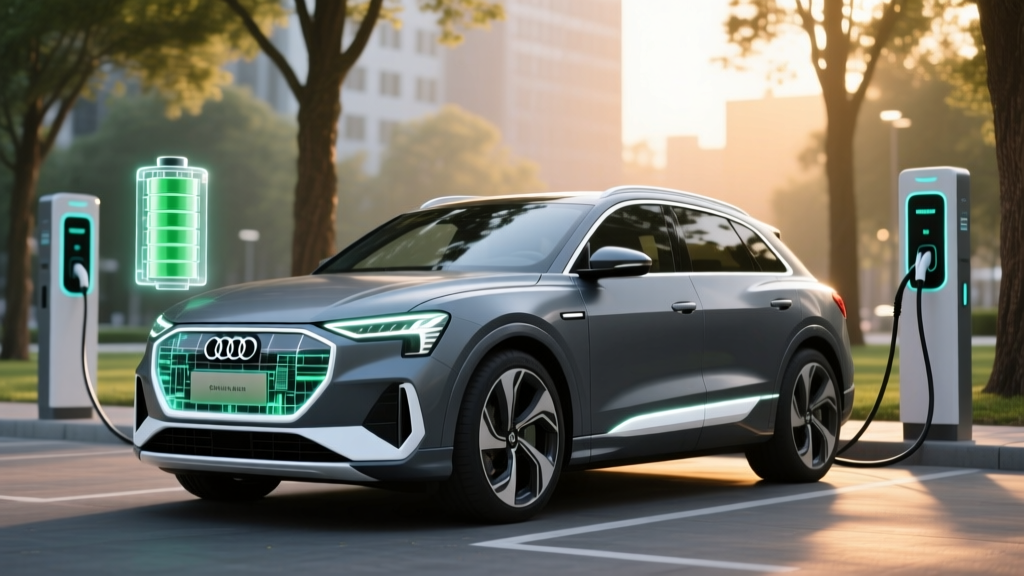
The Audi Q5 e-tron enters 2026 as a luxury compact electric SUV that prioritizes refinement over headline-grabbing numbers. Built on Volkswagen Group's MEB platform, it slots between the Q4 e-tron and the larger Q8 e-tron, targeting buyers who want premium German engineering in an EV that doesn't scream "I'm an EV." But with the segment now crowded — the Tesla Model Y, BMW iX3, Mercedes EQB, and Genesis GV60 all fighting for the same buyer — does the Q5 e-tron's blend of comfort and tech justify its premium price?
After spending time with the 2026 Q5 e-tron across commuting, highway cruising, and cold-weather driving, here's the complete data-driven breakdown you need before signing a purchase agreement.
Range, Efficiency, and the Real-World Reality Check
The 2026 Audi Q5 e-tron carries a 91 kWh gross / 86 kWh usable lithium-ion battery pack using NMC (nickel-manganese-cobalt) chemistry. Audi rates it at 268 miles EPA in the standard dual-motor Quattro configuration.
EPA sticker: 268 miles
Highway cruising (70-75 mph): Expect 220–240 miles. The Q5 e-tron's boxy SUV profile and ~5,000-lb curb weight take a toll at sustained speed.
City / suburban mixed driving: 255–270 miles — regenerative braking recovers energy effectively in stop-and-go traffic.
Cold weather (below 32°F): Plan for 190–220 miles. The heat pump (standard on 2026 models) helps, but NMC chemistry still loses 15–25% capacity in deep cold without preconditioning.
Efficiency lands at 87 MPGe combined, which translates to roughly 39 kWh per 100 miles. That's middling for the segment — the Tesla Model Y Long Range achieves 122 MPGe combined on a smaller battery, thanks to superior aerodynamics and a lighter platform. If efficiency-per-mile is your top priority, the Q5 e-tron isn't the segment leader. If cabin quietness and ride quality rank higher, keep reading.
Charging Speed: DC Fast and Home Level 2
Audi equips the Q5 e-tron with a 150 kW peak DC fast-charging rate on CCS1-compatible stations (NACS adapter included with 2026 models for Tesla Supercharger access). The charge curve is progressive rather than peaky — it ramps steadily but tapers noticeably past 80% State of Charge (SoC).
| Charging Level | Power / Rate | Time / Speed | Notes |
|---|---|---|---|
| Level 1 (120V household) | 1.4 kW | ~3 mi/hr | Emergency/trickle only — 60+ hours for full charge |
| Level 2 (240V, 40A circuit) | 9.6 kW | ~26 mi/hr; 0–100% in ~9.5 hours | Standard home setup; overnight-ready |
| Level 2 (240V, 48A circuit) | 11.5 kW | ~31 mi/hr; 0–100% in ~8 hours | Requires 60A dedicated circuit |
| DC Fast Charge (peak) | 150 kW | 10–80% in ~30 minutes | Sustains ~125 kW to 50%, tapers to ~75 kW by 70% |
The 30-minute 10–80% time is acceptable but trails the Hyundai Ioniq 5 (18 minutes on a 350 kW charger) and the Porsche Macan Electric (21 minutes at 270 kW). On a road trip, you'll spend roughly 10 extra minutes per stop compared to 800V-architecture rivals. For daily home charging, however, the 9.6 kW onboard charger fills the battery overnight with ease — most owners will plug in at 30–40% and wake up at 100%.
Preconditioning tip: Use the MMI navigation to route to a DC fast charger, and the Q5 e-tron will automatically warm the battery to optimal temperature, shaving 5–8 minutes off your charge session. Skipping preconditioning in cold weather can push 10–80% times past 45 minutes.
Performance and Drivetrain
The 2026 Q5 e-tron comes exclusively with Audi's Quattro dual-motor all-wheel-drive system. The setup pairs a front asynchronous motor with a rear permanent-magnet synchronous motor for a combined output of 335 horsepower and 339 lb-ft of torque.
| Drivetrain | Dual-motor AWD (Quattro) |
| Horsepower | 335 hp combined |
| Torque | 339 lb-ft |
| 0–60 mph | 5.7 seconds |
| Top Speed | 112 mph (electronically limited) |
| Curb Weight | ~5,050 lbs |
| Towing Capacity | 2,600 lbs (braked) |
The 5.7-second 0–60 time is brisk but not thrilling — a Model Y Long Range hits 60 in 4.8 seconds, and the BMW iX3 does it in 5.5. Where the Q5 e-tron distinguishes itself is in the quality of its acceleration: smooth, linear, and whisper-quiet, with none of the torque-steer or drivetrain whine you'll find in less refined platforms. The adaptive air suspension (available on Prestige trim) soaks up road imperfections in a way that makes the performance numbers feel secondary to the ride experience.
Pricing, Trims, and Federal Tax Credit Eligibility
The 2026 Q5 e-tron is offered in three trims: Premium, Premium Plus, and Prestige.
| Trim | Base MSRP | Destination | Est. As-Tested | §30D Credit Eligible? |
|---|---|---|---|---|
| Premium | $55,995 | $1,195 | $58,500–$61,000 | Partial — see below |
| Premium Plus | $60,495 | $1,195 | $63,000–$67,000 | Partial — see below |
| Prestige | $65,995 | $1,195 | $69,000–$74,000 | Unlikely — exceeds SUV MSRP cap |
Federal tax credit (§30D) reality check: Under current IRS rules, SUVs must have an MSRP at or below $80,000 to qualify. The Premium and Premium Plus trims clear this cap, but eligibility also depends on:
- Battery component sourcing: A percentage of battery components must be manufactured or assembled in North America. The Q5 e-tron's MEB-platform battery is currently sourced from suppliers in Europe and China, which may reduce or eliminate the $3,750 battery-component half of the credit.
- Critical minerals sourcing: The remaining $3,750 requires critical minerals extracted or processed in the U.S. or a free-trade-agreement country. Audi has not published full supply-chain transparency for the 2026 model year.
- Buyer income caps: Modified adjusted gross income must not exceed $300,000 (joint), $225,000 (head of household), or $150,000 (single).
- Point-of-sale transfer: If eligible, the credit can be transferred to the dealer at purchase, reducing your out-of-pocket cost immediately rather than waiting for tax filing.
Bottom line: do not assume the full $7,500 credit applies. Verify current sourcing compliance on fueleconomy.gov before purchase, and consult a tax professional. The Premium trim, potentially qualifying for $3,750, brings the effective starting price closer to $53,500 — still premium, but more competitive.
Interior Space, Tech, and Driver Assistance
The Q5 e-tron's cabin is where Audi earns its luxury badge. Materials quality is excellent — open-pore wood, available Valcona leather, and tight panel gaps throughout. The MEB platform's flat floor creates generous rear legroom.
| Front Headroom | 40.1 in |
| Front Legroom | 41.2 in |
| Rear Headroom | 38.8 in |
| Rear Legroom | 37.6 in |
| Cargo (behind 2nd row) | 27.1 cu ft |
| Cargo (seats folded) | 56.9 cu ft |
| Frunk | None (MEB platform) |
The lack of a frunk is a MEB-platform limitation — the front motor and power electronics consume the space. Cargo volume trails the Model Y (30.2 cu ft rear / 76.2 cu ft total) but matches the BMW iX3 closely.
Infotainment: The 2026 model runs Audi's latest MMI touch response system on a 10.9-inch upper display and 8.6-inch climate/control lower display. Wireless Apple CarPlay and Android Auto are standard. The system is responsive, though the dual-screen layout demands more eyes-off-road time than physical climate knobs would.
Driver assistance: Audi's Adaptive Cruise Assist with lane-centering is standard — this is a SAE Level 2 system, meaning the driver must remain engaged with hands on the wheel and eyes on the road at all times. It performs competently on highways but does not offer hands-free operation like GM's Super Cruise or Ford's BlueCruise. Audi has not announced a Level 3 or higher system for the Q5 e-tron.
Audi Adaptive Cruise Assist is a Level 2 driver-assistance system. It does NOT enable self-driving. The driver is legally and operationally responsible for vehicle control at all times. Do not disengage from driving while the system is active.
Pros, Cons, and the Verdict
Pros
- Exceptional cabin quietness and ride refinement
- Premium materials and build quality
- Standard AWD with competent all-weather traction
- Comfortable rear seating for adults
- Available air suspension (Prestige)
- Strong dealer/service network
Cons
- Below-segment efficiency (87 MPGe)
- 150 kW DC charging trails 800V competitors
- No frunk storage
- Touch-heavy infotainment with no physical climate controls
- Federal tax credit likely reduced or unavailable
- Cargo volume trails Model Y significantly
Who Should Buy the 2026 Audi Q5 e-tron?
The Q5 e-tron is best suited for luxury-oriented commuters and families who prioritize cabin comfort, ride quality, and brand prestige over maximum range or the fastest charging. If your daily drive is under 80 miles round-trip, you have reliable Level 2 home charging, and you value a quiet, well-appointed cabin above all else, the Q5 e-tron delivers.
It is not ideal for frequent road-trippers who need 300+ mile range and sub-20-minute charge stops, efficiency-focused buyers tracking cost-per-mile, or anyone expecting a full $7,500 federal credit without verifying sourcing compliance.
Choose the Q5 e-tron if: You want a refined luxury EV for commuting and family duty, value ride quality over raw efficiency, and can charge at home nightly.
Look elsewhere if: You road-trip frequently (consider the Ioniq 5 or Model Y), need maximum cargo space, or require the full $7,500 tax credit to make the math work.
Warranty and Long-Term Ownership
Audi backs the Q5 e-tron with a competitive warranty package:
- Basic vehicle: 4 years / 50,000 miles
- Battery and electric powertrain: 8 years / 100,000 miles (whichever comes first)
- Battery capacity retention: Audi warrants the battery will retain at least 70% of original capacity during the 8-year/100,000-mile period
- Corrosion perforation: 12 years, unlimited mileage
The 70% retention threshold is industry-standard but worth noting: if your battery degrades to 69% capacity within the warranty window, Audi will repair or replace it. In practice, NMC batteries on liquid-cooled MEB platforms have shown degradation curves of roughly 8–12% over the first 100,000 miles based on fleet data from European-market MEB vehicles, suggesting most owners will remain well above the threshold.
Frequently Asked Questions
What is the real-world range of the 2026 Audi Q5 e-tron?
The EPA rates it at 268 miles. In real-world highway driving at 70+ mph, expect 220–240 miles. In city driving, you'll approach 260+. In sub-freezing temperatures, plan for 190–220 miles unless you precondition the battery while plugged in.
How fast does the Q5 e-tron charge?
On a DC fast charger, it peaks at 150 kW and charges from 10–80% in approximately 30 minutes (with battery preconditioning). At home on a 240V/40A Level 2 charger, it adds about 26 miles per hour, filling from empty overnight in roughly 9.5 hours.
Does the Q5 e-tron qualify for the federal EV tax credit?
It depends on trim and current sourcing rules. The Premium and Premium Plus trims fall under the $80,000 SUV MSRP cap, but battery component and critical mineral sourcing requirements under IRS §30D may reduce the credit to $3,750 or eliminate it entirely. Always verify on fueleconomy.gov before purchasing and consult a tax professional.
How does it compare to the Tesla Model Y?
The Model Y Long Range offers more range (330 miles EPA), faster charging (250 kW peak), more cargo space (76 cu ft), a lower starting price (~$48,990), and better efficiency (122 MPGe). The Q5 e-tron counters with superior cabin materials, a quieter ride, a more traditional luxury driving experience, and Audi dealer service. They serve different buyer priorities.
Is the Q5 e-tron good for towing?
It's rated for 2,600 lbs (braked), which covers a small utility trailer or a pair of dirt bikes but not a boat or camper. Towing will reduce range by 30–40%, so plan for roughly 150–170 miles between charge stops when towing near the limit.
Does it have one-pedal driving?
The Q5 e-tron offers adjustable regenerative braking via steering-wheel paddles (three levels) and an "auto" mode that uses radar data to modulate regen based on traffic ahead. It does not offer true one-pedal driving that brings the car to a complete stop — you'll still use the brake pedal at low speeds.