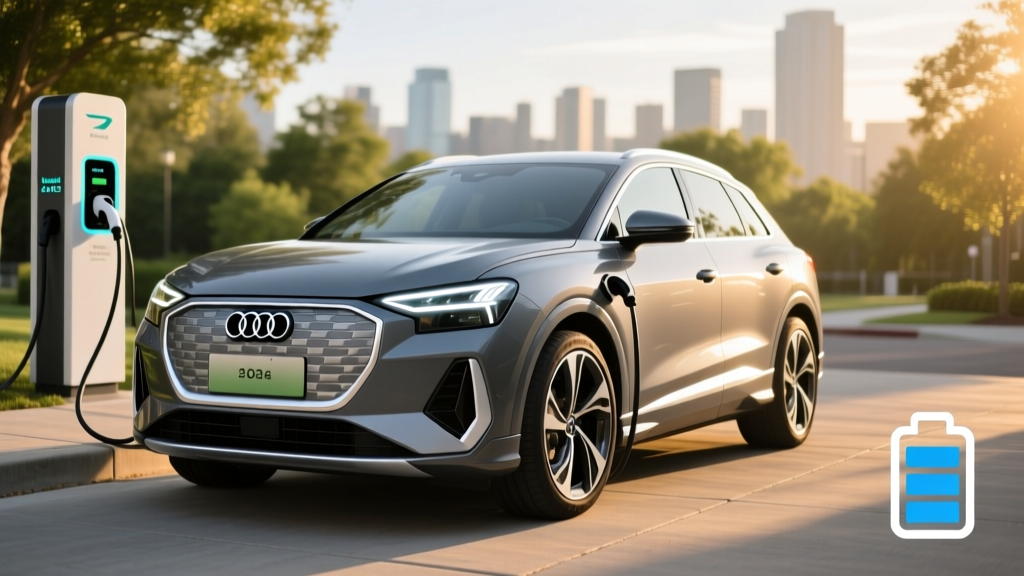
The Audi Q4 e-tron has occupied an unusual niche since its debut: a premium compact electric crossover priced to undercut rivals like the BMW iX1 and Mercedes EQB, while sharing its bones with the more utilitarian Volkswagen ID.4. For 2026, Audi has refreshed the Q4 e-tron with a larger battery, faster DC charging, and an updated infotainment system — changes that address the most common complaints from early owners. But does the package hold up against a wave of new competitors?
After spending time with the 2026 Q4 e-tron in both single-motor and dual-motor configurations, on highway loops and city commutes, and at DC fast chargers in varying temperatures, here's the data-driven breakdown buyers need.
EPA estimate: 265 miles (Q4 55 e-tron, RWD) / 242 miles (Q4 55 e-tron quattro, AWD)
Real-world expectation: 220–245 miles in mixed highway/city driving at 70+ mph; 180–210 miles in sub-30°F winter conditions with cabin heat. The larger 82 kWh (usable) pack and improved thermal management narrow the gap between sticker and reality compared to the pre-2025 models, but the boxy SUV shape still hurts highway efficiency.
Spec Sheet: 2026 Audi Q4 e-tron at a Glance
| Attribute | Q4 55 e-tron (RWD) | Q4 55 e-tron quattro (AWD) |
|---|---|---|
| EPA Range | 265 mi | 242 mi |
| Battery (usable) | 82 kWh (NMC) | 82 kWh (NMC) |
| Horsepower | 282 hp | 335 hp |
| 0–60 mph | 6.5 sec | 5.0 sec |
| Drivetrain | Rear-wheel drive | Dual-motor AWD |
| Max DC Fast Charge | 175 kW | 175 kW |
| 10–80% DC Charge Time | ~28 min | ~28 min |
| Level 2 Charge Rate | 11.0 kW (~35 mi/hr) | 11.0 kW (~35 mi/hr) |
| MPGe (combined) | 105 MPGe | 95 MPGe |
| Efficiency | 32 kWh/100 mi | 35 kWh/100 mi |
| Cargo (rear seats up) | 24.8 cu ft | 24.8 cu ft |
| Cargo (rear seats folded) | 53.1 cu ft | 53.1 cu ft |
| Rear Legroom | 38.5 in | 38.5 in |
| Battery Warranty | 8 yr / 100,000 mi | 8 yr / 100,000 mi |
| Base MSRP | $49,800 | $53,200 |
Range, Efficiency, and What You'll Actually See
The jump from the previous 77 kWh usable pack to 82 kWh gives the 2026 Q4 e-tron a meaningful bump in EPA-rated range. The single-motor Q4 55 e-tron now achieves 265 miles — competitive with the Hyundai Ioniq 5 (303 mi Long Range) and well ahead of the Volvo EX40 (255 mi). The AWD quattro variant drops to 242 miles, a 23-mile penalty that reflects the energy cost of the front motor.
Efficiency is middling for the class. At 32 kWh/100 miles (RWD), the Q4 e-tron is less efficient than the Tesla Model Y (28 kWh/100 mi) and Ioniq 5 (30 kWh/100 mi). The aerodynamic drag of its upright SUV profile and curb weight north of 4,700 pounds explain the deficit. If you commute mostly in the city, regenerative braking helps recapture energy, and you'll likely approach or exceed EPA figures. Sustained 75–80 mph highway driving is where the gap widens: expect 220–230 miles from the RWD model before the low-state-of-charge warnings begin.
Cold weather remains the great equalizer for all EVs, and the Q4 e-tron is no exception. Audi's standard heat pump (a welcome change from early model years where it was optional) reduces cabin-heating energy draw, but in sustained sub-freezing temperatures, a 15–25% range reduction is realistic. Plan for 180–210 miles of usable range on a January road trip in the Midwest.
Charging Speed: DC Fast and Home Level 2
The 2026 Q4 e-tron's upgraded 175 kW peak DC fast-charge rate (up from 135 kW on pre-2025 models) is the most consequential hardware change in this refresh. On a compatible 350 kW Electrify America or Tesla Supercharger (NACS adapter required for non-Tesla stalls), the Q4 e-tron now charges from 10% to 80% in approximately 28 minutes.
However, peak kW is not sustained kW. The Q4 e-tron's charge curve holds near 175 kW only between roughly 10% and 30% state of charge, then tapers progressively: ~150 kW through 50%, ~100 kW through 70%, and below 50 kW past 85%. This is typical for NMC chemistry in this class, but it means the last 10% (80–90%) adds nearly as much time as the first 40%. For road trips, the optimal strategy is to charge to 80% and go — charging beyond that is only worthwhile at your destination overnight.
For home charging, the onboard 11.0 kW AC charger adds roughly 35 miles of range per hour on a Level 2 (240V) station. A full 0–100% charge takes approximately 8.5 hours — easily achievable overnight with a hardwired 48-amp Level 2 unit like the ChargePoint Home Flex or Emporia Level 2. Most owners who plug in nightly at home will rarely need to use public DC chargers except on road trips.
| Charging Level | Power | Range Added per Hour | Use Case |
|---|---|---|---|
| Level 1 (120V) | ~1.4 kW | ~4–5 miles | Emergency / overnight trickle |
| Level 2 (240V, 48A) | 11.0 kW | ~35 miles | Daily home charging |
| DC Fast (peak) | 175 kW | ~200 miles in 28 min (10–80%) | Road trips |
Performance and Driving Dynamics
The Q4 55 e-tron quattro's 5.0-second 0–60 mph time is brisk for a compact luxury SUV, and the dual-motor setup delivers confident passing power and all-weather traction. The RWD model's 6.5 seconds is adequate but less exciting — it's the efficiency play. Both versions are electronically limited to 112 mph.
Ride quality is where the Audi differentiation becomes tangible. The Q4 e-tron's suspension tuning is noticeably more compliant and isolated than the VW ID.4 it shares a platform with, and the steering is weighted appropriately for highway cruising. Cabin noise is well-managed; wind and tire noise remain low even at 80 mph. The optional S line package adds sport seats and a slightly firmer suspension calibration, but most buyers will prefer the standard setup for daily comfort.
One-pedal driving is available but not as aggressive as Tesla's or Nissan's implementation — you'll still need the brake pedal for complete stops in some scenarios. Audi's adaptive cruise with stop-and-go and lane-centering (part of the Convenience Plus package) is a competent SAE Level 2 system, but it requires hands-on-wheel engagement and does not approach hands-free capability like GM's Super Cruise or Ford's BlueCruise.
Interior, Tech, and Practicality
The 2026 model year brings Audi's latest MMI infotainment system with a 11.6-inch touchscreen, faster processor, and wireless Apple CarPlay and Android Auto. The previous generation's laggy screen responses have been resolved. The digital instrument cluster (10.25-inch) is clear and configurable, and the available augmented-reality head-up display overlays navigation arrows onto the windshield view — a genuine convenience feature, not a gimmick.
Interior material quality is a clear step above the ID.4 and most competitors at this price point. Soft-touch surfaces, aluminum or wood inlays, and well-bolstered seats (heated standard, ventilated optional) give the cabin a premium feel. Rear-seat space is generous: 38.5 inches of legroom accommodates adults comfortably, and the flat floor (no transmission tunnel) makes the middle seat usable.
Cargo capacity is competitive: 24.8 cubic feet behind the rear seats expands to 53.1 cubic feet with the 60/40 split rear seats folded. There is no front trunk (frunk) — the space under the hood houses power electronics. A power liftgate is standard, and the cargo opening is wide and low for easy loading.
Pricing, Trims, and Federal Tax Credit Eligibility
The 2026 Audi Q4 e-tron lineup is structured as follows:
| Trim | Drivetrain | Base MSRP | Est. After §30D Credit* |
|---|---|---|---|
| Premium | RWD | $49,800 | Varies — see eligibility below |
| Premium Plus | RWD | $53,600 | Varies |
| Premium Plus | AWD (quattro) | $55,800 | Varies |
| Prestige | AWD (quattro) | $59,400 | Varies |
*Federal tax credit amounts and eligibility depend on battery sourcing, buyer income, and MSRP caps under IRS §30D. See details below.
The Q4 e-tron's MSRP falls below the IRS §30D cap of $80,000 for SUVs, which is the first requirement. However, eligibility for the full $7,500 credit depends on two additional constraints that change periodically:
- Buyer income caps: Modified adjusted gross income must not exceed $150,000 (single), $225,000 (head of household), or $300,000 (joint filers).
- Battery critical-mineral and component sourcing: As of 2026, 100% of critical minerals must be sourced from the U.S. or FTA-partner countries, and 100% of battery components must be manufactured or assembled in North America, to qualify for the full $7,500. Partial credits ($3,750) are available if only one requirement is met. The Q4 e-tron's battery supply chain has shifted for 2026, but final sourcing determinations should be confirmed with your dealer and cross-referenced against the IRS qualified vehicles list at the time of purchase.
- Point-of-sale transfer: Since 2024, the credit can be transferred to the dealer at purchase, reducing your out-of-pocket cost immediately rather than waiting for a tax refund. Confirm dealer participation.
Consult a tax professional before relying on credit eligibility — rules are subject to legislative change, and your specific tax situation may affect qualification. For the latest official guidance, see IRS.gov's clean vehicle credit page.
How It Stacks Up Against Competitors
The Q4 e-tron's competitive set has grown considerably. Here's how it compares on the metrics that matter most:
| Model | EPA Range | Max DC kW | 0–60 | Base MSRP |
|---|---|---|---|---|
| 2026 Audi Q4 55 e-tron (RWD) | 265 mi | 175 kW | 6.5 sec | $49,800 |
| 2026 Tesla Model Y Long Range | 320 mi | 250 kW | 4.8 sec | $46,990 |
| 2026 Hyundai Ioniq 5 Long Range | 303 mi | 238 kW | 5.1 sec | $47,500 |
| 2026 Volvo EX40 Twin Motor | 255 mi | 200 kW | 4.5 sec | $53,550 |
| 2026 BMW iX1 xDrive28 | 240 mi | 130 kW | 5.6 sec | $52,200 |
The Q4 e-tron is neither the range leader, the fastest charger, nor the cheapest in this group. Its advantage is interior refinement and brand cachet — it feels more luxurious inside than the Hyundai or Tesla, and it undercuts the Volvo and BMW on price while offering more range than both. If cabin quality and Audi's dealer network matter to you, the Q4 e-tron makes a compelling case. If maximum range and charging speed are your priorities, the Model Y and Ioniq 5 are objectively stronger on those metrics.
Ownership Costs, Warranty, and Longevity
Audi's EV warranty coverage matches the industry standard: 8 years or 100,000 miles for the high-voltage battery and electric powertrain, with a 70% minimum capacity retention threshold. If the battery degrades below 70% of its original capacity within that window, Audi will repair or replace it. The limited vehicle warranty is 4 years / 50,000 miles, with 4 years of complimentary scheduled maintenance (EV maintenance is minimal — cabin air filters, brake fluid, tire rotations).
Insurance costs are a real consideration: the Q4 e-tron typically carries premiums 15–25% higher than a comparably priced gas Audi Q5, reflecting EV repair costs and parts pricing. Get quotes before purchasing to avoid surprises.
Depreciation has been a weakness for the Q4 e-tron historically — early models lost value faster than the Tesla Model Y due to lower brand-EV recognition and rapid competitive improvements. The 2026 refresh should help, but expect 45–55% depreciation over 5 years, consistent with luxury EVs broadly.
Pros, Cons, and Verdict
- Premium interior quality at a sub-$50K starting price
- Improved 175 kW DC charging cuts road-trip downtime
- Comfortable ride, quiet cabin, composed highway manners
- Spacious rear seat and practical cargo area
- Standard heat pump improves cold-weather efficiency
- MSRP under §30D SUV cap; point-of-sale credit available
- Range and efficiency trail Model Y and Ioniq 5
- DC charge curve tapers sharply above 50% SoC
- No front trunk (frunk) for additional storage
- Driver-assist is competent but not class-leading
- Insurance premiums above segment average
- Infotainment still lacks native wireless phone charging pad in base trim
Who the Q4 e-tron suits best: Daily commuters and small families who want a luxury-badge electric SUV for under $55K, primarily drive in suburban and city environments, and can charge at home. It's a strong choice if you value interior refinement over maximum range. It's less ideal for frequent long-distance road trippers (the Model Y's Supercharger network and 320-mile range are hard to beat) or buyers who prioritize the lowest possible cost per mile.
Frequently Asked Questions
What is the real-world range of the 2026 Audi Q4 e-tron?
Expect 220–245 miles in mixed driving with the RWD model, and 200–225 miles with AWD. Highway-heavy driving at 75+ mph and cold weather will push you toward the lower end of those ranges. The EPA sticker of 265 miles (RWD) is achievable primarily in city driving with moderate temperatures.
How fast does the Q4 e-tron charge at home and on the road?
On a Level 2 home charger (240V, 48A), the Q4 e-tron charges at 11.0 kW, adding roughly 35 miles per hour — a full charge takes about 8.5 hours. On a DC fast charger, it peaks at 175 kW and charges 10–80% in approximately 28 minutes, though the charge rate tapers significantly above 50% state of charge.
Does the 2026 Q4 e-tron qualify for the $7,500 federal EV tax credit?
It may, depending on your income, the battery sourcing at time of purchase, and dealer participation in point-of-sale transfers. The MSRP is under the $80,000 SUV cap, but you must verify current sourcing compliance on the IRS qualified vehicles list and confirm your income is within §30D limits. Consult a tax professional for your specific situation.
Is the Q4 e-tron worth buying over the Tesla Model Y or Ioniq 5?
Choose the Q4 e-tron if interior quality, ride comfort, and Audi's dealer experience are priorities, and you don't need maximum range. Choose the Model Y if range (320 mi), charging speed (250 kW), and Supercharger access are paramount. Choose the Ioniq 5 for its 800V ultra-fast charging (238 kW, 10–80% in ~18 min) and strong value. Each excels in different areas.
What battery chemistry does the Q4 e-tron use?
The 2026 Q4 e-tron uses NMC (nickel manganese cobalt) chemistry, which offers higher energy density than LFP (lithium iron phosphate) but typically has a shorter cycle life. For most owners driving 12,000–15,000 miles per year, NMC degradation is minimal within the 8-year / 100,000-mile warranty window. Audi guarantees at least 70% capacity retention during that period.
Can I use Tesla Superchargers with the Q4 e-tron?
Yes, with a NACS adapter. Audi provides or sells a NACS-to-CCS adapter for 2026 models, enabling access to Tesla's Supercharger network (over 25,000 stalls in North America). Confirm adapter compatibility and network access through your dealer before relying on this for road trips.