Quick Verdict: A Premium Compact EV That Plays It Safe
The 2026 Audi Q4 e-tron occupies a specific niche: buyers who want a luxury-branded compact electric SUV without the polarizing design of a Tesla Model Y or the tech-first minimalism of a Hyundai Ioniq 5. Built on Volkswagen Group's MEB platform, it delivers competent range, respectable charging speeds, and Audi's trademark interior refinement. But at a starting MSRP near $49,800, it faces stiff competition from rivals offering more range, faster charging, or sharper performance for the money.
After spending time with the Q4 e-tron across commuting, highway road trips, and DC fast-charging stops, our take is straightforward: it's a well-rounded, if unremarkable, luxury EV. The real-world range holds up reasonably well, the cabin is genuinely quiet and well-built, and Audi's dealer network makes servicing painless. Where it falls short is charging speed relative to 800V competitors and a rear-seat and cargo package that doesn't fully exploit its footprint.
Range, Battery, and Efficiency
The 2026 Q4 e-tron carries a 77 kWh usable battery pack (82 kWh gross) using NMC (nickel manganese cobalt) pouch cells supplied by LG Energy Solution. Audi does not offer an LFP variant, which means you get higher energy density but should follow the typical 80% daily charge recommendation for long-term battery health.
EPA estimated range: 265 miles (Q4 55 e-tron quattro, 20" wheels)
Real-world highway (70-75 mph, moderate temps): ~230–245 miles
Real-world cold weather (below 32°F, highway): ~195–215 miles
City/mixed commuting: 255–265 miles achievable with regen use
The Q4 e-tron's efficiency sits at 98 MPGe combined (Q4 55 quattro) per EPA fueleconomy.gov data, translating to roughly 34 kWh/100 mi. Highway driving at sustained speeds pushes consumption closer to 38–41 kWh/100 mi, which is where the range gap opens up. Cold weather compounds this with cabin heating demands — the Q4 e-tron uses a heat pump (standard on 2026 models), which mitigates but does not eliminate winter range loss.
| Trim | Drivetrain | EPA Range | MPGe (Combined) | kWh/100 mi |
|---|---|---|---|---|
| Q4 45 e-tron (RWD) | Single-motor RWD | 288 mi | 105 | 32 |
| Q4 55 e-tron quattro | Dual-motor AWD | 265 mi | 98 | 34 |
| Q4 55 e-tron Prestige (21" wheels) | Dual-motor AWD | 253 mi | 94 | 36 |
The RWD Q4 45 e-tron is the range champion of the lineup, squeezing 288 EPA miles from the same pack thanks to reduced drivetrain losses and lighter curb weight. If your commute is long and you don't need AWD traction, it's the efficiency play. But the quattro models are what most buyers cross-shop against the BMW iX1, Volvo EX40, and Tesla Model Y — and there, 265 miles is merely adequate for the price point.
Charging Speed and Infrastructure
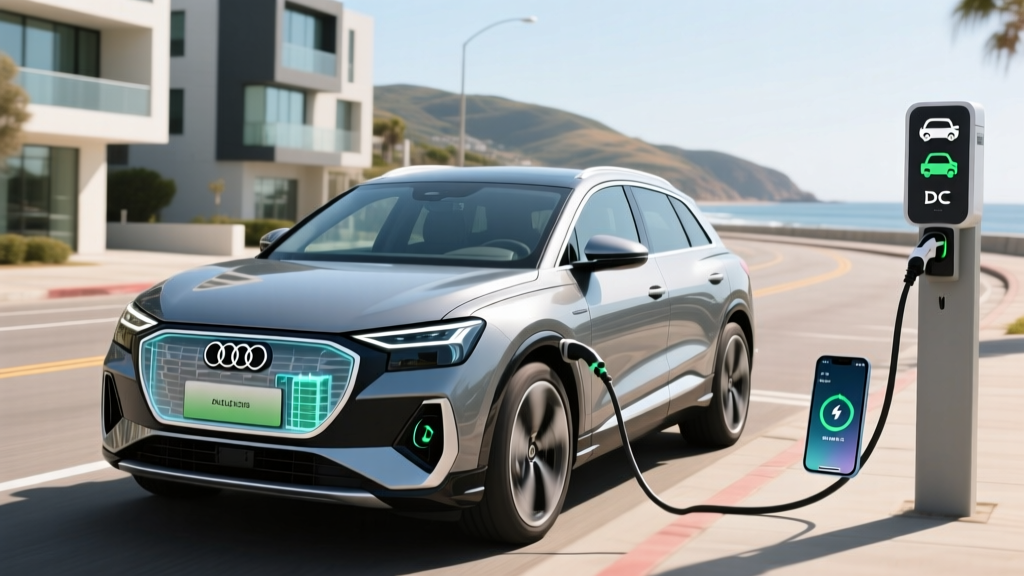
Charging is where the Q4 e-tron's MEB-platform roots show their age against 800V architectures from Hyundai/Kia and the latest Tesla Supercharger V4 speeds. The Q4 e-tron peaks at 175 kW on DC fast charging (CCS1 connector), with a 10–80% charge time Audi rates at approximately 28 minutes under ideal conditions.
| Charging Level | Power (kW) | Speed | Notes |
|---|---|---|---|
| Level 1 (120V household) | ~1.4 kW | ~3–4 mi/hr | Emergency/trickle only |
| Level 2 (240V home, 48A) | 11.5 kW | ~28 mi/hr | Full charge in ~7.5 hours |
| DC Fast Charge (CCS) | 175 kW peak | 10–80% in ~28 min | Tapers significantly above 80% |
The real-world charging experience tells a more nuanced story. The Q4 e-tron hits its 175 kW peak only briefly between roughly 10–25% state of charge when the battery is properly preconditioned. From 25–60%, expect sustained rates around 120–140 kW, and from 60–80%, it drops to 70–90 kW. This charge-curve taper means your actual time at a DC fast charger for a 10–80% session often stretches to 32–35 minutes — noticeably slower than an Ioniq 5 or Kia EV6 on an 800V system (which can do 10–80% in roughly 18 minutes).
For home Level 2 charging, the onboard 11.5 kW AC charger is competitive. A full overnight charge from empty takes about 7.5 hours on a 48-amp circuit, which is practical for daily use. You'll need a NEMA 14-50 outlet or a hardwired Level 2 station — budget $500–$1,500 for installation depending on your electrical panel capacity and run length from panel to garage.
One notable gap: the Q4 e-tron does not have native NACS (Tesla Supercharger connector) compatibility in 2026. Audi provides a CCS-to-NACS adapter for Supercharger access, but this adds a step and limits peak charging speed on some V3 stalls. Audi has signaled NACS-native ports for future model years.
Performance and Drivetrain
| Spec | Q4 45 e-tron (RWD) | Q4 55 e-tron quattro |
|---|---|---|
| Horsepower | 282 hp | 340 hp |
| Torque | 339 lb-ft | 402 lb-ft |
| 0–60 mph | 6.7 sec | 5.0 sec |
| Top Speed | 112 mph | 112 mph |
| Drivetrain | Single-motor RWD | Dual-motor AWD |
| Towing Capacity | 2,200 lbs | 2,600 lbs |
The Q4 55 e-tron quattro is the volume seller and the one we'd recommend for most buyers. The 5.0-second 0–60 time is brisk enough for confident highway merging and passing, and the dual-motor AWD system provides reassuring traction in rain and snow. The RWD Q4 45 is adequate at 6.7 seconds but feels noticeably less urgent when loaded with passengers and cargo.
Ride quality is where the Audi badge earns its keep. The suspension tuning is firm but controlled — it absorbs highway expansion joints and broken pavement without transmitting harshness into the cabin. Steering is precise if light, and the low center of gravity from the floor-mounted battery keeps body roll well-managed through corners. This isn't a sporty SUV in the Porsche Macan EV sense, but it's composed and comfortable in a way that matches the Audi brand promise.
Regenerative braking offers multiple modes selectable via steering-wheel paddles: coast, mild regen, and strong regen. There's also an auto-regen mode that uses radar and navigation data to adjust deceleration based on traffic ahead and upcoming curves. It works well in practice, though true one-pedal driving (full stop without touching the brake) isn't available — the car will creep at very low speeds, requiring the brake pedal for a complete hold.
Interior, Cargo, and Technology
The Q4 e-tron's cabin is where Audi's value proposition becomes clearest. Material quality is a step above the Hyundai Ioniq 5 and Ford Mustang Mach-E, with soft-touch surfaces, real aluminum trim on Prestige models, and supportive sport seats with available ventilation and massage. The dual-screen layout (10.25" digital cluster + 11.6" center touchscreen) is intuitive, and Audi's MMI infotainment system has improved markedly in responsiveness for 2026. Wireless Apple CarPlay and Android Auto are standard.
Passenger space is generous up front and adequate in the rear:
- Front headroom: 41.2 inches
- Front legroom: 41.6 inches
- Rear headroom: 38.5 inches
- Rear legroom: 37.3 inches
Rear legroom at 37.3 inches is competitive with the Volvo EX40 but trails the Tesla Model Y (41.6" rear legroom) by a significant margin. Tall adults will be comfortable for shorter trips but may find knee room tight on long journeys.
Cargo capacity is a relative weak point for the segment:
- Behind rear seats: 24.8 cubic feet
- Rear seats folded: 53.1 cubic feet
- Frunk: None (no front trunk)
The absence of a frunk is a missed opportunity — the MEB platform has space under the hood, but Audi uses it for HVAC and power electronics. The 24.8 cu ft behind the rear seats trails the Model Y (30.2 cu ft) and Ioniq 5 (27.2 cu ft), though it's in line with the Volvo EX40. The cargo area is well-shaped and includes a variable-height load floor and under-floor storage for charging cables.
Driver-assistance technology includes Audi's Adaptive Cruise Assist (a Level 2 SAE system combining adaptive cruise and lane centering), which is competent but unremarkable. It maintains lane position and following distance reliably on highways but doesn't offer hands-free driving like GM's Super Cruise or Ford's BlueCruise. The driver must keep hands on the wheel, and the system's lane-change assist requires manual confirmation. Audi does not currently offer a higher-level autonomy package on the Q4 e-tron.
Audi Adaptive Cruise Assist is a Level 2 driver-assistance system per SAE classification. The driver must remain fully engaged, monitor the road, and keep hands on the steering wheel at all times. This is not autonomous or "self-driving" capability.
Pricing, Trims, and Federal Tax Credit
| Trim | MSRP | Est. After §30D Credit |
|---|---|---|
| Q4 45 e-tron Premium (RWD) | $49,800 | ~$42,300* |
| Q4 55 e-tron Premium (quattro) | $54,300 | ~$46,800* |
| Q4 55 e-tron Premium Plus | $58,200 | ~$50,700* |
| Q4 55 e-tron Prestige | $62,700 | ~$55,200* |
*Tax credit estimates assume full $7,500 §30D eligibility. Actual credit varies by buyer. Destination charge ($1,195) not included in MSRP figures shown.
The 2026 Audi Q4 e-tron qualifies for the IRS §30D New Clean Vehicle Credit if all of the following apply:
- MSRP cap: Vehicle MSRP must be ≤ $80,000 for SUVs — all Q4 e-tron trims qualify ✓
- Buyer income cap: Modified AGI must not exceed $150,000 (single), $225,000 (head of household), or $300,000 (joint filers)
- Battery sourcing: Critical minerals and battery components must meet phased-in percentage thresholds for 2026 (varies — verify on IRS eligible vehicle list at purchase time)
- Point-of-sale transfer: As of 2024+, you can transfer the credit to the dealer for an immediate price reduction rather than claiming it on your tax return
- Final assembly: Vehicle must undergo final assembly in North America — the Q4 e-tron is assembled in Zwickau, Germany, which disqualifies it from the §30D credit
⚠ Critical note: Because the Q4 e-tron is manufactured in Germany, it does not meet the North American final assembly requirement for the §30D new-vehicle tax credit. Buyers should not count on the $7,500 federal credit when budgeting. However, the Q4 e-tron may qualify for lease-based incentives under §45W (commercial clean vehicle credit passed through by the lessor), which does not have the same assembly requirement. Consult your tax professional and Audi dealer for current lease incentive details.
This is a critical ownership consideration. Unlike the Tesla Model Y (assembled in Texas) or the Ford Mustang Mach-E (assembled in Mexico but meeting USMCA rules), the German-built Q4 e-tron misses the §30D credit entirely for purchases. Lease customers may benefit from pass-through commercial credits, but purchase buyers should budget the full MSRP. State and local incentives may partially offset this — check state EV incentive databases for your jurisdiction.
Warranty and Ownership Costs
| Coverage Type | Duration |
|---|---|
| Basic / Bumper-to-Bumper | 4 years / 50,000 miles |
| Powertrain | 4 years / 50,000 miles |
| HV Battery | 8 years / 100,000 miles (70% capacity retention) |
| Corrosion Perforation | 12 years / unlimited miles |
| Roadside Assistance | 4 years / unlimited miles |
The 8-year/100,000-mile HV battery warranty is industry-standard, matching Tesla, BMW, and Volvo. The 70% capacity retention threshold means Audi will repair or replace the battery if it degrades below 70% of original capacity within the warranty period. Based on MEB-platform data from VW ID.4 and related models, real-world degradation for NMC cells in this application is approximately 5–8% over the first 100,000 miles with normal charging habits — well within the warranty buffer.
Insurance costs tend to be higher than comparable gas-powered compact SUVs. Expect annual premiums in the $1,800–$2,400 range depending on your profile, location, and coverage level. The Q4 e-tron's repair costs after collision can be elevated due to battery-adjacent structural components and specialized aluminum body panels.
How It Stacks Up Against Competitors
The Q4 e-tron competes in the luxury compact EV SUV segment against several strong alternatives:
| Spec | Audi Q4 55 e-tron | Tesla Model Y LR | Volvo EX40 Twin | BMW iX xDrive50 |
|---|---|---|---|---|
| Starting MSRP | $54,300 | $47,990 | $54,950 | $87,250 |
| EPA Range | 265 mi | 320 mi | 254 mi | 324 mi |
| Peak DC Charge | 175 kW | 250 kW | 200 kW | 205 kW |
| 0–60 mph | 5.0 sec | 4.8 sec | 4.5 sec | 4.4 sec |
| Cargo (rear seats up) | 24.8 cu ft | 30.2 cu ft | 18.5 cu ft | 35.5 cu ft |
| §30D Tax Credit | No (German assembly) | Yes ($7,500) | No (Belgian assembly) | No (German assembly) |
The Model Y remains the value and range benchmark, and its eligibility for the $7,500 federal credit widens the effective price gap significantly. The Volvo EX40 is the closest rival in brand positioning and pricing, offering slightly quicker acceleration but less range and cargo space. The BMW iX is a segment above in size and price, included here to illustrate what a larger luxury EV delivers if budget allows.
Pros, Cons, and Who Should Buy
✓ Pros
- Premium cabin materials and quiet ride quality
- Standard heat pump improves cold-weather efficiency
- Competent 175 kW DC fast charging for road trips
- Strong Audi dealer network for service and support
- Comfortable, composed ride with minimal body roll
- Wireless CarPlay/Android Auto standard
✗ Cons
- No §30D tax credit eligibility (German assembly)
- Range trails Model Y by 55+ miles
- No frunk for additional cargo
- Rear legroom tighter than key competitors
- DC charging slower than 800V rivals (Ioniq 5, EV6)
- No native NACS port — adapter required for Superchargers
- Adaptive Cruise Assist is capable but not class-leading
Choose the Q4 e-tron if: You prioritize cabin quality and brand prestige over maximum range, you have reliable home Level 2 charging, your daily driving is under 150 miles, and you value a comfortable, quiet ride over sporty handling. It's well-suited for luxury-brand loyalists who want an EV that feels like a traditional Audi — refined, understated, and dealer-supported.
Look elsewhere if: You need maximum range for frequent road trips (Model Y), you want the fastest DC charging available (Ioniq 5/EV6), you need maximum cargo and rear-seat space for family duty (Model Y), or you want to maximize federal tax credit savings (Model Y, Mach-E). If budget is a primary concern, the Q4's lack of §30D eligibility creates a significant effective price disadvantage.
Frequently Asked Questions
What is the real-world range of the Audi Q4 e-tron?
The EPA rates the Q4 55 e-tron quattro at 265 miles. In real-world highway driving at 70–75 mph in moderate temperatures, expect 230–245 miles. In cold weather below 32°F, highway range drops to approximately 195–215 miles. City and mixed driving with regenerative braking can approach the EPA figure.
How fast does the Q4 e-tron charge at home and on the road?
At home on a Level 2 (240V, 48A) charger, the Q4 e-tron charges at 11.5 kW, adding roughly 28 miles of range per hour and fully recharging in about 7.5 hours. On DC fast chargers, it peaks at 175 kW and can charge from 10–80% in approximately 28 minutes under ideal conditions, though real-world sessions typically take 32–35 minutes due to charge-curve tapering above 60%.
Does the Audi Q4 e-tron qualify for the $7,500 federal tax credit?
No. The Q4 e-tron is assembled in Zwickau, Germany, and does not meet the North American final assembly requirement of IRS §30D. Purchase buyers cannot claim the $7,500 federal credit. However, lease customers may benefit from §45W commercial clean vehicle credits passed through by Audi Financial Services as lease incentives — check current offers with your dealer.
Is the Q4 e-tron worth buying over the Tesla Model Y?
It depends on your priorities. The Model Y offers significantly more range (320 vs. 265 miles), faster charging (250 kW), more cargo space, native Supercharger access, and qualifies for the $7,500 federal credit — all at a lower starting price. The Q4 e-tron counters with a more premium cabin, a quieter ride, traditional luxury-brand dealer service, and a more conventional driving experience. If range, value, and charging speed are paramount, the Model Y wins on specs. If cabin quality and brand experience matter more, the Q4 is competitive.
Does the Q4 e-tron have a front trunk (frunk)?
No. The Q4 e-tron does not have a frunk. All cargo space is in the rear cargo area (24.8 cu ft behind rear seats, 53.1 cu ft with seats folded). Charging cables store in an under-floor compartment.
What is the battery warranty on the Q4 e-tron?
Audi covers the high-voltage battery for 8 years or 100,000 miles, whichever comes first, against capacity loss below 70% of the original state of health. This is consistent with industry standards for NMC battery packs.