The Audi Q4 e-tron occupies a specific niche: buyers who want a premium badge, a practical compact SUV footprint, and a cabin that feels genuinely upscale — without stepping up to the six-figure e-tron GT or the larger Q8 e-tron. For 2026, Audi has refined the formula with updated infotainment and slightly improved charging speeds, but the fundamental question remains the same. Does the Audi Q4 e-tron interior and overall package justify its premium over mainstream rivals like the Tesla Model Y, Hyundai Ioniq 5, and Ford Mustang Mach-E?
After spending time with the 2026 Q4 e-tron across commuting, highway cruising, and DC fast-charging stops, here's the data-driven verdict.
Quick Verdict: Who the Q4 e-tron Is For
Choose the Audi Q4 e-tron if: You prioritize cabin material quality, ride comfort, and a traditional luxury aesthetic over maximum range or the fastest charging in the segment. You want a compact SUV that fits easily in urban garages but still offers decent cargo space for weekend trips.
Look elsewhere if: You need 320+ miles of EPA range, the absolute quickest DC charging, or a sporty driving experience. The Tesla Model Y and Hyundai Ioniq 5 beat it on efficiency and charge speed, though neither matches its interior refinement.
Audi Q4 e-tron Key Specs at a Glance
| Specification | Q4 55 e-tron (AWD) | Q4 45 e-tron (RWD) |
|---|---|---|
| EPA Range | 258 miles | 265 miles |
| Battery (usable / gross) | 77 kWh / 82 kWh (NMC) | 77 kWh / 82 kWh (NMC) |
| Horsepower | 340 hp | 282 hp |
| 0–60 mph | 4.7 seconds | 5.8 seconds |
| Drivetrain | Dual-motor AWD | Single-motor RWD |
| Max DC Fast Charge | 175 kW | 175 kW |
| 10–80% DC Charge Time | ~28 minutes | ~28 minutes |
| Level 2 Charge Rate | 11 kW (~31 mi/hr) | 11 kW (~31 mi/hr) |
| MPGe (combined) | 95 MPGe | 100 MPGe |
| Efficiency | 35 kWh/100 mi | 34 kWh/100 mi |
| Base MSRP | $58,200 | $51,400 |
| Battery Warranty | 8 years / 100,000 miles | 8 years / 100,000 miles |
Inside the Audi Q4 e-tron: Interior Quality and Layout
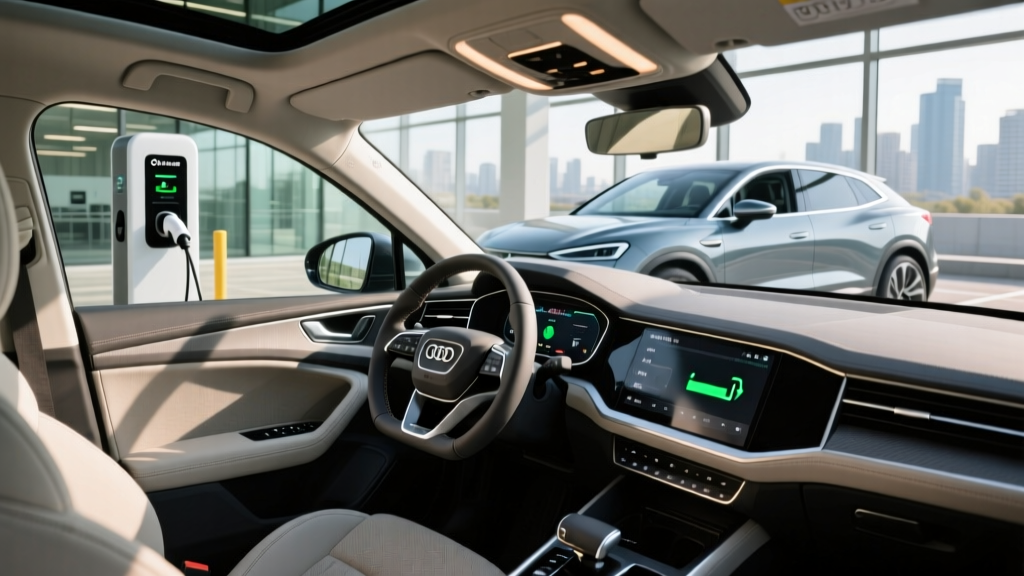
The Audi Q4 e-tron interior is the single strongest argument for choosing this SUV over its competitors. Where the Tesla Model Y leans minimalist to the point of austerity and the Hyundai Ioniq 5 embraces retro-futurism with hard plastics in lower-touch areas, the Q4 e-tron delivers the traditional Audi recipe: dense, soft-touch materials on the dash and door uppers, precise switchgear, and a cabin that feels assembled with care.
Materials and Build Quality
The dashboard uses a layered design with a stitched synthetic leather upper (real leather is optional on Prestige trims), aluminum-look trim, and a clean horizontal air vent strip. Door panels feature padded armrests and contrast stitching. The center console offers a padded knee rest on both sides — a small detail that matters on longer drives. Panel gaps are tight and consistent, and nothing rattles or squeaks even on broken pavement.
Seating and Passenger Space
Front seats are eight-way power-adjustable with optional ventilation and massage (Prestige trim). The seating position is upright and commanding, with good outward visibility thanks to relatively thin A-pillars. Rear legroom measures 38.5 inches — competitive with the Model Y and generous for the compact SUV class. Headroom is ample at 41.2 inches up front and 39.5 inches in the rear, even with the panoramic sunroof fitted.
The rear seat cushion is slightly short on thigh support for adults over six feet tall, a common compact SUV compromise. However, the seatback angle is comfortable, and a flat floor (no driveshaft tunnel) means the middle passenger has real foot space.
Infotainment and Technology
The 2026 Q4 e-tron uses Audi's latest MMI system on an 11.6-inch touchscreen, angled toward the driver. Response times are quick, and the tile-based interface is logical. Wireless Apple CarPlay and Android Auto are standard. A 10.25-inch digital instrument cluster handles speed, range, and navigation, and the optional augmented-reality head-up display overlays navigation arrows onto the windshield — genuinely useful for complex interchanges.
Physical climate controls have been replaced by touch-capacitive sliders on a lower panel. These look clean but are harder to use while driving than physical knobs — a recurring complaint in modern Audis. The steering wheel uses touch-sensitive controls that require deliberate presses; some drivers prefer physical buttons.
Cargo Space
Cargo volume is 24.8 cubic feet behind the rear seats and 54.4 cubic feet with the rear seats folded (60/40 split). That's competitive with the BMW iX1 and slightly less than the Tesla Model Y (30.2 cu ft rear / 72.1 cu ft folded). There is no frunk — the space under the hood houses electronics and the heat pump system. A powered liftgate is standard, and the load floor is flat and low.
Real-World Range vs. EPA Estimates
EPA Estimate: 265 miles (RWD 45) / 258 miles (AWD 55)
Real-World Expectation: In mixed driving at 65–75 mph in moderate temperatures (55–80°F), expect 235–250 miles from the AWD 55 and 245–260 miles from the RWD 45. At sustained highway speeds of 80 mph, plan for roughly 215–230 miles. In cold weather (below 30°F), range drops 20–30% — budget for 175–200 miles on the AWD model unless you precondition the battery while plugged in.
The Q4 e-tron's 82 kWh (77 usable) NMC lithium-ion battery pack is shared with the Volkswagen ID.4, but Audi's tuning prioritizes ride comfort and cabin quietness over efficiency. The result is a combined 95–100 MPGe — respectable, but behind the Tesla Model Y Long Range (117 MPGe combined) and the Hyundai Ioniq 5 (114 MPGe combined), per fueleconomy.gov.
The standard heat pump helps preserve range in cold weather by scavenging waste heat from the drivetrain rather than relying solely on resistive cabin heating. Preconditioning the battery while still plugged in (via the myAudi app) is essential for maximizing both range and charging speed in winter conditions.
Charging Speed: DC Fast and Home Level 2
| Charging Level | Power / Rate | Speed (Miles Added) | Notes |
|---|---|---|---|
| Level 1 (120V household) | ~1.4 kW | ~4 mi/hr | Emergency / overnight trickle only |
| Level 2 (240V home) | 11 kW (48A) | ~31 mi/hr | Full charge in ~7.5 hours |
| DC Fast Charge | Peak 175 kW | 10–80% in ~28 min | Tapers above 80% SoC; sustained avg ~120 kW |
The Q4 e-tron's 175 kW peak DC fast-charging rate is its most notable limitation versus competitors. The Hyundai Ioniq 5 and Kia EV6, built on 800-volt architectures, peak at 235–240 kW and complete a 10–80% charge in roughly 18 minutes. The Tesla Model Y peaks at around 250 kW on V3 Superchargers.
In practice, the Q4 e-tron sustains close to its 175 kW peak from roughly 10–35% SoC, then tapers progressively. The curve flattens meaningfully above 70%, which is why Audi quotes 10–80% rather than 10–100%. Charging from 80–100% can add another 25–30 minutes — plan your road-trip stops accordingly and charge to 80% unless you need the full battery.
On the NACS front: Audi has confirmed that 2026 Q4 e-tron models sold in North America are equipped with the NACS charge port (the Tesla connector), granting native access to Tesla Supercharger stalls without an adapter. This is a significant practical improvement over the CCS-port 2024–2025 models and expands the available fast-charging network substantially.
For home Level 2 charging, the onboard 11 kW charger is generous — most competitors offer 9.6–11.5 kW. A full overnight charge from near-empty takes about 7.5 hours on a 48-amp Level 2 circuit. A licensed electrician will typically install a NEMA 14-50 outlet or hardwired wall connector for $800–$2,000 depending on panel proximity and local permitting.
Performance and Driving Dynamics
The dual-motor Q4 55 e-tron produces 340 horsepower and 402 lb-ft of torque, delivering a 4.7-second 0–60 mph time. That's quick for daily driving — merging onto highways and passing slower traffic requires no planning. The single-motor Q4 45 (282 hp, 5.8 seconds to 60) is adequate but feels noticeably less urgent, especially when loaded with passengers and cargo.
Ride quality is where the Q4 e-tron separates itself from sportier rivals. The suspension tuning is firmly comfort-oriented, absorbing potholes and expansion joints with a composed, damped feel. Road noise is well-suppressed, and the cabin remains conversation-quiet even at 80 mph. This is not a corner-carving SUV — the steering is light and somewhat numb, and body roll is noticeable on twisty roads. If driving engagement is a priority, the BMW iX1 or Tesla Model Y Performance will feel more engaging.
Regenerative braking is adjustable via steering-wheel paddles (three levels plus an auto mode that uses radar to adjust regen based on traffic ahead). There is no true one-pedal driving mode that brings the car to a complete stop — it will creep at very low speeds, requiring the brake pedal. This is a deliberate Audi choice and a point of frustration for drivers accustomed to Nissan Leaf or Tesla-style one-pedal operation.
Pricing, Trims, and Federal Tax Credit Eligibility
| Trim | Drivetrain | Base MSRP | Est. After §30D Credit* |
|---|---|---|---|
| Premium | RWD (45) | $51,400 | $43,900 |
| Premium Plus | RWD (45) | $55,600 | $48,100 |
| Prestige | RWD (45) | $59,800 | $52,300 |
| Premium | AWD (55) | $58,200 | $50,700 |
| Premium Plus | AWD (55) | $62,400 | $54,900 |
| Prestige | AWD (55) | $66,600 | $59,100 |
*Estimated prices assume full $7,500 federal tax credit under IRS §30D. Actual eligibility depends on multiple factors. See checklist below.
Federal Tax Credit Eligibility (§30D)
- Vehicle MSRP cap: SUVs must be priced at or below $80,000. All Q4 e-tron trims qualify.
- Buyer income cap: Modified adjusted gross income must not exceed $150,000 (single), $225,000 (head of household), or $300,000 (married filing jointly).
- Battery sourcing: The vehicle must meet critical-minerals and battery-component sourcing requirements that tighten annually. For 2026, verify current compliance on fueleconomy.gov or with your dealer before purchase.
- Point-of-sale transfer: Under current IRS rules, eligible buyers can transfer the credit to the dealer at purchase, receiving the $7,500 as an immediate price reduction rather than waiting for a tax refund. Confirm with your dealer that they participate.
- Assembly: The Q4 e-tron for the North American market is assembled in Emden, Germany. Verify that current §30D final-assembly requirements are met — this has been a shifting target and should be confirmed at the point of sale.
Always consult a tax professional and check IRS.gov for the latest rules before relying on credit eligibility. State and local incentives may stack on top but vary by jurisdiction.
Driver Assistance and Safety Technology
SAE Automation Level: The Q4 e-tron's Audi adaptive cruise assist with lane guidance is a Level 2 driver-assistance system. You must keep your hands on the wheel and your eyes on the road at all times. This is not self-driving.
Standard safety features include automatic emergency braking with pedestrian detection, lane-departure warning, blind-spot monitoring, rear cross-traffic alert, and a surround-view camera (Premium Plus and above). The available Audi adaptive cruise assist combines adaptive cruise control with lane-centering and works well in highway traffic, maintaining smooth following distances and handling gentle curves competently.
However, the system is conservative — it will disengage and request driver input more frequently than GM's Super Cruise or Ford's BlueCruise on compatible highway sections. It also lacks the hands-free capability those competitors offer on mapped divided highways. For the Q4 e-tron, hands must remain on the steering wheel, detected via capacitive touch.
The Q4 e-tron earned a Top Safety Pick+ rating from the IIHS (applicable model years) with Good ratings across all crashworthiness tests. NHTSA ratings should be verified on nhtsa.gov for the specific 2026 model year.
Pros, Cons, and How It Stacks Up
Pros
- Premium interior materials and build quality that outclass mainstream rivals
- Comfortable, quiet ride ideal for commuting and highway cruising
- Standard NACS charge port for native Tesla Supercharger access (2026 models)
- Strong safety ratings and comprehensive standard driver assists
- Practical cargo space and rear-seat room for the compact SUV segment
- Heat pump standard for improved cold-weather efficiency
Cons
- 175 kW peak DC charging is slower than Ioniq 5, EV6, and Model Y
- No true one-pedal driving (won't hold at a complete stop)
- Touch-capacitive climate and steering-wheel controls are distracting
- Range and efficiency trail the segment leaders
- No frunk for additional cargo storage
- Price climbs quickly with AWD and higher trims
Competitor Snapshot
vs. Tesla Model Y Long Range: The Model Y offers more range (~320 miles EPA), faster charging, more cargo space, and a lower starting price — but its interior materials and ride quality don't match the Audi. Choose the Model Y for maximum efficiency and tech; choose the Q4 e-tron for cabin refinement.
vs. Hyundai Ioniq 5: The Ioniq 5 charges dramatically faster (18 min 10–80%), offers competitive range, and costs $8,000–$12,000 less. Its interior is stylish but uses more hard plastics. A strong value alternative if luxury badging isn't a priority.
vs. BMW iX1: The closest rival in spirit. The iX1 is slightly smaller, slightly sportier to drive, and similarly priced. The Q4 e-tron offers more rear-seat and cargo space.
Ownership Costs and Warranty
Audi covers the Q4 e-tron's battery pack and electric powertrain for 8 years or 100,000 miles, whichever comes first. The battery warranty guarantees a minimum of 70% capacity retention over that period — industry standard. The basic vehicle warranty is 4 years / 50,000 miles, with 4 years of complimentary scheduled maintenance (which for an EV primarily means cabin air filter changes and fluid top-offs).
Insurance costs for the Q4 e-tron run 15–25% higher than a comparably priced gas SUV, consistent with EV industry averages. Shop quotes before purchasing — premiums vary significantly by carrier, ZIP code, and driving history.
Charging cost at home (at the US average of ~$0.16/kWh) works out to roughly $0.056 per mile for the AWD model — compared to $0.12–$0.15 per mile for a 25 MPG gas SUV at $3.50/gallon. Public DC fast charging is more expensive ($0.35–$0.55/kWh depending on network and time of day), making home charging the clear economic advantage of EV ownership.
Frequently Asked Questions
What is the real-world range of the Audi Q4 e-tron?
The EPA rates the AWD Q4 55 e-tron at 258 miles and the RWD Q4 45 at 265 miles. In real-world mixed driving at moderate temperatures, expect 235–260 miles. Sustained highway driving at 75–80 mph reduces this to roughly 215–230 miles, and cold weather (below 30°F) can drop range by 20–30%.
How fast does the Q4 e-tron charge at home and on the road?
On a Level 2 home charger (240V, 48A), the Q4 e-tron charges at 11 kW, adding about 31 miles of range per hour and reaching a full charge in roughly 7.5 hours. On a DC fast charger, it peaks at 175 kW and charges from 10–80% in approximately 28 minutes — slower than the Ioniq 5 or Model Y.
Does the Audi Q4 e-tron qualify for the $7,500 federal EV tax credit?
Eligibility under IRS §30D depends on buyer income (under $150K single / $300K joint), vehicle MSRP (under $80K for SUVs — all trims qualify), battery-sourcing compliance, and final-assembly requirements. The Q4 e-tron is assembled in Germany, so confirm current compliance with your dealer and a tax professional before purchase. Eligible buyers can transfer the credit to the dealer for a point-of-sale price reduction.
Is the Audi Q4 e-tron worth buying over the Tesla Model Y or Ioniq 5?
If interior quality, ride comfort, and a traditional luxury experience are your top priorities, the Q4 e-tron is worth the premium. If you prioritize maximum range, the fastest charging, or the lowest price, the Model Y and Ioniq 5 are stronger choices. Test-drive all three — the cabin experience is where the Audi makes its case.
Does the Q4 e-tron have one-pedal driving?
No. The Q4 e-tron offers adjustable regenerative braking via steering-wheel paddles, including an auto mode that adapts to traffic. However, the regen does not bring the vehicle to a complete stop and hold it — you must use the brake pedal at stops. This is a deliberate Audi engineering choice.
What connector does the 2026 Q4 e-tron use?
The 2026 Audi Q4 e-tron for North America is equipped with the NACS (Tesla) charge port, providing native access to Tesla Supercharger stations without an adapter. Previous model years used CCS1 and require a NACS adapter for Supercharger access.