Quick Verdict: Is the Audi Q4 e-tron EV Worth It in 2026?
The 2026 Audi Q4 e-tron is a premium compact electric SUV targeting buyers who want German build quality, a usable ~265-mile EPA range, and relatively quick DC fast charging (up to 175 kW, 10–80% in roughly 28 minutes). Starting around $49,800 before incentives, it qualifies for partial or full §30D federal tax credit depending on battery sourcing and buyer income. It's best suited for drivers with home Level 2 charging who commute 30–60 miles daily and want a luxury badge without stepping up to the larger, pricier Q8 e-tron. Highway and cold-weather driving will reduce real-world range to roughly 220–240 miles — plan accordingly.
Range, Battery, and Real-World Efficiency
The 2026 Q4 e-tron carries an 82 kWh usable lithium-ion battery pack (NMC chemistry) across all trims. The rear-wheel-drive Q4 40 e-tron achieves an EPA-estimated 265 miles of range, while the dual-motor Q4 55 e-tron with quattro all-wheel drive drops to approximately 242 miles due to the added motor weight and higher rolling resistance.
EPA Range vs. Real-World Expectations
| Trim | EPA Range | Real-World Highway (70 mph) | Cold Weather (below 30°F) |
|---|---|---|---|
| Q4 40 e-tron (RWD) | 265 mi | ~230–240 mi | ~195–215 mi |
| Q4 55 e-tron (AWD) | 242 mi | ~210–220 mi | ~175–195 mi |
Cold weather reduces range because the battery must expend energy heating itself and the cabin. The Q4 e-tron includes a heat pump on most trims, which recovers some efficiency, but expect a 15–25% range penalty in sustained sub-freezing conditions. Preconditioning the battery while plugged in mitigates this significantly.
Efficiency on the combined cycle lands around 99 MPGe for the Q4 40 e-tron per fueleconomy.gov, translating to roughly 34 kWh per 100 miles. That's competitive with the BMW iX1 and slightly behind the Tesla Model Y's class-leading efficiency of ~28 kWh/100 mi.
Charging Speed and Connector Details
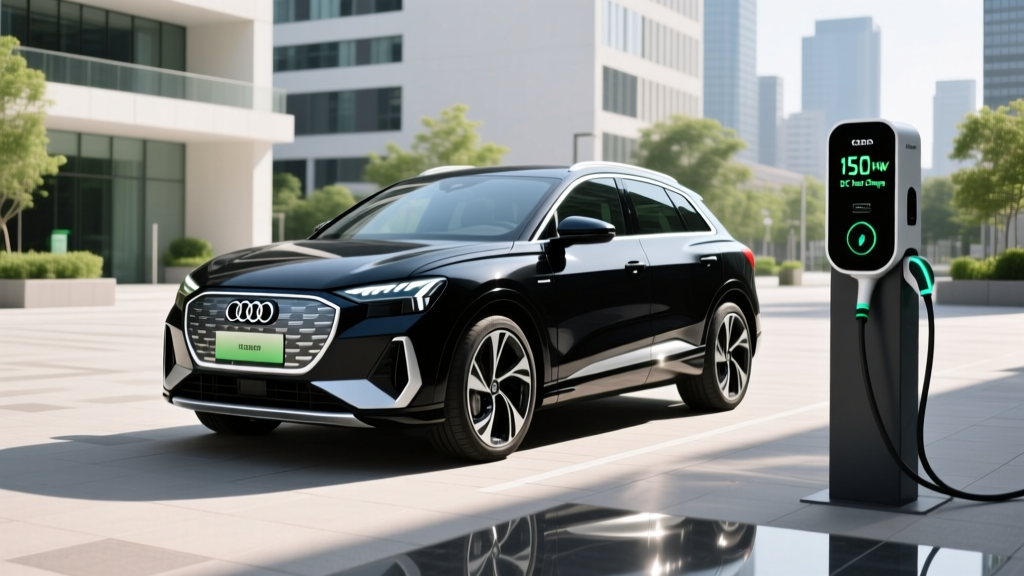
Audi equips the 2026 Q4 e-tron with a CCS1 (Combined Charging System) DC fast-charge port. For the 2026 model year, Audi has not transitioned to the NACS (Tesla-style) connector, though a NACS adapter is available for Supercharger access on the Electrify America and partner networks.
| Charging Level | Power (kW) | Time / Rate | Notes |
|---|---|---|---|
| Level 1 (120V household) | ~1.4 kW | ~3–4 mi/hr | Emergency/top-up only; full charge takes 60+ hours |
| Level 2 (240V home/public) | 11 kW (max onboard) | ~25 mi/hr, 0–100% in ~8.5 hrs | Requires 48A circuit; ideal for overnight home charging |
| DC Fast Charge (CCS) | 175 kW peak | 10–80% in ~28 min | Peak rate sustained to ~30% SoC, then tapers; 80–100% adds ~15 min |
The 175 kW peak charge rate is respectable but not class-leading — the Hyundai Ioniq 5 peaks at 240 kW and charges 10–80% in about 18 minutes. The Q4 e-tron's charge curve holds near peak for roughly the first 10–15 minutes on a 350 kW-capable station, then steps down through 125 kW and eventually below 50 kW past 80%. For road trips, plan stops around the 20–80% window to minimize time at the charger.
At home on a Level 2 charger, the 11 kW onboard charger means you'll recover roughly 200 miles overnight in 8 hours — more than enough for daily driving. A dedicated 48-amp Level 2 wallbox installation typically costs $800–$2,000 including equipment and electrician labor, depending on panel proximity and whether a 200-amp service upgrade is needed.
Pricing, Tax Credits, and Total Cost of Ownership
The 2026 Audi Q4 e-tron starts at approximately $49,800 for the Premium trim (RWD) and climbs to around $58,000 for the Prestige quattro. Destination charges add roughly $1,195.
| Trim | Drivetrain | MSRP (approx.) | Est. Federal Credit |
|---|---|---|---|
| Premium (40 e-tron) | RWD | $49,800 | Up to $7,500* |
| Premium Plus (40 e-tron) | RWD | $53,200 | Up to $7,500* |
| Premium Plus (55 e-tron) | AWD | $56,400 | Up to $7,500* |
| Prestige (55 e-tron) | AWD | $58,000 | Up to $7,500* |
*Federal §30D tax credit eligibility depends on battery critical-mineral sourcing, buyer adjusted gross income (single filers ≤ $150,000; joint ≤ $300,000), and the vehicle's MSRP staying under the $80,000 SUV cap. The credit can now be transferred to the dealer at point of sale as an upfront discount. Verify current eligibility at irs.gov before purchasing — sourcing requirements tighten annually.
5-Year Cost of Ownership: Q4 e-tron vs. Audi Q5 (Gas)
| Category | Q4 40 e-tron (EV) | Audi Q5 45 TFSI (Gas) |
|---|---|---|
| Purchase Price (after credit) | ~$42,300 | ~$48,500 |
| Fuel/Energy (5 yrs, 15k mi/yr) | ~$4,800 (home charging avg.) | ~$11,250 ($3.75/gal, 25 MPG) |
| Maintenance (5 yrs) | ~$1,800 | ~$4,200 |
| Insurance (5 yrs, avg.) | ~$9,500 | ~$8,200 |
| Estimated Depreciation | ~$18,000 | ~$17,500 |
| Total 5-Year Cost | ~$76,400 | ~$89,650 |
The EV wins on fuel and maintenance savings — no oil changes, fewer brake replacements due to regenerative braking, and electricity costing roughly $0.14/kWh nationally. Insurance runs 10–20% higher on the Q4 e-tron due to repair costs and battery replacement risk. Depreciation on luxury EVs remains steeper than gas equivalents but has stabilized as the market matures.
Performance, Tech, and Interior
The Q4 40 e-tron (RWD) produces 282 horsepower and 229 lb-ft of torque from its single rear motor, reaching 0–60 mph in approximately 6.7 seconds. The Q4 55 e-tron (AWD) bumps output to 340 hp and 339 lb-ft, cutting the 0–60 time to about 5.0 seconds. Neither is a performance EV, but both deliver smooth, instant torque that makes highway merging effortless.
Inside, the Q4 e-tron uses Audi's latest MMI infotainment system on a 11.6-inch touchscreen with wireless Apple CarPlay and Android Auto. Build quality is a clear step above the Tesla Model Y and Volkswagen ID.4 (its MEB-platform sibling), with soft-touch materials, a flat floor, and 24.8 cubic feet of cargo space behind the rear seats (57.1 cu ft with seats folded). There is no front trunk (frunk) — a packaging consequence of the MEB platform's front-mounted power electronics.
Driver assistance includes adaptive cruise control with stop-and-go, lane-centering assist, and traffic-jam assist. This is SAE Level 2 automation — you must keep your hands on the wheel and eyes on the road at all times. It is not self-driving. The system is competent for highway cruising but requires active supervision.
EV vs. Gas: Common Misconceptions Addressed
| Myth | Fact (with data) |
|---|---|
| "EVs are worse in winter." | Range drops 15–25% in sub-freezing weather, but preconditioning while plugged in recovers most of the loss. The Q4 e-tron's heat pump helps. Winter traction with quattro AWD is excellent. |
| "Charging takes too long." | Home Level 2 charging happens while you sleep — 8 hours adds ~200 miles. DC fast charging to 80% takes ~28 minutes, comparable to a sit-down meal stop on a road trip. |
| "Batteries need replacing every few years." | Audi warranties the Q4 e-tron battery for 8 years/100,000 miles against degradation below 70% capacity. Real-world MEB-platform data shows ~5–8% degradation at 100k miles. Replacement, if ever needed, runs $12,000–$16,000 out of warranty. |
| "EVs cost more to own." | Over 5 years, the Q4 e-tron saves ~$6,400 on fuel and ~$2,400 on maintenance vs. the gas Q5, even after accounting for higher insurance and slightly steeper depreciation. |
| "There aren't enough chargers." | There are over 190,000 public charging ports in the U.S. per the DOE, and the Q4 e-tron's CCS connector is compatible with Electrify America, EVgo, ChargePoint, and (with adapter) Tesla Superchargers. Home charging covers 80%+ of most drivers' needs. |
Decision Framework: Is the Q4 e-tron the Right EV for You?
Choose the Audi Q4 e-tron If:
- You have access to home Level 2 charging (garage or driveway with 240V circuit)
- Your daily commute is under 60 miles round-trip, with occasional 200+ mile road trips
- You value premium interior materials, quiet cabin isolation, and brand prestige over maximum range-per-dollar
- You live in a moderate or warm climate, or you can precondition in cold weather
- You qualify for the §30D credit based on income and the vehicle's current sourcing compliance
Consider Alternatives If:
- You need 300+ miles of range: The Tesla Model Y Long Range offers 310+ EPA miles and NACS Supercharger access natively, starting around $47,000.
- You rely exclusively on public charging: The Hyundai Ioniq 5 charges significantly faster (240 kW peak, 18 min 10–80%) and has NACS compatibility for 2026.
- Budget is the top priority: The Volkswagen ID.4 shares the Q4 e-tron's platform and battery but starts ~$10,000 lower, albeit with a less refined interior.
- You need three rows or max cargo: The Kia EV9 or Rivian RDS offer more space; the Q4 e-tron is strictly a two-row compact SUV.
Battery Longevity and Warranty
Audi covers the Q4 e-tron's high-voltage battery with an 8-year/100,000-mile warranty guaranteeing at least 70% capacity retention. The NMC chemistry in this pack is proven across the VW Group's MEB platform — vehicles like the ID.4 and Skoda Enyaq have demonstrated modest degradation curves, typically losing 5–8% state of health (SoH) over the first 100,000 miles when DC fast charging is used moderately.
To maximize battery lifespan:
- Set daily charge limits to 80% for routine driving; charge to 100% only before long trips
- Precondition the battery before DC fast charging (the car does this automatically when a charger is set in navigation)
- Avoid leaving the car at 100% SoC for extended periods, especially in hot weather
- Use Level 2 home charging as your primary method; reserve DC fast charging for road trips
Frequently Asked Questions
Does the 2026 Audi Q4 e-tron qualify for the $7,500 federal tax credit?
It can, but eligibility depends on three factors: (1) your adjusted gross income must fall under §30D caps ($150K single / $300K joint), (2) the vehicle's battery must meet current-year critical mineral and component sourcing thresholds, and (3) the MSRP must stay under the $80,000 SUV cap — which all Q4 e-tron trims do. The credit can be applied at point of sale as a direct price reduction. Confirm current sourcing compliance with your dealer and check IRS guidelines before signing.
Can I charge the Q4 e-tron at Tesla Superchargers?
Yes, with Audi's CCS-to-NACS adapter. The Q4 e-tron retains the CCS1 port for 2026. The adapter unlocks access to Tesla's Supercharger network, which is the largest and most reliable DC fast-charging network in the U.S. Expect charge speeds to be limited by the Q4's 175 kW peak, even at 250 kW V3 Superchargers.
How does the Q4 e-tron compare to the Tesla Model Y?
The Model Y Long Range offers more EPA range (~310 mi vs. 265 mi), faster acceleration (4.8s vs. 6.7s 0–60), native NACS Supercharger access, and a lower starting price. The Q4 e-tron counters with superior interior material quality, a quieter cabin, more traditional dealership service, and a more intuitive driver-assist interface. If range and charging infrastructure are your top priorities, the Model Y wins. If build quality and luxury feel matter more, the Q4 e-tron is the stronger pick.
What happens if the battery degrades past 70% within the warranty period?
Audi will repair or replace modules within the pack to bring capacity back above the 70% threshold at no cost to you. Full pack replacement is rare — most degradation issues are resolved by swapping individual modules. Out of warranty, a full pack replacement costs approximately $12,000–$16,000, though this is uncommon within the first 150,000 miles based on current MEB-platform data.
Is the Q4 e-tron good for road trips?
It's adequate but not ideal. With ~230 miles of real-world highway range and a 28-minute 10–80% charge stop, you'll plan charging breaks every 3–3.5 hours on the interstate. That's manageable, but vehicles with 300+ mile range and faster charging (like the Ioniq 5 or Model Y) require fewer and shorter stops. The CCS adapter for Supercharger access helps significantly for route planning.