Quick Verdict: The Audi Q4 45 e-tron at a Glance
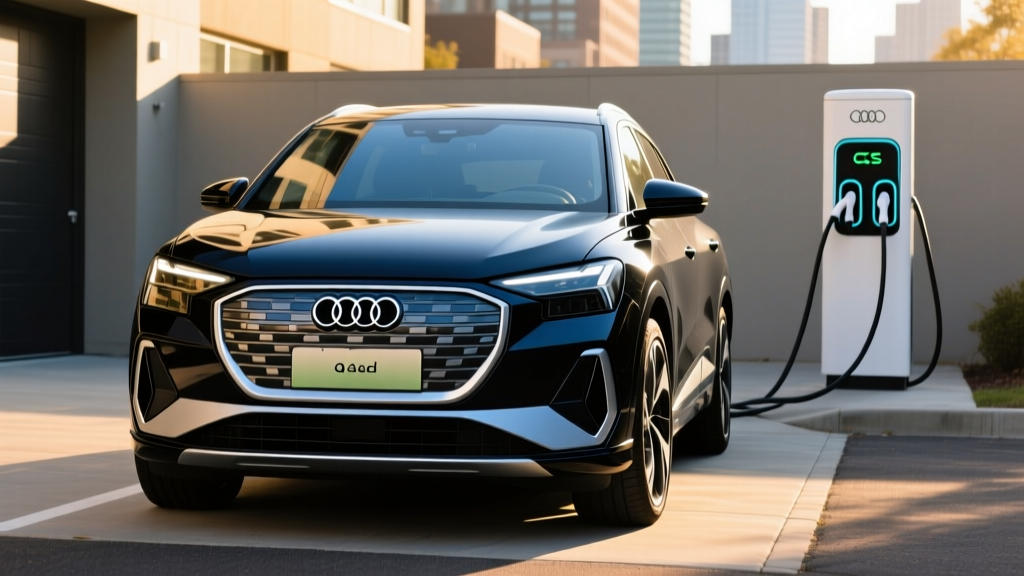
The Audi Q4 45 e-tron occupies a specific niche in the compact luxury electric SUV segment: it prioritizes refinement, cabin quality, and approachable driving dynamics over raw range or segment-leading charging speed. Built on the Volkswagen Group's MEB platform alongside the VW ID.4, the Q4 45 e-tron wraps that architecture in a more premium shell with Audi's signature interior materials, a quieter ride, and a more polished infotainment experience than its mainstream cousin.
For 2026, the Q4 45 e-tron continues with a single-motor rear-wheel-drive layout as the volume seller, while the dual-motor Q4 55 e-tron handles all-weather and performance duties. The 45 variant is the one most buyers cross-shop against the Tesla Model Y, BMW iX1, Genesis GV60, and Volvo EX40. Here's everything you need to know before signing a lease or purchase agreement.
| Spec | Value |
|---|---|
| EPA Range | 265 miles |
| Battery (usable / gross) | 77 kWh usable / 82 kWh gross, NMC |
| Drivetrain | Rear-wheel drive (single motor) |
| Horsepower / Torque | 282 hp / 339 lb-ft |
| 0–60 mph | 5.8 seconds |
| Max DC Fast Charge | 175 kW (peak) |
| 10–80% DC Charge Time | ~28 minutes |
| Level 2 Home Charge Rate | 11.0 kW (~33 mi/hr) |
| MPGe (city / hwy / combined) | 114 / 94 / 104 MPGe |
| Energy Consumption | 32 kWh/100 mi |
| Cargo (behind rear / max) | 24.8 cu ft / 53.1 cu ft |
| Rear Legroom | 38.5 inches |
| Base MSRP (Premium) | $50,995 |
| Battery Warranty | 8 years / 100,000 miles |
Range and Efficiency: EPA vs. the Real World
The EPA rates the 2026 Q4 45 e-tron at 265 miles of combined range. That's competitive for the segment but not class-leading — the Tesla Model Y Long Range AWD posts 320 miles, and the Hyundai Ioniq 5 (with its larger battery option) reaches 303 miles. Range is only part of the picture, though; efficiency matters just as much for operating cost.
Real-World Range Reality Check
EPA sticker: 265 miles. In mixed driving at 70°F, expect 240–255 miles on a full charge. Sustained highway driving at 75+ mph drops that to roughly 215–230 miles due to aerodynamic drag. In freezing temperatures (below 32°F), plan for 185–210 miles — the Q4's heat pump (standard on 2026 models) helps, but cold still suppresses lithium-ion output and increases cabin heating load. Drivers in northern climates should budget for a 20–30% seasonal range reduction.
At 32 kWh per 100 miles combined, the Q4 45 e-tron's efficiency is mid-pack. The Model Y achieves roughly 28 kWh/100 mi, meaning the Audi costs about 14% more per mile to fuel on the same electricity rate. For an owner paying the U.S. average of $0.16/kWh for home charging, that translates to roughly $5.12 per 100 miles — still dramatically cheaper than a comparable gas-powered Audi Q5 at current fuel prices.
Data source: EPA Fuel Economy (fueleconomy.gov).
Charging Speed: DC Fast Charging and Home Setup
Charging is where the MEB platform shows its age relative to 800-volt competitors. The Q4 45 e-tron maxes out at 175 kW peak on DC fast chargers — respectable, but the Hyundai Ioniq 5 and Kia EV6 can pull 240+ kW on their 800V architectures, and the Porsche Macan Electric peaks even higher.
| Charge Level | Power / Voltage | Miles Added per Hour | Time / Notes |
|---|---|---|---|
| Level 1 (120V household) | 1.4 kW | ~4 mi/hr | Full charge: ~55 hours (emergency use only) |
| Level 2 (240V home / public) | 11.0 kW | ~33 mi/hr | Full charge: ~8 hours (overnight) |
| DC Fast Charge (CCS) | 175 kW peak | Up to ~190 mi in 30 min | 10–80%: ~28 min; tapers above 80% |
A critical nuance: 175 kW is a peak, not a sustained rate. The Q4 45 e-tron's charge curve holds near peak output between roughly 10% and 35% state of charge, then progressively tapers. From 50% to 80%, average speed drops to approximately 90–110 kW. This means the advertised 28-minute 10–80% time assumes ideal battery preconditioning and a capable 175+ kW charger — conditions you won't always find on Electrify America or EVgo networks where charger uptime and actual output vary.
Preconditioning matters. The Q4 45 e-tron will warm the battery toward its optimal charging temperature when you navigate to a DC fast charger in the MMI system. If you arrive at a charger without preconditioning — especially in cold weather — peak rate may initially be 60–80 kW before climbing. Always set the charger as your navigation destination to enable this.
Connector note: The 2026 Q4 45 e-tron ships with a native NACS (Tesla-style) charge port, aligning with Audi's transition to the North American Charging Standard. A CCS adapter is included for legacy Electrify America and other CCS stations. This gives Q4 owners access to the Tesla Supercharger network (now open to non-Tesla EVs via NACS) — a significant practical advantage for road trips.
Performance and Driving Impressions
The single rear-mounted motor produces 282 horsepower and 339 lb-ft of torque. The 0–60 mph time of 5.8 seconds is quick enough for confident highway merging and passing, though it trails the dual-motor Q4 55 e-tron (5.0 seconds) and competitors like the Tesla Model Y Long Range (4.8 seconds).
Where the Q4 45 e-tron earns its premium positioning is in ride quality and isolation. The suspension tuning filters road imperfections more effectively than the ID.4, and cabin noise levels at 70 mph are noticeably lower. The steering is precise but light — tuned for comfort over sportiness. Regenerative braking offers multiple levels selectable via steering-wheel paddles, but the Q4 does not offer true one-pedal driving in the way a Nissan Leaf or Chevrolet Bolt does; you'll still use the brake pedal regularly.
The rear-wheel-drive layout gives the Q4 45 e-tron a tighter turning circle (33.5 feet) than its AWD sibling, making it genuinely maneuverable in urban environments. If you live in a region with heavy snow or plan to tow (1,100 lb capacity for the RWD model — light cargo and bike racks only), the dual-motor Q4 55 e-tron with its 2,600-lb tow rating is the better choice.
Interior, Cargo, and Technology
The Q4's cabin is where the Audi badge justifies its price premium over the VW ID.4. Soft-touch materials, aluminum or wood inlays, and Audi's 10.1-inch MMI touchscreen (upgradable to 11.6 inches on higher trims) create an environment that feels a tier above mainstream EVs. The 10.25-inch digital instrument cluster is clear and configurable.
Cargo volume is practical for the compact SUV segment: 24.8 cubic feet behind the rear seats and 53.1 cubic feet with the 60/40 split rear seatbacks folded. That's slightly less than the Model Y (30.2 / 72.1 cu ft) but competitive with the BMW iX1 and Volvo EX40. There is no front trunk (frunk) — the space under the hood houses the power electronics and HVAC components.
Rear-seat comfort is a strength. The 38.5 inches of rear legroom accommodates adults on longer trips, and the relatively flat floor (thanks to the MEB skateboard) makes the middle seat usable. Headroom is generous even with the panoramic sunroof option.
Driver assistance: The Q4 45 e-tron comes standard with Audi Pre Sense Front (automatic emergency braking with pedestrian detection), Lane Departure Warning, and Adaptive Cruise Control with Stop & Go. The available Audi Adaptive Cruise Assist with Lane Guidance is an SAE Level 2 system — it manages steering, acceleration, and braking on highways, but the driver must remain fully attentive and keep hands on the wheel. This is not a hands-free system like GM's Super Cruise or Ford's BlueCruise, which permit hands-off driving on mapped highways.
ADAS Clarification: All driver-assistance features on the Q4 45 e-tron are SAE Level 2. The driver is responsible for monitoring the road at all times. No current Audi production vehicle offers Level 3 or higher autonomous driving in the United States.
Pricing, Trims, and Federal Tax Credit
The 2026 Q4 45 e-tron is offered in three trims, all sharing the same 77 kWh battery and single-motor powertrain:
| Trim | Base MSRP | Key Additions |
|---|---|---|
| Premium | $50,995 | 10.1" MMI, heated front seats, Audi Virtual Cockpit, power liftgate |
| Premium Plus | $54,595 | 11.6" MMI, panoramic roof, 360° cameras, Adaptive Cruise Assist, parking system |
| Prestige | $58,395 | Matrix-design LED headlights, head-up display, premium audio, Nappa leather |
All prices include destination charge. Options and packages can push a Prestige model past $62,000.
Federal Tax Credit Eligibility (IRS §30D)
The Audi Q4 45 e-tron's eligibility for the up to $7,500 federal clean vehicle credit under IRS §30D depends on several factors that change based on battery sourcing and buyer qualifications. As of 2026, the key requirements are:
- MSRP cap: SUVs must have a base MSRP at or below $80,000. All Q4 45 e-tron trims qualify.
- Buyer income cap: Modified adjusted gross income must not exceed $150,000 (single), $225,000 (head of household), or $300,000 (married filing jointly).
- Battery sourcing: The credit is split into two halves — $3,750 for meeting critical-minerals requirements and $3,750 for meeting battery-component requirements. Sourcing rules tighten annually, and vehicles using battery components from "foreign entities of concern" (FEOC) are disqualified. Audi's supply chain sourcing determines the exact credit amount each model year.
- Point-of-sale transfer: Eligible buyers can transfer the credit to the dealer at purchase, reducing the out-of-pocket price immediately rather than waiting for a tax refund.
Check the latest eligibility status at fueleconomy.gov and confirm with your tax professional before relying on a specific credit amount. The Q4 45 e-tron has historically qualified for a partial credit ($3,750) due to battery-component sourcing constraints, though this is subject to change as Audi adjusts its supply chain.
Ownership Costs and Warranty
Audi backs the Q4 45 e-tron's high-voltage battery with an 8-year / 100,000-mile warranty that guarantees at least 70% capacity retention. The limited vehicle warranty covers 4 years / 50,000 miles. These terms are standard for the luxury EV segment and match BMW and Mercedes-Benz, though Hyundai/Kia's 10-year / 100,000-mile battery warranty is more generous.
The NMC (nickel manganese cobalt) battery chemistry in the Q4 45 e-tron offers higher energy density than LFP (lithium iron phosphate) alternatives, which is why Audi can fit 82 kWh gross into a compact SUV footprint. The trade-off is that NMC batteries generally experience slightly faster long-term degradation than LFP, and Audi recommends keeping daily charge levels between 20% and 80% for optimal longevity — reserving 100% charges for road trips.
Insurance for the Q4 45 e-tron typically runs 15–25% higher than a comparable gas-powered Q5, reflecting the higher repair costs associated with EV battery packs and specialized body structures. Get quotes from multiple carriers before purchasing.
Maintenance is minimal: no oil changes, no spark plugs, no transmission fluid. Expect to replace cabin air filters, wiper blades, brake fluid (every 2 years), and tires. The regenerative braking system significantly extends brake pad life — many EV owners report original pads lasting 80,000+ miles.
How the Q4 45 e-tron Stacks Up Against Competitors
Pros
- Quiet, refined cabin that feels genuinely premium
- NACS charge port enables Tesla Supercharger access
- Comfortable ride quality, well-isolated from road noise
- Practical cargo and rear-seat space for families
- Intuitive infotainment with physical volume knob
Cons
- Range (265 mi) trails Model Y (320 mi) and Ioniq 5 (303 mi)
- DC charging capped at 175 kW — slower than 800V rivals
- No one-pedal driving mode
- No front trunk (frunk) for extra storage
- Federal tax credit may be partial ($3,750 vs. full $7,500)
Choose the Q4 45 e-tron if you prioritize cabin refinement, ride comfort, and brand prestige over maximum range or the fastest charging. It's well-suited for daily commuters with home Level 2 charging who want a luxury badge without stepping up to the much pricier Audi Q8 e-tron or Porsche Macan Electric. Families who take 2–3 road trips per year will appreciate Supercharger access via NACS, though the 265-mile range means more frequent stops than a Model Y would require.
Look elsewhere if range is your top priority (Tesla Model Y, Hyundai Ioniq 5), you need hands-free highway driving (Cadillac Lyriq with Super Cruise, Ford Mustang Mach-E with BlueCruise), or you want the fastest possible DC charging (Ioniq 5, EV6, or any 800V platform vehicle).
Frequently Asked Questions
What is the real-world range of the Audi Q4 45 e-tron?
The EPA rates it at 265 miles combined. In real-world mixed driving at moderate temperatures, expect 240–255 miles. Highway-only driving at 75 mph reduces that to roughly 215–230 miles, and winter conditions (below freezing) can drop range to 185–210 miles depending on cabin heating use and whether you precondition the battery.
How fast does the Q4 45 e-tron charge at home and on DC fast chargers?
On a Level 2 home charger (240V, 48A circuit), the Q4 charges at up to 11.0 kW, adding about 33 miles of range per hour — a full charge takes roughly 8 hours overnight. On DC fast chargers, it peaks at 175 kW and charges from 10% to 80% in approximately 28 minutes under ideal conditions. Actual times vary with battery temperature, state of charge, and charger capability.
Does the 2026 Q4 45 e-tron qualify for the $7,500 federal EV tax credit?
It may qualify for a partial credit. Eligibility depends on battery-component and critical-mineral sourcing requirements that change annually under IRS §30D rules. The MSRP and buyer income caps are met by most trims and buyers. Check IRS.gov for the current determination and consult a tax professional. Point-of-sale transfer is available for qualifying purchases.
Is the Audi Q4 45 e-tron worth buying over the Tesla Model Y or Hyundai Ioniq 5?
It depends on your priorities. The Model Y offers more range (320 mi), faster charging, and more cargo space for less money. The Ioniq 5 charges faster (800V architecture) and offers a longer-range battery option. The Q4 45 e-tron wins on cabin refinement, ride comfort, and noise isolation. If luxury feel matters more to you than spec-sheet dominance, the Audi makes a compelling case — particularly now that NACS gives it Supercharger access.
Does the Q4 45 e-tron have one-pedal driving?
No. While the Q4 offers adjustable regenerative braking levels via steering-wheel paddles (including a strong regen mode), it does not come to a complete stop using regen alone. You will need to use the brake pedal for final stops, unlike the one-pedal experience in vehicles like the Nissan Leaf or Chevrolet Bolt.
Can I tow with the Q4 45 e-tron?
The rear-wheel-drive Q4 45 e-tron has a maximum tow rating of 1,100 pounds — suitable for a small cargo trailer or bike rack, but not for boats or campers. If towing is a priority, the dual-motor Q4 55 e-tron increases capacity to 2,600 pounds.