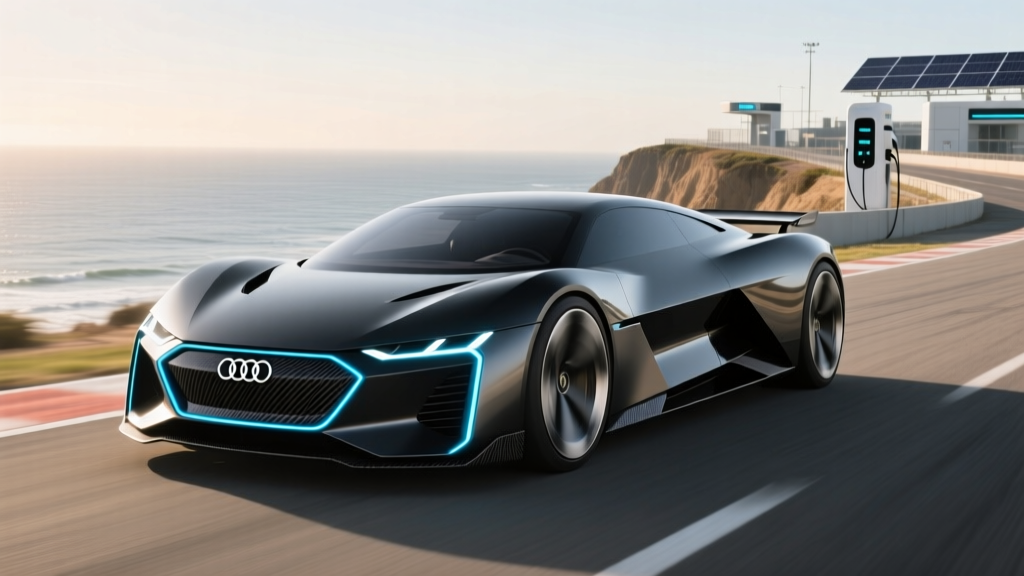
The Audi PB18 e-tron first appeared at Pebble Beach in 2018 as a radical, single-seat-capable electric supercar concept. Nearly eight years later, it remains exactly that — a concept. Despite periodic rumors and enthusiast petitions, Audi has never confirmed a production version, and the PB18 e-tron is not available for purchase in any market as of 2026.
That hasn't stopped search interest. With roughly 260 monthly searches, EV enthusiasts and Audi fans continue to ask: Will Audi ever build it? What were the claimed specs? And how would it stack up against production electric supercars like the Lotus Evija, Rimac Nevera, or even Audi's own e-tron GT lineup? This profile separates confirmed concept data from speculation and puts the PB18 e-tron's engineering in context.
Audi PB18 e-tron: Concept Specifications at a Glance
Because the PB18 e-tron never entered production, there are no EPA-certified figures, no MSRP, and no crash-test ratings. The numbers below are Audi's claimed concept specifications from its 2018 reveal and subsequent press materials. Treat them as engineering targets, not buyer-ready data.
| Attribute | Claimed Figure | Status |
|---|---|---|
| Production status | Concept only (2018) | Not available for purchase |
| Battery capacity | 95 kWh (claimed) | Preliminary |
| Battery chemistry | Not disclosed (likely NMC) | Unconfirmed |
| Range (WLTP) | ~310 miles / 500 km | Audi estimate, not EPA |
| EPA range | None — never certified | N/A |
| Max DC fast-charge rate | 150 kW (claimed, 800V architecture) | Preliminary |
| 10–80% charge time | ~15 minutes (claimed) | Preliminary |
| Wireless charging | Inductive pad (concept demo) | Not production-ready |
| Powertrain | Tri-motor AWD (1 front, 2 rear) | Concept configuration |
| Horsepower | 671 hp (500 kW) / up to 764 hp with boost | Claimed |
| Torque | 612 lb-ft (830 Nm) | Claimed |
| 0–62 mph (0–100 km/h) | Under 2.0 seconds | Claimed |
| Drivetrain | AWD, torque-vectoring rear axle | Concept |
| Weight | ~3,417 lb (1,550 kg) | Claimed, unverified |
| Length / Width / Height | 179.1 in / 78.7 in / 48.4 in | Concept body |
| Seating | 1 (center) or 2 (offset mode) | Concept feature |
| MSRP | None — never priced | N/A |
| Federal tax credit | Not eligible (not a production vehicle) | N/A |
Range and Efficiency: WLTP vs. Real-World Reality
The 95 kWh battery, if it used current-generation NMC (nickel-manganese-cobalt) cells, would likely deliver efficiency in the range of 30–35 kWh per 100 miles under spirited driving — comparable to other high-performance EVs. For reference, the production Audi RS e-tron GT achieves 79 MPGe combined (43 kWh/100 mi) on the EPA cycle, but it's a heavier, more comfort-oriented grand tourer. A lightweight, mid-engine-style supercar like the PB18 would trade efficiency for raw performance.
Charging: 800V Architecture Ahead of Its Time
One of the PB18 e-tron's most forward-looking claims was its 800-volt electrical architecture, the same platform Audi co-developed with Porsche for the Taycan and e-tron GT. In 2018, this was cutting-edge; by 2026, 800V is becoming mainstream across Hyundai/Kia, GM's Ultium, and Lucid.
| Charging Level | Claimed Spec | Context |
|---|---|---|
| DC Fast Charge (peak) | 150 kW | Conservative for 800V; Porsche Taycan peaks at 320 kW (2025+) |
| 10–80% time | ~15 minutes (claimed) | Would require sustained ~200+ kW; 150 kW peak suggests longer actual time |
| Level 2 (AC) | Not disclosed | Likely 11–22 kW onboard charger (European spec norm) |
| Wireless inductive | Demonstrated at 11 kW | No production vehicle offers this at scale in the U.S. |
A critical reality check on the 15-minute claim: a 95 kWh battery charged from 10% to 80% requires roughly 66.5 kWh of energy delivery. At a sustained 150 kW, that takes about 27 minutes. To achieve 15 minutes, the PB18 would need to sustain roughly 266 kW average — possible with modern 800V cells (as Lucid and Hyundai now demonstrate), but the 150 kW peak figure Audi cited contradicts the 15-minute time claim. This discrepancy is common in concept-car marketing; production specs would need to resolve it.
The wireless inductive charging pad was a showpiece feature. As of 2026, no U.S.-market EV supports wireless charging at any meaningful scale, and SAE J2954 standardization is still in early adoption. Don't expect this on any near-term Audi production model.
Performance Engineering: Tri-Motor, Sub-2-Second Ambition
The PB18 e-tron's tri-motor layout — one on the front axle, two on the rear — was designed for extreme torque vectoring. Audi claimed 671 horsepower (500 kW) continuous with a temporary boost function pushing to 764 hp. Combined with a claimed curb weight of just 3,417 pounds — roughly 1,000 pounds lighter than a production RS e-tron GT — the power-to-weight ratio would rival or exceed any production EV.
The sub-2.0-second 0–62 mph claim places the PB18 in hypercar territory alongside the Rimac Nevera (1.85 seconds) and Pininfarina Battista (1.79 seconds). Both of those vehicles entered limited production at prices exceeding $2 million. Whether Audi could have achieved this with a more accessible price point remains an open engineering question.
The concept also featured an adjustable ride height system that dropped the body for track use and a rear diffuser that extended at speed — active aerodynamics that would have been essential to manage the thermal load on the battery and motors during sustained high-speed driving.
Design and Technology: The Sliding Seat and Transparent OLED
The PB18's most-discussed interior innovation was its adjustable seating position. The driver's seat and instrument cluster could slide laterally from a centered "monoposto" (single-seat race car) position to an offset position that allowed a passenger seat to deploy beside it. This meant the car could function as a single-seat track weapon or a two-seat grand tourer, depending on the driver's preference.
The instrument panel used a transparent OLED display that projected navigation and telemetry data in the driver's sightline — a precursor to the augmented-reality head-up displays now appearing in production Audis like the Q6 e-tron and A6 e-tron.
Notably absent: any mention of SAE Level 3 or Level 4 autonomous driving. The PB18 was explicitly positioned as a driver's car, rejecting the autonomous-capsule trend of the late 2010s. In Audi's words, it was designed to give the driver "the experience of being in a racing car." This philosophy aligns with Audi's current production direction — the brand has scaled back its autonomous-driving ambitions and refocused on driver engagement.
Why the Audi PB18 e-tron Was Never Produced
Several factors explain why the PB18 e-tron remained a concept:
- Platform economics: The PB18 was built on a bespoke, low-volume architecture. Audi's production EVs use the shared PPE (Premium Platform Electric) developed with Porsche, which doesn't accommodate a mid-engine supercar layout at viable cost.
- Market positioning: Audi's performance halo role is filled by the RS e-tron GT (shared with the Porsche Taycan). A $2M+ limited-production supercar would compete with the Rimac Nevera in a market of perhaps a few hundred global buyers per year.
- VW Group strategy: Within Volkswagen Group, the hypercar role belongs to Bugatti (now Bugatti-Rimac) and Lamborghini. An Audi supercar would create internal brand conflict.
- Battery supply: In 2018–2020, high-energy-density cells suitable for a 1,550-kg supercar were not available at scale. Solid-state batteries, which would have been ideal for this application, remain in pre-production as of 2026.
The PB18's design DNA did influence production vehicles. The e-tron GT's roofline, rear haunches, and lighting signatures clearly reference the concept. If you're drawn to the PB18's aesthetics, the Audi RS e-tron GT is the closest production analog — starting at approximately $164,400 for the 2026 model year with 637 hp, a 2.5-second 0–60 time, and an EPA-estimated 232 miles of range.
How the PB18 e-tron Compares to Production Electric Supercars
| Attribute | Audi PB18 (Concept) | Lotus Evija | Rimac Nevera | Audi RS e-tron GT (2026) |
|---|---|---|---|---|
| Status | Not produced | Limited production (~130 units) | Limited production (150 units) | In production |
| Battery | 95 kWh (claimed) | 70 kWh | 120 kWh | 93.4 kWh (NMC) |
| Range | ~310 mi WLTP | ~250 mi (WLTP) | ~300 mi (WLTP) | 232 mi (EPA) |
| Horsepower | 671–764 hp | 1,972 hp | 1,914 hp | 637 hp |
| 0–60 mph | <2.0 sec (claimed) | <3.0 sec | 1.85 sec | 2.5 sec |
| Price | N/A | ~$2.3 million | ~$2.4 million | $164,400 (base MSRP) |
| Weight | 3,417 lb (claimed) | 4,160 lb | 4,739 lb | 5,139 lb |
The comparison reveals the PB18's core concept promise: supercar performance at a fraction of the weight. The Rimac Nevera and Lotus Evija both exceed 4,000 pounds, largely due to massive battery packs needed to sustain 1,900+ horsepower. Audi's claimed 3,417-pound target would have required aggressive use of carbon fiber and a smaller battery — a trade-off that limits range but maximizes handling dynamics. In the real world, hitting that weight with a 95 kWh pack and three motors has never been achieved in production; even the lightest current EVs with comparable batteries (like the Porsche Taycan at ~4,600 lb) are significantly heavier.
Is the Audi PB18 e-tron Worth Waiting For?
- Choose the Audi RS e-tron GT if you want Audi's most powerful production EV with real-world availability, EPA-certified range, dealer service support, and eligibility for evaluation under IRS §30D tax credit rules (though at $164,400 MSRP, it exceeds the §30D sedan cap of $55,000 and is ineligible).
- Choose the Porsche Taycan Turbo GT if you want the PPE-platform performance ceiling with 1,019 hp, a 10–80% charge time of approximately 18 minutes at 320 kW peak, and proven track capability.
- Choose the Rimac Nevera or Lotus Evija if you have a seven-figure budget and want verified sub-2-second performance in a limited-production electric hypercar.
- Do not wait for the PB18 e-tron unless Audi makes an official production announcement — which, as of 2026, has not happened and appears unlikely given VW Group's brand architecture.
Federal Tax Credit Note
Because the Audi PB18 e-tron is not a production vehicle, it has no MSRP, no VIN, and no eligibility under the IRS §30D Clean Vehicle Credit. For reference, any production vehicle must meet all of the following to qualify for up to $7,500 in federal credits (2026 rules):
- MSRP at or below $55,000 for sedans / $80,000 for SUVs, pickups, and vans
- Buyer adjusted gross income at or below $150,000 (single) / $300,000 (joint)
- Battery components and critical minerals meeting North American sourcing thresholds (phased in annually through 2029)
- Final assembly in North America
Any supercar-class vehicle would almost certainly exceed the MSRP cap, making the credit irrelevant. Consult a tax professional for your specific eligibility.
Frequently Asked Questions
Can I buy the Audi PB18 e-tron in 2026?
No. The Audi PB18 e-tron is a design concept revealed in 2018. It was never approved for production, and Audi has not announced any plans to build it. It cannot be ordered, reserved, or purchased in any market.
What was the claimed range of the Audi PB18 e-tron?
Audi claimed approximately 310 miles (500 km) under the WLTP test cycle. This figure was never EPA-certified. A realistic EPA-equivalent estimate would be roughly 260–280 miles, with real-world highway driving likely yielding 220–250 miles and cold-weather driving potentially dropping to 170–200 miles.
How fast would the PB18 e-tron charge?
Audi claimed a 150 kW peak DC fast-charge rate on an 800-volt architecture, with a 10–80% time of approximately 15 minutes. However, the math suggests that 15 minutes would require a sustained average well above 150 kW; a more realistic estimate at 150 kW peak would be 25–30 minutes for a 95 kWh battery. These figures remain unverified since no production vehicle exists to test.
Does the Audi PB18 e-tron qualify for the federal EV tax credit?
No. The §30D Clean Vehicle Credit applies only to new, production vehicles purchased from a dealer with a valid VIN. A concept car has no MSRP, no VIN, and no eligibility. Even if produced, a supercar-class vehicle would almost certainly exceed the §30D MSRP cap of $55,000 (sedans) or $80,000 (SUVs/trucks).
What Audi EV should I buy if I like the PB18 e-tron design?
The Audi RS e-tron GT is the closest production vehicle, sharing design language and the 800V PPE platform. It delivers 637 hp, a 2.5-second 0–60 time, 232 miles of EPA range, and starts at $164,400. The standard Audi e-tron GT quattro offers a more accessible entry at approximately $106,500 with 496 hp and 270 miles of range.
Will Audi ever build a mid-engine electric supercar?
There is no confirmed plan as of 2026. Audi's performance EV strategy focuses on the PPE platform (e-tron GT, upcoming Q6 e-tron variants) and SSP platform (next-generation, post-2027). A low-volume supercar would require a business case that competes internally with Lamborghini and Bugatti-Rimac within VW Group, making it unlikely in the near term.
Final Assessment: A Concept That Shaped Audi's EV Direction
The Audi PB18 e-tron's legacy isn't in what it became — it became nothing you can buy — but in what it signaled. Its 800-volt architecture, torque-vectoring tri-motor layout, and driver-first philosophy directly informed the production e-tron GT and Audi's broader EV performance identity. The sliding-seat concept, transparent OLED display, and wireless charging demo were all technology previews that have since appeared, in evolved forms, across Audi's production lineup.
For the enthusiast who keeps searching for the PB18 e-tron, the practical path is clear: the RS e-tron GT delivers 90% of the concept's spirit with 100% of the real-world usability, warranty coverage, and dealer support. The PB18 remains one of the most compelling "what if" concepts in EV history — and a reminder that concept-car specs should always be read with a critical, physics-informed eye.