Quick Answer: Should You Buy an Audi EV in Virginia Beach?
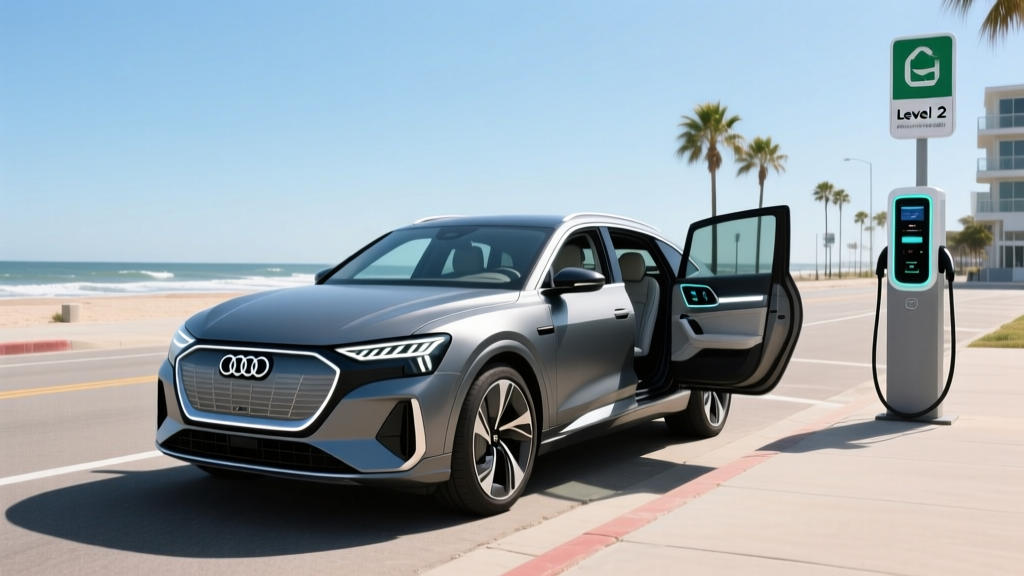
For Virginia Beach drivers, Audi's 2026 EV lineup — the Q4 e-tron, Q8 e-tron, and e-tron GT — offers premium electric driving with strong local practicality. The Q4 e-tron starts around $49,800 with 265 miles EPA range and is the most accessible. The Q8 e-tron offers 285 miles EPA and faster 170 kW DC charging, starting near $74,400. The e-tron GT delivers supercar performance from $106,500. Virginia Beach's mild winters mean minimal cold-weather range loss (typically 5–10%, vs. 20–30% in northern climates), and Dominion Energy's average residential rate of ~$0.13/kWh makes home charging significantly cheaper than gas. However, Audi EVs currently do not qualify for the full $7,500 federal §30D tax credit due to battery-sourcing requirements — a critical factor in your purchase math.
Audi's 2026 EV Lineup: Virginia Beach Specs at a Glance
Audi sells three battery-electric models in the U.S. for 2026. Each targets a different buyer: the compact luxury crossover segment, the midsize premium SUV space, and the performance sedan market. Here's how they stack up on the numbers that matter.
| Spec | 2026 Q4 e-tron | 2026 Q8 e-tron | 2026 e-tron GT |
|---|---|---|---|
| EPA Range | 265 mi | 285 mi | 238 mi (232 mi quattro) |
| Battery (usable) | 77 kWh (NMC) | 106 kWh (NMC) | 83.7 kWh (NMC) |
| Peak DC Fast Charge | 175 kW | 170 kW | 270 kW |
| 10–80% DC Charge Time | ~28 min | ~31 min | ~22 min |
| Level 2 (240V) Rate | 11 kW | 11 kW | 11 kW |
| 0–60 mph | 5.8s (quattro) | 5.5s (55 quattro) | 3.1s (quattro) |
| Horsepower | 295 hp (quattro) | 402 hp (55 quattro) | 522 hp (quattro) |
| MPGe (combined) | 95 MPGe | 83 MPGe | 85 MPGe |
| Starting MSRP | $49,800 | $74,400 | $106,500 |
| Battery Warranty | 8 yr / 100,000 mi | 8 yr / 100,000 mi | 8 yr / 100,000 mi |
Sources: EPA / fueleconomy.gov, Audi USA press specifications.
Real-World Range: What to Actually Expect in Virginia Beach
EPA estimates assume a mix of city and highway driving at moderate temperatures. In Virginia Beach's subtropical climate, your real-world results will be closer to EPA than in colder regions:
- Q4 e-tron: Expect ~240–255 mi on highway trips along I-64 or US-13 at 70+ mph. City driving with regenerative braking can match or exceed EPA.
- Q8 e-tron: Expect ~255–270 mi highway. The larger 106 kWh battery provides a comfortable buffer for trips to the Outer Banks or Richmond.
- e-tron GT: Expect ~210–225 mi highway. Performance driving significantly reduces range — aggressive acceleration can drop efficiency by 30% or more.
- Winter impact: Virginia Beach averages 41°F in January. Expect only ~5–10% range reduction, far less than the 20–30% loss in sub-freezing climates. All three models include heat pumps for efficient cabin heating.
Virginia Beach Charging: Home, Public, and Costs
Charging access is the make-or-break factor for EV ownership. Virginia Beach has a growing infrastructure, but your experience depends heavily on whether you can charge at home.
| Charging Level | Power | Connector | Miles Added/Hour (Q4 e-tron) | Best For |
|---|---|---|---|---|
| Level 1 (120V) | 1.4 kW | J1772 | ~4 mi/hr | Overnight top-ups, emergencies |
| Level 2 (240V) | 11 kW | J1772 | ~32 mi/hr | Daily home charging |
| DC Fast Charge | Up to 175 kW | CCS1 | ~200 mi in 28 min | Road trips, quick stops |
Home Charging Installation Costs
Most Virginia Beach homeowners will want a Level 2 (240V) home charger. Here's what to budget:
| Item | Low Estimate | High Estimate | Notes |
|---|---|---|---|
| Level 2 Charger (hardware) | $400 | $750 | Audi-recommended or ChargePoint Home Flex |
| Electrician labor | $600 | $2,000 | Depends on panel proximity and conduit run |
| Permit (Virginia Beach) | $75 | $150 | City electrical permit required |
| Panel upgrade (if needed) | $1,500 | $3,500 | Only if existing panel lacks capacity (200A recommended) |
| Total (typical install) | $1,075 | $2,900 | Without panel upgrade |
Virginia Beach homes built after 2000 typically have 200-amp panels with spare capacity. Older homes in neighborhoods like Great Neck or Kempsville may need upgrades. Always have a licensed electrician evaluate your panel before purchasing equipment.
Public DC Fast Charging Near Virginia Beach
The Virginia Beach/Norfolk metro area has multiple Electrify America, EVgo, and ChargePoint DC fast stations. Key locations include Lynnhaven Mall, Virginia Beach Town Center, and several stops along I-64 toward Williamsburg and Richmond. Audi's MMI navigation includes real-time charger availability and automatic preconditioning — the car warms or cools the battery en route to a DC charger to maximize charge speed.
Charging curve reality check: The Q4 e-tron's 175 kW peak rate only sustains from roughly 10–40% State of Charge. Above 60%, speed tapers to ~80 kW, and above 80% it drops to ~30 kW. This is normal for NMC battery chemistry and why 10–80% times are the meaningful metric — not peak kW alone.
Cost of Ownership: Audi EV vs. Gas vs. Hybrid in Virginia Beach
Let's compare five-year costs for a Virginia Beach driver covering 12,000 miles/year. We'll compare the Q4 e-tron against the Audi Q5 (gas) and the Audi Q5 PHEV (TFSI e) to give a full picture.
| Cost Factor (5-Year) | Q4 e-tron (EV) | Q5 45 TFSI (Gas) | Q5 55 TFSI e (PHEV) |
|---|---|---|---|
| Starting MSRP | $49,800 | $46,600 | $56,400 |
| Federal Tax Credit (§30D) | $0–$3,750* | $0 | $0–$3,750* |
| Fuel/Energy (5 yr) | $3,120** | $9,750*** | $5,400**** |
| Maintenance (5 yr) | $1,800 | $3,500 | $3,200 |
| Insurance (5 yr avg) | $10,500 | $8,400 | $9,200 |
| Estimated 5-Yr Total | $65,220 | $68,250 | $74,200 |
*Audi EVs face §30D credit limitations due to battery component and critical mineral sourcing rules. Some configurations may qualify for $3,750 (critical minerals only). Verify current eligibility at IRS.gov before purchase. Point-of-sale transfer is available through participating dealers.
**Based on 12,000 mi/yr, 3.0 mi/kWh avg efficiency, $0.13/kWh (Dominion Energy residential rate), 80% home charging / 20% public DC.
***Based on 12,000 mi/yr, 25 MPG combined, $3.35/gal regular unleaded (Virginia avg).
****PHEV: 50% electric (home), 50% gas driving.
Common Misconceptions About Audi EVs — Corrected
| Myth | Fact |
|---|---|
| "Audi EVs get the full $7,500 tax credit." | Most 2026 Audi EVs qualify for $0–$3,750 due to battery sourcing rules. The credit is not guaranteed — check the IRS qualified vehicle list before committing. |
| "The range isn't enough for road trips." | The Q8 e-tron's 285-mile EPA range and 170 kW DC charging handle I-64 corridor trips (Virginia Beach to D.C. is ~210 miles) with one 25-minute charge stop. |
| "EVs need more maintenance." | EVs eliminate oil changes, spark plugs, transmission fluid, and exhaust system repairs. Brake pad life extends 2–3x thanks to regenerative braking. Expect ~40–50% lower maintenance costs vs. gas. |
| "The battery will need expensive replacement." | Audi's 8-year/100,000-mile battery warranty covers capacity below 70%. NMC batteries in thermally managed Audis typically degrade 10–15% over 100,000 miles. Full replacement (rare) runs $12,000–$18,000 but is usually covered under warranty. |
| "I can't charge if I don't have a garage." | Virginia Beach has growing public Level 2 and DC fast infrastructure. However, relying solely on public charging adds 30–50% to your energy cost and requires time planning. Home charging is strongly recommended. |
Federal and Virginia EV Incentives: What You Actually Qualify For
The federal §30D Clean Vehicle Credit has strict requirements that affect Audi buyers:
- MSRP cap: SUVs must be under $80,000; sedans under $55,000. The Q4 e-tron qualifies; the Q8 e-tron (SUV, $80K cap) qualifies in most trims; the e-tron GT sedan exceeds the $55K cap and does not qualify.
- Buyer income cap: AGI must not exceed $300,000 (joint), $225,000 (head of household), or $150,000 (single).
- Battery sourcing: To receive the full $7,500, both battery components (≥60% North American) and critical minerals (≥50% from U.S. or FTA partners) must meet thresholds. Audi's supply chain currently meets critical mineral requirements for some models ($3,750) but not the full component requirement.
- Point-of-sale transfer: You can transfer the credit to the dealer at purchase for an immediate price reduction, rather than waiting for tax filing.
Virginia-specific: Virginia offers a $2,500 tax credit for qualifying EVs (income-limited, vehicle price under $45,000 — which excludes most Audi models). Dominion Energy also occasionally offers off-peak charging rebates. Check Virginia DEQ for current state incentive availability.
Is an Audi EV Right for Your Virginia Beach Lifestyle?
Virginia Beach's geography — flat coastal terrain, mild climate, and a metro area roughly 30 miles across — is favorable for EV ownership. But your specific situation determines which model (if any) makes sense.
Decision Framework: Which Audi EV Fits You?
Choose the Q4 e-tron if:
- You want the lowest entry price ($49,800) with adequate range for daily driving and occasional Richmond/Williamsburg trips
- You have home Level 2 charging and drive under 50 miles/day
- You want a compact luxury crossover for commuting on I-264 or Shore Drive
- Cargo space for a small family is a priority (24.8 cu ft rear seats up)
Choose the Q8 e-tron if:
- You regularly drive 200+ miles (Virginia Beach to D.C., Charlotte, or the Outer Banks)
- You want the longest range (285 mi EPA) and more spacious interior
- You tow occasionally (4,000 lb capacity — enough for a small boat trailer)
- Budget allows $74K+ and you value ride comfort and cabin quietness
Choose the e-tron GT if:
- Performance is the priority (3.1s 0–60, 522 hp)
- You primarily drive in-city and on shorter highway runs
- You accept 238 mi range as a tradeoff for sports-car dynamics
- MSRP above $100K and no federal tax credit eligibility are acceptable
Consider a PHEV (Q5 TFSI e) instead if:
- You lack home charging access (apartment, condo, street parking)
- You frequently drive 300+ miles and don't want to plan DC charge stops
- You want electric commuting (~23 mi EV range) with gas flexibility for longer trips
First-Time Audi EV Buyer Checklist
- Confirm home charging feasibility. Check your electrical panel (200A recommended). Get a quote from a licensed electrician before ordering the car.
- Verify §30D eligibility. Check the IRS qualified vehicle list for the exact trim and build date you're considering. Rules change periodically.
- Test drive with real routes. Drive the Q4 e-tron or Q8 e-tron on your actual commute and a highway segment. Note real-time kWh/mi consumption on the trip computer.
- Download charging apps. Install Electrify America, PlugShare, and ChargePoint apps before purchase. Map DC fast chargers along your most common road-trip routes.
- Ask about off-peak rates. Contact Dominion Energy about Time-of-Use (TOU) plans. Charging overnight (11 PM–5 AM) can reduce your per-kWh cost to ~$0.08, cutting fuel costs further.
- Factor in insurance. Get quotes before buying. Audi EV insurance averages 15–25% higher than equivalent gas Audis due to repair costs and parts pricing.
Frequently Asked Questions
Are there Audi dealerships with EV service in Virginia Beach?
Yes. Audi Virginia Beach (on Virginia Beach Blvd) is a certified e-tron sales and service center with high-voltage-trained technicians. For major battery or powertrain work, Audi's regional service network supports Hampton Roads.
How do Audi EVs handle hurricanes and flooding?
Audi EVs have sealed battery packs rated IP67 (submersion protection). However, no EV or gas car should be driven through floodwater. EV battery packs are mounted low and sealed, but saltwater exposure from storm surge can cause corrosion. Comprehensive insurance covers flood damage — confirm your policy includes this, especially in flood-prone areas like Sandbridge or parts of Princess Anne.
What happens if I need to drive from Virginia Beach to Washington D.C.?
The ~210-mile trip is within the Q8 e-tron's 285-mile EPA range if you start fully charged and drive conservatively (65 mph, climate control moderate). At highway speeds (75 mph), expect ~255 real-world miles — plan one 20-minute DC fast charge stop near Richmond (multiple Electrify America stations on I-95/I-64). The Q4 e-tron (265 EPA) will require one charge stop regardless.
Can I charge an Audi EV at Tesla Superchargers?
As of 2026, Audi has not adopted NACS (Tesla's connector) natively. Audi EVs use CCS1. However, Audi offers a NACS adapter for some models, enabling access to Tesla's V3 and V4 Supercharger network (with adapter). Check with your dealer for adapter availability and compatibility with your specific model year.
How long will the battery last before needing replacement?
Audi's NMC batteries with active thermal management typically lose 10–15% capacity over 100,000 miles based on industry fleet data. The 8-year/100,000-mile warranty covers capacity below 70% of original. Most owners will never need a battery replacement within typical ownership periods. Full replacement, if needed out of warranty, costs $12,000–$18,000 depending on model.
Is it cheaper to charge at home or use public DC fast chargers?
Home charging is significantly cheaper. At Dominion Energy's ~$0.13/kWh residential rate, a full Q4 e-tron charge (77 kWh) costs ~$10 for 265 miles. Public DC fast charging at Electrify America averages $0.35–$0.48/kWh, making that same charge $27–$37. Budget 80%+ home charging for the best economics.