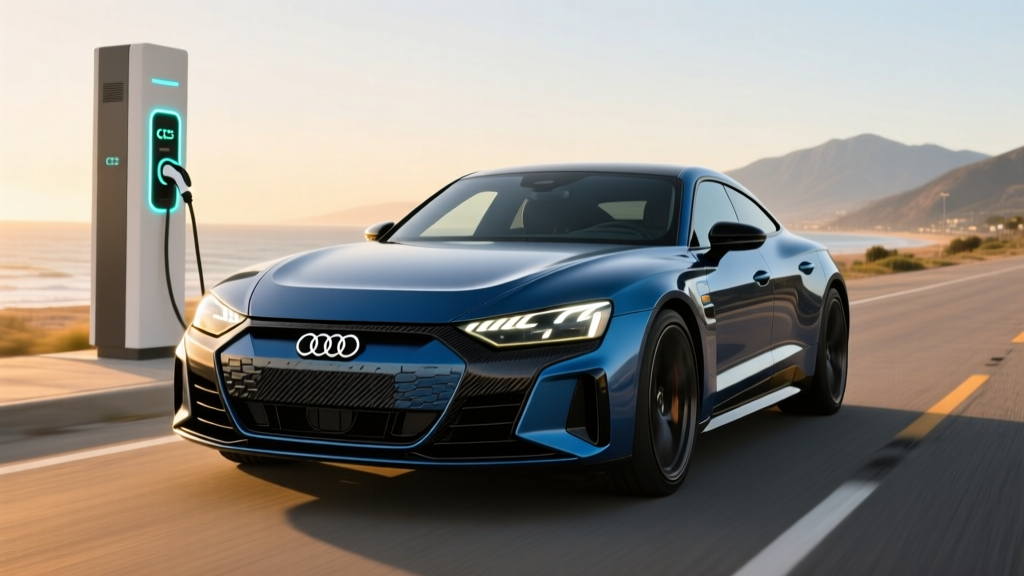
The 2026 Audi e-tron GT RS sits at the apex of Audi's electric lineup — a luxury grand tourer that trades the practicality of an SUV for low-slung styling, brutal acceleration, and 800-volt charging architecture. Built on the same J1 platform as the Porsche Taycan, the RS variant pushes output to supercar territory while attempting to deliver daily-driver usability. But with a starting price well over six figures and an EPA range that trails more efficient rivals, the e-tron GT RS demands a clear-eyed look at what you're actually getting.
This review breaks down the 2026 Audi e-tron GT RS with exact numbers: EPA and real-world range, charging curve behavior, efficiency, interior space, tax credit eligibility, and how it stacks up against the Taycan Turbo GT, Tesla Model S Plaid, and BMW i7 M70.
Quick Verdict: Who Should Buy the e-tron GT RS?
The 2026 Audi e-tron GT RS is a performance-first electric grand tourer. It rewards drivers who prioritize acceleration, build quality, and 800V fast-charging capability over maximum range or cargo space. If your use case is spirited canyon runs, highway passing confidence, and arriving in a cabin that feels like a flagship Audi — this car delivers. If you need 300+ miles of range, family-friendly rear seats, or sub-$80,000 pricing, look elsewhere.
Choose the e-tron GT RS if: You want 0-60 in ~2.5 seconds, 800V DC fast-charging, and Audi's flagship interior — and you accept ~232 miles of EPA range as the trade-off.
Choose a competitor if: You need 300+ miles of range (Tesla Model S), four-door practicality with more rear headroom (Porsche Taycan with Sport Turismo body), or a luxury sedan experience (BMW i7).
2026 Audi e-tron GT RS: Specifications at a Glance
| Specification | 2026 Audi e-tron GT RS |
|---|---|
| EPA Range | 232 miles (est.) |
| Battery (Usable) | ~97 kWh (NMC chemistry, 800V architecture) |
| Drivetrain | Dual-motor AWD (quattro) |
| Horsepower | 680 hp (boost mode) |
| 0–60 mph | ~2.5 seconds |
| Top Speed | 155 mph (electronically limited) |
| Max DC Fast Charge | ~320 kW (peak) |
| 10–80% DC Charge | ~18 minutes (ideal conditions) |
| Level 2 AC Charge | 11 kW (onboard charger) |
| Efficiency (MPGe) | ~82 MPGe combined (est.) |
| Base MSRP | ~$164,900 (incl. destination) |
| Battery/Powertrain Warranty | 8 years / 100,000 miles |
Real-World Range: What to Expect Beyond the EPA Sticker
EPA Estimated Range: 232 miles
Real-World Expectations:
- City / mixed driving (mild weather): ~220–240 miles
- Sustained highway (70–80 mph): ~185–210 miles
- Cold weather (below 32°F): ~160–185 miles (25–30% reduction)
The e-tron GT RS's 232-mile EPA estimate reflects the physics of a heavy, powerful, aerodynamically compromised (relative to a sedan like the Lucid Air) performance car. On fueleconomy.gov, you'll find that high-performance EVs consistently underperform their EPA ratings on sustained highway loops because the test cycle includes substantial city/regen driving that recovers energy.
In real-world highway testing at 75 mph in moderate temperatures, J1-platform vehicles (including the Taycan) typically deliver 80–88% of their EPA sticker. For the e-tron GT RS, plan for roughly 190–205 miles of usable highway range before you need to find a charger. In freezing temperatures, battery internal resistance increases and cabin heating draws significant energy — expect a further 25–30% reduction, putting cold-weather highway range around 160–185 miles.
The car's heat pump (standard on the RS) helps mitigate winter losses compared to resistive heating, but it cannot eliminate them. Preconditioning the battery while plugged in before departure recovers some range by warming the cells using grid power rather than battery energy.
Charging: 800V Architecture and the Charge Curve Reality
The e-tron GT RS uses an 800-volt electrical architecture — the same system that gives the Porsche Taycan its reputation for repeatable fast-charging performance. Higher voltage allows the car to accept more power (kW) at lower current, which reduces heat buildup in the battery and cables. This matters for sustained charge rates, not just peak numbers.
| Charging Level | Power | Speed | Notes |
|---|---|---|---|
| Level 1 (120V) | ~1.4 kW | ~4 mi/hr | Emergency/trickle only |
| Level 2 (240V, 48A) | 11 kW | ~32 mi/hr | Full overnight charge in ~9 hrs |
| DC Fast (350 kW station) | Peak ~320 kW | 10–80% in ~18 min | Requires preconditioning; tapers above 80% |
| DC Fast (150 kW station) | ~150 kW | 10–80% in ~28 min | More common station type |
Understanding the charge curve: The ~320 kW peak rate is not sustained across the entire session. Like all lithium-ion batteries, the e-tron GT RS charges fastest between roughly 10–40% state of charge (SoC), then progressively tapers. By 60% SoC, you may see ~200 kW; by 80%, perhaps ~100 kW. The 10–80% time of ~18 minutes assumes a 350 kW-capable charger, a preconditioned battery, and favorable ambient temperature.
At a typical 150 kW Electrify America or EVgo station — still the most common DC fast-charger type in the U.S. — expect 10–80% in roughly 28 minutes. This is still competitive for road trips, meaning a 20–25 minute stop adds approximately 140–160 miles of range.
Home charging: The 11 kW onboard AC charger means a full 0–100% charge on a Level 2 home station takes approximately 9 hours. With a typical daily commute of 40–60 miles, overnight charging on a 48-amp Level 2 circuit fully replenishes your daily use in 2–3 hours. Installation of a 240V/60A circuit typically costs $800–$2,500 depending on your electrical panel capacity and run distance — consult a licensed electrician for your specific home.
Performance: 680 HP and the Quattro Drivetrain
The e-tron GT RS uses a dual-motor all-wheel-drive layout with a permanently excited synchronous motor on the rear axle and an asynchronous motor up front. In boost mode (activated via launch control or the RS drive select), total system output reaches approximately 680 horsepower and 612 lb-ft of torque.
The result is a 0–60 mph time of roughly 2.5 seconds — placing the e-tron GT RS in hypercar acceleration territory. The two-speed transmission on the rear axle (a J1-platform hallmark) provides an aggressive first gear for launches and a taller second gear for efficient highway cruising. This is a mechanical distinction most EVs lack; nearly all competitors use a single-speed reduction gear.
Real-world performance notes:
- Repeatable launches: The 800V system and advanced thermal management allow multiple hard launches without significant power derating — a known weakness in some competitors.
- Highway passing: 50–70 mph acceleration is instantaneous; the car never feels breathless at speed.
- Ride quality: Standard adaptive air suspension with RS-tuned damping balances compliance and body control. In Comfort mode, it's a credible daily driver; in Dynamic, it sharpens noticeably.
- Regen braking: Up to ~0.3g of regenerative deceleration; one-pedal driving is available but not as aggressive as Tesla or Hyundai/Kia implementations.
Interior, Cargo, and Daily Usability
The e-tron GT RS cabin reflects Audi's flagship ambitions: standard Valcona leather (or available Dinamica microfiber), a 10.1-inch MMI touchscreen, a 12.3-inch Virtual Cockit Plus digital instrument cluster, and a Bang & Olufsen 3D sound system. Build quality is exemplary — panel gaps, material density, and switchgear feel justify the price.
However, the GT's low-roof coupe proportions create real compromises:
| Dimension | Measurement |
|---|---|
| Front headroom | ~38.0 in |
| Rear headroom | ~36.5 in (tight for 6'+ passengers) |
| Rear legroom | ~32.0 in |
| Cargo (rear trunk) | ~9.2 cu ft |
| Cargo (front trunk/frunk) | ~3.2 cu ft |
| Total cargo | ~12.4 cu ft |
The 12.4 cu ft total cargo volume is modest — comparable to a Porsche 911 and significantly less than a Tesla Model S (~28 cu ft behind the rear seats). The rear seat is best suited for children or adults on short trips. If you regularly carry four adults or need luggage space for road trips, this is a genuine limitation.
Pricing, Trims, and Federal Tax Credit Eligibility
The 2026 Audi e-tron GT RS is offered as a single, heavily equipped trim. Options are limited to wheel designs, exterior colors, interior trim packages, and the available carbon-fiber roof and mirror caps.
| Item | Amount |
|---|---|
| Base MSRP (incl. destination) | ~$164,900 |
| Typical as-tested (with options) | ~$172,000–$178,000 |
| Federal §30D Tax Credit | Not eligible |
| Effective price after credit | ~$164,900+ |
Federal tax credit ineligibility: The e-tron GT RS does not qualify for the IRS §30D clean vehicle credit for two compounding reasons:
- MSRP cap: §30D limits the credit to sedars with an MSRP of $55,000 or less (vans/SUVs/pickups are capped at $80,000). At ~$164,900, the e-tron GT RS far exceeds this threshold.
- Income cap: Even if the MSRP qualified, modified adjusted gross income (MAGI) limits are $150,000 (single), $225,000 (head of household), and $300,000 (joint). Most buyers in this price bracket exceed these limits.
- Battery sourcing: §30D also requires critical-mineral and battery-component sourcing from the U.S. or FTA partners. Audi's supply chain for the J1 platform does not currently meet these thresholds.
Some states offer additional incentives that are not income- or MSRP-capped (e.g., certain utility rebates, HOV lane access, or state-level credits). Check your state's energy office or your utility provider for specifics — eligibility varies by jurisdiction.
How the e-tron GT RS Stacks Up Against Key Competitors
| Spec | Audi e-tron GT RS | Porsche Taycan Turbo GT | Tesla Model S Plaid | BMW i7 M70 |
|---|---|---|---|---|
| EPA Range | ~232 mi | ~240 mi | ~396 mi | ~295 mi |
| 0–60 mph | ~2.5s | ~2.1s | ~1.99s | ~3.5s |
| Horsepower | 680 hp | 1,019 hp | 1,020 hp | 650 hp |
| Max DC Charge | ~320 kW | ~320 kW | ~250 kW | ~205 kW |
| Base MSRP | ~$164,900 | ~$230,000 | ~$108,490 | ~$168,500 |
| Cargo | ~12.4 cu ft | ~14.3 cu ft | ~28.0 cu ft | ~18.8 cu ft |
| Federal Credit | No | No | No (MSRP cap) | No (MSRP cap) |
Key takeaways from the comparison:
- The Tesla Model S Plaid offers more range, more power, more cargo, and a lower price — but cannot match Audi's interior quality, ride refinement, or 800V charging speed.
- The Porsche Taycan Turbo GT is the track-focused sibling on the same J1 platform, with even more power and slightly more range, but at a ~$65,000 premium.
- The BMW i7 M70 trades acceleration for rear-seat luxury, more range, and a full-size sedan footprint — a different mission entirely.
Pros and Cons
Pros
- Brutal 2.5-second 0–60 with repeatable launches
- 800V architecture enables 10–80% DC charging in ~18 min
- Flagship Audi interior build quality and materials
- Adaptive air suspension balances comfort and sport
- Two-speed rear transmission for launch + highway efficiency
- Standard heat pump for cold-weather efficiency
- 8-year/100,000-mile battery warranty
Cons
- 232-mile EPA range trails competitors significantly
- Highway range drops to ~190–205 miles in real-world use
- Tight rear headroom and legroom for adults
- Only ~12.4 cu ft total cargo space
- No federal tax credit eligibility (MSRP + income caps)
- $165K+ starting price with expensive options
- Infotainment lacks the responsiveness of Tesla/BMW systems
- CCS1 connector (no native NACS; requires adapter for Tesla Superchargers)
Warranty and Long-Term Ownership
Audi covers the e-tron GT RS with the following warranty terms:
- Battery: 8 years / 100,000 miles (whichever comes first), with a capacity retention threshold of 70% — if the battery degrades below 70% of original capacity within this period, Audi will repair or replace it.
- Powertrain: 8 years / 100,000 miles
- Bumper-to-bumper: 4 years / 50,000 miles
- Corrosion: 12 years, unlimited miles
The NMC battery chemistry in the e-tron GT RS is well-proven across the Volkswagen Group's 800V platforms. Real-world degradation data from 2020–2025 Taycan and e-tron GT owners suggests approximately 5–8% capacity loss over the first 60,000 miles, with the curve flattening significantly thereafter. This is consistent with modern liquid-cooled NMC packs managed conservatively by the BMS (battery management system).
Ownership cost considerations:
- Insurance: Expect premiums in the $3,500–$5,500/year range depending on location, driving record, and coverage levels. High-performance EVs carry elevated insurance costs due to repair complexity and parts pricing.
- Tires: The RS rides on 20- or 21-inch performance tires that typically last 15,000–25,000 miles. Replacement sets run $1,600–$2,800.
- Charging cost: At the national average electricity rate of ~$0.16/kWh and ~35 kWh/100 mi consumption, expect roughly $5.60 per 100 miles of home charging — compared to ~$15–$18 per 100 miles for a comparable gas-powered performance sedan at $3.50/gal.
- Depreciation: Luxury performance EVs have historically depreciated 45–55% over 3 years. The e-tron GT RS is unlikely to be an exception.
Driver Assistance and Technology
The e-tron GT RS includes Audi's adaptive cruise assist with lane guidance, which operates at SAE Level 2 — meaning the driver must remain attentive, keep hands on the wheel (or provide periodic touch confirmation), and supervise all driving tasks at all times.
Important: Audi adaptive cruise assist is not self-driving. It is a Level 2 driver-assistance system that combines adaptive cruise control and lane-centering. The driver is legally and practically responsible for the vehicle at all times. Do not rely on it in construction zones, on unmapped roads, or in severe weather.
Additional tech features:
- MMI Navigation Plus: 10.1-inch touchscreen with wireless Apple CarPlay and Android Auto
- Virtual Cockpit Plus: 12.3-inch configurable instrument display with RS-specific views (G-meter, power output, lap timer)
- Head-up display: Augmented-reality projection for navigation and speed
- Matrix-design LED headlights: Adaptive high beams with selective dimming
- Surround-view cameras: 360-degree parking assist with curb-view
- Audi connect: Over-the-air updates, remote preconditioning, and charge-status monitoring via smartphone app
The infotainment system is functional but trails Tesla and BMW's iDrive in responsiveness and visual polish. Wireless phone charging, a Wi-Fi hotspot, and USB-C ports (front and rear) are standard.
Frequently Asked Questions
What is the real-world range of the 2026 Audi e-tron GT RS?
The EPA estimates 232 miles. In real-world mixed driving at moderate temperatures, expect roughly 220–240 miles. On sustained highway trips at 70–80 mph, plan for 185–210 miles. In cold weather (below freezing), highway range drops to approximately 160–185 miles.
How fast does the e-tron GT RS charge?
On a 350 kW DC fast charger with a preconditioned battery, the e-tron GT RS peaks at ~320 kW and charges from 10–80% in approximately 18 minutes. On a 150 kW station, expect 10–80% in about 28 minutes. At home on Level 2 (11 kW), a full charge takes roughly 9 hours.
Does the Audi e-tron GT RS qualify for the federal EV tax credit?
No. The e-tron GT RS does not qualify for the IRS §30D clean vehicle credit. Its MSRP (~$164,900) far exceeds the $55,000 sedan cap, and most buyers in this price range exceed the income limits ($150K single / $300K joint). Additionally, its battery sourcing does not currently meet critical-mineral and component requirements. Check IRS.gov for the latest rules.
Is the e-tron GT RS worth buying vs. the Porsche Taycan or Tesla Model S?
If you value Audi's design language, interior quality, and a slightly more comfortable ride than the Taycan, the e-tron GT RS is a compelling choice. However, the Tesla Model S Plaid offers more range (396 mi EPA), more cargo, and a lower price. The Porsche Taycan Turbo GT is the track-focused option with more power. Your choice depends on whether you prioritize luxury GT character (Audi), track performance (Porsche), or range and value (Tesla).
Can the e-tron GT RS charge at Tesla Superchargers?
The e-tron GT RS uses a CCS1 charge port. Audi has not adopted the NACS (Tesla) connector natively. You can use a CCS-to-NACS adapter at Tesla Superchargers that support non-Tesla vehicles, but charging speed may be limited compared to native CCS1 stations. Check Tesla's Supercharger map for CCS-compatible locations.
What is the battery warranty and expected lifespan?
Audi covers the battery for 8 years or 100,000 miles with a 70% capacity retention threshold. Real-world data from J1-platform vehicles suggests 5–8% degradation over 60,000 miles, with the rate slowing significantly thereafter. With proper care (avoiding frequent 100% charges and prolonged storage at extreme SoC), the battery should remain functional well beyond the warranty period.
How much does it cost to charge the e-tron GT RS?
At the national average home electricity rate of ~$0.16/kWh and a consumption rate of ~35 kWh/100 miles, home charging costs approximately $5.60 per 100 miles. Public DC fast charging is more expensive — typically $0.35–$0.50/kWh, or $12–$18 per 100 miles. Both figures are significantly less than a gas-powered performance sedan averaging 18 MPG at $3.50/gal (~$19.40 per 100 miles).
Sources: U.S. EPA Fuel Economy, IRS §30D Clean Vehicle Credit, Audi USA specifications.